Volunteers Survey NJ’s Eagle Population

Midwinter Eagle Survey

by Larissa Smith, Biologist and Volunteer Manager
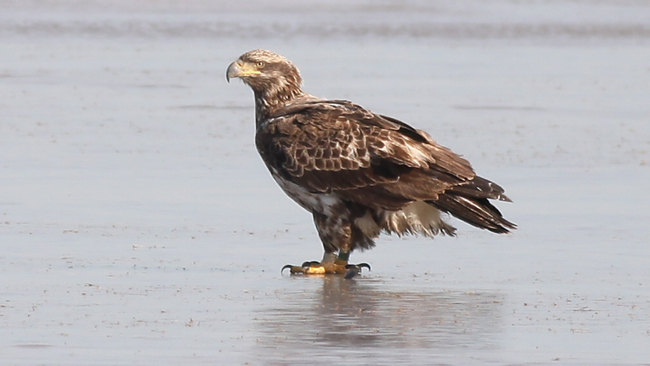
An immature eagle at Forsythe NWR in Oceanville. © Eric C. Reuter

The New Jersey midwinter eagle survey takes place each January and is part of the National midwinter eagle survey to monitor population levels.  Another benefit of the midwinter eagle survey is that new eagle nests and nesting pairs are often located.  The target dates for the 2011  survey was January 8th and 9th.  Approximately 75 volunteers participated throughout the state. This year the snowy winter weather on Saturday did  effect  the count due to the heavy snow fall at times and low visibility.  Sunday was clear and sunny which allowed volunteers to get out and survey.

Preliminary results:
  • 194 eagles – southern NJ
  • 24 eagles – northern NJ reservoirs
  • 17 eagles – Delaware Water Gap
  • A total of 235 eagles were observed this year.

This total is lower than 2010s count of 333 eagles which is in large part due to the weather. Full results will be released soon.

Thank you to all the volunteers who braved the snow, cold and windy weather!

Going nuts for Woodrats!

Help collect acorns for the endangered Allengany Woodrat

by Maria Grace, Education and Outreach Manager

Allegheny woodrats are sometimes referred to as “packrats” because of their hoarding behavior. © Mick Valent

The Allegheny woodrat is a state endangered species. It was added to the endangered species list in 1991. There is one remaining population of these small mammals left in the state and they need our help this winter.

This season we are going to help the woodrat by providing it with food. We will distribute acorns, beech nuts, hickory nuts or any other nuts from native New Jersey trees in the area the woodrats live. By providing them with food we will help them survive the winter.

Collecting nuts while learning about the habits and habitat needs of the Allegheny woodrat is a great service learning project! Have your students collect native tree nuts throughout the community and help to protect one of NJ’s rarest wildlife residents.

We are collecting nuts now through November 24th to distribute to the woodrat’s location throughout the winter. If you would like to contribute to the woodrat’s winter food pantry, please drop off nuts from native New Jersey trees to  the Endangered and Nongame Species Program’s office in Clinton, New Jersey.

  • Please contact Maria Grace at Conserve Wildlife Foundation at (609) 984-0621 for specific instructions.
  • Nuts will be collected until November 24th.

Photo from the Field

Installing Osprey Platforms

By Ben Wurst, Habitat Program Manager

This past week I installed two osprey nesting platforms with the help of some dedicated volunteers. The platforms were installed on two islands known as Little Sedge Islands off Lavallette in Barnegat Bay. I originally planned on only installing one platform there for a woman who donated to help support our osprey project. However, this past spring on the day we were planning to install the platform my wife went into labor with our first child. So I made up for not having the platform installed before this year’s nesting season by installing two this past week.

The islands are preserved as open space and are great habitat for ospreys. They prefer to nest over or near water (their source of food). Islands provide additional protection from ground predators, like raccoons. There are several nesting platforms nearby that are always occupied, so it’s likely that these platforms will be occupied within the next couple years.

Thank you to everyone who helped out!!

Volunteers finish installing an osprey nesting platform on an island on Barnegat Bay. © Ben Wurst

More photos from the installation:

Brigantine Shorebird Study

Volunteers are needed to help study migratory shorebird distribution and human use

A large flock of migratory shorebirds at North Brigantine Natural Area. © Ben Wurst

A partnership between Conserve Wildlife Foundation of NJ, Endangered and Nongame Species Program, and Rutgers University.

Survey Period: 10/13/2010 – 10/24/2010

Volunteers are needed to help conduct a study that will measure all influences of shorebird distribution (food, predation and human use/disturbance) while altering human recreational use (close sections of beach, restricted access to key areas or to the waterline) to determine impact both to recreational use and shorebirds at a coastal stopover site (North Brigantine Natural Area). Volunteers are needed to survey shorebird behavior and distribution and/or human use of the natural area.

The ultimate goal is to recommend management programs that create the best protection with minimal impact to recreational use to all Federal and State agencies responsible for sites important to migratory shorebirds.


Shorebird Study:

Volunteers/interns must have the ability to:

  1. Identify shorebird species including Red Knot, Semi-palmated Plover, Sanderling, Sandpiper spp., Dunlin, Ruddy Turnstone is required.
  2. Accurately observe and record estimates of flock size and behaviors.
  3. Work anywhere 11-hour days with breaks throughout the day on site as needed.
  4. Walk several miles on the beach throughout the shift.
  5. Communicate effectively, intelligently and positively with the public despite potential opposition.
  6. Provide own transportation to Brigantine Natural Area.
  7. Lodging will be provided for those traveling and/or working consecutive days.

Human Use Study:

Volunteers/interns must have the ability to:

  1. Communicate effectively, intelligently and positively about the study with the public despite potential opposition. Volunteers will be supplied with a 1-page hand out about the project with contact information to share with the public.
  2. Advise public of beach closure.
  3. Interview visitors where possible to establish recreational activities, recreational rates, and perceptions.
  4. Accurately record responses.
  5. Work 11 hour days (includes two weekends) with breaks as needed on site throughout the day.
  6. Provide own transportation to Brigantine Natural Area.
  7. Lodging is available for those traveling and working consecutive days.

The schedule will be composed of 11-hour daily survey periods over the course of 12 consecutive days. This includes three pre-treatment days (10/13-10/15) followed by six treatment (beach closure) days (10/16-10/21) and three post-treatment days (10/22-10/24). Obviously, greater availability is preferred but flexible scheduling will be considered. We would like to keep this project a volunteer/intern support survey, so pay is not likely although may be considered if we are able to identify additional funding.

Please contact Cristina Frank at cristina_frank@hotmail.com if you’d like to volunteer.

Photo from the field

Natural Succession at its finest

By Ben Wurst, Habitat Program Manager

A former golf course called “Ponderlodge,” now referred to as Villas WMA and officially part of Cape Island Wildlife Management Area in Lower Township, NJ is slowly reverting back to forested habitat. Forests and trees are good for migratory and resident wildlife, the environment, and people! Trees provide food and cover to migratory birds. Many early successional woody species like, Winged sumac, Black cherry, Sassafras, and Mulberry are already established on old fairways on site. Other trees like White oak, Willow oak, and Pitch pine are sprouting from seed, especially in areas where the overstory of trees acts like a nursery for these to grow quickly. As you may know trees naturally sequester or capture CO2. Over time, large amounts of carbon are stored as biomass in the parts of a tree (leaves, branches, roots, and trunk). A one acre reforestation site can sequester an estimated 3 metric tons of CO2 in one year. In 20 years that’s 65 metric tons of CO2 that is removed from the atmosphere. Once many of the fairways that we are working dilagently to reforest with the NJ Division of Fish and Wildlife are reforested, over 170 acres forested habitat will exist on site.

A former fairway at Ponderlodge. Four years after this property was acquired by Green Acres its fairways are being to succumb to forest succession. © Ben Wurst

This summer has been tough on many of our plantings. The severe drought in Cape May County has killed a large amount of seedlings that were planted in early 2009. However, when planting we choose to overstock or plant at a higher density to allow for some mortality to occur. Only the strong survive and will be more adaptable to future droughts!

Next year we plan to plant more seedlings on additional fairways to convert “fairways to forests.” We will be needing volunteers to assist with the plantings. If you’d like to volunteer to help plant trees send me an email and I’ll let you know when we’ll be planting (sometime in March).

Fall Migration is Underway!

Viewing Wildlife and migration studies

by Ben Wurst, Habitat Program Manager

A juvenile black skimmer is viewed through a spotting scope at Forsythe NWR in Oceanville, NJ. © Ben Wurst

Fall migration is underway! Ospreys are headed south for the winter. Juveniles will spend the next two years in their wintering areas in northern South America. Rob Bierregaard, from the University of North Carolina at Charlotte has been tracking ospreys from Martha’s Vineyard since 2000. Currently twelve ospreys are fitted with satellite transmitters. Rob uses the data to study migration patterns and the local dispersal of juvenile and adult ospreys. Check out maps from this seasons birds by clicking here. A great place to view ospreys as they travel south is at Cape May Point State Park. Go after a cold front has passed and you should see high numbers of raptors including ospreys on migration.

Red knots, black belly plovers, dunlin, and ruddy turnstones are beginning to show up on beaches along the coastline. Many hop-scotch their way south to their wintering grounds in South America. Great places to view them include Brigantine Inlet, Avalon, Stone Harbor Point, and North Wildwood. Many of these shorebirds are banded with an alpha-numeric color band. If you have a high power spotting scope, then you should be able to read the band. You can contribute your sightings to the International Shorebird Project by submitting your sightings.

Another great website that tracks avian (bird) migration patterns over New Jersey is www.woodcreeper.com. It is run by David La Puma who uses Doppler radar to track movements of birds as they take off on migration, most at night. He is predicting that a large number of birds will take off Wednesday night/Thursday morning after a cold front with winds that prevail from the north passes through. He expects large numbers of migrants to arrive here to “rest and refuel” on Thursday/Friday. Check out this cool graphic of some Doppler radar where you can see birds moving behind the passing cold front (with precipitation).

Get out this weekend and enjoy the beautiful fall weather and watch some of the amazing natural events that take place in New Jersey. Learn key locations to view wildlife by visiting our wildlife viewing map.

A healthy population

Osprey numbers continue to rise

by Ben Wurst, Habitat Program Manager

Three osprey nestlings at a nest near Osbourne Island. © Eric Sambol

Ospreys are currently listed as a threatened species in New Jersey. They were first listed as endangered in 1974 after the state population declined to only 50 pairs, from over 500 prior to 1950. Ospreys have made a remarkable recovery in New Jersey thanks to biologists with the Endangered and Nongame Species Program (ENSP) and many volunteers. Surveys that help monitor the population were conducted in late June and early July.

Volunteers and biologists surveyed all major nesting colonies from Sandy Hook south along the Atlantic Coast to Cape May and west to Salem County. Ospreys almost exclusively nest on man-made structures including platforms designed specifically for them, cell towers, duck blinds, channel markers, and boat lifts. Surveyors visited these nest structures to observe whether or not they were occupied. If they’re occupied, then the number of young were recorded and the young were banded for future tracking with a USGS bird band. Preliminary results show that productivity rates are up for all nesting colonies except one (Sedge Island WMA). Since ospreys are predators, they are at the top of the food chain. They are considered to be an indicator species, or a species that is sensitive to changes in environmental conditions and can serve as an indicator of an unhealthy marine ecosystem. Basically, a healthy osprey population means a healthy marine ecosystem.

The climate during this summer has been the complete opposite as last year. It was hot, dry, and calm, with only a few severe storms with high winds that caused some nests to fail. Otherwise, fish stocks are plentiful, especially menhaden. This year many out-of-state commercial fishing boats have started fishing for bunker off New Jersey waters. This is mostly due to declines in herring stocks in New England and the high demand for bait for use in lobster pots. State legislators have introduced a bill that would limit boats from catching bunker for use as bait. Read more here and this press release from the Recreational Fishing Alliance.

Full results from this years survey will be published soon in our annual newsletter. Here is last year’s newsletter.

End of the Beach Nesting Bird Season

A final report from our seasonal beach nesting bird steward at Stone Harbor Point

by Christopher Haxter, Seasonal Steward

A juvenile piping plover. © Chris Kisiel

Well as summer’s end slowly draws near, the beach nesting bird season has wrapped up on Stone Harbor Point.  All of the Piping Plover and American Oystercatcher chicks have fledged (i.e. reached the stage where they can fly).  In the past, this has often been a very depressing time.  Stone Harbor Point has a bad history of flooding, and many of the nests and chicks were destroyed; some years we only had a couple of chicks fledge.  This year, however, there is good news!  A total of 13 Piping Plover chicks and 10 Oystercatcher chicks have fledged, from 9 and 21 breeding pairs, respectively!  I owe this very successful year to the weather cooperating during the high spring tides; flooding was not a big issue this summer.  I also owe my thanks to the public for respecting the rules and staying out of the fenced areas, giving these beach nesting birds the room to successfully fledge their chicks.

This breeding season sure has had its ups and downs.  One low point that comes to mind is finding Oystercatcher nest after nest washed away from a high tide the night before (most of them luckily renested).  One of the greatest feelings is finding a chick on its fledge date, knowing that it now has a much greater chance of survival.  We also had a Least Tern colony on Stone Harbor Point that fledged a good amount of chicks.

Our focus now has shifted to migration.  Thousands of migratory shorebirds are now congregating on Stone Harbor Point.  Most are on their way south from breeding up north in Canada and the Arctic.  Oystercatchers and Piping Plovers are also preparing to head south for the winter.  They are currently gathering in huge roosting flocks before their departure.  This gives us ample opportunity for band resighting and to conduct surveys, estimating the population sizes of these shorebirds.

Since the season is just about over it means my job (as Seasonal Steward) is just about over.  Words can’t describe how much I love this job and what I have learned over the last four months.  The Conserve Wildlife Foundation of NJ is truly making the difference for wildlife all over the state, and I’m glad I got to be a part of it!

Photo from the Field

Counting bats or the lack thereof

by Ben Wurst, Habitat Program Manager

It is clear to me that White-nose syndrome (WNS) has decimated a large portion of the bat population in New Jersey, or at least at a site where I count bats for the Summer Bat Count. In 2008 (before WNS), I counted 261 bats at the Chatsworth General Store in August. Counting bats may seem like a daunting feat, but at dusk (when there is still a little light) the bats fly out of their daytime roosts. Sometimes, 1-2 at a time or in bursts of 3-4 or more. In August 2009, I counted 169 bats at the store. This past Sunday, I only counted 23 bats. To say the least these results are alarming. I hope that at other locations in New Jersey people are still seeing bats and I hope that WNS does not continue to decimate the population.

A photo of the bat houses installed on the Chatsworth General Store where many of the bats roost during the day. Many more used to roost in the attic. This image was captured using a technique referred to as HDR. © Ben Wurst.

Human/Wildlife Interactions

Juvenile eagle released back into the wild

by Ben Wurst, Habitat Program Manager

The eagle in a carrier to be transported from Sandy Hook to The Raptor Trust. Image courtesy National Park Service.

Last Tuesday I met with Debra and Gail, volunteers with The Raptor Trust in northern New Jersey to help release a juvenile eagle. The release was coordinated by Kathy Clark with the Endangered and Nongame Species Program and Cathy with the Raptor Trust. They transported the eagle for more than 2 hours to see it return to the wild. I was merely there because I have experience with handling birds of prey (in case anything were to happen).

The eagle was found on Gunnison Beach in late June inside Gateway National Recreation Area on Sandy Hook.The eagle was spotted by park visitors on the beach. The eagle was distressed but had no injuries. Jeanne McArthur–Heuser, NPS transported the eagle to the Raptor Trust, located in Millington, New Jersey.

Many juvenile raptors or birds of prey are not 100% successful at catching prey. Some rely on their parents for food until they learn the skills to catch prey that they will use for the rest of their lives.

The eagle takes flight after being rehabilitated at the Raptor Trust. © Debra Falanga

The eagle was rehabilitated at the Raptor Trust for 6 weeks. It was a male and was banded with a federal USGS bird band for future tracking. At the Raptor Trust it got plenty of rest and relaxation under their care. I met Gail and Debra in Millville where we traveled south towards Newport. We released the eagle at a location determined by Kathy Clark in Cumberland County at Nantuxent Wildlife Management Area. The release was uneventful (which is good!!!). We basically stood behind and to the sides of a large dog crate and opened the door. I held the door open and lifted up the back to try and encourage the eagle to leave the crate. After about 45 seconds, the eagle hopped out of the crate and immediately took off into the distance with a strong flight.

Without the care of the National Park Service, The Raptor Trust, and the Endangered and Nongame Species Program, this eagle might not have survived! This is a clear example of how we are all connected and how delicate the balance of nature is! We hope this eagle lives on and is able to flourish in New Jersey!