SPECIES ON THE EDGE ART & ESSAY CONTEST AWARDS CEREMONY
by Karena DiLeo, Assistant Biologist
The Species on the Edge Art & Essay Contest Awards Ceremony was May 6th at the New Jersey Education Association in Trenton. We had a great turn out and would like to thank everyone who attended and submitted entries into the contest. We received over 2,000 entries this year! Winning artwork is currently on display at NJ Audubon’s Plainsboro Preserve and will travel to Liberty State Park on June 6th.
Angela Guo from Mercer County received her First Place certificate from CWF Executive Director Margaret O'Gorman and Board Member and sponsor Bob Coleman.
Having accurately mapped rare species data is essential for insuring that critical habitat for those species remains protected. For that reason, I recently accompanied Kris Schantz, a biologist from the NJ Endangered and Nongame Species Program, in documenting two timber rattlesnake den locations in northern New Jersey using a GPS (global positioning system) unit. Our goals were to see if the rattlesnakes had emerged from hibernation, survey how many were present, and to accurately map their locations in the heavily wooded area less than 30 miles outside New York City.
Timber rattlesnakes (Crotalus horridus horridus), like other reptiles, are cold-blooded. In order to survive through the long, cold winter in New Jersey, they hibernate in dens. Research has shown that rattlesnake dens in the northern part of the state can vary from rocky outcroppings with crevices, ledges or boulders to forest interior dens consisting of a few rocks and a hole in the ground. In New Jersey’s Pinelands, however, rattlesnake dens are quite different. Rattlesnake dens in the Pinelands are usually underground crevices near bodies of water, often underneath large tree roots.
Rattlesnakes will almost always use the same den year after year. In addition, rattlesnake young typically follow the scent trail of their mother in order to find their way to her den their first fall, or may follow any timber rattlesnake to a suitable den. As a result, a good den site may provide a winter refuge for a number of rattlesnakes of all age classes, as well as other species of snakes.
Since the goal of our mission was to map den locations, we had to make sure we arrived at the den site once it was warm enough for the rattlesnakes to come out of their crevasses to bask but before they had enough warm weather to travel away from the den site. Timing was crucial. After a week with some fairly warm days mixed with very cool nights and a few cool days, we ventured out during the last week of April on a day when the air temperature climbed into the lower 80’s.
The first den site we visited required a fairly long hike through a rocky, deciduous forest. Fortunately, Kris had visited both den sites several years earlier so she had a good idea of where we needed to go. We were fortunate to find two individuals at the den site, one yellow-phase juvenile and one yellow-phase sub-adult or young adult. While I GPSed the den site, Kris attempted to determine their sex based on their appearance (the young adult was a female but the juvenile’s sex could not be determined).
GPS units work when there is an unobstructed line of sight to four or more GPS satellites. With 7-8 satellites being detected by the GPS unit, my task of mapping the site was fairly easy and took little time. The trees had yet to leaf-out so my GPS unit had a clear signal from above. We also observed a northern black racer (Coluber constrictor constrictor) at the den site.
The second den site required a much longer and more strenuous hike accompanied by swarms of black flies. At that location, we observed three rattlesnakes – one black-phase adult (sex undetermined), one yellow-phase adult male, and one yellow-phase sub-adult or young adult (sex undetermined). GPSing this location took a little more effort though due to the terrain both because it was more difficult to get to the site and once there, the terrain made getting a clear signal on the GPS unit a little more tricky and it took far longer than at the first den.
Out of the five rattlesnakes we observed, only one ever rattled. Rattlesnakes rely on their camouflage as their first line of defense. Even when we were close by, they remained motionless. At no point did any of the snakes approach us or attempt to strike. The only two individuals which moved at all during our survey, moved away from us into rock crevasses and that was likely due to our prolonged presence staring at them.
Snakes, and venomous snakes in particular, have an undeserved bad reputation. At no point during our survey did I ever have any fear of being bitten by a rattlesnake. In all honesty, I was actually far more afraid of being bitten by a tick instead (I only found about four or five on me during the entire day).
The installation of a custom made nestbox on a water tower is no easy task. Just climbing this tower is a scary feat. First off the tower is over 70 years old and has little safety features on it. You rely on your own climbing gear and strength to safely climb this tower. After several delays, we successfully got the nestbox up on the water tower where we hope to get peregrines from another nest site to nest.
This site was chosen because it is suitable habitat for peregrines to nest and there are adequate prey resources in the area (pigeons, starlings, and doves). Peregrine nest sites were once along the D. Bayshore in this area, but a recent study conducted in coastal Virginia found that peregrines there were negatively influencing the behavior of migratory shorebirds. This spring the decision was made to remove a nestbox that was located along the Bay to help protect species like the endangered red knot while they feed on horseshoe crab eggs.
I constructed the nestbox from salvaged wood from the Forest Resource Education Center’s sawmill. It’s a mixture of white cedar, western red cedar, and scrap plywood (from construction of bat houses). Reusing salvaged wood is something I am really passionate about. I make all sorts of things from it including picture frames that I sell, furniture, and osprey platforms.
Kyle Whittle, a Boy Scout from West Milford, will earn his Eagle rank soon for a project that adds summer roosting habitat for forest bats. Dwindling habitat is a threat to NJ bats – even those that aren’t affected by White-nose Syndrome – and most of our 9 species need dead/dying trees with flaking bark to roost and raise their young. Artificial roosts can also be successful and long-lasting. Kyle chose to put his Eagle-eye on bats after hearing about our Indiana Bat Forestry Project through a family friend with several wooded acres to offer.
Last week I worked with Kyle and a group of his friends to mount bat roosts at the West Milford property, which sits on the edge of the Bearfort Mountains. We hiked up a steep hill of rhododendrons and hemlocks to the deeper part of the forest…a really enjoyable walk without the ladders, hammers, bundles of cedar shakes, asphalt paper, screw guns, and 15-lb bat houses!
The afternoon made good use of the teenagers’ energy, carpentry skills, and tree-climbing impulses. They put up four traditional bat houses, built earlier by Kyle, and a few tree “wraps” meant to resemble the loose bark of dead trees. We chose trees that get a lot of sun during the day; the owners will also do some girdling to open the canopy and create natural roosts.
Bats are starting to show up in their summer grounds again. Thanks, Kyle & crew, for rolling out the welcome mat!
Last year Conserve Wildlife Foundation of NJ started a new project that was focused on reducing the amount of terrapins that were killed by motor vehicles. The project began because of one individual terrapin that I encountered on Great Bay Blvd in 2009. I observed the female terrapin as she walked along the edge of the Blvd. I saw this as being odd. Typically they cross the road and often at a speedy pace (probably because they know the apparent danger from crossing roads). I stopped and saw that she had an injury to her lower mandible, probably from a motor vehicle. I knew that she needed help.
Terrapins face a variety of threats in their environment. An untold number are trapped in crab traps that are not fitted with Bycatch Reduction Devices (BRDs), some are hit by speeding boats and jet skis, and many more are injured or killed while attempting to cross roads. Along Great Bay Blvd. in Little Egg Harbor several studies have documented the amount of live and dead individuals on the road.
As soil and coastal waters begin to warm, terrapins begin to become active again. In late April/early May hatchlings begin to emerge from nest cavities where they overwintered. Adults also begin to become active, but mostly remain in the waters where they live until June when females emerge to lay eggs in nests they dig on land.
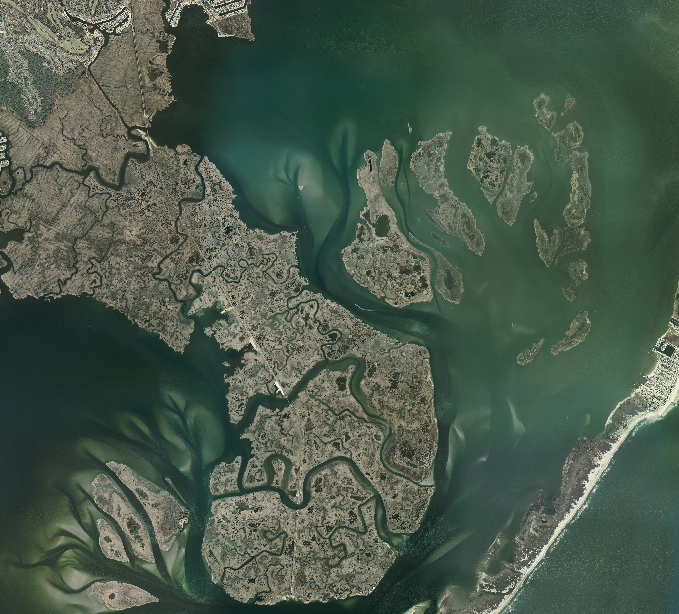
The penninsula that surrounds Great Bay Blvd. is pristine habitat for terrapins in southern Barnegat Bay.
Last year we raised enough funding to develop and print an educational brochure, purchase and install “Terrapin X-ING” signs, and install 4,000 feet of barrier fencing. The fencing was placed along the first stretch of road where the highest mortality rates were recorded. The fence proved to be effective at reducing road kills and increasing awareness of terrapins. The fence was removed in late 2010. This year it will be installed again along the same portion of road with help from a local construction company, Sambol Construction. After this season, we hope to keep the fence up year-round and hope to fence the whole first section of the road (and possibly more).
This year to help reduce the amount of terrapins that are hit by motor vehicles, we are recruiting volunteers to act as “Terrapin Stewards.” Stewards will be asked to routinely drive, walk, or bike down Great Bay Blvd. during the summer months from June to mid-July (especially on weekends, holidays and when there is a full or new moon). Volunteers will educate the public about terrapins, their threats in the environment, and our project. Volunteers will also help terrapins safely cross roads and help record locations of live or dead animals. No more than 10 volunteers will be recruited this year.
Our Message to visitors:
The habitat that surrounds Great Bay Boulevard is very important to the reproduction of northern diamondback terrapins, a species in decline in New Jersey. Female terrapins often nest along the soft shoulders of roadways. Sometimes they enter the roadway to reach these suitable nesting areas where they lay their eggs. Research has shown that dozens of female terrapins are killed by motor vehicles each year along Great Bay Boulevard. Please help conserve terrapins by driving carefully while traveling along the road.
If you’d like to participate you are required to attend a training session on May 3rd @ 6pm at the Jacques Cousteau National Estuarine Research Reserve. Volunteers will fill out paperwork and learn more about terrapins and our project. You must register to attend this training/information session.
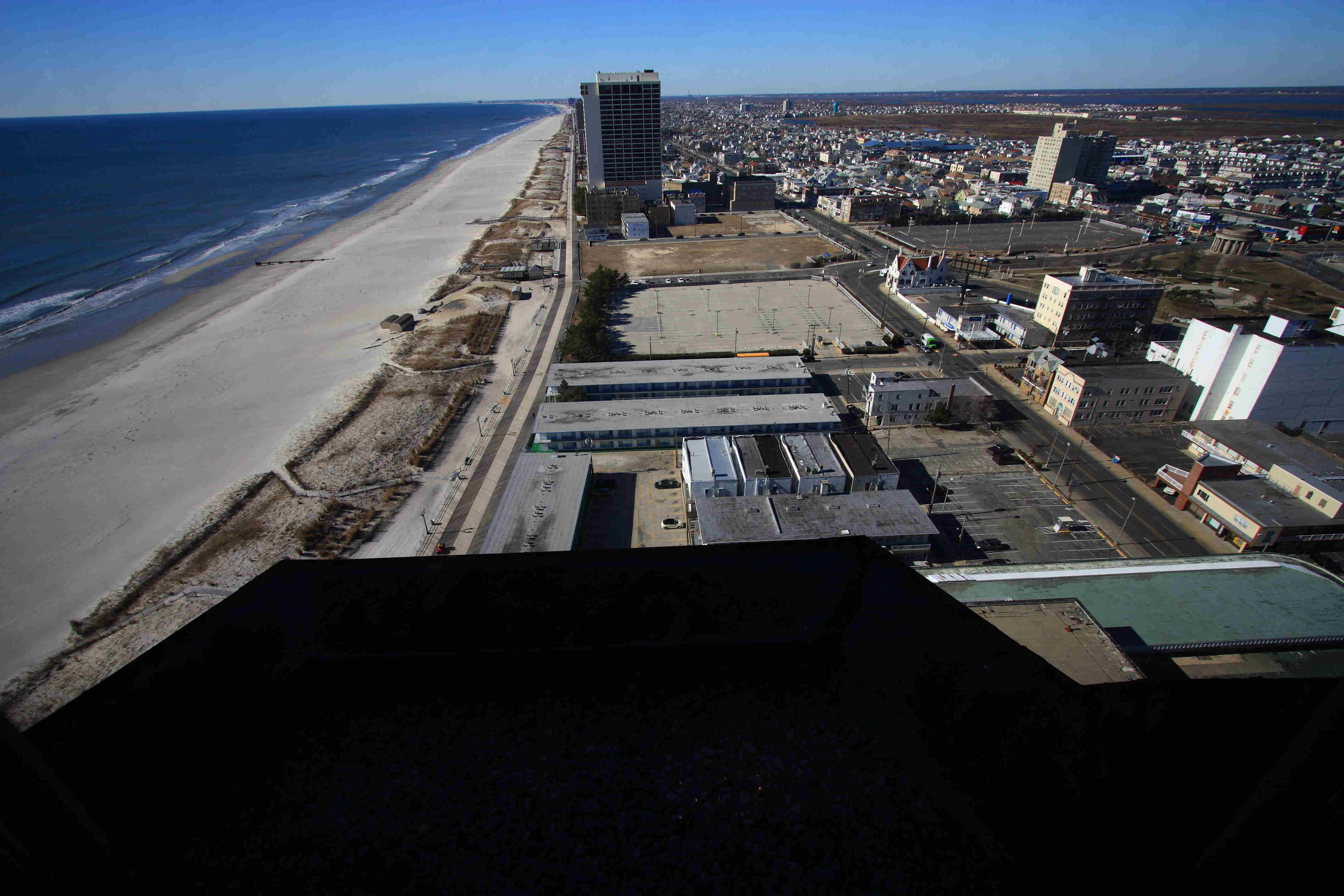
Since 1985, one boardwalk casino has been home to a pair of peregrine falcons. On the 23rd floor of the Hilton (originally named as the Golden Nugget, then Bally’s Grand, The Grand) in Atlantic City a pair of peregrines have nested since 1988. Since then only two females have ever occupied the territory there. The first female nested there until 2002. In October of that year she was found injured after it was believed that she had struck an object. She was transported to The Raptor Trust for treatment, but unfortunately died later that night. She was the oldest nesting peregrine in New Jersey at the time (she was born in 1985 at a nest site in Sedge Island WMA) and was a NJ native falcon. She raised a total of 25 young during the 15 years that she nested there. She was known for her tenacious attitude and brave assaults on biologists and photographers by dive-bombing them “fighter jet style” to protect her young.
Here is an excerpt from the article “Storied A.C. Peregrine Dies: State’s oldest nesting falcon was N.J. native” in our old Conserve Wildlife newsletter from 2002:
“She’d been around nearly as long as I’ve been a biologist,” says Clark. “I felt a kinship from our many years at her nest, banding her young.”
Last June, as Clark was returning the bird’s two chicks to the ledge after she had banded them inside the penthouse suite, the biologist noticed the fierce female accidentally glance one of the building’s structural columns. But Clark will remember more all the times the bird was at her fighterpilot best, strafing Clark, her assistants and the news photographers who bravely clambered out onto the narrow ledge to record what had become a much publicized, annual banding ritual. In fact, in 1997 within a span of several minutes the bird was able to strike the heads of both an assistant biologist and a photographer. That’s why Clark, since then, had been banding the chicks inside.
Ironically, it took her death to solve the final mystery of her existence. In 1994, thanks to a remote-controlled camera, Clark was able to read all but the last digit on her leg band. The numbers confirmed her 1985 hatch date, but without that missing digit she could have been fledged anywhere from Maine to Virginia.
When Clark recovered the fatally injured bird, she recorded the entire banding number, and quickly learned the female had been hatched atop a nest tower erected in Barnegat Bay’s Sedge Islands Wildlife Management Area, just 25 miles north of Atlantic City. One of the first offspring of restored, wild-nesting peregrines in New Jersey, she had been a lifelong resident of the Garden State.” written by Bruce Beans.
Measuring the length of the ledge where deterrent will be installed.
Today, the only other female peregrine to nest on the ledge of the penthouse floor will be 13 years old this summer. She originated from a nest site in coastal Virginia in 1998. In early 2009 we placed a deterrent (wood and pigeon spikes) along a portion of the ledge to deter the pair from nesting. The preferred nest site is a nest tray where the pair can be more closely monitored by casino staff and butlers (Mel and Pete) on the penthouse floor and it also has more protection from harsh weather conditions. The deterrent worked quite well last year, but it wasn’t quite large enough. The female proceeded to nest directly next to our deterrents (see photo below). She was allowed to nest there, but after her young were banded, they were placed in the nest tray on the west side of the building.
Yesterday Kathy Clark, zoologist with the Endangered and Nongame Species Program, and myself visited the site to measure the ledge where additional deterrent will be placed next week. The nesting pair was present and aggressive as usual. The female dove at us both as we were out on the ledge. The spirit of the old “storied” peregrine has certainly been passed on to this bird. The new deterrents will be installed next week. Peregrines begin nesting in March.
Our website features profiles on every one of New Jersey’s 73 Endangered or Threatened species in our Online Field Guide. Now, we’re beginning to profile New Jersey’s Species of Special Concern. The term “Species of Special Concern” applies to species that warrant special attention because of some evidence of decline, inherent vulnerability to environmental deterioration, or habitat modification that would result in their becoming a Threatened species. This category may also be applied to species that meet those criteria and for which there is little understanding of their current population status in the state. There are currently 108 species within New Jersey with the Special Concern status. So far, we have profiles for 18 of those species.
Protecting Terrapins Through Education and Awareness
By Ben Wurst, Habitat Program Manager
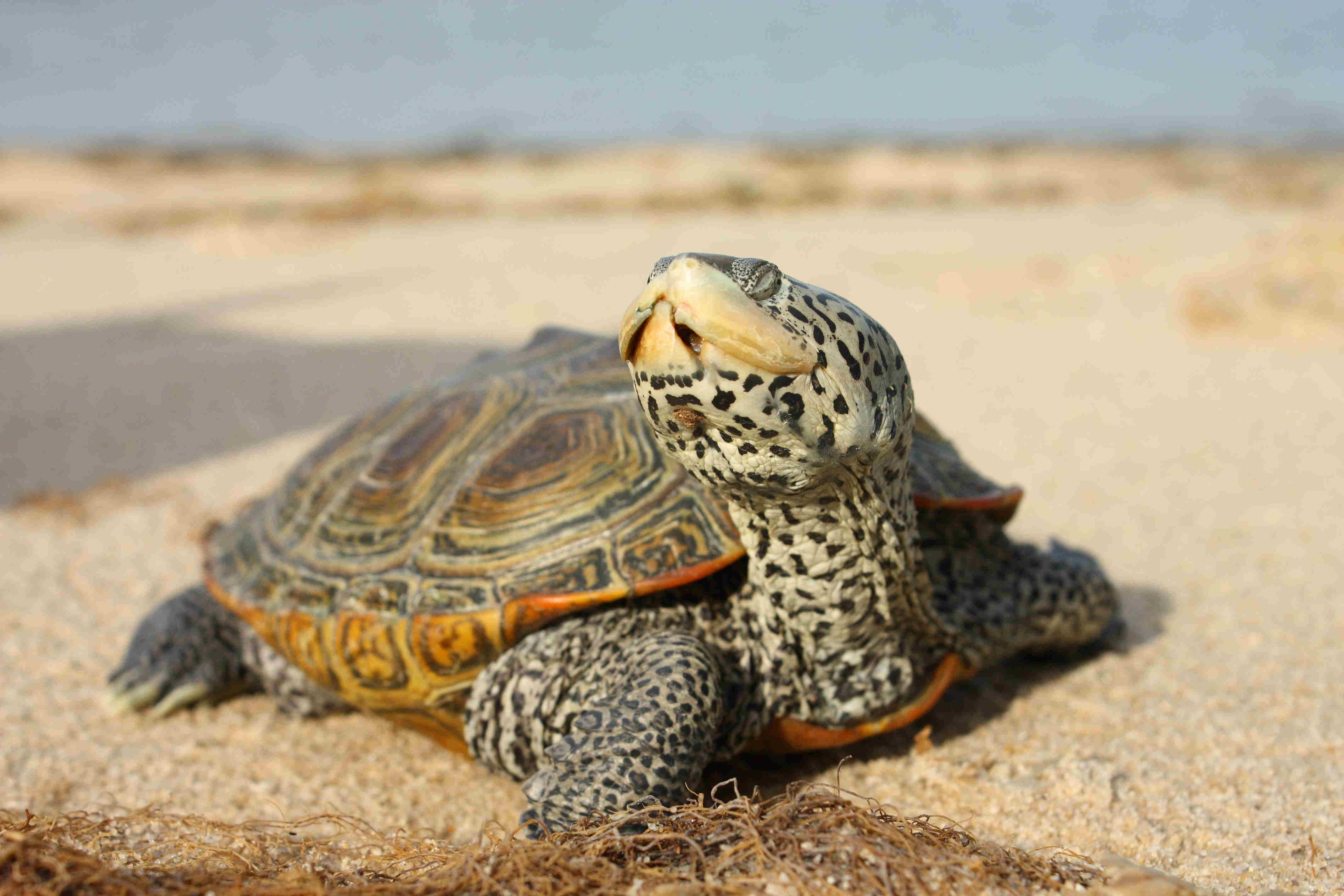
Female Northern Diamondback terrapin by Jonathan Carlucci
Terrapins are ectothermic, or they are cold-blooded, and their activity is regulated by external temperatures in the environment. While they may be dormant at the moment, I’m far from that. I’ve never stopped working to protect terrapins from the end of last year’s nesting season. While it’s almost impossible to prevent every terrapin from being hit-by-car, it’s more important to highlight the need for protection and for people to become more aware of terrapins when driving.
Here are a few things I’m working on to help terrapins in the Great Bay area this year:
I’ve been working on getting some funding to help raise awareness, i.e. more X-ING signs, other signs (like “slow down, terrapin X-ING”) and other educational materials.
I developed an educational presentation about terrapins and our work to protect them. I just presented it for the first time a couple weeks ago at the Jacques Cousteau Coastal Educational Center in Tuckerton.
I have been in touch with the town engineer for Little Egg Harbor Twp. about lowering the speed limit on Great Bay Blvd. this year. The speed is currently 50mph!! For a road with soft shoulders (and in some areas, saltmarsh or shrubs that are growing onto the road), seven bridges, a lot of human use in summer, terrapins that nest on the edges and enter the roadway, and the fact that it divides a pristine Wildlife Management Area, it is just way too high.
I am attending both the environmental commission and town council meeting this month to address my concerns and to ask for their support for our project.
I recently met with officers from the Osborne Island Homeowners Association to assist them with protecting terrapins along Radio Rd.
I am developing a volunteer project where volunteers will help patrol area roadways to educate the public about terrapins, to help them cross roads safely, and to help document terrapins on roadways.
If you would like to help us protect terrapins in the Great Bay area, we could use your help!
A "natural" osprey nest in a snag on the Manasquan Reservoir. Image courtesy Tanya Dinova, Monmouth County Parks.
On January 17th I was forwarded a message from fellow osprey conservationist and colleague Jon Rosky. Jon has been helping provide nesting structures for ospreys since the early 90s with his Osprey Recovery Project. Tanya Dinova, a naturalist/interpreter at the Manasquan Reservoir Environmental Center contacted Jon to get assistance with a snag (a dead standing tree) that held an osprey nest since 2008 on the reservoir. This past October a storm caused the snag to snap and the nest was lost.
Luckily this occurred during the non-breeding season, otherwise the nestlings would not have survived. Tanya reported that the nest produced 2 young in 2010 and 2 in 2009. Great results for a natural nest that is directly over water! One might argue to not do anything and allow ospreys to find another snag to build a nest on. There are multiple snags in the water that could provide another natural nest site. If we were not going to do anything then this would be the likely outcome. However, many of the snags are not large enough to hold an osprey nest and there is a good chance the nest could fall during the breeding season.
Ospreys return to the same nest site year after year. And young adults return to where they originated to reproduce when they are 3 years old. Ospreys usually live till around 10 years old in the wild. The oldest osprey that was ever encountered in New Jersey was a female that was 18 years old. She sustained injuries from a close encounter with an eagle near Avalon several years ago and did not survive.
Here you can see the extent of the damage to the tree. Image courtesy Tanya Dinova, Monmouth County Parks.
In her message Tanya stressed the importance of having ospreys that nest on the reservoir as an educational resource to visitors of the park. A total of 3 pairs of ospreys nest on the reservoir. Naturalists, like Tanya, educate the public about ospreys, their decline, their importance in the ecosystem, and their return to historic numbers in New Jersey. This is a very important part of the recovery of ospreys in New Jersey and it will help foster awareness for them in the future.
Monmouth County has been an area of interest to me. Since I began working with ospreys in 2004 there were only a few nests in Monmouth County that were monitored. In 2010 there were 14 active nests (not including those on Sandy Hook and the Raritan Bay) where nesting observations were made. These observations help us determine the health of the local and state populations. In 2010, productivity averaged 1.86 young/active (known-outcome) nest. It was recorded at 1.25 in 2009. The population is continuing to grow in Monmouth County and with only limited areas to nest, ospreys are nesting in peculiar locations.
Many ospreys are choosing to nest on cell towers, boat lifts, and other tall structures. Because of habitat loss these are the only a few structures that are available to them. Manasquan Reservoir is an exception. When the dam was installed it killed trees when the water levels rose. This created new nest sites for ospreys from the snags that were left. However, today many snags are beginning to decay and osprey nesting sites are lost.
This situation has created a unique opportunity to collaborate and find a solution. I suggested that instead of installing a new nesting platform, to install a box-top (3×3′ wood box) on top of the snag. The box would allow the ospreys to nest in the same tree and it would provide added stability ospreys rely on to incubate eggs and raise young. We will perform this delicate task before ospreys return in mid-March.
Yesterday, the New Jersey Department of Environmental Protection released a rule proposing certain changes to endangered species list and other considerations about rare wildlife in the state.
The list of species protected on the Endangered Species list has not been updated since 2003. This new proposal reflects years of work by wildlife biologists engaged in endangered species protection.
The rule change proposes to add five species to the list of endangered species in the state and change the consideration of eight other species to offer different levels of protection for breeding and non-breeding populations.
The species being added to the list are the black rail, golden-winged warbler, red knot, Indiana bat and gray petaltail (a dragonfly). The Indiana Bat is being added because it is on the federal endangered species list and any species on this list also found in New Jersey is, by default, considered endangered in New Jersey. The other species are being added to the list as a result of a review of their status using something called the Delphi Technique.
The Delphi Technique is an iterative process whereby wildlife biologists and academics, using the best available data, come to consensus agreement of the status of the species under consideration. This review is then approved by the Endangered and Nongame Species Council which is made up of wildlife biologists, academics and other interested parties. Delphi Reviews of birds, freshwater mussels, butterflies, dragonflies and damselflies were carried out between 2000 and 2005. The results of these reviews inform this proposed rule change.
In addition to adding five species to the endangered species list, the Department is proposing to modify the endangered status of eight species of birds for either the breeding or non-breeding populations.
The bald eagle is currently classified as endangered for both breeding and non-breeding populations. The classification of the bald eagle will continue to be endangered for the breeding population, which includes all bald eagles present in the State during the breeding season. However, the non-breeding population, which includes all bald eagles present in the State outside of the breeding season, will be reclassified as threatened.
Six bird species – the pied-billed grebe, northern harrier, northern goshawk, peregrine falcon, short-eared owl and vesper sparrow – currently listed as endangered for both breeding and non-breeding populations will continue to be classified as endangered for breeding populations but will be listed as special concern for their non-breeding populations.
The Endangered Species List is not a one-way street and while we worry about the removal of protections for species, we must recognize and celebrate the recovery and return of these species. In the 1950’s, no peregrine falcons nested east of the Mississippi River, today our non-breeding population is strong and growing. In the late 1980’s, one pair of bald eagles remained in New Jersey, today the winter population is counted in the high 200’s and the breeding population approaches 100 pairs. Species recovery can succeed and with this proposed rule change, we should celebrate these successes.
But, we should mourn the additions to the list and wonder why, since the Endangered Species Act passed in 1973, we still see declining populations and we still add species to the Endangered Species List in New Jersey.