100+ Dead Seals in New England Are Cause For Concern in NJ This Winter

NOAA DECLARES AN UNUSUAL MORTALITY EVENT

By Michael Davenport, Marine Species & GIS Programs Manager

Since September, at least 146 harbor seals were found dead along the New England coast.  The National Oceanic and Atmospheric Administration (NOAA) has declared the deaths “an unusual mortality event” and federal officials are now investigating the cause(s) of the deaths.  Five of the dead seals have tested positive for the Influenza A virus.

An injured harbor seal ashore in Ocean Grove, NJ.
An injured harbor seal ashore in Ocean Grove, New Jersey. © Michael J. Davenport

NOAA has ruled-out human involvement in the deaths (such as intentional attacks or entanglement in fishing line).  They also reported that the number of deaths is three times the number of strandings that typically occur this time of year.

The months of November and December are when seals normally return to New Jersey waters from further north (they can usually be found during the winter in NJ until April when they swim north again).   For this reason, there is great concern that our state’s shores may soon also witness a higher than average number of sick or dead seals.

Any dead seals or seals which appear to be ill or in distress should be reported to the Marine Mammal Stranding Center at 609-266-0538.  Keep in mind, however, that a seal on the beach is not necessarily sick or injured.  Resting on the beach is normal behavior for seals.  They may haul-out onto beaches, jetties, or floating docks to rest or escape predators.  So, a seal on land is not necessarily a seal in distress.  Obvious indications of illness or injury are open wounds, entangled fishing line, or lack of responsiveness to their surroundings.

Continue reading “100+ Dead Seals in New England Are Cause For Concern in NJ This Winter”

AMERICAN OYSTERCATCHERS TAGGED AND READY FOR MIGRATION

TRACKING THEIR PATH AS THEY HEAD SOUTH FOR THE WINTER

By Allison Anholt, Field Technician, (NJDFW) and Emily Heiser, Field Technician, (CWFNJ)

Color band being placed on oystercatcher.
Color band being placed on oystercatcher chick at Stone Harbor, N.J.

Throughout the fall, there is a remarkable sight to see along New Jersey’s coastline.  Thousands of shorebirds group together in huge flocks, using our state’s coastline as a migration stopover point to rest and feed.  One particularly interesting shorebird is the American oystercatcher, which is listed as a species of special concern in New Jersey.   At the Conserve Wildlife Foundation of New Jersey, we work with biologists from the New Jersey Division of Fish and Wildlife to survey these birds throughout the fall season.

The oystercatcher is an especially easy bird to survey during fall migration due to its distinct features. Not only do they stand apart from other shorebird species with their unique orange bill and striking coloration, but color bands help us determine individuals as well.  Banding efforts have been underway in New Jersey since 2004 in order to give insight to researchers regarding the
oystercatcher’s breeding habits, pair behavior, and migration patterns. About 300 oystercatchers have been banded in New Jersey to date, including a significant percentage of the state’s estimated 400 breeding pairs. Continue reading “AMERICAN OYSTERCATCHERS TAGGED AND READY FOR MIGRATION”

Photo from the field

Students help provide homes for ospreys on New York Bay

by Ben Wurst, Habitat Program Manager

Students and teachers from Bayonne High School stand in front of an osprey platform that was built this past week. © Ben Wurst

This past week I spent the day with students and teachers at Bayonne High School (BHS). I was there to help students construct three osprey nesting platforms. The platforms are being placed at the Bayonne Golf Club (BGC) along a portion wetland habitat that was restored by the BGC along New York Bay. This whole project began when I was approached a couple months ago by Tom Tokar, a teacher at BHS, about assisting them with the construction and placement of the platforms with some of his students. Tom and Larissa Drennan, a teacher at the Woodrow Wilson School, have involved their students in many environmental projects in Bayonne, one of which is where they grow mussels and seed them at the BCG. Ron D’Argenio, with BGC has supported their efforts from the beginning not only by offering up the BGC as a location to seed the mussels but also through financial assistance. Ron and the BGC are also fully funding this project as well, with a very generous donation to CWF. Continue reading “Photo from the field”

NJ Bald Eagle numbers soar in 2011

thanks to the dedicated NJ Bald Eagle Project Volunteers

by Larissa Smith, Biologist/Volunteer Manager

Adult Bald Eagle at East Lake © John fox

2011 was a great year for bald eagles in NJ.  This season a record high of 118 chicks fledged from nests throughout New Jersey.  A total of 111 eagle pairs were monitored of these 95 were active which means that they laid eggs.  Seventy-one of these were successful in producing the 118 fledges.  This is especially good news after 2010’s less than stellar nesting season where only 69 young chicks fledged.

The success of the NJ Bald Eagle Project is directly due to the dedicated volunteers.  Every eagle nest that can be viewed is monitored by a volunteer/s.  Volunteers report on important dates such as incubation, hatching and fledging.  They also help to protect the nest by reporting disturbance and educating the public about eagles.  We can’t thank our eagle project volunteers enough for all the time and energy which they put into this project.

More details on the the 2011 nesting season will be  available later this year in the 2011 NJ Bald Eagle Project report.

Bats, Birds, Boy Scouts, Bobcats, Bog turtles and a Beaver:

MY “THANK YOU” NOTE TO THE CWF

By Erica Fischer, CWF Summer Intern

Holding a big brown bat during a maternity colony survey. Photo by MacKenzie Hall

It’s hard to believe that it has been two months since the start of my internship with the Conserve Wildlife Foundation of New Jersey. As a rising senior in college (when did that happen?), I can attest to the fact that time flies. Last December I contacted MacKenzie Hall, a Private Lands Biologist with the CWF and bat expert with a proposition. My college had provided me with a stipend after the completion of a long list of requirements for an unpaid internship. Being an avid wildlife lover, biology student and a resident of New Jersey, the Conserve Wildlife Foundation of New Jersey seemed like the perfect fit. MacKenzie graciously agreed to take me under her [bat] wing.

On June 1, I jumped right into MacKenzie’s work with the bat population of New Jersey. I was quickly contacting volunteers, designing driving routes and delivering acoustic bat detectors. We were working on assessing the bat population of New Jersey with the use of five brand new acoustic bat detectors split amongst forty volunteers.


Continue reading “Bats, Birds, Boy Scouts, Bobcats, Bog turtles and a Beaver:”

Creating Range Maps for NJ Wildlife

USING CARTOGRAPHY TO ILLUSTRATE WHERE SPECIES LIVE

By Michael Davenport, Marine Species & GIS Programs Manager

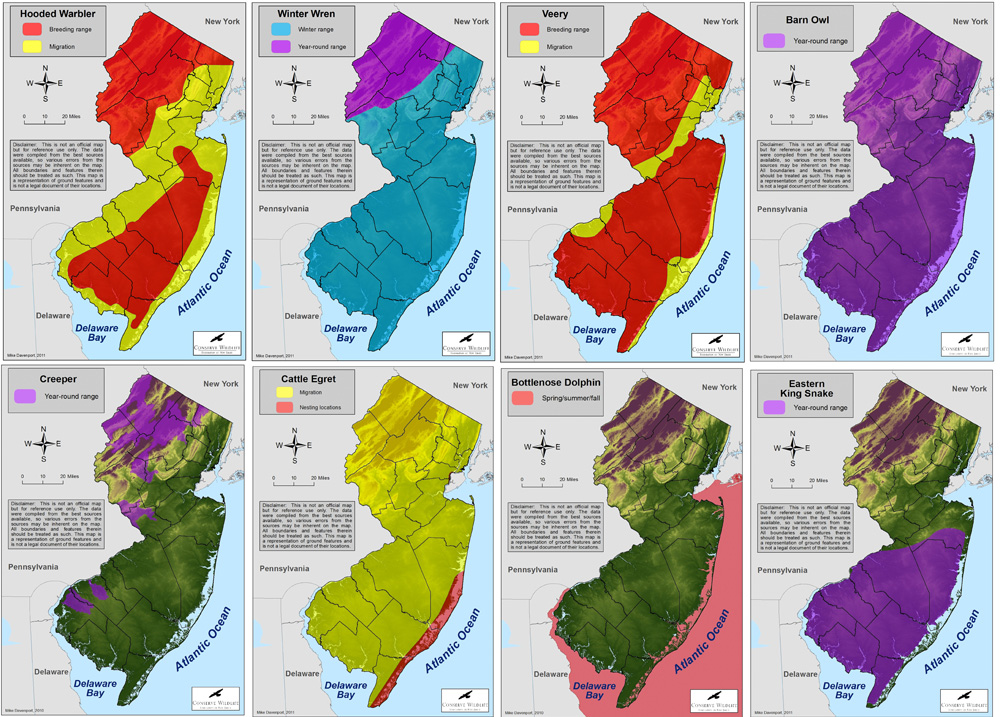
Several range maps found on the CWF on-line field guide.

Conserve Wildlife Foundation of NJ (CWF) staff have been busy updating the CWF website’s on-line field guide with additional species’ profiles in order to add descriptions for New Jersey’s Species of Special Concern.  One important component of the on-line field guide, like almost any other field guide, is the inclusion of a range map.

Our Online Field Guide

The CWF on-line field guide is specific to New Jersey, so the only portion of each species’ range illustrated is that portion within the boundary of the state.  For a species’ full range, there are numerous additional sources of information.  CWF, being focused on New Jersey wildlife, is uniquely able to provide more specific range information based upon the data available to our staff as well as our first-hand knowledge.

The range maps within the on-line field guide are created using Geographic Information Systems (GIS) software and multiple sources of data.  First, we begin with the raw species observation data which is maintained within the NJ Endangered and Nongame Species Program’s (ENSP) Biotics database, a database which CWF staff maintains in partnership with ENSP.  Then, like any range map, some generalization needs to be made to account for the fact that animals cannot be observed 24 hours a day, 365 days a year.  In order to do so, data such as land cover types, hydrology, and/or topology is considered in order to fill-in the areas between observation points or omit other areas. Continue reading “Creating Range Maps for NJ Wildlife”

Birding by kayak

Nature Tours at Island Beach State Park

by Skyler Streich

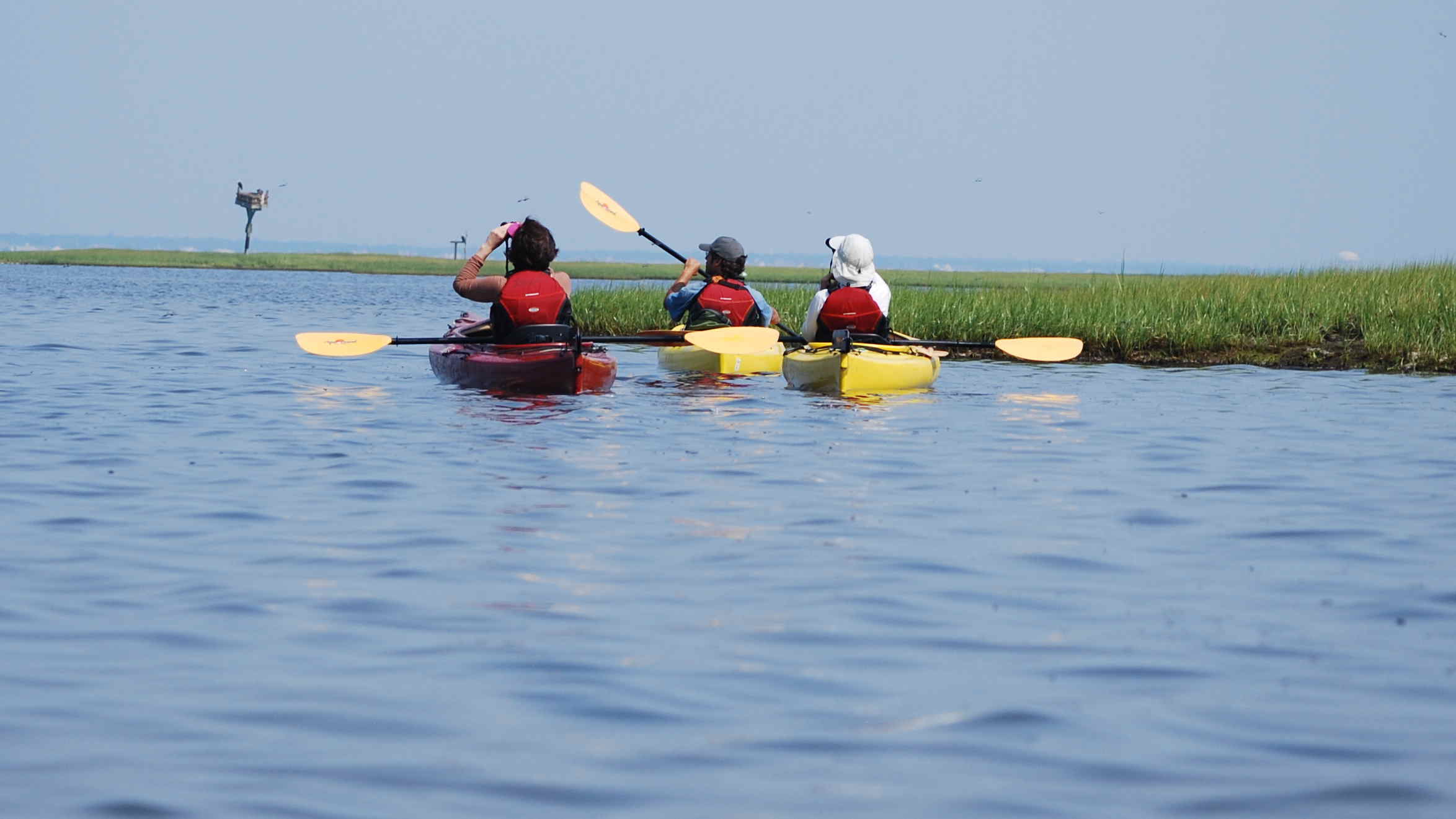
So far at Island Beach State Park, this year, we had two Birding-by-Kayak trips sponsored by Conserve Wildlife Foundation of NJ and they were a huge hit. The highlight, was a Greater Scaup which was present on both trips in the same location in the little cove called, “Spizzle Creek.” This bird should be high in the northern latitudes at this time of the year on it’s breeding grounds. Instead it did not make it up there this year due to many possible causes. We also had a Turkey Vulture fly right over us on the Sedge Islands, which was a first for me there and many others for that location. It was a strong west wind that day, which most likely brought the vulture all the way to Island Beach. Herons, egrets, warblers, flycatchers and terns were plentiful on the tours. Two weeks ago, we also had the first of the migratory shorebirds showing up on the sandbars and mudflats to refuel for their journey back south to their wintering grounds in the southern U.S, Mexico, and Central and South America.  More and more shorebirds are trickling into the area each day!

Birders use kayaks to reach birding hot spots inside Sedge Islands. Photo by Skyler Streich

Conserve Wildlife Foundation is partnering with Island Beach State Park and The Friends of Island Beach this year to help keep these wonderful tours for years to come. There are many more birding tours available at the park this summer, so all you have to do is sign up and you are on your way to a learning adventure at a beautiful location!


There are 3 more “Birding by Kayak” tours being offered this season.  August 18; September 1, 15. Cost is $25. To sign up call Kathy at 732-250-6314 or email her: D-Kathy@live.com.

We are also offering two great birding programs for both beginner and advanced levels of birdwatchers. The Beginner program on August 25th, will show participants how to properly use binoculars, and learn how to use field guides to identify the birds they are seeing. The Advanced program will focus on tackling the identification of the many shorebirds that will be present at Island Beach. That program is offered on July 28th and August 11th. The Cost is free.  Please preregister by calling the nature center at Island Beach at; 732-793-1698 or email: ibspnature@netcarrier.com.

We hope that you join us for an unforgettable experience at Island Beach State Park!

Photo from the field

Osprey numbers continue to rise!

by Ben Wurst, Habitat Program Manager

Three osprey nestlings were a common sight in many nests from Sedge Island to Little Egg Harbor, New Jersey. © Ben Wurst

Volunteers, CWF staff, and biologists with NJ Fish & Wildlife recently completed osprey nesting surveys throughout coastal areas of New Jersey. Each year these “osprey banders” complete “ground surveys” (referred to as ground surveys because they are surveying nests by land/sea, not by helicopter) that cover around 70% of the state population. I survey colonies on Barnegat Bay, Little Egg Harbor, and Absecon. The surveys are meant to keep track of the population and determine its health. During the surveys the banders access nesting areas mainly by boat since most ospreys nest in coastal areas or by water (their source of food). We use ladders to access nests where we count the number of young produced and then place an aluminum band on each of the young.  For the past two years we have also been collecting feather samples for a study being conducted by the Academy of Natural Sciences in Philadelphia where they are analyzing the stable isotopes to determine what ospreys are eating and how their diet has changed over time. More specifically they’ll be looking for changes in the isotope profiles across the local range of ospreys – something that has never been done before.

In one area, Sedge Island WMA, that I’ve surveyed for the past few years I surveyed 27 nests. 22 of those nests were occupied and produced a total of 47 young. 34 of those young were banded for future tracking. From the survey I can calculate the productivity or reproductive rate which is a measure of how healthy the population of that colony is. The productivity rate for Sedge Island is 2.14 young/active(known-outcome)nest this year which is the highest ever recorded (see chart at right for more details). These awesome results are the result of calm and mild weather conditions this spring and summer, high availability of prey, and possibly the increased amount of experienced breeding birds. Another factor that has surely helped to give the population a boost is the increased availability of suitable nest sites along the coast. Since 2004, I’ve helped to install more than 100 nesting platforms. Many of these platforms replaced old dilapidated structures and now give ospreys a better chance at successfully raising young that will eventually return to New Jersey to reproduce.


Photo from the Field

Stranded osprey gets helping hand

by Ben Wurst, Habitat Program Manager

I’ve been off work for the past week to spend some time with the newest member of my family, Reed Alexander Wurst. I was planning on heading into the office today to play catch up with a lot of projects that I’ve involved with (having a baby during field season is definitely keeping me busy!). So I started the day by opening up my laptop to download the 90+ emails I’ve gotten in the past week. As I sat down for some breakfast I saw an email from a woman where the subject said “Osprey on our Sailboat and we need help!” Immediately after I saw that I thought, there goes heading into the office… The woman who contacted me was Melissa, who was living on her sailboat that was moored in the harbor at Barnegat Light (BL). She sent me an image and this is what she wrote:

“We read your story in the SandPaper so are contacting you about this situation.

We heard a loud noise around 1am and when we looked with the flashlight we saw this osprey. It tried to fly up and out w/o success and now that it’s light we can see blood and it’s appears that his/her wing is injured.

We are anchored at Barnegat Light across from the town boat ramp. Our boat is Piscator and is the 32′ white and green double-ender.

We have no way to deal with handling this osprey, so really need help!! “

An injured osprey on the deck of s/v Piscator in Barnegat Light, NJ. © Ben Wurst

I called Melissa and I headed up to BL. I met John at the boat ramp and we rode out to the s/v Piscator in his dingy. After the short ride I saw that that osprey had a fracture to it’s left wing in the carpal (wrist) joint. I carefully collected the osprey and saw that she was banded. I looked up the band (788-49090) and she was banded in Sandy Hook on June 30, 2009. This would be her first year back from her wintering areas to breed in New Jersey. Ospreys spend two years after fledging in their wintering areas. One positive aspect is that most two year old birds do not raise young their first year after returning to nest in areas where they originated. So, no young ospreys are dieing b/c of her injury.

I then called Don Bonica with Toms River Avian Care and transported the osprey to Barnegat Animal Clinic where it would temporarily stay. I don’t know if it will heal from its wounds. Ospreys don’t do well in captivity or in rehabilitation settings. I can only hope that its fracture is minor and that it heals quickly!

Melissa knew who to contact after reading a story about my work with ospreys in New Jersey, especially the B. Bay Watershed in The Sandpaper. The story is viewable online until Wednesday, June 15th.

Volunteers needed to help install barrier fence

Protecting Terrapins through conservation along Great Bay Blvd.

by Ben Wurst, Habitat Program Manager

Great Bay Blvd. in Little Egg Harbor, New Jersey. © Ben Wurst

Northern Diamondback Terrapins are native to New Jersey and inhabit the many miles of coastal salt marshes along the Atlantic Coast and Delaware Bay. Terrapins were once very common and were used as a main food source of protein by Native Americans and then European settlers. In the early 1900’s it was hunted so extensively that it almost faced extinction. Luckily, during the 1920’s, use of terrapins for food dropped in popularity. This allowed the population to slightly recover and avoid extinction. However, several major threats still threaten their survival. Habitat loss, mortality from being drowned in crab traps, and road mortality all pose major threats to the health of the population. Each year thousands of terrapins are killed by motor vehicles throughout their range and here in New Jersey, Great Bay Boulevard is no exception.

Great Bay Boulevard or Seven Bridges Road extends approximately 5 miles into estuarine emergent wetlands and northern diamondback terrapin nesting habitat. The boulevard is surrounded by over 5,500 acres of protected coastal habitat (Great Bay Boulevard Wildlife Management Area – Managed by NJ Division of Fish and Wildlife), a relatively unspoiled, estuarine ecosystem. This road, at times, has high a volume of traffic, especially on weekends when boaters and outdoorsmen travel on the road to get to and from one of the several active marinas along the road. Currently during May-August there is no protection to terrapins when they cross Great Bay Blvd. from vehicle traffic. Most terrapins who cross the road are adult females who are laden with eggs and are looking for a suitable nesting site. These females lay their eggs in a sand/gravel mixture where it is easy for them to dig and cover their eggs, like sandy beaches and in scrub-shrub habitat along road edges. Many female terrapins are inadvertently hit-by-car and injured or killed by speeding motorists or people unaware of the summer nesting habits of the terrapin. This high mortality rate has caused the local population to decline and it has also caused the average size of adults to drop significantly over the past 20 years.

How you can help:

Volunteers are needed to help install ~ 4,000 ft. of barrier fencing along Great Bay Blvd to help reduce the amount of road kills. Sambol construction will be helping us by trenching a ditch for us to place the fence in. Volunteers will help lay out fence, install metal posts, hang fence, and back fill trenches.

  • Please pack a lunch and bring plenty of water, sunblock, and bug spray.
  • We are starting work on Friday at 8am, but if we don’t finish, we’ll wrap up work on Saturday morning.
  • We will meet after the first bridge; click here for a Google Map link. You can park here and then we can car pool to the section of the road where the fence will be installed.
  • Please register if you plan to attend by emailing Ben Wurst.

Check out our project page on Facebook and become a fan today!