Go Wild for Art!

D & R Greenway exhibit brings wildlife to life

By Jen Smith, CWF Outreach Intern

Annelies van Dommelen, Q

The D&R Greenway Land Trust’s “Wild Creatures: 40 Years of Protecting Endangered Species” exhibit is being featured at the Johnson Education Center in Princeton, NJ.  It is a vivid art-viewing experience that celebrates the U.S. Endangered Species Act and the wildlife it has sought to protect since its inception.

But time is running out to catch this unique blend of science and art!

“The response to the exhibit has been overwhelmingly positive with visitors who are simultaneously delighted by the whimsical creatures, reverent of their noble struggle, and inspired by the recovery efforts undertaken across the globe to save them,” said Diana Moore, curator for the exhibit.

Eight local artists were featured for their work, including Tricia Zimic’s foreboding mobile entitled “A Cautionary Tale.” Henslow sparrows, a Bobolink, and a Peregrine Falcon struggle in an all-to-lifelike storm of fishing wire, plastic and debris. Annelies van Dommelon’s playful yet informative work is also not to be missed. Filling up an entire room with her breathtaking “Bestial Alphabet” viewers can glimpse the A to Z of creatures aided by the Endangered Species Act, many of those depicted being native to New Jersey. More than one viewer compared the exhibit to watching an Aesop’s Fables book come to life.

“This creative exhibit highlights just how special our wildlife is in New Jersey – and why so many species continue to need our protection,” noted David Wheeler, CWF Executive Director. “Each artist brings a unique vision to illustrating the challenges that so many wildlife species face, and to capturing the extraordinary beauty possessed by each species.”

D&R Greenway Land Trust’s mission is to preserve and protect the permanent network of lands they have ensured remain open spaces and to create conditions for a healthy and diverse environment to flourish. In creating public access to these open spaces, it is D&R’s goal and hope that people will develop a greater appreciation for the natural world, and be inspired by conservation ethics and education.  D&R President Linda Mead was honored this past December at Women & Wildlife by CWF for the Greenway’s leadership in protecting wildlife habitat in a region of the state that desperately needed that protection.

“Wild Creatures” will be running now through March 21st. The Johnson Education Center in Princeton, NJ is open 10am – 5pm on weekdays. You can call ahead for availability (609)-924-4646 or visit www.drgreenway.org for more details and driving directions.

More information about Tricia Zimic’s artwork can be found at www.triciazimic.com.

Hurry now before this rare showcase comes to an end!

Terrapins and tires don’t mix!

Get college credit and help protect terrapins!

by Ben Wurst, Habitat Program Manager

Female terrapin on Great Bay Blvd. © Ben Wurst

Since 2010, Conserve Wildlife Foundation (CWF) has been engaged in the conservation of northern diamondback terrapins (Malaclemys terrapin terrapin) in the Little Egg Harbor area. This year, CWF seeks to continue to protect terrapins through additional conservation and education initiatives that include the installation and maintenance of barrier fencing, road patrols on Great Bay Blvd., and the continuation of this student internship. This year we are attempting to replicate a study conducted in 2004 on the same road, and results will help us to better determine how effective our conservation measures have been.

Interns will conduct field work in the lower Barnegat Bay watershed including hourly road patrols on Great Bay Blvd., volunteer steward scheduling and management, educational related activities, and the best part – save hundreds of female terrapins from becoming road kill!

Currently this is a volunteer student internship, but there is an opportunity for this to be a paid internship through the Barnegat Bay Student Grant Program. Willing students must develop a scientific research project to qualify for the grant. The deadline to apply is April 4th.

Living with eagles as your neighbors

Brochures now available

by Larissa Smith: Wildlife Biologist/Volunteer Coordinator

Bald Eagle Project Brochures.

The New Jersey Bald Eagle nesting population is on the rise with 148 nesting pairs monitored in 2013 and 177 young fledged.  As the eagle nesting population increases so do the incidences of eagles nesting in close proximity to humans and human activity. It’s exciting to have a pair of bald eagles nesting and people often want to get a closer look but this can cause disturbance to the nesting eagles and have detrimental impacts. Over half of NJ’s eagle nests are located on private property which makes it important to advise and educate land owners, land managers about living with eagles.

To address this issue CWF received a grant to produce two informational brochures about co-existing with bald eagles in NJ. One is a general brochure for anyone interested in eagles in NJ and the other is specifically for landowners/land managers with eagle nests located on their property.  The brochures contain information on eagle history, living with eagles as you neighbors, how to be a good eagle watcher or steward, as well as phone numbers for information and law enforcement. As the eagle project volunteers monitor their nests they will have these brochures available to educate interested people.

New Jersey’s 1st Annual Super Bowl

This Week, Play in New Jersey’s Super Bowl…of Wildlife

wildlife superbowl

This Sunday, for the first time ever, New Jersey will host the Super Bowl. Millions await the drama between two evenly matched high-flying teams.

You mean the Seahawks versus Broncos in the NFL Super Bowl?

Guess again.

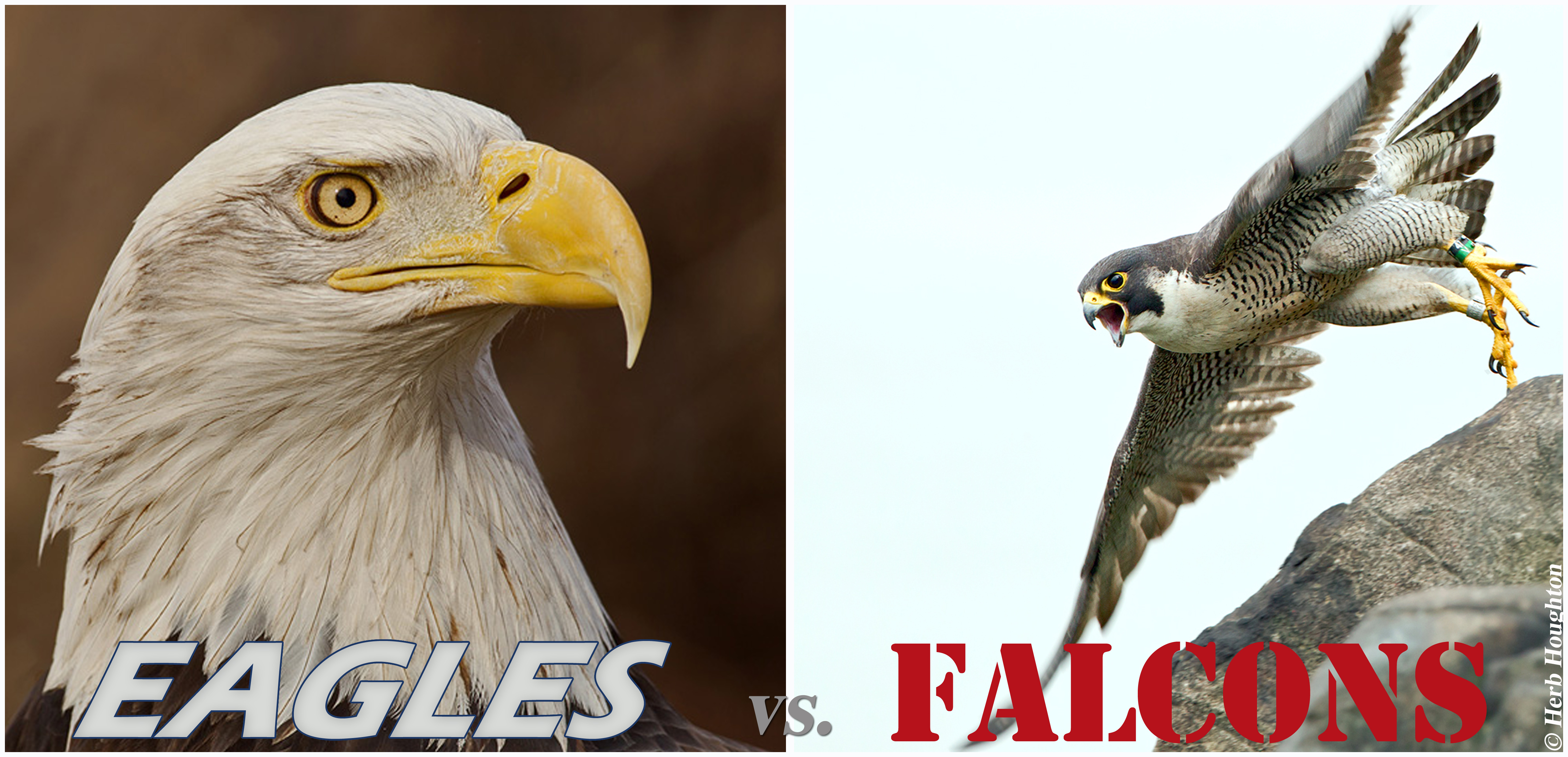
Try the Falcons versus Eagles in the CWF Super Bowl!

As in peregrine falcons, the fastest animal on earth, against the bald eagles, the symbol of All-American grandeur. These two “teams” have overcome incredible odds to make it to the biggest stage imaginable: the Conserve Wildlife Foundation of New Jersey (CWF) battle for the first annual state wildlife championship. The winner will be announced on Monday morning, after a week of Facebook “likes” and donations in favor of the Falcons, or of the Eagles.

All donations will help support CWF’s work on that species, with falcon support dedicated to our Jersey City webcam program and eagle support helping our statewide stewardship work. At stake is not the NFL’s Lombardi Trophy, but an extra boost in CWF’s efforts to protect one of these imperiled species and ensure its inspiring recovery continues.

Surviving the Regular Season

How did these CWF champions make it this far? From their home stadium in downtown Jersey City (and 23 other nests across New Jersey), the Falcons have soared through the season in a continued recovery from decades of struggle against opponents like DDT and pollution. The Falcons then entered the CWF playoffs with momentum, defeating the Bobcats, Terrapins, Ravens, and Fishhawks (ospreys) in succession to reach this big stage.

Their opponent, the Eagles, play the majority of their home games on the windswept Delaware Bayshore, but also play at 118 other nests across the state. Like the Falcons, the Eagles had decades with seemingly no hope because of DDT and a rapidly changing landscape. Yet the Eagles bounced back with an inspiring few seasons, capped by victories over the Bog Turtles, Plovers, Tigers (salamanders), and Dolphins.

Among the teams that continued struggling this season were the Rattlers, the Bats, the Tree Frogs, the Skippers (butterflies), and the Goldenwings (warblers). Conversely, the Seals and Snowy Owls had strong winter seasons. Two closely rivaled teams, the Red Knots and the Horseshoe Crabs, overcame the loss of their stadium to Hurricane Sandy with a newly built New Jersey home that greatly improved their odds of success.

Now that the game is on – what are the rules for the CWF Super Bowl?
Do you win, too, if you support the winning team?

All supporters of the winning team will be eligible for a drawing to join a banding of the winning raptor this summer, with eligibility weighted by donations and points – the greater the donation or support, the greater your chance of winning! But EVERYONE is eligible, even for as simple as a Facebook like!

As for you non-football fans out there…just as the NFL Super Bowl attracts attention far beyond regular football fanatics, our CWF Championship is meaningful to all of us who care about imperiled wildlife in New Jersey. Here is a chance to ensure that a magnificent raptor – a bald eagle or a peregrine falcon – continues to grace New Jersey’s skies. Either way, score a win for New Jersey’s wildlife!

So consider this the opening kickoff! Getting out on the field is as easy as clicking a link in this email – but choose wisely. The champion awaits!

Bahamas Piping Plover Project

Eleuthera Edition

By Todd Pover, Beach Nesting Bird Project Manager
Stephanie Egger, Wildlife Biologist

Piping plover roosting beach on the island of Eleuthera, Bahamas.

Up until now, nearly all of our piping plover conservation work in the Bahamas has been focused on the island of Abaco.  One of the objectives of our Disney Worldwide Conservation Fund grant is to identify other islands and partners where and with whom the model we are developing on Abaco might be implemented as well.  With this in mind, we spent the past several days on the island of Eleuthera.

Although we believe the basic elements of our Abaco work are transferable to other islands, a “one size fits all” approach may not entirely work.  The various major islands are unified under the Bahamas flag, but each also has its own flavor, history, and way of life.  The best analogy would be that they operate much like the individual states in the U.S.

On Abaco, we have been partnering with Friends of the Environment, a non-profit organization with a strong education and outreach component to all of their work – not so different from what we do here at the Conserve Wildlife Foundation.  On Eleuthera we are hoping to partner with the Cape Eleuthera Institute (CEI) and The Island School.  Although education is at the core of their work as well, it is also different in that they carry out and support primary research and host visiting scientists and students at their campus. Continue reading “Bahamas Piping Plover Project”

Save the Jersey City Falcon Cam!!

Tiercel peregrine falcon at Jersey City. © Kathy Clark/ENSP

Since 2000, a pair of state endangered peregrine falcons have nested on a building in Jersey City, New Jersey. Peregrine falcons are drawn to urban areas since there are high levels of prey (pigeons) and suitable areas to nest (building ledges and outcrops). To follow along with their daily life cycle a webcam was first installed in 2001. Since then it has broadcast their success and struggles over the years to reproduce and help bolster the population in the state.

Peregrines have made a remarkable recovery in New Jersey since their reintroduction in the 1970s, and the Falcon Cam has allowed us to help raise awareness for their conservation. This past year we learned that the NJ Division of Fish and Wildlife, who hosted the camera since it’s installation, no longer has funding to maintain the webcam. Over the next month we’ll be fundraising to help keep the webcam online! At the same time we’ll also be featuring a weekly series “The Month of the Falcon” with insight from biologists and awesome photos of peregrines from New Jersey.

Piping plover sister school project

Dispatch from Green Turtle Cay, Abaco, The Bahamas
Sister School students of Amy Robert Primary School
Sister School students of Amy Roberts Primary School, Abaco, The Bahamas, working hard on their Piping Plover Unit!

The Conserve Wildlife Foundation of NJ continues to be extremely excited about our sister school project which links a school on Green Turtle Cay in Abaco, The Bahamas and one in Ocean City, New Jersey, USA through piping plover conservation. We particularly like how it is shaping up to be a multi-disciplinary educational initiative. Below is a report we received last week from Jan Russell, the project teacher from the Amy Roberts Primary School on Green Turtle Cay:

Today was the first official in-class activity to start the Joint Piping Plover Unit.  On Monday the students were placed in groups based upon their strengths and identified cooperation skills. The first activity included a review of the Power Point presentation presented by Todd Pover and Stephanie Egger of CWFNJ when they visited us on November 5, 2013.  As each slide was presented, each group recorded a comment or question on a large sheet of poster paper.  The comments and questions will be used to develop our research direction and our final product choices. Continue reading “Piping plover sister school project”

Osprey Cam: Back up and running!

After much delay…

by Ben Wurst, Habitat Program Manager

Last week we set out to finally repair the osprey cam at Edwin B. Forsythe NWR. (Note: we do all of the technical repairs and maintenance to the camera system) Initial repairs were delayed to protect the osprey young. Timing restrictions are set in place to reduce disturbance to nesting ospreys and nests cannot be disturbed from April 1 – August 30. This is a good thing! When we finally set out to figure out the issue with why the camera suddenly lost power, we had to wait until it was safe to enter the nest. When we first went out (August 15) for a quick diagnosis (after we knew all young were flying and not relying on the nest as much) and got the cam online again…but it died after 30 minutes of streaming…

We went out again in late September and determined it was the solar charge controller but had to wait to get a new one. In October we went out out to replace the charge controller but the system was still down and the equipment was not getting power. The two batteries only had 6 volts of charge and needed to be recharged. So, the two 50lb. batteries were lugged a pretty long distance and charged up. Once they held a charge we made plans to go back to re-install them and hoped it would work. Success!! The batteries powered up the system and within minutes the camera was streaming online!

Special thanks to volunteer Joe Bilotta for helping out with the re-installation of the batteries!

Osprey Cam equipment
Volunteer, Joe Bilotta helps to setup a ladder to access osprey cam equipment.
Ben gives thumbs up!
Thumbs up!!
Osprey nest in off season
Not so green anymore!

Can A Bobcat Pose For A Picture?

Encourage your 5th graders to find out by entering the Species on the Edge Art & Essay Contest!

by Maria Grace, Education & Outreach Manager

SpeciesOnEdgeLogoNow in its 11th year and open to all 5th graders throughout New Jersey, the very popular Species on the Edge Art & Essay Contest encourages students to think about rare wildlife in New Jersey.

To enter the contest, students research a species of wildlife that is rare or endangered in New Jersey.  They write an essay detailing the needs of the species and the challenges to its future existence. They then create artwork – a painting or collage – depicting their chosen animal in its natural habitat.

Over the past 10 years, over 25,000 students have entered the contest and have expanded their knowledge about New Jersey’s imperiled wildlife.  Hundreds of teachers throughout the state have participated in the contest and have praised its interdisciplinary approach and its ability to create a deep appreciation for nature:

“My students love the Species on the Edge Contest because they enjoy learning about the many endangered animals in New Jersey, which fits into our curriculum.  The contest helps raise their awareness about how humans interact with the natural world. My students take ownership of one species, and through artwork and research, they express their concerns about the environment and how to protect it.”

–Mary Keyser, Maple Road School, West Milford, NJ

A winner is chosen from each county in NJ, 21 winners in all. The winning artwork and essays become part of a statewide traveling exhibit, helping to raise awareness for New Jersey’s endangered wildlife.

Check out the 2013 winners!

The contest is free and it’s easy to participate! Download your contest kit today from our website.  The kit contains everything you need to participate – lesson plans, entry forms, and a list of approved resources for research.

Basic Training Course for Wildlife Rehabilitation

ANNOUNCEMENT:

Basic Training Course for Wildlife Rehabilitation

Where:  Mercer County Community College

When:  Weekdays Nov 4 – Nov 8, 2013


A young Barn Owl, healed of a leg fracture and about to be returned to its nest.  Photo by MacKenzie Hall
A young Barn Owl, healed of a leg fracture and about to be returned to its nest. Photo by MacKenzie Hall

Wildlife rehabilitation is the process of  caring for injured, ill and orphaned native wild animals with the goal of releasing each back to their natural habitat.  This course is designed for individuals interested in becoming licensed wildlife rehabilitators, rehabilitators who wish to include additional species to their current permit and any person wishing to obtain knowledge about native New Jersey wildlife. Over the course of five (5) weekdays, students will have the opportunity to be taught by, interact with, and build relationships with some of the foremost experts in wildlife rehabilitation.


Course Description


The Basic Training Course for Wildlife Rehabilitation focuses on the skill sets necessary to become a successful wildlife rehabilitator. This course offers information and professional training provided by some of the most knowledgeable instructors in the field of wildlife rehabilitation. It includes history, licensing requirements and regulations, mammal, bird and reptile species identification and anatomy, proper handling, care and nutrition, medical procedures, and much more. Approved by the New Jersey Division of Fish & Wildlife (NJDEP), this course is part of an alternative route program to meet New Jersey State licensing requirements for wildlife rehabilitators. Successful completion of the course will count for 40 hours toward the 200 hour New Jersey apprenticeship licensing requirement. This course will also benefit anyone interested in the handling and care of native wildlife. 


Objectives


Upon successful completion of this course, participants will be able to:


  • better understand all aspects of wildlife rehabilitation
  • know how to provide safe handling and care of wildlife
  • have basic knowledge that encompasses mammal, avian and reptile species


The course will run five weekdays Nov 4 through Nov 8, 2013 from 9:00 am to 5:00 pm each day. Completion of the course requires attendance at all classes. The course schedule and instructor bios can be found on the CDI website at www.cditraining.org.

Tuition for this program is $499.00, which includes all materials. Registration will be through Mercer County Community College at 609-570-3311. There is no requirement for prior experience or training to attend this course. Please contact Career Development Institute (CDI) with any additional course content questions that you may have:  732-821-6997, www.cditraining.org.