Project RedBand continues on Barnegat Bay

92 Ospreys Enlisted in Citizen Science Based Re-sighting Project

by Ben Wurst, Habitat Program Manager

A young osprey was banded with a color auxiliary band: 76/C for future tracking at a nest on Long Beach Island.
A young osprey named “Danny” was banded with a color auxiliary band 76/C for future tracking at a nest on Long Beach Island. Photo by Northside Jim.

This is the critical time of year for monitoring our nesting ospreys. Each year biologists and specially trained volunteers, aka Osprey Banders, conduct ground surveys by boat to monitor the state population. They visit or survey the most densely populated colonies of nesting ospreys: Sandy Hook, Barnegat Bay, Great Bay, Absecon, Ventnor-Margate-Ocean City, Great Egg Harbor Watershed, Sea Isle, Avalon-Stone Harbor, Wildwood, Maurice River, and parts of the Delaware Bay. These surveys have been conducted since the early 1970s when ospreys were not so common, with only 50 pairs in 1973.


Their recovery has been quite remarkable. With an estimated 600 nesting pairs throughout the state, our ospreys are in a much better position today. Why put so much time and effort into monitoring a seemingly healthy population? Even though their population is much larger than it was decades ago, ospreys still face a variety of threats that jeopardize their ultimate survival. It’s commonly known that ospreys face very high mortality rates in their first year of life. Before even leaving the nest their young are so vulnerable. They can fall or be blown out of the nest, predated by raccoons, crows, or eagles, killed by their own siblings, or die from starvation. After they fledge, then they need to learn to find and catch prey and avoid power lines and wind turbines. Then they need to learn to migrate south and avoid being shot in the process. Once they find a suitable wintering site, then they remain in the same area for the next two years. Then they return to their natal areas to find a suitable nest site and start their own osprey family!


Today, we need your help! We cannot reach all active nests in New Jersey. There is still plenty of time to help us keep track of the state population. Citizens are encouraged to submit sightings of activity at osprey nests on Osprey Watch, a global osprey watching community. In 2013 all of the known locations for osprey nests was released on Osprey Watch’s website. As a partner with Osprey Watch, we share and use the data collected to help determine the overall health of the population, which is summarized in our annual report.


To help engage our Osprey Watchers, we started Project RedBand, a citizen science based osprey re-sighting project. This is year two of the project. So far we’ve deployed 92 red bands (out of 100) on young produced at nests on Barnegat Bay (62 in 2014 and 30 in 2015). The young that were banded last year will start to return to New Jersey in 2016. Usually young adults return later than older adults, so the red banded birds might not be seen until May or June. That’s when they’ll find areas with high prey availability and suitable nest sites. Usually males don’t stray far from their natal areas but females do. With these red bands, we hope to learn a little more about where our ospreys are dispersing to and at the same time engaging our coastal communities in osprey conservation.


Learn more:


Ben Wurst is the Habitat Program Manager for Conserve Wildlife Foundation of New Jersey.

Bill Proposed to Encourage Homeowners to Create and Maintain Wildlife-Friendly Yards

Native Species Habitat Bill Passes in the Assembly

By: McKenzie Cloutier, Special Events and Fundraising Intern

Warbler
Golden-winged warbler. Photograph by Evan Madlinger

Of great interest to New Jersey homeowners, the Garden State’s General Assembly recently passed a native species habitat bill. This bill, pending further action in the Senate, encourages homeowners to create and maintain more wildlife-friendly yards. In hopes of creating more livable habitats for New Jersey’s wildlife, this bill includes a certificate program that promotes the growth of native plant species in landowners’ yards.


Under the provisions of this bill, landowners would be encouraged to grow and preserve native plant species that provide natural habitats for New Jersey’s other important species. In addition, this bill would also defend certified landowners against any municipal ordinances. For example, the bill would defend a landowner from an ordinance that calls for the removal of certain native plants or “weeds.”
The native species habitat bill not only benefits New Jersey’s wildlife, but homeowners as well, by reducing maintenance and chemical treatment costs. Under this program, yards will require less mowing and maintenance, and pesticide use is discouraged. With such changes, landowners could experience significant reductions in their usual yard maintenance costs, while helping to conserve local wildlife.


The native species habitat bill encourages New Jersey residents to become active participants in the preservation of wildlife. At the Conserve Wildlife Foundation, we encourage landowners to create wildlife-friendly backyards, and we are involved in helping private landowners to do so. Our wildlife biologist Kelly Triece works in partnership with United States Department of Agriculture’s Natural Resource Conservation Service (USDA-NRCS) to assist private landowners in managing existing cropland, forestland, and pastureland to best meet wildlife habitat needs or in establishing new wildlife habitat areas. Depending on the goal of the landowner, these programs can either help create or preserve pollinator, woodland, wetland and grassland habitats for many different wildlife species.

 
In particular, CWF biologists work with forest landowners to enhance young forest habitats on private lands. Young forest habitats are imperative for many birds, especially the Golden-winged warbler, a species of particular concern in New Jersey. The open canopy of a young forest also provides food such as berries, insects and small mammals to newly fledged birds, wild turkey, ruffed grouse, reptiles, black bears, bobcats, and butterflies.


Since 2008, CWF, NRCS and other partners have collaborated with landowners to create or restore over 225 acres of Golden-winged warbler habitat in New Jersey!

 
Want to get involved and help conserve wildlife on your property? Here are ten tips on how to create a wildlife-friendly habitat in your own backyard:

  • Allow native plants to grow.
  • Create a brush pile for ground nesting birds or small mammals such as chipmunks or mice.
  • Install a pond to benefit birds, frogs, salamanders, and aquatic vegetation.
  • Create a meadow for wildlife by choosing not to mow a section of your yard.
  • Plants trees and shrubs to provide food and cover for wildlife.
  • Buy a bird bath.
  • Remove invasive or non-native plants.
  • Refrain from using pesticides. Try composting!
  • Hang bird feeders.
  • Obtain a bird house.


Visit our website for more tips on how to create a wildlife-friendly backyard.


McKenzie Cloutier is the Special Events and Fundraising Intern for Conserve Wildlife Foundation of New Jersey.

Video Showcases EagleCam Lesson Plan Contest Winner Diane Cook

New Video Highlights Diane Cook’s Eagle Banding Experience and Classroom

By: Kathleen Wadiak, Wildlife Conservation Intern


This year, Conserve Wildlife Foundation of New Jersey and Duke Farms worked together to organize a contest in which educators could submit lesson plans based on the Duke Farms EagleCam, a webcam providing a live stream of a bald eagle nest. The winner, computer literacy teacher Diane Cook, had the opportunity to assist biologists in banding the eagle chicks from a nest in Hunterdon County. The new video showcasing Diane gives an up close and personal view into her story and her experience!


Diane has been incorporating the EagleCam into her lessons since the cam first went online in 2008, helping to inspire a respect for the animals and environment in her students from kindergarten to fourth grade. Diane also teaches her students about internet safety, web forums, and writing.


The Duke Farms EagleCam allows educators to connect their lessons to important environmental issues in a way that is interesting to their students. Teachers like Diane Cook are making a difference by encouraging children to care about their impact on local ecosystems and wildlife.


Learn more:


Kathleen Wadiak is a Wildlife Conservation Intern with the Conserve Wildlife Foundation of New Jersey.

Researching Beach Nesting Birds at Edwin B. Forsythe National Wildlife Refuge

Conserve Wildlife Foundation Partners with National Wildlife Refuge to Collect Data on Beach Nesting Birds

Posted by: Lindsay McNamara, Communications Manager


Piping Plover Nest
Piping Plover Nest

Did you know barrier island beach makes up approximately 2% of the Edwin B. Forsythe National Wildlife Refuge? This area is the most productive for beach nesting birds. The federally threatened piping plover and other species such as least tern, black skimmer, and a species of special concern, the American oystercatcher, nest on Holgate Beach. The refuge closes the Holgate unit from April 1st to September 1st every year to provide undisturbed nesting habitat for these important species.


Not only is it important to protect nesting habitat for the birds, but it is also important to provide education opportunities to the public. Each summer, the refuge relies on volunteers during the summer months to talk to the public about the beach closure and bird management, and answer any general questions about Forsythe Refuge.


This year, Conserve Wildlife Foundation of New Jersey partnered with the refuge to assist in the collection of nesting data. “In the past, refuge staff has done all the beach nesting bird monitoring,” said Refuge Manager Virginia Rettig. “This year we are very excited to be working with our partners to monitor the population status of these birds. The work they are doing, combined with the data they collect, will improve our understanding of beach nesting birds on Forsythe Refuge.”


CWF Field Technician Jesse Amesbury tracking piping plovers at Holgate with his scope.

“Holgate provides highly suitable undisturbed natural habitat for at-risk beach nesting birds, especially piping plover – a rarity along the otherwise highly developed and recreated New Jersey Coast,” said Todd Pover, CWF Beach Nesting Bird Project Manager. “Maximizing productivity at this site is a high priority for regional and range-wide recovery efforts.”


Edwin B. Forsythe National Wildlife Refuge protects more than 47,000 acres of sensitive wetlands, marshes, and coastal habitats along the New Jersey shore. It is one of the most important habitats for migrating waterfowl and shorebirds east of the Mississippi River.

Learn more:

Conserve Wildlife Foundation’s Beach Nesting Bird Project
Edwin B. Forsythe National Wildlife Refuge


Lindsay McNamara is the Communications Manager for Conserve Wildlife Foundation of New Jersey.

Species on the Edge Art & Essay Contest Gets Interactive

2015 Species on the Edge Art & Essay Contest Winners Represented on New Story Map

By: Kathleen Wadiak, Wildlife Conservation Intern

SpeciesontheEdgeStoryMap

Conserve Wildlife Foundation’s 2015 Species on the Edge Art and Essay Contest gave fifth grade students from across the state the opportunity to research an endangered species and submit a drawing and essay written from the animal’s perspective. Meant to support awareness of endangered species in students, the Species on the Edge Art & Essay Contest encourages fifth graders to think like wildlife biologists as they gather research and learn about pressing environmental issues. The results of this contest are the subject of our newest story map!


This interactive map allows the user to click on icons to see participating schools, first and second winners from each county, and honorable mention entries. Scrolling through the text on the left side changes the content of the points on the map. A click on each map point brings up more information, like the number of classes from each school that submitted an entry. While scrolling through the list of winners, users can even click on the schools’ icons to bring up the students’ names, essays, and artwork.


The format of this story map is simple and easy to use, allowing for an interesting, interactive way to display the hard work of students across New Jersey.


Learn more:


Kathleen Wadiak is a Wildlife Conservation Intern with the Conserve Wildlife Foundation of New Jersey.


Be Terrapin Aware!

Public urged to use caution while driving in shore areas this summer

By: Ben Wurst, Habitat Program Manager and Stephanie Egger, Wildlife Biologist

A adult female northern diamondback terrapin searches for a suitable nest site along Great Bay Blvd. Photo by Ben Wurst
An adult female northern diamondback terrapin searches for a suitable nest site along Great Bay Blvd. Photo by Ben Wurst

Each year in late May and early June the annual nesting season for northern diamondback terrapins begins. This unique species of turtle is the only one to inhabit our coastal estuaries year round. They live exclusively in brackish water.

During this time of year, adult females emerge from the protection of their aquatic habitat to find suitable areas to lay eggs. They seek nesting areas with a sandy gravel type substrate that’s above the high tide line.

Throughout their range along the coast, terrapins face a variety of threats to their survival. Terrapin nesting habitat has been lost due to commercial and residential development, shoreline hardening and flooding which poses a greater threat to these limited nesting areas. Loss of terrapin nesting habitat along marsh systems put terrapins at greater risk of mortality as a result of increased time searching for adequate nesting areas (Winters 2013). Terrapins will utilize roadsides for nesting which increases the threat of being hit by motor vehicles. Roads are essential to our daily life but they often are barriers to wildlife, especially small critters like terrapins. Studies have shown that adult females have become less abundant and smaller from road mortality. (Avissar, 2006).

You can help terrapins several ways during the nesting season. Driving more cautiously from now until mid-July is a simple way to be more aware of terrapins crossing the roads. Nesting peaks during the full and new moon cycles and they’re more active during the high tide (less distance to travel on land to nest sites). We ask drivers in coastal areas to “Be Terrapin Aware” while driving in these areas. If you find a terrapin crossing the road use these steps to help it cross safely:

  • Stay safe. Never put yourself at risk! Make sure that you do not endanger yourself, or others, by walking into traffic.
  • When safe to do so, pull your car over and onto the shoulder, if possible. Turn on your hazard signals.
  • When safe to enter the roadway, approach the turtle and pick it up by grabbing its shell with both hands between its front and hind legs. HOLD ON – Terrapins have strong legs!
  • It is important that you move the turtle in the direction that it is heading. They are not always headed directly towards water. They will turn around if you put them in the wrong direction, so work with their instincts.
  • Place the terrapin off the road onto the soft shoulder (dirt or grass).
  • If you have a GPS or a smartphone then record your location and submit your sighting on our website.
  • Please do not move a terrapin long distances to “somewhere safe!” They have very small home ranges and moving them will only hurt them.

Rescuing a live terrapin (or any other turtle) from the road is a rewarding experience. It’s a great way to engage future generations in caring for our terrapins.

You can also help terrapins during the nesting season by supporting our new “Turtle Gardens” project. CWF, in partnership with the Marine Academy of Technology of Environmental Sciencewill develop and implement an educational initiative to promote terrapin nesting habitat enhancement. These “Turtle Gardens” will raise awareness of the benefit of living shorelines to terrapins and other coastal wildlife, as it relates to sea level rise and coastal flooding within the Barnegat Bay Watershed. Turtle Gardens for terrapins are patches of sandy nesting habitat above the high water line that are less susceptible to flooding. They also reduce the risk of road mortality. We will be having informational training sessions for those that would like to volunteer for monitoring Turtle Gardens or have property that would support a Turtle Garden. Information on these sessions will be announced in mid-June.

In addition, we will also be looking for terrapin sighting information with Project Terrapin in Berkeley and Lacey Townships in Ocean County as part of an initiative to fill in data gaps for this species on the mainland. If you see terrapins in these locations please report your sightings online.

Learn more:


Ben Wurst is the Habitat Program Manager for Conserve Wildlife Foundation of New Jersey and Stephanie Egger is a Wildlife Biologist with Conserve Wildlife Foundation of New Jersey.
Fifth Graders from Across New Jersey Honored for Art & Essays on Rare Wildlife

2015 Species on the Edge Art & Essay Contest Winners announced at Awards Ceremony

By: Lindsay McNamara, Communications Manager

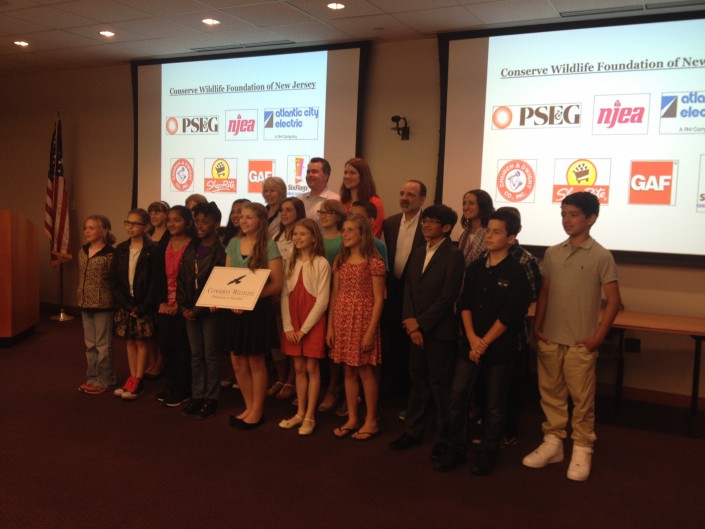
2015 Species on the Edge Winners
2015 Species on the Edge Winners with representatives from CWF and PSEG


Today, Conserve Wildlife Foundation of New Jersey celebrated and recognized the winners of the 2015 Species on the Edge Art & Essay Contest, a statewide educational contest open to all fifth-graders, which encourages students to become wildlife biologists through their research and artwork on the endangered and threatened wildlife species in New Jersey.


“The vibrant artwork and passionate essays that we received from fifth-graders across the state reveal just how much these talented children poured their hearts into the Species on the Edge contest,” said David Wheeler, Conserve Wildlife Foundation Executive Director. “We are so thrilled to help connect the next generation of New Jersey conservation leaders with the natural world around them. Through their art and essays, all of us can see the wonders of nature – and the many challenges that we must overcome to help rare wildlife survive in our densely populated state.”


Students were asked to draw a picture of one of New Jersey’s 83 endangered and threatened wildlife species and compose an essay about how the animal became endangered and what can be done to help protect it. The Species on the Edge Art & Essay Contest encourages students to learn about local environmental issues, express their concerns for the world around them, think creatively about ways to improve it, and to consider how their actions impact the natural world.


Abby Miller, a student at T.P. Hughes Elementary School in Union County believes that it is important to protect wildlife in New Jersey because “everything deserves to be saved when they’re endangered.”


Bald Eagle from Mercer County Wildlife Center

This year’s ingenious group of winners was honored at an awards ceremony which was hosted at the New Jersey Education Association, in Trenton, New Jersey. The contest was sponsored by PSEG, NJEA, GAF, Atlantic City Electric, Church & Dwight, ShopRite and Six Flags Great Adventure. Mercer County Wildlife Center brought a live Bald Eagle to the event.


The statewide contest drew over 2,000 entries from across the state. Since 2003, over 10,000 children from across New Jersey have entered the Species on the Edge Art & Essay Contest.


For more information, visit Conserve Wildlife Foundation’s website.


Lindsay McNamara is the Communications Manager for Conserve Wildlife Foundation of New Jersey.

Help Clean-up the Barnegat Bay Watershed!

Barnegat Bay Blitz set for Wednesday, June 3, 2015

By: Lindsay McNamara, Communications Manager

Barnegat Bay

Concerned about the health of the Barnegat Bay ecosystem? Consider participating in a day of action for the Bay! The New Jersey Department of Environmental Protection (DEP) will be hosting its next Barnegat Bay Blitz clean-up day on Wednesday, June 3.


You can join thousands of volunteers as they fan out across the watershed, which includes all of Ocean County amd parts of Monmouth County, to clean up the Barnegat Bay Watershed and spread awareness about the people pollution impacting the Bay. Clean-up events are happening in all 37 municipalities!


To register for a clean-up, visit DEP’s website.


Barnegat Bay Blitz highlights include:

  • DEP Commissioner Bob Martin will be kicking off this year’s Barnegat Bay Blitz at the iconic Barnegat Lighthouse State Park. Hundreds of volunteers will gather at this one location to learn about the Bay and start a day full of awesome stewardship activities. Take part in the fun at 10 AM on June 3rd at the Lighthouse! To volunteer, visit DEP’s website.
  • In the middle of Barnegat Bay, there are many small islands called Sedges. These islands are home to a number of species of plants and animals, but unfortunately are impacted by litter that the tide washes in. Volunteers by boat, kayak and standup paddle board will make their way out to many of these islands, including Island Beach State Park, Seaside Heights and Brick to sweep them clean of debris. Get involved!
  • It’s not just the bayfront communities that impact Barnegat Bay. Communities miles and miles inland also play a role. After all, we are all downstream! That is why at the Barnegat Bay Blitz, volunteers will work to clean up all over the watershed, from inland areas of Plumsted to the barrier islands. In Plumsted, a farming community, volunteers include more than just people! Llamas will also join the crew to help haul out trash and debris that volunteers collect from the Colliers Mills Wildlife Management area. To make friends with llamas, register for the Plumsted clean-up on DEP’s website.

We hope to see you on Wednesday, June 3, for DEP’s next Barnegat Bay Blitz!


Questions? Feel free to contact:

The Return of Bald Eagles in New Jersey

Conserve Wildlife Foundation Releases New Story Map: “The Return of Bald Eagles in New Jersey”

By: Brian Henderson, GIS Specialist

Bald Eagle Story Map

Today, Conserve Wildlife Foundation of New Jersey (CWF) announced the release of “The Return of Bald Eagles in New Jersey” a Story Map that provides a new way to visualize the increasing number of bald eagle pairs nesting in New Jersey over time.


For years, CWF has worked closely with the New Jersey Endangered & Nongame Species Program (ENSP) to track and restore the bald eagle population within the state. It has been a rewarding experience for all involved to witness the return of bald eagles to the garden state, and now the public can appreciate the scope of their return as well.


The recovery of bald eagles nationally and in New Jersey is fairly well known, but some may not realize that as recently as the mid-80’s there was only a single pair of nesting bald eagles in all of New Jersey. The ban of DDT, combined with restoration efforts by ENSP biologists, resulted in population increases to 23 pairs in 2000, 48 pairs by 2005 and 82 pairs in 2010.


In 2014, there were a record 146 active bald eagle pairs nesting in New Jersey. This year, 190 nesting territories are being monitored and currently 88 chicks have been reported at 52 nests; it is still early in the season so we don’t have a count for all nests yet.


“The Return of Bald Eagles in New Jersey” Story Map displays the locations of all the known active bald eagle nests in New Jersey from 1985-2014. Users can choose to view the nests active in a single year or over a longer period of time. By choosing a one year interval and beginning in 1985, it’s possible to watch as nests multiply from a single nest in Bear Swamp to densely populating the Delaware Bay coast and spreading across the southern portion of the state and eventually into almost every county of New Jersey. In 2014, the only counties in New Jersey without an active bald eagle nest were Essex and Hudson.


The Story Map also highlights “featured” nests, or nests of special significance, including the Duke Farms nest which has been featured on a webcam since 2005 and the Millville nest where a juvenile eagle was fitted with a GPS tracking device in 2014. These featured nests include more information, pictures and links to pages that explore related projects in greater depth.


As the bald eagle population has reached record numbers in New Jersey, the raptors have expanded into non-traditional parts of the state, providing more and more people with a chance to glimpse this iconic species. This map highlights the ongoing success of conservation efforts and illustrates that whether you realize it or not, you’re never very far from a bald eagle nest in New Jersey!


Learn more:

Brian Henderson is the GIS Specialist for Conserve Wildlife Foundation of New Jersey.


Dedicated, Passionate Hunterdon County Computer Teacher Wins Statewide Wildlife Education Contest

Contest winner to help band EagleCam chicks at Duke Farms next month

By: Lindsay McNamara, Communications Coordinator

From Left to Right: Duke Farms Executive Director Michael Catania, Contest Winner Diane Cook, CWF Executive Director David Wheeler

Copper Hill School computer teacher Diane Cook was recognized by Duke Farms and Conserve Wildlife Foundation for winning their EagleCam lesson plan contest earlier this week. Cook will join wildlife biologists to help band the new Duke Farms EagleCam chicks next month.


The EagleCam Lesson Plan contest, jointly organized by Duke Farms and Conserve Wildlife Foundation, called on educators to submit lesson plans incorporating the Duke Farms EagleCam into their classrooms. Installed in 2008, the Duke Farms EagleCam, a web cam on a tree adjacent to a Bald Eagle nest, has provided a streaming look into the daily lives of the eagle family for over 10 million viewers.


Diane Cook submitted three creative lesson plans for the contest and is working with the Duke Farms and Conserve Wildlife Foundation EagleCam team to expand the camera’s potential as an educational vehicle.


“Duke Farms is delighted to support dedicated teachers that bring nature to life in their classrooms. Diane Cook’s winning lesson plan featured innovative strategies to teach digital citizenship through student observations of the nesting eagles,” explained Michael Catania, Duke Farms Executive Director. “Her participation in this year’s banding of the Duke eagle chicks will be a highlight for our staff.”


The EagleCam has been a staple of Diane Cook’s classrooms since the webcam was installed in 2008. Cook began blogging about the eagles in 2011 and allows students in grades kindergarten through four to share their thoughts, observations or questions on what they see happening in her computer literacy class. Cook also live streams the EagleCam in her classroom for her students to watch. Her first graders use the webcam as a part of an internet safety unit and her third and fourth graders use the EagleCam to learn how to write blogs themselves.


“Watching the EagleCam gives us all, adults and students, the opportunity to experience nature happening right before our eyes. It opens the way for meaningful discussions and great questions, both at school and at home as families watch together,” said Computer Literacy Teacher and Contest Winner Diane Cook. “This year, I am using the EagleCam to teach how to write a thoughtful and meaningful comments in social media forums. Fourth graders are learning how to blog. They are excited to write about a topic that excites them.”


“As a dedicated and inspiring teacher, Diane Cook is helping us realize the incredible potential for connecting our kids with the natural world around us,” stated David Wheeler, Conserve Wildlife Foundation Executive Director. “The amazing comeback of Bald Eagles across New Jersey mirrors the recovery that our state has made from the devastating legacies of unchecked pollution. Teachers like Diane Cook work so hard to make sure the next generation of leaders understands first-hand how much all of us – humans and Bald Eagles alike – depend on a clean and healthy environment.”


Originally from Branchburg, New Jersey, Cook now resides in Ringoes. She has been an educator at Cooper Hill School in the Flemington Raritan School District for 19 years, teaching first grade, second grade and now computer literacy. Cook gets outside as often as she can, and she enjoys gardening, birding or looking for other wildlife, hiking, walking, fishing, and learning her newest craft of photography.


“I’m hoping to instill in all who learn about the EagleCam in my class a sense of wonder, appreciation for our natural world, and a desire to take care of our world,” explained Cook. “Environmental science is one of my passions. I want to pass along a small part of that to others.”


Lindsay McNamara is the Communications Coordinator for Conserve Wildlife Foundation of New Jersey.