Calling All New Jersey High School Students – Win a Scholarship!

Enter Conserve Wildlife Foundation’s New Species on the Edge 2.0 Contest by May 22, 2015

By: Lindsay McNamara, Communications Coordinator


Attention New Jersey High School Students!


Love experimenting with new multimedia and technology programs? Want to express your concern for New Jersey’s endangered species and help show the public why wildlife protection is important in the Garden State? Make sure to enter our Species on the Edge 2.0 Multimedia Contest!


Open to all New Jersey high school students, this contest invites students to submit a video, app, podcast, digital graphic design, webpage, or other multimedia component showing why wildlife protection is important in New Jersey. Watch the new Species on the Edge 2.0 video, created by 2015 Video Intern Tyler Grimm, to learn more about this great opportunity.


Thanks to PSEG, our generous sponsor, first place, second place and third place entries will be awarded scholarships! For more information, visit Conserve Wildlife Foundation’s website and watch our new Species on the Edge 2.0 video. All entries due by Friday, May 22, 2015.


Lindsay McNamara is the Communications Coordinator for Conserve Wildlife Foundation of New Jersey.


Exploring our Largest Undeveloped Barrier Island

New website promotes natural resources and recreational opportunities found at Island Beach State Park

By: Ben Wurst, Habitat Program Manager

Make sure to bookmark: www.islandbeachnatureprograms.org!

Over the past few months, we have been working with interpretive staff at Island Beach State Park to develop a new website. The new website showcases the rich natural resources available to visitors of the Park. Daily and guided programs are offered throughout the summer, starting in June.


Programs include:

  • Daily programs include: daily beach walks and Seining (these are free)
  • Guided programs (cost between $5-25) include: Birding by Kayak, Surfing, Coastal Cooking, Kayak Eco-Tour, Beginner’s Surf Fishing Clinic, Clamming, Moonlight Hike, Nature Photography Seminars, and more!
  • And there are several nature programs just for kids (including toddlers)


Make sure to point your browser to the new, Island Beach Nature Programs website. Check out the list of programs. Bookmark the site and share it with your friends! Make sure to include some awesome, educational outdoor recreational plans for your summer vacation along the Jersey Shore!


Ben Wurst is the Habitat Program Manager for Conserve Wildlife Foundation of New Jersey.


“Harbor Seals in New Jersey” – Conserve Wildlife Foundation’s Latest Story Map

Conserve Wildlife Foundation of New Jersey Releases a New Story Map: “Harbor Seals in New Jersey”

By: Michael Davenport, GIS Program Manager


Conserve Wildlife Foundation of New Jersey (CWF) has partnered with Jenkinson’s Aquarium of Point Pleasant Beach, New Jersey to create and release our latest Story Map, “Harbor Seals in New Jersey.”

Seal Story MapOver the years, CWF staff have worked with a number of marine biologists in order to monitor seal populations in New Jersey and minimize disturbance or harm to them. Most recently, CWF held two workshops in 2014 to educate first responders on handling marine mammal (and sea turtle) strandings. We’re continuing our efforts at educating the public about these amazing animals with our “Harbor Seals in New Jersey” Story Map. A Story Map is a web-based interactive map embedded with multimedia content, such as text, photographs, and video.


The release of this Story Map coincides with the renovation of the seal exhibit at Jenkinson’s Aquarium. Jenkinson’s has been home for harbor seals since 1991, when their first seal (“Luseal”) moved in. She was soon joined by another seal, “Seaquin.”


This Story Map provides general information about harbor seals: where they live, how they live, and what dangers they face in the wild from both predators and humans. Luseal and Seaquin also have pages devoted to them, with photos and interesting facts about their lives and behaviors.


Learn more:


Michael Davenport is the GIS Program Manager for Conserve Wildlife Foundation of New Jersey.


Conserve Wildlife Foundation of New Jersey “2014 Annual Report” Released

CWF Releases its First Annual Report Ever Using a Story Map Format: “2014 Annual Report

By David Wheeler, Executive Director

Technology has proven to be vital to Conserve Wildlife Foundation’s work protecting rare wildlife species over the years. Our biologists depend greatly on modern technologies to band, track, and share online the journeys of wildlife. Our webcams broadcast the most intimate behaviors of nesting birds and bats across the web. And we seek out ever-evolving communications technologies to spread the word about the inspiring stories of wildlife, from social media and infographs to e-books and Story Maps. These technologies offer newfound abilities to share complex data on multiple levels, while still incorporating the awe-inspiring photography and videos that bring wildlife’s stories to life.

Conserve Wildlife Foundation of New Jersey is excited to offer our 2014 Annual Report in a unique format that utilizes one of those technologies – Story Maps. In the past year, we have explored the wonders of American oystercatchers with our first Story Map – and now the annual report allows all of our projects to be highlighted in this interactive format.

A screen capture of one of the pages of the CWF 2014 Annual Report Story Map.

Visit the multiple pages within this Story Map to learn about Conserve Wildlife Foundation’s many projects and partnerships in 2014, and the imperiled wildlife species in need of our help. Find examples of the innovative and dedicated leadership of our biologists and volunteers. And take an online journey across the state to learn how our projects made a difference in all corners of New Jersey in 2014 – a great year for wildlife in the Garden State!


Springtime Resources for New Jersey Educators

Environmental Education Workshops, Field Experiences and STEM Contests

By: Lindsay McNamara, Communications Coordinator


Green Eggs and Sand Curriculum Workshop

Picture1

A Green Eggs and Sand Curriculum Workshop will be held May 29-31 at the Wetlands Institute in Stone Harbor, Cape May County, New Jersey.

The workshop will delve into the ecological connections between horseshoe crabs and shorebirds, human connections to horseshoe crabs, and the challenges encountered in managing this resource via presentations, field trips and hands-on activities.


Sedge Island Summer Experiences

Kayaking at Sedge Island (c) Stephanie Feigin

The Sedge Island Natural Resource Education Center offers week long experiences in the heart of Barnegat Bay.

Three programs will be offered in 2015:

  • Sedge Island Fishing Experience: June 25 to 28, 2015 open to students entering grades 8 and 9 in the fall of 2015. Application deadline is March 31.
  • Sedge Island Field Experience: July 28 to 31, 2015 open to students entering grades 7, 8, and 9 in the fall of 2015. Application deadline is March 20.
  • Sedge Island Field and Research Experience: July 8 to 14, 2015 for students entering grades 10 and 11 in the fall of 2015. Application deadline is April 17.

For more information, visit Conserve Wildlife Foundation’s website.


Species on the Edge 2.0 Multimedia Contest

An American kestrel. Photo courtesy of Jim Gilbert.

The Species on the Edge 2.0 Multimedia Contest combines high school students’ expertise with technology and their love for nature. Students show why New Jersey’s wildlife is important by creating a video, app, podcast, webpage, or other multimedia project.

But best of all, its FREE and offers all New Jersey high school students the opportunity to win scholarship money!

Special thanks to Species on the Edge 2.0 Multimedia Contest sponsor PSE&G.

All entries are due before April 30, 2015.

For more information and to learn how to enter the contest visit our website.

Questions?
Contact Stephanie Feigin at stephanie.feigin@conservewildlifenj.org.


Lindsay McNamara is the Communications Coordinator for Conserve Wildlife Foundation of New Jersey.

Jersey’s Newest Frog: The “Chuckling” Atlantic Coast Leopard Frog

“Chucks” and Occasional Groans of New Species Caught on Video by Former CWF Biologist

Conserve Wildlife Foundation is excited to celebrate Amphibian Awareness Month during March 2015! Follow us on social media and be sure to check your email (sign up for our list) for weekly stories on the amphibians of the Garden State and our work to protect them. 

By: Lindsay McNamara, Communications Coordinator

Photo: New Jersey Division of Fish and Wildlife

Remember back in late October of 2014 when word quickly spread about a new frog species in New Jersey? The Atlantic Coast leopard frog is mint-gray to light olive green with medium to dark spots. The frog has been found along the Delaware River and Bayshore, along Atlantic Ocean coastline, in the Meadowlands and on Staten Island.


Did you know this Jersey frog groans and makes cough-like sounds or “chucks” rather than typical croaking sounds? Listen closely while you watch the video, the sounds originally caught on film by former Conserve Wildlife Foundation biologist Brian Zarate, below to hear the Atlantic Coast leopard frog’s distinctive call:


Although other leopard frog species, like the southern leopard frog and northern leopard frog, have been recognized and found in New Jersey’s wetlands for some time, researchers only recently gained the ability to use technology such as DNA and digital bioacoustic analysis to present thorough evidence that the Atlantic Coast leopard frog was a unique species.


In March 2003, CWF Biologist Brian Zarate and other scientists volunteered to survey salamanders at the Great Swamp National Wildlife Refuge in Morris County, New Jersey. As the biologists gathered in the parking lot, they heard an unfamiliar sounding frog. The group captured the frog and took photos, reasoning that it wasn’t the common southern leopard frog, and that might be a northern leopard frog released into the wild.


Zarate, now a zoologist with the state’s Division of Fish and Wildlife, moved on to other projects, but in 2007 he checked in on the strange frogs. He heard them near the same Great Swamp parking lot. He posted a video of the frog on YouTube.


Four years later, the group returned to Great Swamp, and found the strange frog there and in several other places too. Through the partnership of Zarate, Jeremy Feinberg, a Rutgers doctoral candidate, and Eric Kiviat, a collaborator with Hudsonia Ltd., and the implementation of new technology, it was proven that the strange frog was indeed a different species of leopard frog, the Atlantic Coast leopard frog.


Starting this spring, Endangered & Nongame Species Program biologists, including Zarate, will begin a two-year project mapping the potential range of the Atlantic Coast leopard frog. Biologists and volunteers alike will comb New Jersey’s wetlands in search of evidence of the frog and collect data on its habitat preferences.


Looking to report a possible sighting of an Atlantic Coast Leopard Frog? Contact Brian Zarate at brian.zarate@dep.state.nj.us.


Learn more:


Lindsay McNamara is the Communications Coordinator for Conserve Wildlife Foundation of New Jersey.


SNOWstorm at Island Beach State Park

Snowy Owls in Seaside Park, New Jersey

By: Guest Blogger Eric Chandler, Wildlife & Nature Photographer

16457352488_13dd57d925_o

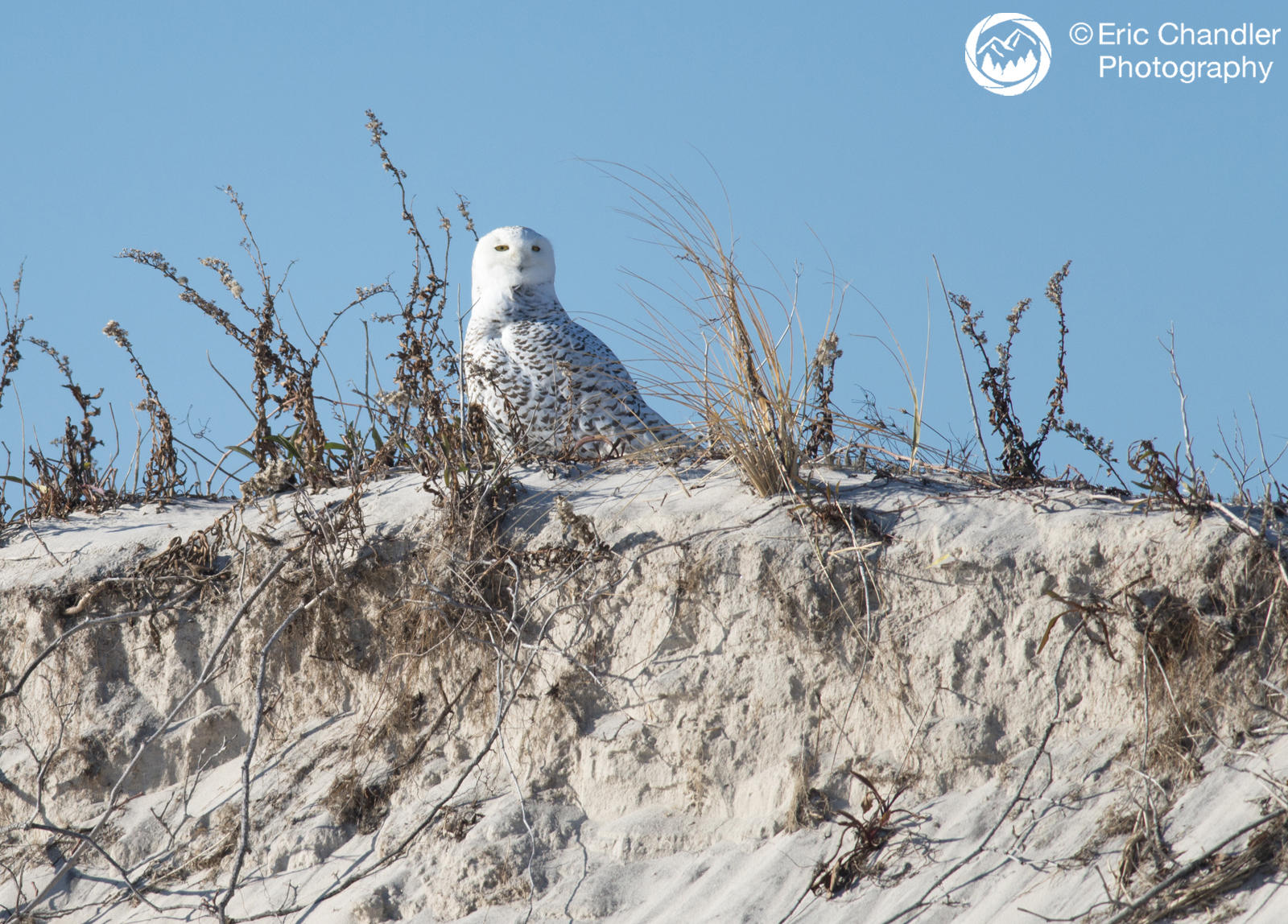
Why do snowy owls from the Arctic migrate to New Jersey? I was determined to photograph these beautiful creatures, as well as research why snowy owls return to Island Beach State Park (IBSP) every year.


The migratory snowy owl population has been spotted all along the coast of New Jersey. Popular hangouts include Sandy Hook, Island Beach State Park, Long Beach Island and even further south as all the Atlantic City. Snowy owls have also been spotted as south as North Carolina.


Unlike other raptors, snowy owls spend the majority of their time sitting, as they hunt for prey from the ground. Their unique ability to rotate their head up to 270 degrees allows them to sit in one spot and scan large land areas for prey. The sand dunes at Island Beach State Park provide owls with an opportunity to scan for prey from a seated position, while elevated. Extreme winds are also present on ISBP; the offshore and onshore winds produce some pretty wicked combinations, which give snowy owls that at home feel.


The only real threat to snowy owls at IBSP is human disturbance. Like all raptors, it is illegal to hunt or trap snowy owls. Even though they aren’t hunted with rifles, they are hunted by photographers, who may step on dunes. I can’t express how many times I’ve watched snowy owls take off due to people getting too close. I’m thankful that they still return instead of finding a new migration home. Occasionally, helicopters fly overhead and the owls just watch them in confusion.

16458749439_88cf955d1d_o

Don’t be fooled by the size of snowy owls; these birds have wingspans up to five feet and reach up to two feet tall. With such great size, snowy owls are able to hunt ducks, geese, and even large waterfowl if need be. Small rodents such as lemmings and hares are their favorite, they consume over 1,600 lemmings a year! IBSP features a wide variety of prey on their local menu such as squirrels, mice and small birds. Unfortunately, in the three seasons I’ve spent studying and photographing snowy owls, I have yet to witness a snowy owl eat. Snowy owls are diurnal, which means they are active during both the day and night. It never clicked in my head, but if you think about it, during many months in the arctic there are 24 hours of sunlight, which explains why they are diurnal. During migrations, they mostly hunt late in the day.


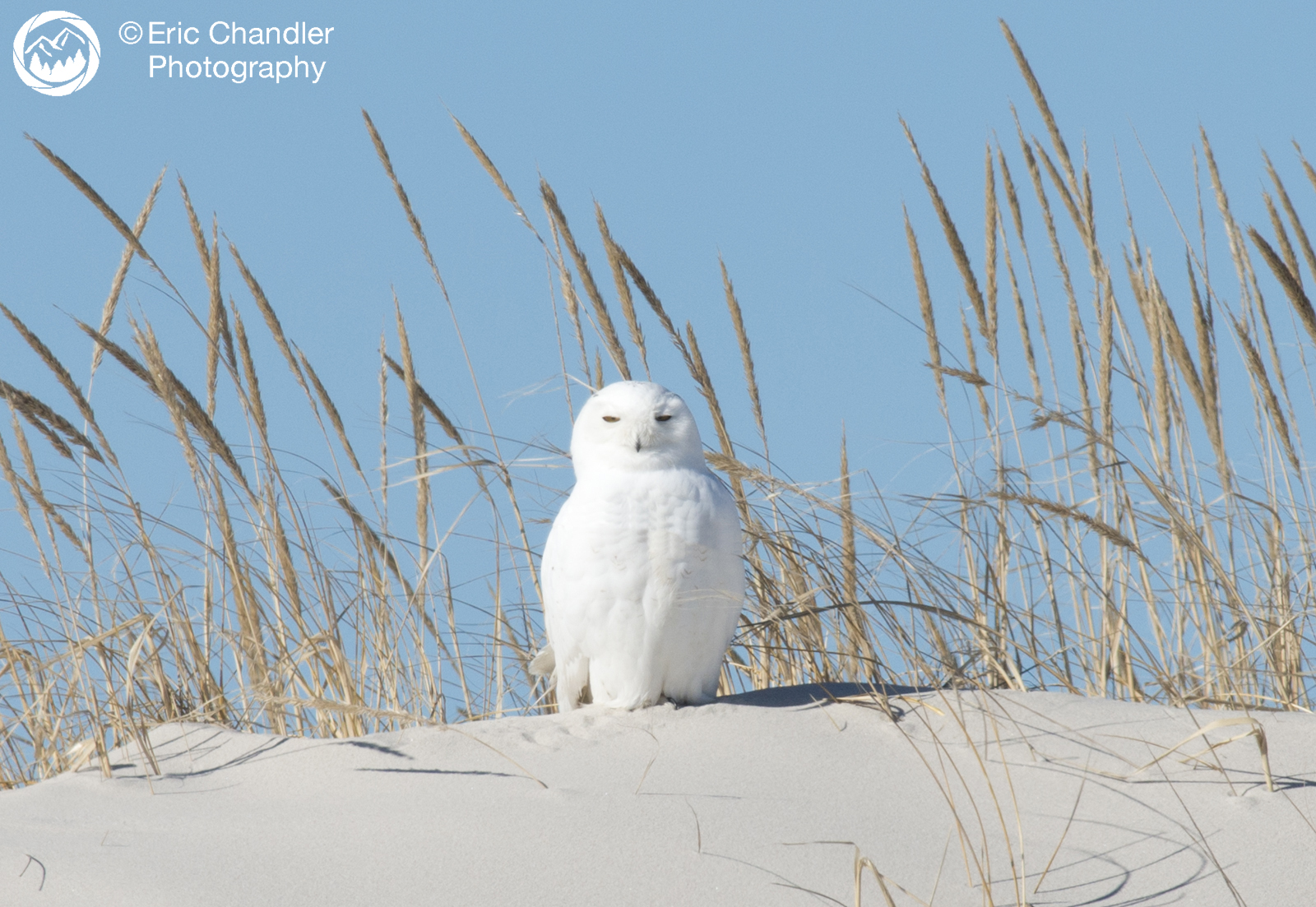
Over the past three seasons of photographing the female snowy owl, I never spotted a male, until this year! To my knowledge, this is the first year the male has been spotted at IBSP. The female is very beautiful, with dark markings throughout her pure white feathers, and bright, cat-like yellow eyes. I could photograph her for days. As I was packing up after photographing the female one afternoon, I saw a massive heard of photographers with their bazooka lenses. They must have spotted something pretty important, so I had to see. Could there be two female snowy owls? Once I arrived, I could not believe my eyes, a pure white snowy owl. Now, I love using the term majestic when it comes to wildlife, it’s a very powerful adjective. This male snowy owl surpasses that adjective for sure. It’s so hard to put into words how beautiful this creature is when seeing it right before your eyes, in order to appreciate its beauty. From his ability to spin his head up to 270 degrees, to seeing him squint his yellow eyes at you. His beauty almost demands to have his photograph taken. The stunning glow of the solid white plumage reflecting off the sunlight was a sight to see. I believe he enjoyed the paparazzi coverage; he wasn’t disturbed at all and sat with us for hours. For weeks after that day, every photographer that I bumped into and had not seen him since.


On an early Sunday morning, after shooting the female owl for three-four hours with about twenty photographers, I decided to venture a little bit and search for the male. If you’re not familiar with Island Beach State Park, it is a narrow, 10-mile barrier island with only one road. It’s very easy to get in the car and drive from parking lot to parking lot, but your chances of missing the wildlife are extremely high (many people also acquire a driving on the beach permit.) For me, I love being out in sub 20 degree temperatures, admiring the peaceful empty beach and watching groups of ocean birds play tag with each other. After four miles of walking, hoping to spot the male owl, all of a sudden this huge white bird starts flying towards me. He literally landed on top of a dune right in front of me! I spent the remainder of my day with him and captured some the best photographs of my career.

16022625514_7377959710_o

Underneath multiple layers with the cold wind blowing in my face on a gorgeous beach without a cloud in the sky, the sun to my back, a prime photography setting, and not a person within miles of my view, this was my sanctuary. If you want to capture the award winning photograph, you must learn patience and be respectful of the wildlife. Don’t chase after wildlife, they will come to you when the time is right. If you didn’t get your opportunity today, you will in the future.


So, now we know why this pair of snowy owls enjoys migrating to Island Beach State Park each year. They have plenty of mammals and birds to prey upon, elevated sand dunes to hunt from with almost no threat from larger predators. A few years ago, there was a eruption of snowy owls that traveled the coastline. Researches said this rare abundance of snowy owls usually occurs every 30-40 years! This was due to a large population of lemmings in the Arctic, prior to migration seasons. I find it very interesting that in Paleolithic caves in France, drawings of snowy owls were created over 40,000 years ago. That makes them the one of the oldest recognizable bird species show in in pre-historical art in the world.


From drawings in a cave, to photographs that I capture, it’s pretty awesome to share the appreciation of snowy owls from thousands of years ago. They are beautiful creatures and I look forward to their return each winter. Snowy owls migrate back to their homes in the tundra in late March, early April. With only a few months left, get out there and search for snowy owls at your local beach, but please be sure to respect the wildlife, and stay off the dunes!


Eric Chandler is a Wildlife & Nature Photographer based in New Jersey.

Eric reports that roughly three-four weeks ago the pair of Snowy Owls mentioned in this post left Island Beach State Park. Recent reports of large amounts of snowy owls in Northern New York have led Eric to believe that the owls are heading back home!


Why are Science, Technology, Engineering and Mathematics (S.T.E.M.) Important to Wildlife Conservation?

By: Stephanie Feigin, Conserve Wildlife Foundation of New Jersey Wildlife Ecologist

Photo: atlantaschoolguide.com

S.T.E.M. (Science, Technology, Engineering and Mathematics) education is an important learning tool for today’s students. It encourages critical thinking, problem management skills, and uses real world applications to promote innovation. S.T.E.M. has become a new way to prepare students for the future and help them succeed in this new information-based and highly technological society.


As technology continues to become more accessible to the masses and continues to play a major role in the lives of the general public, wildlife conservationists have begun to utilize these innovative advancements to reach new audiences on growing social networking platforms, and educating the public through new technologies on the importance of protecting wildlife.


Conserve Wildlife Foundation of New Jersey (CWF) uses new media and technology, such as live webcams and interactive story maps, to educate the public and advance our work to protect New Jersey’s rare wildlife. In an effort to highlight the importance of S.T.E.M. education in the classroom, Conserve Wildlife Foundation has launched a new Species on the Edge 2.0 Multimedia Contest.


Species on the Edge 2.0 is the first contest that CWF has specifically designed to focus on S.T.E.M. education. We hope that this focus will engage and teach high school students about science and New Jersey’s rare wildlife, while also capitalizing on students’ fast-growing expertise with technology. This contest invites all New Jersey high school students to submit an original video, application, podcast, digital graphic design, webpage, or other multimedia project showing why wildlife protection is important in New Jersey. The contest is free to enter, with prizes up to $1,000 in scholarship money thanks to our sponsor PSE&G.


All Species on the Edge 2.0 Multimedia Contest entries are due before April 30, 2015. For more information and to download your contest kit visit: www.ConserveWildlifeNJ.org/Education/Edge2.0.


artinline_373

The Species on the Edge 2.0 Multimedia Contest expands on the success of Conserve Wildlife Foundation’s existing Species on the Edge Art & Essay Contest for fifth graders. The contest is open to all New Jersey fifth graders in public, private, or home schools. It is a great way to engage and excite students into learning about New Jersey’s over 80 endangered and threatened wildlife species. Educators praise the contest for encompassing inter-disciplinary teaching using science, language arts, computer technology, art, and geography. Judging takes place in March. Winners are notified by the end of April.


Entries for the Species on the Edge Art & Essay Contest are due before January 31, 2015. For more information and to download your contest kit visit: http://www.ConserveWildlifeNJ.org/education/edge/.


Wildlife Beach Restoration Groups Applaud Endangered Species Act Designation for Red Knot

Shorebird now federally protected as threatened species under Endangered Species Act

By: Lindsay McNamara, Communications Coordinator

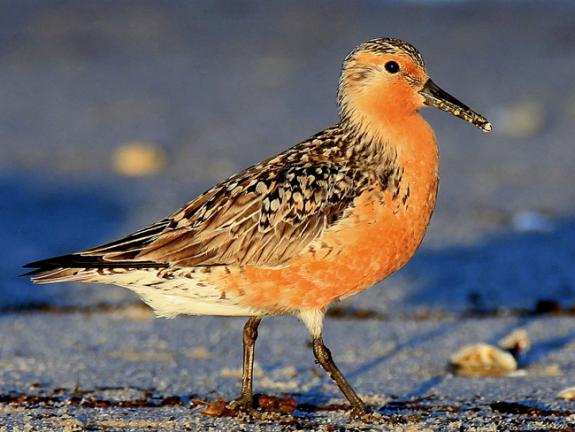
A red knot in breeding plumage along the Delaware Bay. © Bill Dalton

Wildlife conservation organizations leading the efforts to restore New Jersey’s Delaware Bay beaches for at-risk shorebirds today applauded the U.S. Fish and Wildlife Service decision to designate the Red Knot, a migratory shorebird, as “threatened” under the Endangered Species Act. A “threatened” designation means a species is at risk of becoming endangered throughout all or a significant portion of its range.


“This federal designation will make a big difference in strengthening the protections of this incredible shorebird,” said David Wheeler, Executive Director for Conserve Wildlife Foundation of New Jersey.


“Here in New Jersey, we are restoring the vital beach habitat that had been decimated by Hurricane Sandy, and this designation ensures the safeguards we are providing can be complemented along the East Coast,” Wheeler added.


Since the 1980’s, the Knot’s population has fallen by about 75 percent in some key areas. Wildlife biologists believe the major threat to the Red Knot is the dramatic decline of horseshoe crab eggs, an essential food source at the most critical stop over during their 8,000 mile trip from southern wintering grounds to Arctic breeding territory. High-energy horseshoe crab eggs provide nourishment for Red Knots to refuel and continue their journey.


“This is an important and needed step in the conservation and recovery of the Red Knot. It is an essential step in preventing the extinction of this amazing long distance traveler,” stated Tim Dillingham, Executive Director for American Littoral Society.


The largest concentration of Red Knots is found in May in the Delaware Bayshore of New Jersey and Delaware, where the shorebirds stop to gorge themselves on the eggs of spawning horseshoe crabs. In just a few days, the birds nearly double their weight to prepare for the final leg of their long journey.


“The major decline of horseshoe crabs in Delaware Bay is one of the largest threats to the survival of the shorebird,” explained Dr. Larry Niles, a biologist who leads the beach restoration efforts for Conserve Wildlife Foundation of New Jersey and American Littoral Society, and has studied Red Knots for three decades. “Agency groups have been working hard for the last two years, and will continue for the next two years going forward to rebuild the habitat damaged by Hurricane Sandy that the horseshoe crabs rely on. This work is integral to the recovery of the Red Knot and the shorebird’s best hope for survival.”


In the wake of Hurricane Sandy, American Littoral Society and Conserve Wildlife Foundation of New Jersey worked with the U.S. Fish and Wildlife Service, the New Jersey Division of Fish and Wildlife and the New Jersey Recovery Fund to remove 8,000 tons of debris and added 45,000 tons of sand to the beaches just before the annual spring arrival of the Red Knot in 2013.


Learn More:

Lindsay McNamara is the Communications Coordinator for Conserve Wildlife Foundation of New Jersey.

Piping Plovers and Researchers Return to The Bahamas

PROTECTING PIPING PLOVER HABITAT CRITICAL PART OF CONSERVE WILDLIFE FOUNDATION’S WORK

By: Todd Pover, Beach Nesting Bird Project Manager and Stephanie Egger, Wildlife Biologist

We talk quite a bit about “site fidelity” in connection with our beach nesting bird project. And for good reason, whether it be on the breeding or wintering grounds, these birds, like most wildlife, are strongly connected to specific places and types of habitats. Not just in the general sense; many piping plovers return to the same precise site year after year.

Aerial view of one of several hundred Bahamas islands and cays, with tidal flats, highly suitable piping plover habitat, visible stretching around the island.


We were reminded of this the last several days as we made our way around Abaco, The Bahamas, in search of wintering piping plovers. Having made a number of trips to Abaco since 2011, we have started to narrow down where it is likely we will be able to find them: the Green Turtle Cay Gillam Bay flat at low tide or the adjacent upper beach hummocks at high tide, Casuarina Point to forage at low tide, a number of the main island’s southern oceanfront beaches for roosting, to name a few. We are still finding new sites, not previously surveyed or documented, but we now have a much better idea of what to look for and on what tide or wind condition.


The catch is, this only works if the habitat remains intact and suitable. Back in New Jersey, we know this well, as many of the formerly suitable sites for beach nesting birds are lost forever to development or are highly disturbed by recreational activities so the likelihood of reproductive success is low even if they do choose to nest at those locations. Sadly, our breeding pairs of piping plover are relegated to a limited number of suitable sites, which is not a good recipe for recovery of this endangered shorebird.


With its hundreds of islands and cays, many undeveloped or lightly settled, we may be inclined to think this is less of an issue on the wintering grounds in the Bahamas. And relatively speaking, this might be true to some extent, but it would be unwise to believe this will always be the case. Economic forces are a driving factor there, as in anywhere in the world, so the lure of development and commercial use of resources is strong in the Bahamas as well.

Black Flag "K2", a Canadian breeder and one of six color marked piping plovers observed on wintering grounds on Abaco, The Bahamas, this past week by CWFNJ's Todd Pover and Stephanie Egger.
Black Flag “K2”, a Canadian breeder and one of six color marked piping plovers observed on wintering grounds on Abaco, The Bahamas, this past week by CWFNJ’s Todd Pover and Stephanie Egger.


Fortunately, there is also a strong incentive to protect shorebirds in the Bahamas. The tidal flats and shallow water habitats that shorebirds use are also important for bonefish, conch, and other fisheries that are important to the local economy and provide jobs. Furthermore, birding and wildlife-based activities are increasing an important part of the tourist sector. However, In order to sustain those activities and opportunities, ecosystems must remain intact and pristine.


A number of organizations, local and from abroad, are diligently working to designate more protected areas in the Bahamas. One of the top priorities now, an effort being led by the Bahamas National Trust and National Audubon Society, is to protect the vast flats area in the Joulter Cays, Andros, which are especially important for shorebirds such as the piping plover. On Abaco, where we have been focusing our piping plover work, Friends of the Environment  is strongly advocating for protection of East Abaco Creeks, Cross Harbour, and more recently The Marls.


During a survey this past week on Man-O-War, one of Abaco’s offshore cays, we were able to locate a banded piping plover that had originally been marked on its breeding grounds in Canada. In discussing the bird with a local resident who had first spotted it, she was surprised that the bird was remaining in the same spot ever since she saw it two months ago. This was site fidelity illustrated in its truest sense, and in the same vein, the researchers in Canada are already anticipating it will return to the same site to nest next spring. From what we know about piping plovers that is highly likely…as long as we remain committed to protecting the habitat they use.