Green Bands: Telling the Story of New Jersey Eagles

January 2015 is the Month of the Eagle! CWF is kicking off the new year by celebrating all things eagle. Follow us on social media and be sure to check your email (sign up for our list) for weekly stories on these amazing raptors from our own eagle biologist Larissa Smith. Larissa, a wildlife biologist who has been working for Conserve Wildlife Foundation since 2000, coordinates the New Jersey Bald Eagle Monitoring Project.

By: Larissa Smith, Wildlife Biologist and Volunteer Manager


During the Month of the Eagle, we have discussed at length the use of telemetry to see the daily movements of eagles in the state. Another method that biologists use to obtain information on New Jersey eagles is from Re-Sighting New Jersey Eagles. Biologists look for the bands on the re-sighted eagles to find out the age of the bird and the nest that it came from.


In June 2014, we learned about a banded New Jersey Eagle Nesting in PA. Unfortunately, the pair lost its chicks during a wind storm last April. I recently contacted Linda Oughton, the nest observer, and she reports that the pair has been busy bringing sticks to the nest in preparation for the upcoming nesting season. We wish “Jersey Girl” and her mate a successful year!

 

NJ  eagle bands (green) and federal eagle bands (silver)
NJ eagle bands (green) and federal eagle bands (silver)

Biologists also obtain information about New Jersey eagles from bands when eagles are recovered injured or dead. This isn’t as “feel good” as the re-sighting of a living, healthy bird, but the band still contains valuable information about the eagle’s age and the nest from which it originated.


If you find a bird with a New Jersey band, please report it to the National Bird Banding Lab.


The Banding Lab notifies New Jersey biologists when a band has been reported. The majority of recovered New Jersey birds are found in our state, but Jersey banded eagles have also been recovered in Delaware, Maryland, New York, Pennsylvania and Maine.  Each band that is found tells a story about the eagles life.


  • On April, 26, 2013, a female eagle was found dead at the Aberdeen Proving Ground in Maryland. She was banded with a red band which revealed that she was one of the eagles from the Dividing Creek Hack site* in 1988, making her 25 years old when she died. The nest observer at the Aberdeen believes that this was the female she observed nesting at Aberdeen for 20 years. At the time of the eagle’s death, there were three chicks in the nest and the male was able to successfully raise them by himself. She is the oldest New Jersey banded eagle that has been recovered.
  • In the fall of 2013, the remains of an eagle with a red band were found in the Nantuxent Wildlife Management Area. The bird was 24 years old. The eagle had been brought along with another eaglet from Canada after their nest was lost. They were placed in the Tuckahoe Hack site* and fledged in 1989.

    *The New Jersey eagle hacking project was started in 1983 as a part of the eagle restoration efforts.  Young eagles approximately six weeks of age were brought from Canada where the eagle population was stable. Hacking towers were built at two sites, Dividing Creek, Cumberland County and Tuckahoe, Cape May County. The chicks were placed in the towers and provided food until the time of fledging. The idea was that the birds, when mature, would return to their place of fledging to nest. These hacked eagles were banded with a red band. Sixty young birds were fledged from these hacking towers over an eight year period contributing to the increase in the New Jersey eagle population.

  •  A thirteen year old eagle was recovered in November of 2011 in Delaware, the cause of death was determined to be lead poisoning. The bird had been banded on May 14, 1999 in Cumberland County. What makes this eagle so special is that in 2003 the same bird was found in Cape May County with a leg hold trap attached to its foot. The foot was amputated and the bird was released. It is amazing to know that this eagle survived for eight years with just one foot!
  • The Duke Farms Eagle Cam is has gained a large online following, so it was sad news when one of the juveniles from the 2014 nest was found dead in Maine this past August.  From talking with the finders of the bird we were able to piece together the story of D-98.

These are just a few examples of the recoveries of dead eagles, but there are also many injured eagles that are cared for by dedicated wildlife rehabilitators and released back into the wild.
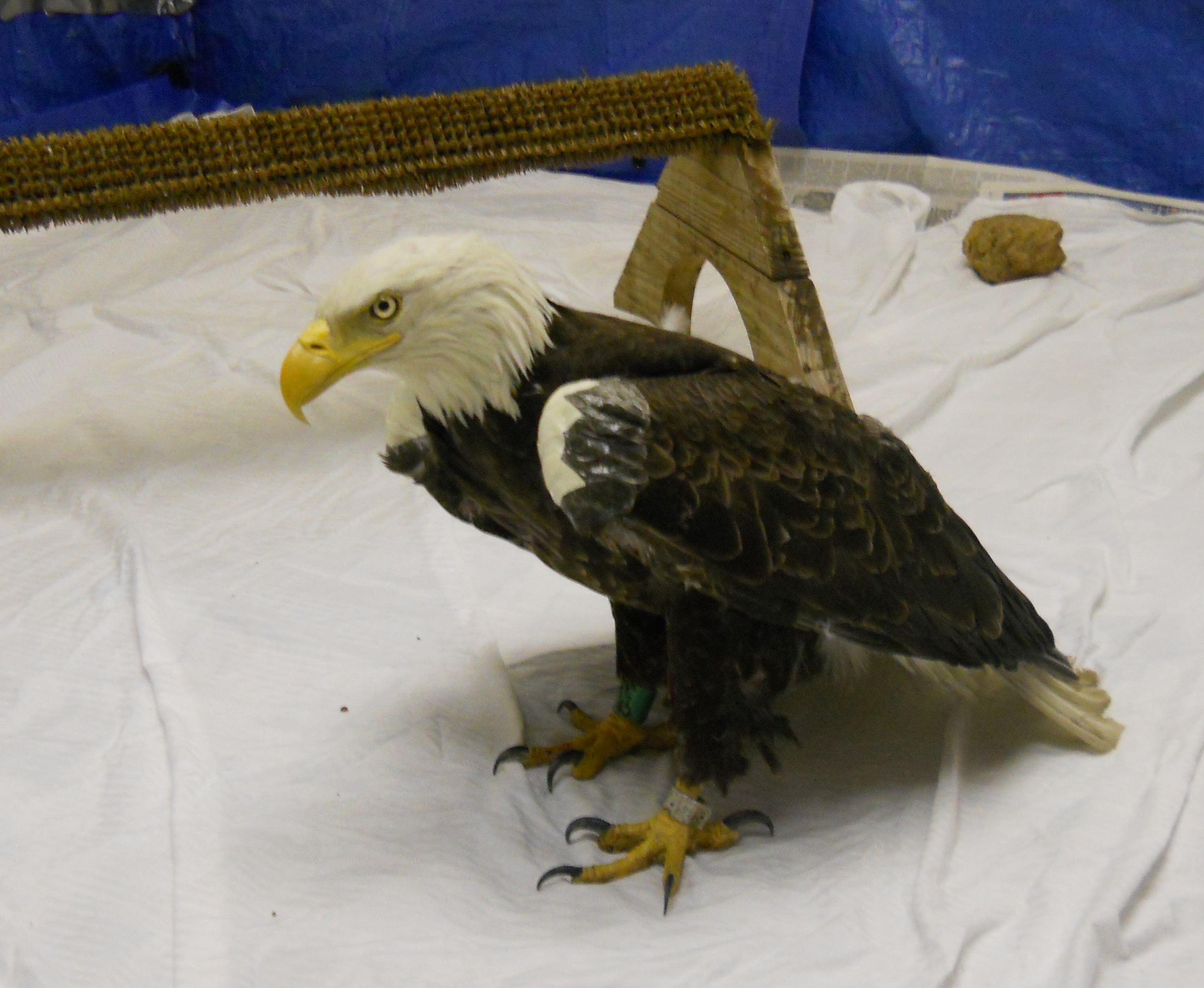
C/45 in recovery at Tri-State Bird Rescue and Research, DE

A New Jersey banded eagle was rescued from the Chesapeake Bay by a fisherman from Cecil County, Maryland on March 17th, 2013. The male had been banded at the Union Lake nest, Cumberland County on May 15, 2007 making him six years old.


The eagle was taken to Tri-State Bird Rescue and Research in Delaware where he recovered from his injuries, believe to be from a territorial dispute with another eagle, and was released on May 6, 2013.


All eagle recoveries are listed in each years annual eagle report.


Learn more:


Fight for the Flight: Monarch Butterfly Status Under Review

By: Julianne Maksym, Intern 

[youtube=https://www.youtube.com/watch?v=uxIf3YleztI]
A monarch butterfly emerges from a chrysalis in the wild. (Courtesy: US Fish & Wildlife Service)

As the summer leaves turn brown and children head back to school, flutters of black and orange wings flitter through the skies over the beaches in Cape May. As part of its yearly migration from Canada to Mexico, the monarch butterfly passes through New Jersey in search of a warmer climate for the blistery cold winter months. Multiple generations make the trek, leaving in the fall and returning in late spring.


During the summer months, the monarch can be found throughout the United States where milkweed, the species’ host plant, is plentiful. Milkweed provides nutrients to hungry caterpillars as well as space for mature females to lay their eggs. Although an adult monarch may lay up to 500 eggs in its lifetime, it has now been discovered fewer and fewer butterflies make the migration each year.


Losses of habitat and milkweed plants, the insect’s sole food source, are having tremendously devastating effects. According to a petition from butterfly advocates, the North American population has declined by more than 90 percent based on comparisons of the most recent population size estimates to the 20-year average. Numbers of monarch butterflies east of the Rockies dropped to the lowest record ever, signifying a decline of more than 90% since 1995. Monarch numbers west of the Rockies showed a similar decline of more than 50% since 1997. These figures suggest a significant predicament as the North American population represents the vast majority of all monarchs in the world. Without it, the entire species is vulnerable to extinction.


On December 29th, 2014, the U.S. Fish and Wildlife Service announced it would be conducting a status review of the monarch butterfly under the Endangered Species Act (ESA). The Service has reason to believe a listing may be necessary due to considerable evidence from a petition submitted by the Center for Biological Diversity, the Center for Food Safety, the Xerces Society for Invertebrate Conservation and Dr. Lincoln Brower. The petition stated that habitat destruction and loss of milkweed due to pesticide use are two of the most contributing factors to the declining monarch population. Other factors include disease and predation, overutilization for commercial purposes, and lack of existing conservation procedures.


To begin the status review, the Service is requesting scientific and commercial data and other information through a 60-day public information period. The Service is specifically seeking information regarding the following:

  • Subspecies’ biology, range and population trends, habitat requirements, genetics and taxonomy
  • Historical and current range, including distribution patterns
  • Historical and current population levels and current and projected trends;
  • Life history or behavior of the monarch butterfly that has not yet been documented
  • Thermo-tolerance range and microclimate requirements of the monarch butterfly
  • Past and ongoing conservation measures for the subspecies, its habitat or both
  • Factors that are the basis for making a listing determination under section 4(a) of the ESA


Starting on December 31, information can be submitted via www.regulations.gov by entering docket number FWS-R3-ES-2014-0056 in the search box and clicking on “Comment Now!” The information collection period will be open until March 2, 2015.


Until a decision has been made, take a moment to appreciate the beauty that is the monarch butterfly. Consider planting a few milkweed plants in your garden or speaking out against the overuse of pesticides. As much as the monarch butterfly’s migration is a group effort, the conservation of these beautiful creatures is even more so.


Julianne Maksym is a graduate wildlife intern for Conserve Wildlife Foundation of New Jersey.

New Jersey Wildlife Telemetry Study Tracks Bald Eagles on Journeys Across Hemisphere

January 2015 is the Month of the Eagle! CWF is kicking off the new year by celebrating all things eagle. Follow us on social media and be sure to check your email (sign up for our list) for weekly stories on these amazing raptors from our own eagle biologist Larissa Smith. Larissa, a wildlife biologist who has been working for Conserve Wildlife Foundation since 2000, coordinates the New Jersey Bald Eagle Monitoring Project.

Conserve Wildlife Foundation of New Jersey releases results of 2014 State Bald Eagle Report

By: Lindsay McNamara, Communications Coordinator

Photo Credit: Chris Davidson

Conserve Wildlife Foundation of New Jersey (CWF) today released the 2014 Bald Eagle Report, highlighting the number of nesting pairs, active nests and nest productivity for the raptors throughout New Jersey with data collected by New Jersey Department of Environmental Protection Division of Fish and Wildlife biologists, CWFNJ biologists and dedicated volunteers.


Two young bald eagles were fitted with GPS tracking devices (wearable backpacks) in Summer 2014 to conduct a telemetry study to better understand raptor behavior. View the complete Bald Eagle Project Report online. ENSP biologists chose one eagle from Atlantic County (a male nicknamed “Nacote”) and one from Cumberland County (a female nicknamed “Millville”) to be tagged in this telemetry study.


Nacote was in Canada until mid-October when he started heading south. He visited Six Flags Great Adventure in December and for the past two weeks, he has been residing in northeast Atlantic County, especially Edwin B. Forsythe National Wildlife Refuge. Millville ventured out to Delaware Bay marshes in late July and back in early August. In mid-September, she crossed the Delaware River into Delaware and then spent most of September along the Chesapeake Bay in Maryland before crossing over to Virginia.


“Tracking these young eagles is giving us insight into where the birds go once they fledge and the type of habitat they are using,” explained Conserve Wildlife Foundation Wildlife Biologist and Volunteer Manager Larissa Smith. “Unfortunately, we recently learned that the female was found dead in Delaware. The first year of life is tough for young eagles as they learn to survive on their own.”


2014 Eagle Report

The federal government removed the bald eagle from its list of Endangered Species in August of 2007, but the bald eagle’s official New Jersey status remains state-endangered for the breeding season and state-threatened for the non-breeding season. The Division of Fish and Wildlife’s Endangered and Nongame Species Program (ENSP) bald eagle recovery efforts, implemented in the early 1980’s, have resulted in a steady recovery of New Jersey’s bald eagle population. ENSP biologists, Conserve Wildlife Foundation of New Jersey staff, and volunteer observers continue to locate and monitor bald eagle nests and territories each year to analyze the state of the population.


2014 Report Highlights

  • The population of wintering bald eagles has grown along with the nesting population, especially in the last ten years. This growth reflects increasing populations in NJ and the northeast, as each state’s recovery efforts continue to pay off for eagles.
  • This season, 25 new eagle pairs were found.
  • The statewide population increased to 156 pairs (including nesting and territorial) in 2014, up from 148 in 2013.
  • A total of 156 nest sites were monitored during the nesting season, of which 146 were documented to be active (with eggs), up from 119 last year.
  • One hundred fifteen nests (79%) of the 145 known-outcome nests produced 201 young, for a productivity rate of 1.39 young per active and known-outcome nest.
  • The Delaware Bay region remained the state’s eagle stronghold, with 43% of all nests located in Cumberland and Salem counties.
  • 2014 marked the first year of successful eagle nesting in the Palisades Interstate Park in perhaps 100 years.


The telemetry study, in tandem with the most recent annual eagle report, has been illuminating.


“We are thrilled to have the opportunity to follow these juvenile bald eagles on their forays far from New Jersey,” said David Wheeler, Conserve Wildlife Foundation Executive Director. “With the eagles choosing to fly in completely different directions, it’s a reminder on how much we still have to learn about these fascinating creatures. Yet what is not in doubt is the bald eagle’s continuing recovery from the brink of extinction – thanks largely to the dedicated scientists leading the way.”


For maps of the movements of Nacote, updated regularly, visit our Eagle Project page.

Lindsay McNamara is the Communications Coordinator for Conserve Wildlife Foundation of New Jersey.


“New Jersey’s Little Lion”: Biologists Shed Light on Elusive Bobcat

By: David Wheeler, Conserve Wildlife Foundation of New Jersey Executive Director

MountainLionBlog

With our eastern landscape largely devoid of top carnivores, bobcats are a throwback to the wild predators that once ruled our forests. No one understands that better than our partners from the New Jersey Endangered and Nongame Species Program (ENSP). The bobcat was listed as a state endangered species in June 1991, and habitat fragmentation in our densely populated state has made their recovery especially challenging. Biologists Mick Valent and Gretchen Fowles study bobcats in the wild, and here they generously share their insights on this remarkable creature.


What do you find most compelling about working with bobcats?

Mick Valent: I have worked with many species during my tenure with the Division of Fish and Wildlife including bald eagles, peregrine falcons, Allegheny woodrats and timber rattlesnakes, to name a few. However, to me, none epitomize the “wild” in wildlife the way that bobcats do. To me, they are the ultimate New Jersey predator – highly adaptive, perfectly camouflaged, keen senses of sight and sound, blazing speed and quickness, razor sharp claws and teeth, and the ability to stalk their prey quietly or overrun them! Fierce and unyielding, when captured, they are truly New Jersey’s little lion!


Can you describe the feeling of your first bobcat sighting?

MV: As chance would have it, I went many years without seeing a bobcat in the “wild” in New Jersey – even as the population was apparently increasing. Despite spending many days afield tracking and trapping bobcats, it wasn’t until 2011 that I saw my first bobcat (aside from the ones that I trapped and collared). I was in Allamuchy Township in January of 2011 searching for a suitable area to trap, when an adult bobcat bolted from a pile of tree stumps and logs right in front of me. A perfect spot for a bobcat to seek shelter during the daylight hours. And by the way, we were never able to catch that animal!


Are bobcats proving adaptable to New Jersey’s changing landscape and human development?

Gretchen Fowles: Bobcats seem to be increasing in northern New Jersey. In the past couple of years, there have been an increasing number of bobcat sightings south of Route 80 (though still north of Route 78), suggesting that they have been somewhat successful at passing through that tough Route 80 barrier. Our data suggest that bobcats are finding a way to move between core habitat areas in northern New Jersey. We have several males and females that have moved over 30 miles from year to year.

However, major roadways continue to be a problem. We have GPS collar data from a couple of bobcats that indicate that major roadways, such as Routes 80 and 206, seem to be perceived as complete barriers to these animals. The collars recorded movement patterns with location points going right up to and paralleling the road, but not crossing over it. We have been monitoring about 12 crossing structures under major roadways in northern New Jersey that bisect suitable bobcat habitat.


What are the worst threats to bobcats in New Jersey?

GF: Habitat fragmentation and roads are the worst threats, and they’re getting worse. A young bobcat was hit by a car and was found on the shoulder of westbound Route 78 last year. So, they are trying to cross that barrier, but are having difficulty doing so. Another bobcat was hit by a car in Parsippany when attempting to cross Route 46. The final quarter of each year, between October and January, tends to be the peak period for bobcat road mortality, and it is important that people report these incidents to the ENSP. We are working on a project called Connecting Habitat Across New Jersey (CHANJ) that is aimed at reconnecting the landscape for terrestrial wildlife, like bobcats.

We have formed a multi-partner, multi-disciplinary working group to inform the development of this statewide connectivity plan that will help target local, regional, and state planning efforts and ultimately reconnect the landscape in New Jersey. We are mapping the core habitat areas in the state as well as the corridors that can serve to connect those areas together, and are working on a Guidance Document that will recommend ways in which those cores and corridors can be made more permeable through targeted land protection, habitat management and restoration, and road mitigation efforts. We are also developing a bobcat recovery plan.

The constant threat from habitat loss and fragmentation, changes in land use, the existence of barriers to free movement between suitable habitats, and automobile collisions on our busy and abundant roadways will likely limit the growth of New Jersey’s bobcat population. It is likely that bobcats will remain only locally abundant in areas of suitable habitat, primarily in the areas north of Interstate Route 80. Whether or not a few animals are successful at crossing our major roadways, they will always pose an impediment to free movement between suitable habitats and will continue to be a source of mortality to the population.


What are some of the ways you study bobcats in New Jersey? Are you still using dogs in this work?

GF: We continue to use Bear, a professionally trained working dog for wildlife who is used to locate and alert biologists to bobcat scats, to help us better understand the New Jersey bobcat population. Bear is now about 12 years old, but his nose still works!
DNA can be extracted from sloughed intestinal cells contained in bobcat scat and can provide a wealth of information. DNA analyses of scat, as well as the locations where the scats are found, allow biologists to identify individual animals, their sex and movements. The DNA data from scats and tissue samples that we collect from bobcats killed on the road, accidentally snared, or trapped by ENSP in order to fit with GPS collars, are being fed into analyses that will help use estimate survival rate, population size and structure, and sex ratio.

We also collared three bobcats this past winter near major roadways, and set the collars to collect locations every hour. We are excited to retrieve the data from these collars in a few months to evaluate how those major roadways may be influencing the cats’ activity patterns and determine if, when and where they are crossing them. This information will help validate our CHANJ mapping and inform our Guidance Document.


Is the big picture for bobcat populations any different nationally?

GF: A recent national status assessment conducted by the United States Fish and Wildlife Service found that bobcats were generally increasing throughout their North American range. This appears to be holding true in New Jersey in areas where we have suitable habitat that is accessible to the population.


Tell me about your most memorable encounter.

MV: My volunteer and I had responded to a call from a trapper who accidentally caught a bobcat in his cable restraint during one of those January cold spells. The bobcat was caught on the bank of a medium-sized stream next to a footbridge. As we approached, the animal was pacing along the stream bank and jumping up on the foot bridge. As my volunteer distracted the animal, I came in from behind and jabbed the cat in the rump with a jab pole loaded with a tranquilizing drug. We immediately backed off to let the drug take effect so we could remove the cable from the animal’s neck. As the drug began to take effect the animal lost the ability to stand and slipped into the water – struggling to stay above the surface.

Without hesitation, we ran back to the stream. My volunteer arrived first, jumped into the frigid, chest-deep water, and grabbed the cat and pulled him to safety. Although the cat was not fully sedated, we were able to wrap him in a dry blanket, remove the snare from his neck and get him into the truck and off to a rehabilitation facility without incident. Everyone survived unscathed – although I’m certain the bobcat was much better prepared for going into the water than we were!


Learn more:


Climate Change is Threatening the Existence of the World’s Most Amazing Bird

By: Lindsay McNamara, Communications Coordinator

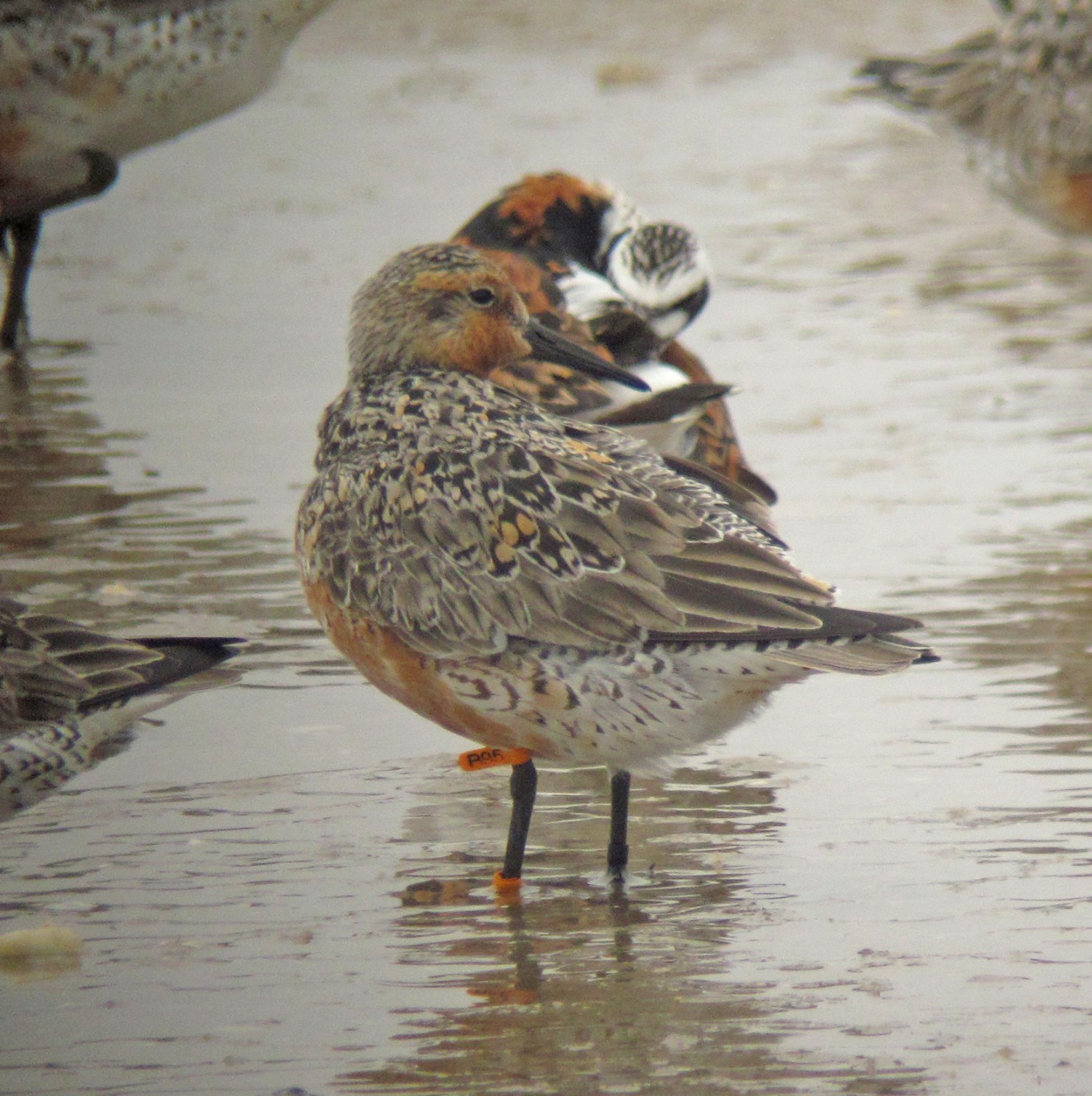
The Rufa red knot (a shorebird) named "Moonbird," or "B95," photographed in a crowd of birds at Fortescue, NJ. Credit: Christophe Buidin.
The Rufa red knot (a shorebird) named “Moonbird,” or “B95,” photographed in a crowd of birds at Fortescue, NJ. Credit: Christophe Buidin.

“Moonbird is the most famous, charismatic member of a group of mid-sized shorebirds called Rufa red knots, whose numbers have plummeted so dramatically in the past several decades that they just became the first bird ever listed under the Endangered Species Act with climate change cited as a “primary threat.”


Rufa red knots are among the avian world’s most extreme long range flyers (especially in light of their relatively small size). They travel vast distances — some flying over 18,000 miles — in the course of an annual migration that begins in Tierra del Fuego, Argentina, and extends all the way up to the Canadian Arctic (and back again).


Which brings us to Moonbird’s distinction: Because he is so old — he is at least 21 — he is believed to have flown as many as 400,000 miles in his lifetime. The distance to the moon varies, depending on where it is in its orbit, but the average distance is about 237,000 miles. Thus, Moonbird has not only flown the distance it takes to reach the moon — he has also covered the bulk of the return voyage.


Assuming that Moonbird is still living — the last sighting was in May — there are reasons to wonder whether there will ever be another bird that is his equal. Why? Simply put, his subspecies has been devastated, and climate change will only make matters worse — making extreme survival of the sort that Moonbird has achieved that much more difficult.”


Washington Post Science and Environment Reporter Chris Mooney explores Moonbird’s journey, threats to the species, and the recent Endangered Species Act listing of the Rufa Red Knot:


Learn more:

Lindsay McNamara is the Communications Coordinator for Conserve Wildlife Foundation of New Jersey.


Humpback Whales Increasing in Waters Near NYC

By: Lindsay McNamara, Communications Coordinator

Humpback Whale feeding off New York City's Rockaway Peninsula. Photo Credit: BBC News
Humpback Whale feeding off New York City’s Rockaway Peninsula. Photo Credit: BBC News

Humpback Whales were spotted 87 times from whale-watching boats near New York City this year, and by cataloging the whales’ markings, at least 19 different humpbacks have been identified in the waters off the city. Naturalists aboard whale-watching boats have seen humpbacks in the Atlantic Ocean within a mile of the Rockaway peninsula, part of New York’s borough of Queens, within sight of Manhattan’s skyscrapers.


In 2012, there were 15 sightings; in 2013, 33; and this year there were 87 sightings totaling 106 humpbacks.


It’s not crystal clear why humpbacks, which can be 50 feet long and weigh 40 tons, are returning to New York’s shores, where they were abundant before they and other whale species were nearly destroyed by whaling.


Associated Press Reporter Jim Fitzgerald investigates the sightings:


Learn more:

Lindsay McNamara is the Communications Coordinator for Conserve Wildlife Foundation of New Jersey.

Wildlife Beach Restoration Groups Applaud Endangered Species Act Designation for Red Knot

Shorebird now federally protected as threatened species under Endangered Species Act

By: Lindsay McNamara, Communications Coordinator

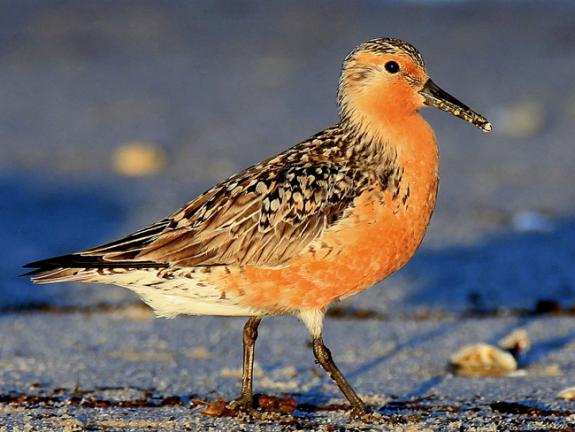
A red knot in breeding plumage along the Delaware Bay. © Bill Dalton

Wildlife conservation organizations leading the efforts to restore New Jersey’s Delaware Bay beaches for at-risk shorebirds today applauded the U.S. Fish and Wildlife Service decision to designate the Red Knot, a migratory shorebird, as “threatened” under the Endangered Species Act. A “threatened” designation means a species is at risk of becoming endangered throughout all or a significant portion of its range.


“This federal designation will make a big difference in strengthening the protections of this incredible shorebird,” said David Wheeler, Executive Director for Conserve Wildlife Foundation of New Jersey.


“Here in New Jersey, we are restoring the vital beach habitat that had been decimated by Hurricane Sandy, and this designation ensures the safeguards we are providing can be complemented along the East Coast,” Wheeler added.


Since the 1980’s, the Knot’s population has fallen by about 75 percent in some key areas. Wildlife biologists believe the major threat to the Red Knot is the dramatic decline of horseshoe crab eggs, an essential food source at the most critical stop over during their 8,000 mile trip from southern wintering grounds to Arctic breeding territory. High-energy horseshoe crab eggs provide nourishment for Red Knots to refuel and continue their journey.


“This is an important and needed step in the conservation and recovery of the Red Knot. It is an essential step in preventing the extinction of this amazing long distance traveler,” stated Tim Dillingham, Executive Director for American Littoral Society.


The largest concentration of Red Knots is found in May in the Delaware Bayshore of New Jersey and Delaware, where the shorebirds stop to gorge themselves on the eggs of spawning horseshoe crabs. In just a few days, the birds nearly double their weight to prepare for the final leg of their long journey.


“The major decline of horseshoe crabs in Delaware Bay is one of the largest threats to the survival of the shorebird,” explained Dr. Larry Niles, a biologist who leads the beach restoration efforts for Conserve Wildlife Foundation of New Jersey and American Littoral Society, and has studied Red Knots for three decades. “Agency groups have been working hard for the last two years, and will continue for the next two years going forward to rebuild the habitat damaged by Hurricane Sandy that the horseshoe crabs rely on. This work is integral to the recovery of the Red Knot and the shorebird’s best hope for survival.”


In the wake of Hurricane Sandy, American Littoral Society and Conserve Wildlife Foundation of New Jersey worked with the U.S. Fish and Wildlife Service, the New Jersey Division of Fish and Wildlife and the New Jersey Recovery Fund to remove 8,000 tons of debris and added 45,000 tons of sand to the beaches just before the annual spring arrival of the Red Knot in 2013.


Learn More:

Lindsay McNamara is the Communications Coordinator for Conserve Wildlife Foundation of New Jersey.

Piping Plovers and Researchers Return to The Bahamas

PROTECTING PIPING PLOVER HABITAT CRITICAL PART OF CONSERVE WILDLIFE FOUNDATION’S WORK

By: Todd Pover, Beach Nesting Bird Project Manager and Stephanie Egger, Wildlife Biologist

We talk quite a bit about “site fidelity” in connection with our beach nesting bird project. And for good reason, whether it be on the breeding or wintering grounds, these birds, like most wildlife, are strongly connected to specific places and types of habitats. Not just in the general sense; many piping plovers return to the same precise site year after year.

Aerial view of one of several hundred Bahamas islands and cays, with tidal flats, highly suitable piping plover habitat, visible stretching around the island.


We were reminded of this the last several days as we made our way around Abaco, The Bahamas, in search of wintering piping plovers. Having made a number of trips to Abaco since 2011, we have started to narrow down where it is likely we will be able to find them: the Green Turtle Cay Gillam Bay flat at low tide or the adjacent upper beach hummocks at high tide, Casuarina Point to forage at low tide, a number of the main island’s southern oceanfront beaches for roosting, to name a few. We are still finding new sites, not previously surveyed or documented, but we now have a much better idea of what to look for and on what tide or wind condition.


The catch is, this only works if the habitat remains intact and suitable. Back in New Jersey, we know this well, as many of the formerly suitable sites for beach nesting birds are lost forever to development or are highly disturbed by recreational activities so the likelihood of reproductive success is low even if they do choose to nest at those locations. Sadly, our breeding pairs of piping plover are relegated to a limited number of suitable sites, which is not a good recipe for recovery of this endangered shorebird.


With its hundreds of islands and cays, many undeveloped or lightly settled, we may be inclined to think this is less of an issue on the wintering grounds in the Bahamas. And relatively speaking, this might be true to some extent, but it would be unwise to believe this will always be the case. Economic forces are a driving factor there, as in anywhere in the world, so the lure of development and commercial use of resources is strong in the Bahamas as well.

Black Flag "K2", a Canadian breeder and one of six color marked piping plovers observed on wintering grounds on Abaco, The Bahamas, this past week by CWFNJ's Todd Pover and Stephanie Egger.
Black Flag “K2”, a Canadian breeder and one of six color marked piping plovers observed on wintering grounds on Abaco, The Bahamas, this past week by CWFNJ’s Todd Pover and Stephanie Egger.


Fortunately, there is also a strong incentive to protect shorebirds in the Bahamas. The tidal flats and shallow water habitats that shorebirds use are also important for bonefish, conch, and other fisheries that are important to the local economy and provide jobs. Furthermore, birding and wildlife-based activities are increasing an important part of the tourist sector. However, In order to sustain those activities and opportunities, ecosystems must remain intact and pristine.


A number of organizations, local and from abroad, are diligently working to designate more protected areas in the Bahamas. One of the top priorities now, an effort being led by the Bahamas National Trust and National Audubon Society, is to protect the vast flats area in the Joulter Cays, Andros, which are especially important for shorebirds such as the piping plover. On Abaco, where we have been focusing our piping plover work, Friends of the Environment  is strongly advocating for protection of East Abaco Creeks, Cross Harbour, and more recently The Marls.


During a survey this past week on Man-O-War, one of Abaco’s offshore cays, we were able to locate a banded piping plover that had originally been marked on its breeding grounds in Canada. In discussing the bird with a local resident who had first spotted it, she was surprised that the bird was remaining in the same spot ever since she saw it two months ago. This was site fidelity illustrated in its truest sense, and in the same vein, the researchers in Canada are already anticipating it will return to the same site to nest next spring. From what we know about piping plovers that is highly likely…as long as we remain committed to protecting the habitat they use.


Why are You Thankful for New Jersey’s Wildlife?

By: Lindsay McNamara, Communications Coordinator

BannerTGiving

This holiday season, Conserve Wildlife Foundation of New Jersey asked our friends, supporters and volunteers, What is special about NJ’s wildlife to you? Why are you thankful for New Jersey’s wildlife? Friends of wildlife shared their thoughts by tweeting us, leaving us a comment on our Facebook page or sending us an email at info@conservewildlifenj.org. We encouraged everyone to use:  #thanksnjwildlife 
Here is a collection of some of the responses we received:

Bill Nigh on Twitter shared that “wildlife gives me perspective.”

Judy Floam wrote over e-mail, “I only spend one week a year in New Jersey (at the beach) but I love to watch the gulls and sandpipers, and go on seine netting expeditions at Island Beach State Park.”

“Why are we thankful for New Jersey’s wildlife? Each and every creature is special to us although the coyote and the bats have a special place in our hearts. We’re grateful to the bats for keeping insect pests at bay and enjoy watching them leave their roost at dusk. Amazing. The coyotes are very musical and we appreciate their part in balancing nature. We’re grateful that the staff and volunteers at Conserve Wildlife work diligently to protect natural habitats. Thank you!”
— Joe & Linda Jedju shared through e-mail.

“Is this really New Jersey? It’s a question I have asked myself numerous times while living in NJ but never so much as over the last three years. It was three years ago that we purchased a small house on a lake in Sussex County. The waters of the lake are pristine and they teem with beavers, herons, numerous waterfowl, and too many different fish to mention. We watch amazing sunsets over the Appalachian Trail. We sit awe struck as foxes and bears routinely traverse our yard. Hummingbirds and beautiful finches occupy our yard and the wildflowers that grow there. We have watched as Bald Eagles circle high above and slowly spiral down to snatch a fish from the surface of the lake. We have sat in the cool evenings and watched the Milky Way appear as a swath of white across a darkening night sky. We watch as some of our endangered friends the bats dance crazy patterns in the night air, feasting on insects. Is this really NJ? Is it the stereotype of landfills, factories, pollution, and exits on the Parkway? Most definitely not! The rich diversity of animal and plant life leave us awe struck on a daily basis. I could also go on and on about our beautiful shoreline, Island Beach State Park, the Pine Barrens, and numerous other ecosystems that make our state so incredible. NJ’s amazing Wildlife is not limited to amusement parks and bars!
David Claeys shared his story over e-mail.

Love what you’re reading? Feeling inspired? Consider getting involved with Conserve Wildlife Foundation:

Lindsay McNamara is the Communications Coordinator for Conserve Wildlife Foundation of New Jersey.

Help Northern Long-Eared Bats Become Listed as Endangered Species

By: Lindsay McNamara, Communications Coordinator

Photo Credit: MacKenzie Hall


The U.S. Fish and Wildlife Service has reopened the public comment period on a proposal to list the northern long-eared bat as endangered under the Endangered Species Act (ESA).  Comments will be accepted through Thursday, December 18, 2014.


The public is invited to submit comments one of two ways:

(1)  Electronically:  Go to the Federal eRulemaking Portal: www.regulations.gov.  In the Search box, enter Docket No. FWS–R5–ES–2011–0024. You may submit a comment by clicking on “Comment Now!”

(2)  By hard copy:  Submit by U.S. mail or hand-delivery to:  Public Comments Processing, Attn:  FWS–R5–ES–2011–0024; Division of Policy and Directives Management; U.S. Fish and Wildlife Service, MS: BPHC; 5275 Leesburg Pike, Falls Church, VA 22041-3803.

During the previous comment period, from June 30 to August 29, 2014, USFWS received over 65,800 comments on this issue!


Why is it so important?

The Northern Long Eared Bat, like many other bat species in the United States, is in danger of extinction due to White-Nose Syndrome, impacts to hibernacula, summer habitat loss and wind farm operation. Listing a species as endangered, under the protections of the Act, increases the priority of the species for funds, grants, and recovery opportunities.


How Else Can You Help Protect Northern Long-Eared Bats?
These tips were pulled from U.S. Fish & Wildlife Service’s Northern Long-Eared Bat Fact Sheet:

  • Do Not Disturb Hibernating Bats
  • Leave Dead and Dying Trees Standing: Where possible and not a safety hazard, leave dead or dying trees on your property. Northern long-eared bats and many other animals use these trees.
  • Install a Bat Box: Dead and dying trees are usually not left standing, so trees suitable for roosting may be in short supply and bat boxes can provide additional roost sites.


Learn more:

Lindsay McNamara is the Communications Coordinator for Conserve Wildlife Foundation of New Jersey.