The Jersey Shore has changed immeasurably over the past century. But one place gives you the chance to recapture the beauty and wild feeling that once encompassed the entire coast – Island Beach State Park.
At Island Beach State Park, you can still find hands-on adventures along the Atlantic Coast and the Barnegat Bay. You can still be immersed in the nature of coastal beach dunes, maritime forest, and vast saltmarsh. You can still find wildlife like osprey, red fox, diamondback terrapins, piping plover, sea turtles, and an incredible array of fish and shellfish.
This week CWF is highlighting the hands-on interactive learning programs offered at Island Beach State Park. This marks the first of five blog stories that will spotlight these programs.
Part 1, Today, will be an introduction to these exciting programs.Part 2, Tuesday, will highlight the Harvest the Bay Day happening this Saturday, August 9 from 3-8pm. Part 3, Wednesday, will give the “Insider’s Look” into the amazing outdoor programs, told through the words of the experts teaching the programs at Island Beach State Park.Part 4, Thursday, will be a roundtable interview with the Island Beach State Park naturalists. AndPart 5, Friday, will feature a personal account from one of CWF’s interns who works at Island Beach State Park.
CWF is excited to partner with New Jersey State Parks and offer incredible programs about New Jersey’s natural world at Island Beach State Park.
Become a WILDCHILD, take a sunset kayak tour, try your hand at surf-fishing, go bird watching, or enjoy a movie night at the park! Whatever you decide, you will be guided by professional educators and naturalists who have plenty of natural and wildlife stories to share with you.
At nearly 10 miles long, Island Beach is New Jersey’s most expansive stretch of undeveloped barrier island. Our programs help you to connect with the beauty of this ecosystem and its ample natural resources. Have your kids participate in a WILDCHILD program including surfing, surf-fishing, and island exploration. Try and catch the big one during a surf-fishing class or discover the beauty of Barnegat Bay through kayaking.
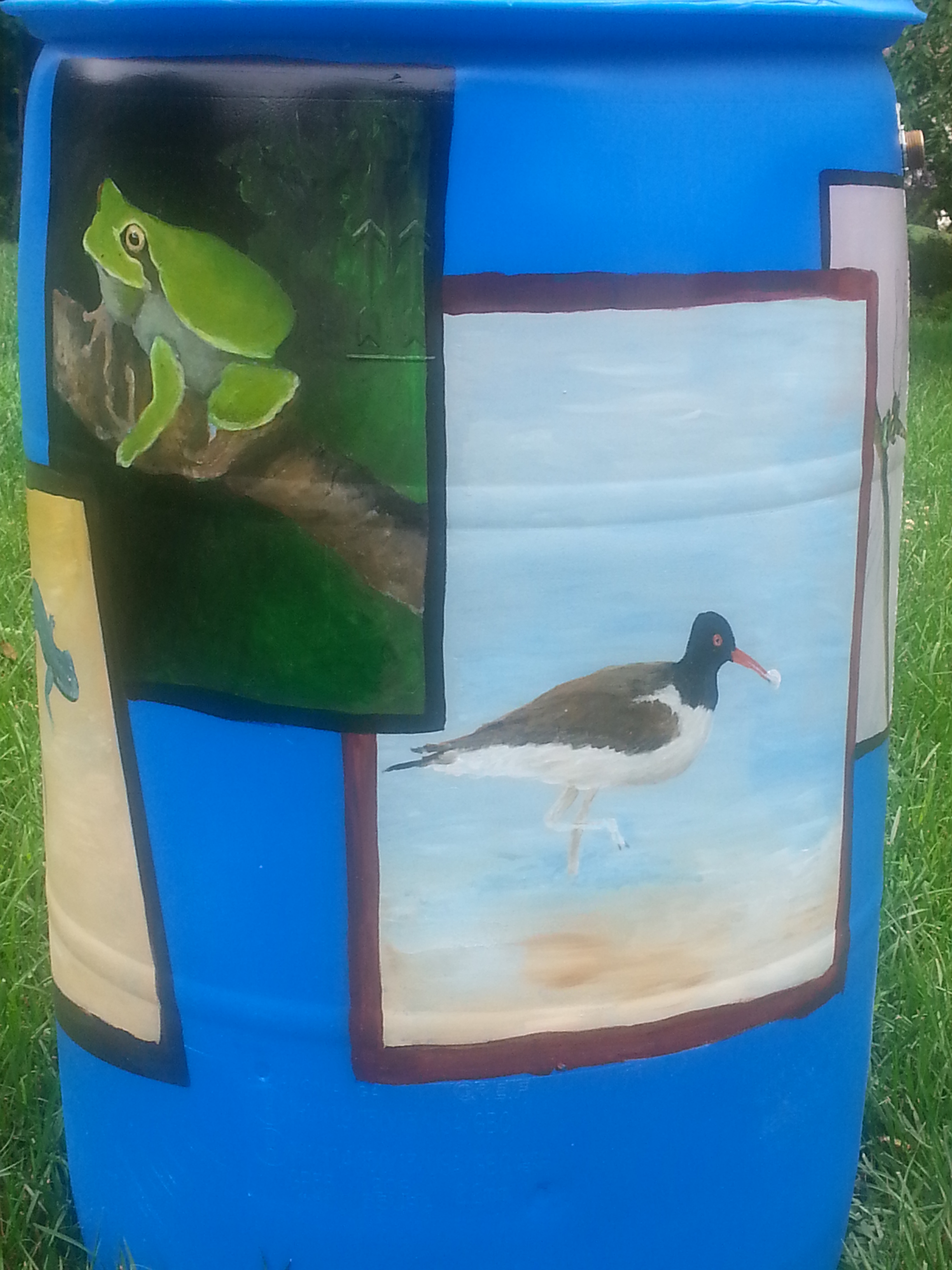
On May 30, 2014 EarthShare New Jersey launched the exciting new Rain Barrel Auctions program. Thanks to a donation of barrels from Ocean Spray Cranberries, Inc. in Bordentown, N.J., each of the 24 members of EarthShare New Jersey will have one designed which captures the important work each of these charities do for our environment. The auctions are designed to raise awareness and funds for the local members of EarthShare New Jersey.
Rain Barrels offer a long-term, sustainable way to collect and store the rain water that drains from our roofs and gutters. The water can then be used around the home, in the garden, or even for hydration as long as it is adequately filtered and cleaned. Each of the rain barrels being auctioned off are not only functional, but exquisite one of a kind works of art designed by artists from across the state. The program will run until the end of 2014.
The rain barrel designed for CWF was recently posted on eBay. CWF is very excited to have been selected for this effort, and we hope this rain barrel raises awareness and the sale is a success! The proceeds for this rain barrel will be split with CWF and EarthShare.
EarthShare is a national non-profit federation with 25 years of experience in connecting people and workplaces with effective ways to support critical environmental causes. Together we’ve raised more than $300 million for programs that care for our air, land, water, wildlife and public health — in your community, across the U.S. and around the world. EarthShare develops and manages employee engagement and giving campaigns to increase support for its member organizations and help our workplace partners achieve their philanthropic and CSR goals.
Conserve Wildlife Foundation is a non-profit and an EarthShare local member organization. Together CWF and EarthShare work to create a sustainable environment through education, conservation, preservation and community awareness. Through ongoing statewide and community activities we address so many important issues.
Check out our rain barrel, with beautiful artwork by Diane Novobilsky, here!
This marks the third story in Shorebird Week! Our first blog post, on Tuesday, introduced the film “A Race Against Time” and directed you to a free viewing of the film on our website. Our second blog post, highlighted an incredible news story about a resighting of the iconic Red knot B95 on the Delaware Bay! And today’s blog post, will highlight volunteers incredible effort to save stranded horseshoe crabs!
Volunteer Don Senior extracts an impinged horseshoe crab from the rubble on the south end of Fortescue beach along the Delaware Bay on Saturday (c) Phillip Tomlinson South Jersey Times
This story illustrates the incredible efforts of volunteers for Conserve Wildlife Foundation and other conservation groups to save the stranded horseshoe crabs on Delaware Bay beaches. Horseshoe crabs can easily be flipped onto their backs by incoming tides, and they are not able to right themselves on their own. They also get trapped easily by tides and man-made obstacles, such as debris, which leaves them unable to return to the water leaving them to eventually die.
Return the Favor, a multi-group effort, has committed to rescuing as many horseshoe crabs as possible from South Jersey’s Delaware Bay beaches by regularly combing designated stretches of beach and helping to flip the crabs back on their bellies and redirect them back to the water. If possible these volunteers go out daily and rescue all of the flipped or impinged crabs. These efforts have been very successful so far, and they hope to continue these efforts and engage more about who want to volunteer.
This marks the second story in Shorebird Week! Our first blog post, on Tuesday, introduced the film “A Race Against Time” and directed you to a free viewing of the film on our website. Today’s blog post, will highlight an incredible news story about a resighting of the iconic Red knot B95 on the Delaware Bay! And tomorrow’s blog post, will highlight volunteer’s incredible efforts to save stranded horseshoe crabs!
This story highlights the iconic Red knot, B95, being resighted on the Delaware Bay. B95, nicknamed Moonbird, is at least 20 years old, which makes him the oldest Red knot on record. He received his nickname because he has flown the equivalent of the distance between the earth and the moon and at least halfway back in his lifetime.
Iconic Red knot shorebird B95
One of Conserve Wildlife Foundation’s partners, Manomet Center for Conservation Science, highlights this bird in an fascinating news story about his resighting and the research efforts being done by the CWF biologist Dr. Larry Niles and Amanda Dey, senior biologist with the Endangered and Non-game Species Division of N.J. Fish and Wildlife and their team to restore the Delaware Bay.
This story marks the last of our five blog stories spotlighting New Jersey’s Diamondback Terrapin – and educating people on the research and efforts being done to protect these fascinating reptiles!
Part 1, Monday, was an introduction into the world of the Diamondback Terrapin.Part 2, Tuesday, featured CWF’s research efforts to protect the terrapins.Part 3, Wednesday, looked at great places to view these beautiful turtles .Part 4, Thursday, highlighted some important ways you can help protect the Diamondback Terrapins. Part 5, today’s post, will showcase some other important regional research being done by our partners.
Beyond New Jersey: Diamondback Terrapins across the Northeast
By Stephanie Egger, CWF Wildlife Biologist
Contributions by Don Lewis (Cape Cod Consultants), Russ Burke (Jamaica Bay Terrapin Research and Conservation), and John Wnek (Project Terrapin)
Conserving the Northern diamondback terrapin in New Jersey is vitally important to CWF and our partners. As a result, it is crucial that we work cooperatively with our partners in the Northeast for the long-term protection and sustainability of terrapins from a regional perspective.
The terrapin has been identified as a Species of Greatest Conservation Need in the Northeast States Wildlife Action Plans (WAP). The terrapin is found in eight states of the Northeast /mid-Atlantic regions and are considered Threatened in Massachusetts and Endangered in Rhode Island under State laws. In New Jersey, while the terrapin receives some protection under commercial and recreational fishing regulations, it is also considered a game species. The species has been also identified by the Northeast Partners in Amphibian and Reptile Conservation (NEPARC) as a species of regional conservation concern in the Northeast Amphibian and Reptile Species of Regional Responsibility and Conservation Concern Report as it found in ≥ 75 % of states listed in their WAPs and > 50% of northern diamondback terrapin distribution is within the Northeast Region of North America (NEPARC 2010).
Our regional partners have invested many years into the survival of this species through their conservation and research efforts below and as partners in the development of the Northeast Regional Conservation Strategy for Terrapins headed by CWF.
Don Lewis and Sue Wieber Nourse, Cape Cod Consultants for terrapins
In Wellfleet Bay on Outer Cape Cod resides the northernmost population of diamondback terrapins. Research on these elusive critters began in June 1980, and this longitudinal study has continued uninterrupted through this, its 35th season. Terrapin research and conservation in Massachusetts encompasses more than 250 miles of coastline, dozens of estuaries and hundreds of sites from the fist of Cape Cod through Buzzards Bay on the South Coast to Mount Hope Bay on the Rhode Island border. Within this expanse, there are many vestigial groups on the cusp of extirpation and a few stable populations. Intense conservation measures over the last decade and a half have reversed statewide population declines, and numbers have begun slowly, yet steadily to increase throughout the range. These measures focus on dramatically increasing the number of hatchlings entering the system through protecting nests and shepherding hatchlings from wild nests through a gauntlet of predators to the safety of their nursery salt marsh. We also strive to expand nesting habitat through uplands preservation and coastal turtle gardens. The result has been a significant, measurable increase in juvenile recruits entering these populations.
Covering this broad expanse of estuaries and beaches entails a large volunteer effort of citizen scientists augmented by hundreds of homeowners within coastal communities throughout Massachusetts. Outreach forms the cornerstone of terrapin conservation. Whether formal in classrooms or informal on beaches and in backyards, hands-on educational experiences transform bystanders into supporters. The goal of each encounter is simply to change personal pronouns from “your turtles” to “our turtles.”
When terrapin activity ends in October, staff and volunteers change into winter garb and return to now frigid Cape Cod beaches to save stranded, cold-stunned sea turtles. Each fall hundreds of sea turtles get trapped in the enormous “seine net” of Cape Cod sticking forty miles into the Atlantic Ocean, and they become too cold to survive without human intervention. Thousands of the most endangered sea turtles in the world have been recovered from Cape beaches, rehabilitated and returned back to the ocean.
Jamaica Bay, New York
Russ Burke, Hofstra University and Jamaica Bay terrapin partner
Alex Kanonik (Queen’s College) and Russell Burke (Hofstra University) run a citizen-science project focusing on the ecology of the diamondback terrapin population in Jamaica Bay, New York. Our work is built around a mark-recapture project started in 1998, and has been the basis for nine M.S. theses and numerous publications co-authored by high school students, undergraduates, and graduate students. Our early focus was on nesting ecology and nest predation, then hatchling behavior, and field tests of temperature sex determination. Currently we are investigating terrapin diets, movements and distribution in Jamaica Bay and elsewhere in New York. We also work closely with biologists at JFK airport to address their issues with terrapins on the runways.
Barnegat Bay, New Jersey
John Wnek, Marine Academy of Technology and Environmental Science and Project Terrapin
Project Terrapin, through the Marine Academy of Technology and Environmental Science, New Jersey, is conducting its 13th year of diamondback terrapin nesting research at Barnegat Bay, New Jersey. We are studying the reproductive output of terrapins throughout Barnegat Bay with an emphasis on populations at Island Beach State Park and Long Beach Island, New Jersey.
We are also studying populations by identifying critical habitat throughout the Barnegat Bay Estuary. We conduct a mark and recapture study throughout the northern Barnegat Bay region. The past two years, we have been focusing on possible impacts on nesting ecology as a result of “shifting” nesting habitats from the storm surge from post-tropical cyclone Sandy. We are also mapping nesting areas throughout the system.
Our team has a few different conservation projects, including the establishment of nesting habitats in areas where there are a high density of nesting terrapins in developed coastal communities. We also sponsor a bycatch reduction device (BRD) distribution program working with local crab pot retailers and manufacturers. To date, we’ve distributed over 20,000 BRDs throughout Ocean County, New Jersey.
We are also working with local environmental education centers and schools to promote diamondback terrapin education, with an emphasis on habitat and the importance of protecting our barrier islands. Project Terrapin has developed an education module called the Terrapin Education KIT used by informal and formal educators. Finally, we also sponsor a hatchling head start program for schools throughout the state and eastern Pennsylvania.
Our latest initiative is to assist with the protection of our barrier islands by promoting and funding coastal vegetation plantings so that the dunes and coastal habitats are better stabilized. This past year, we have reached over 6,000 people, including school students, with volunteers providing over 1100 hours. Project Terrapin works with several colleges and universities supporting both graduate and undergraduate research studies.
NEPARC. 2010. Northeast Amphibian and Reptile Species of Regional Responsibility and Conservation Concern. Northeast Partners in Amphibian and Reptile Conservation (NEPARC). Publication 2010-1.
Stephanie Egger is a Wildlife Biologist for Conserve Wildlife Foundation of NJ and Co-Chair of the Mid-Atlantic region of the Diamondback Terrapin Working Group
Join us on this fascinating journey into the world of the Diamondback Terrapin
Last week, I drove slowly down a road with no buildings or homes on either side, with only vast salt marsh as far as the eye could see. Over the course of the roughly 10-mile round trip, I passed maybe four other cars. But there was another kind of traveler that I found in abundance – 22 diamondback terrapins crossing the road on the way out, and another 18 of these gorgeous turtles on the way back (although I’m sure I saw some of them twice)!
Amazingly enough, this was a drive along the New Jersey coast in June. If you haven’t guessed it, I was on Great Bay Boulevard in Little Egg Harbor. And if you haven’t been there, now is the time to go – it is a true wildlife spectacle that you have to see to believe.
New Jersey’s coast is filled with wonders during the summer months – wonders that go beyond its crowded beaches, boardwalks, and traffic jams! Believe it or not, the coast still has plenty of nature to be found, often in total seclusion. And diamondback terrapins offer as amazing a wildlife story as any.
So today we kick off Terrapin Week! Read our first installment below for an up-close look at the terrapin’s habitat, appearance, range and status. Then stay tuned for a brand new story each day this week by our terrapin biologists Ben Wurst and Stephanie Egger, with topics including our biologists’ research projects, how our volunteers are making a difference, terrapins across the East Coast, and New Jersey locations where you have the best chance of seeing terrapins in the wild!
David Wheeler
Executive Director, Conserve Wildlife Foundation of NJ
Meet the Terrapin
by Stephanie Feigin, CWF Program Coordinator
Northern diamondback terrapins(Malaclemys terrapin terrapin) are native to New Jersey and inhabit the many miles of coastal salt marshes and estuaries along the Atlantic Coast and Delaware Bay. They exclusively inhabit coastal salt marshes, estuaries, tidal creeks and ditches with brackish water (a mix of both salt and freshwater) which is bordered byspartinagrass. They are the only turtle species in the world that is specially adapted to spend its entire life in this type of water.
The northern diamondback terrapin is a medium-sized turtle that varies in length from only 4 to 5.5” in males to 6 to 9” in females. Terrapins have a gray, brown, or blackcarapace(top of shell) and a lighterplastron(bottom of shell), which is a greenish-yellow. The skin is light to dark gray with black spots and other dark markings. Both sexes have a light colored upper mandible. They are named for their diamond shaped pattern on their carapace. Adult terrapins primarily eat mollusks and crustaceans, including snails, fiddler crabs, and mussels. They also eat blue crabs, green crabs, marine worms, fish, and carrion.
Terrapins are cold-blooded, or ectothermic. Theyhibernateduring the winter and bury themselves at the bottom of or in the banks of creeks and ditches. Studies have shown that terrapins also exhibit a high level of site fidelity or they return to the same territoryevery year, some even occupy the same small creeks year after year. Terrapins have a very small home range, from Cape Cod, Massachusetts to Cape Hatteras, North Carolina.
Female Northern Diamondback terrapin (c) Jonathan Carlucci
In 2001, a status review of reptiles in New Jersey recommended that the Northern diamondback terrapin be listed as a species ofspecial concernin New Jersey. The listing as special concern “warrants special attention because of some evidence of decline” (NJ ENSP-Species Status Listing) and little is known about their actual population status in New Jersey. However, terrapins are still harvested for food in New Jersey and the total harvested annually is not known. Since Terrapins are still considered a “Game” species subject to harvest, the Special Concern designation was never officially applied to the species and will not be until they are re-classified as a “Non-game” species.
Major threats to the health of the population include; habitatloss, mortality from being drowned in crab traps, and road mortality. Each year hundreds of terrapins are killed by motor vehicles throughout their range and here in New Jersey. The Conserve Wildlife Foundation (CWF) and their biologists are working hard to protect these incredible reptiles with their many conservation efforts. We are asking you to “Be Terrapin Aware” while driving along roads in New Jersey’s coastal region, and stay tuned for more posts during Terrapin Week about our efforts to protect these turtles!
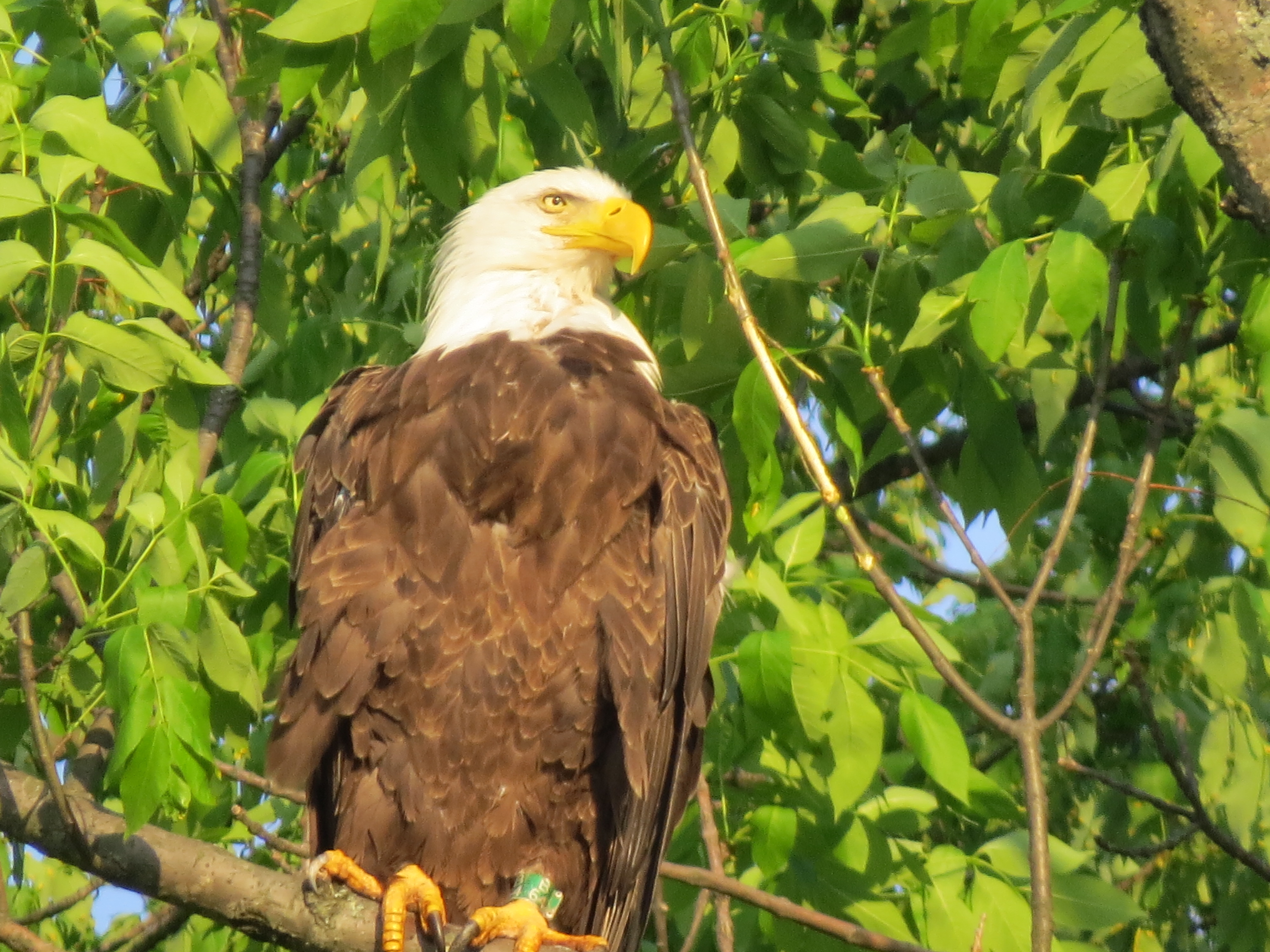
Each year biologists with the NJ ENSP & CWF band chicks at eagle nests though out NJ. Each chick gets a green (NJ) band on one leg and a silver federal band on the other. The Green band indicates that the bird was banded in NJ and the letter over the number combination is recorded so we know where and when. There are at least 20 pairs of eagles nesting in NJ where at least one of the adults is a NJ banded bird. Over the past few years we’ve gotten reports of NJ birds seen in other states and if we’re lucky (and someone has a really good camera) the green band can be read.
We recently heard from Linda Oughton who lives in PA. She has a pair of eagles nesting near her home and was able to get a photo of the perched female with green band B/64. She was able to tell us that this pair has been nesting for the past three years near her development in Montgomery County and raised and fledged four young for two of those years. They were active this season and had two chicks, which unfortunately didn’t survive due to the severe winter weather. Before nesting in this tree they nested for three years at another location where they raised seven young. The banded eagle is a female which is known because she is larger than her mate (female eagles are larger than the males).
B-64 with two chicks raised and fledged in 2013 @ L. Oughton
B/64 was one of three chicks banded in 2004 at the Hopewell West nest which is located in Cumberland County along the Cohansey River. Linda has named B/64 “Jersey Girl” and she keeps everyone in the development where she lives informed about the nest. No doubt that this former NJ bird is well loved and protected.
With Memorial Day Weekend upon us, summer is unofficially here for New Jerseyans. That means plenty of tourists enjoying shore, sand, surf, and sun – but it also means other types of annual summer visitors to our coast: bottlenose dolphins, sea turtles, and whales. However, what may be inspiring sightings from a healthy distance can become tragic encounters when marine animals become stranded or entangled in nets.
This story marks the fifth of five blog stories spotlighting New Jersey’s marine mammals and sea turtles – and educating people how to help animals in need, rather than make a bad situation worse.
Part 1, Monday, revealed the bottlenose dolphin die-off striking the Eastern Seaboard. Part 2, on Tuesday, featured a Question-and-Answer on the dolphin mortality event with NOAA’s Mendy Garron. Part 3, on Wednesday, looked at how people can safely help stranded wildlife. Part 4, yesterday, investigated the fascinating condition of cold-stunned sea turtles. Part 5, today’s blog entry, discusses the importance of reporting marine mammal and sea turtle sightings and how to do so.
By Michael J. Davenport, Marine Species & GIS Programs Manager
Conserve Wildlife Foundation (CWF) staff work with the New Jersey Endangered and Nongame Species Program (ENSP) to manage and populate the state’s official database of rare wildlife, known as Biotics. Currently, this database contains over 39,000 animal and plant records within New Jersey. ENSP and CWF currently collect and enter data for the state’s 182 endangered, threatened, and special concern species.
Although much of the information within Biotics on imperiled species is received from CWF and ENSP biologists, a great deal of useful data is also submitted by the public since, although NJ is a relatively small state, the biologists are unable to survey all areas at all times. The biologists rely on these “citizen scientists” to help them monitor areas which they are unable to and/or locate the presence of species in areas in which they were previously unknown to occur. Wildlife watchers who observe rare wildlife may report such observations by submitting a Rare Wildlife Sighting Report Form which then gets processed and mapped by CWF staff.
Rare species data within the Biotics database plays a critical role in wildlife and habitat conservation within New Jersey. It is used for a number of scientific and conservation efforts such as the state’s Landscape Project and Critical Wildlife Habitat Mapping, environmental review, research (GIS modeling), status review (determining whether a non-listed species should become listed as endangered or threatened and vice versa), and it also assists biologists in targeting future survey efforts to new areas.
A Rare Wildlife Sighting Report Form is available on ENSP’s website for download as well as instructions for completing the form – there is also a Marine Wildlife Sighting Report Form, specifically for reporting sighting of marine mammals and sea turtles. A complete list of all of the species tracked by the state can be downloaded here.
Reporting your rare wildlife observation is easy. Simply complete the form, attach a map of where the animal was observed (a map is not necessary for marine sightings; geographic coordinates may be submitted instead), as well as any photographs taken, and then mail or e-mail the form and any additional documentation to ENSP at the address provided on the form. For more details about the state’s rare species mapping, please visit our webpage.
Observations of dead, dying, or stranded marine mammals or sea turtles should be reported to the Marine Mammal Stranding Center at 609-266-0538. Keep in mind, however, that a seal on the beach is not necessarily sick or injured. Resting on the beach is normal behavior for seals. They may haul-out onto beaches, jetties, or floating docks to rest or escape predators. So, a seal on land is not necessarily a seal in distress. Obvious indications of illness or injury are open wounds, entangled fishing line, or lack of responsiveness to their surroundings.
With Memorial Day Weekend upon us, summer is unofficially here for New Jerseyans. That means plenty of tourists enjoying shore, sand, surf, and sun – but it also means other types of annual summer visitors to our coast: bottlenose dolphins, sea turtles, and whales. However, what may be inspiring sightings from a healthy distance can become tragic encounters when marine animals become stranded or entangled in nets.
This story marks the fourth of five blog stories spotlighting New Jersey’s marine mammals and sea turtles – and educating people how to help animals in need, rather than make a bad situation worse.
Part 1, on Monday, revealed the bottlenose dolphin die-off striking the Eastern Seaboard. Part 2, on Tuesday, featured a Question-and-Answer on the dolphin mortality event with NOAA’s MendyGarron. Part 3, yesterday looked at how people can safely help stranded marine mammals without making the mistake of being a “hero”. And Part 5, tomorrow, will reveal the importance of reporting sightings – both for live or dead marine mammals.
MARINE MAMMAL & SEA TURTLE WEEK: Sea turtles navigate a dangerous path, from entanglements to cold-stunning
By Sara DeAngelo, Conservation Intern
Over 100 first responders along the coast of New Jersey attended Conserve Wildlife Foundation’s marine mammal stranding workshops this past month. Speakers and interactive discussions educated the first responders on how to handle a marine mammal or sea turtle stranding.
The term “stranding” is used for sea turtles and marine mammals that are found along the beach dead or alive. Their death or injury may be resulting from a predator, parasites, pollution, entanglement, etc. In most stranding cases, the cause of the animal stranding itself is unknown. Determining the cause of the animal stranding will help us understand what is going on in the ocean that may be harmful to certain populations.
Sea turtles, however, face a unique set of challenges. We have four species of sea turtles that may be found in New Jersey waters during the summer. Loggerheads are the most common, while green sea turtles and Atlantic leatherbacks – massive creatures weighing as much as a small car – are less frequently seen but not uncommon. Kemp’s Ridley sea turtles are the rarest visitors.
Most of these sea turtles come to New Jersey during the summer months and enjoy the warmer waters. Yet when our seasons change and the waters cool, some sea turtles may lag behind rather than returning south for warmer waters. These turtles can face “cold stunning”.
In colder waters, sea turtles do not have the capability of warming their own bodies. If a turtle is cold stunned, it looks as if it is dead because its heart rate decreases, it becomes lethargic, circulation decreases, and it may be in shock or have pneumonia.
This condition can even result in a common mistake of a passerby or first responder believing a turtle is dead, when it is actually just “cold-stunned”. Unless the sea turtle clearly looks like it has been dead for a while, it is best to report the turtle to a marine mammal and sea turtle stranding hotline.
A green sea turtle. Photo by Cordell Brown.
Sea turtles can also get entangled in fishing nets. At the Conserve Wildlife Foundation workshops this month, first responders were informed to, upon sighting of an entangled or stranded animal, immediately call the Marine Mammal Stranding Center located in Brigantine, NJ, by calling 1-609-266-0538. They could also contact NOAA’s Northeast Region Marine Mammal and Sea Turtle Stranding and Entanglement Hotline by calling 1-866-755-6622.
Boaters who encounter an entangled sea turtle should try to remain near the turtle until help arrives if possible. On shifting seas, it could be hard for the expert responding to the call to locate the animal without the initial person spotting it standing by to direct them there.
One warning was made very clear in the workshop: boaters should never get into the water with a sea turtle or stranded marine mammal. It is extremely dangerous for both the responder and for the animal.
Should the sea turtle be on the beach itself, other tips are helpful for the first responders. While waiting for the trained rescue staff, the first responders were urged to secure the scene, try to keep people at least 100 feet away, and not to touch the animal. Keeping curious beachgoers distant from the animal will minimize stressing out the animal even more. The responders were told that calling the local police department may help enforce the directions to keep back from the animal.
A Kemp’s ridley turtle. Photo courtesy of Jenkinson’s Aquarium.
With Memorial Day Weekend upon us, summer is unofficially here for New Jerseyans. That means plenty of tourists enjoying shore, sand, surf, and sun – but it also means other types of annual summer visitors to our coast: bottlenose dolphins, sea turtles, and whales. However, what may be inspiring sightings from a healthy distance can become tragic encounters when marine animals become stranded or entangled in nets.
This story marks the third of five blog stories spotlighting New Jersey’s marine mammals and sea turtles – and educating people how to help animals in need, rather than make a bad situation worse.
Part 1, on Monday, revealed the bottlenose dolphin die-off striking the Eastern Seaboard. Part 2, yesterday, featured a Question-and-Answer on the dolphin mortality event with NOAA’s Mendy Garron. Part 4, tomorrow, will investigate the fascinating condition of cold-stunned sea turtles. And Part 5, on Friday, will reveal the importance of reporting sightings – both for live or dead marine mammals.
MARINE MAMMAL & SEA TURTLE WEEK: Encounter a stranded marine mammal? Here’s how to help (Hint: Don’t try to be a hero!)
By Jennifer Dexter, Conservation Intern
Last year, over 150 marine mammal strandings occurred in New Jersey, ranging from humpback whales to harbor seals.
In order to better prepare first responders and the general public for such incidents, Conserve Wildlife Foundation of NJ hosted the NJ Marine Mammal Stranding Workshop. For me, the biggest take home message I retained from attending this workshop was a clear one: “Don’t be the hero!”
Keeping people and their pets away from stranded marine mammals is for their safety as well as the animal’s. Photo by Mike Davenport.
Everyone has good intentions when they attempt to ”rescue” a marine mammal stranded on the beach, but often you may be doing more harm than good. Usually, there is a good reason why the animal washed ashore, whether it be injuries or illness at fault. If you simply return the animal to the ocean, it’s likely that they will just become stranded again.
The same goes for animals in danger at sea, such as a turtle entangled in fishing nets. DO NOT go all gung-ho by jumping in the water in attempt to cut the turtle free, as you are putting the animal and yourself in danger.
Close human interaction will put the already stressed animal in defense mode. Sea turtles, such as the leatherback, can weigh more than 1,000 pounds and one thrash of their flipper can leave a human severely injured. In addition, a human can just as easily become entangled in the netting so it’s best to remain on your boat, safe out of harm’s way.
The best and most helpful thing a witness can do in New Jersey is to immediately call the Brigantine Marine Mammal Stranding Center (609-266-0538) and provide the following information: description of the animal, photograph from a distance, location, and description of any injuries.
Most importantly, do not touch, feed, pour water on, or cover the animal. Stand by until a MMSC staff member or local police is dispatched. From that point on, it will be up to the MMSC and the authorities to assess what measures need to be taken based on the animal’s needs. You can walk away knowing you did the right thing – and helped the animal as much as you could.
 CWF is excited to partner with New Jersey State Parks and offer incredible programs about New Jersey’s natural world at Island Beach State Park.