Go Wild for Art!

D & R Greenway exhibit brings wildlife to life

By Jen Smith, CWF Outreach Intern

Annelies van Dommelen, Q

The D&R Greenway Land Trust’s “Wild Creatures: 40 Years of Protecting Endangered Species” exhibit is being featured at the Johnson Education Center in Princeton, NJ.  It is a vivid art-viewing experience that celebrates the U.S. Endangered Species Act and the wildlife it has sought to protect since its inception.

But time is running out to catch this unique blend of science and art!

“The response to the exhibit has been overwhelmingly positive with visitors who are simultaneously delighted by the whimsical creatures, reverent of their noble struggle, and inspired by the recovery efforts undertaken across the globe to save them,” said Diana Moore, curator for the exhibit.

Eight local artists were featured for their work, including Tricia Zimic’s foreboding mobile entitled “A Cautionary Tale.” Henslow sparrows, a Bobolink, and a Peregrine Falcon struggle in an all-to-lifelike storm of fishing wire, plastic and debris. Annelies van Dommelon’s playful yet informative work is also not to be missed. Filling up an entire room with her breathtaking “Bestial Alphabet” viewers can glimpse the A to Z of creatures aided by the Endangered Species Act, many of those depicted being native to New Jersey. More than one viewer compared the exhibit to watching an Aesop’s Fables book come to life.

“This creative exhibit highlights just how special our wildlife is in New Jersey – and why so many species continue to need our protection,” noted David Wheeler, CWF Executive Director. “Each artist brings a unique vision to illustrating the challenges that so many wildlife species face, and to capturing the extraordinary beauty possessed by each species.”

D&R Greenway Land Trust’s mission is to preserve and protect the permanent network of lands they have ensured remain open spaces and to create conditions for a healthy and diverse environment to flourish. In creating public access to these open spaces, it is D&R’s goal and hope that people will develop a greater appreciation for the natural world, and be inspired by conservation ethics and education.  D&R President Linda Mead was honored this past December at Women & Wildlife by CWF for the Greenway’s leadership in protecting wildlife habitat in a region of the state that desperately needed that protection.

“Wild Creatures” will be running now through March 21st. The Johnson Education Center in Princeton, NJ is open 10am – 5pm on weekdays. You can call ahead for availability (609)-924-4646 or visit www.drgreenway.org for more details and driving directions.

More information about Tricia Zimic’s artwork can be found at www.triciazimic.com.

Hurry now before this rare showcase comes to an end!

Living with eagles as your neighbors

Brochures now available

by Larissa Smith: Wildlife Biologist/Volunteer Coordinator

Bald Eagle Project Brochures.

The New Jersey Bald Eagle nesting population is on the rise with 148 nesting pairs monitored in 2013 and 177 young fledged.  As the eagle nesting population increases so do the incidences of eagles nesting in close proximity to humans and human activity. It’s exciting to have a pair of bald eagles nesting and people often want to get a closer look but this can cause disturbance to the nesting eagles and have detrimental impacts. Over half of NJ’s eagle nests are located on private property which makes it important to advise and educate land owners, land managers about living with eagles.

To address this issue CWF received a grant to produce two informational brochures about co-existing with bald eagles in NJ. One is a general brochure for anyone interested in eagles in NJ and the other is specifically for landowners/land managers with eagle nests located on their property.  The brochures contain information on eagle history, living with eagles as you neighbors, how to be a good eagle watcher or steward, as well as phone numbers for information and law enforcement. As the eagle project volunteers monitor their nests they will have these brochures available to educate interested people.

Duke Farms 2009 Eagle Chick All Grown Up

Jersey banded bird re-sighted in Maryland

by Larissa Smith, Wildlife Biologist/Volunteer Coordinator

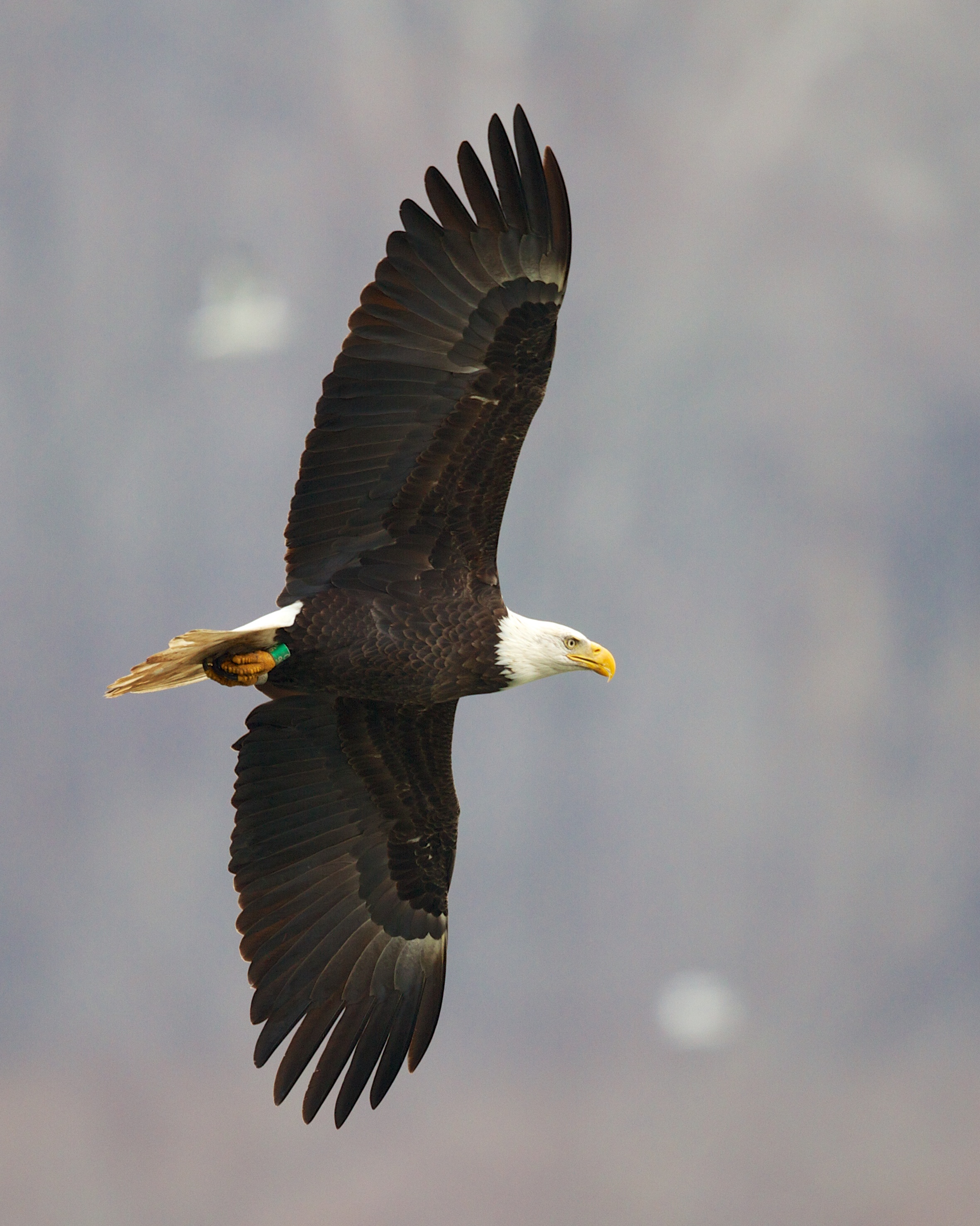
NJ banded eagle at Conowingo Dam, MD © Kevin Smith

The Duke Farms eagle camera was put in place in 2008. Since then it has had quite a following of people interested in seeing the pair raise their young. After the young birds leave the nest it is unknown what happens to them. The mortality rate for first year eagles is fairly high since they are just learning how to fly and hunt on their own.  So it was quite exciting when on December 1, 2013 Kevin Smith photographed a NJ banded bird at Conowingo Dam, Maryland. He was able to zoom in close enough to view the green band which read C96. This bird had been banded on May 18, 2009 at Duke Farms. He was the oldest of three males raised by the pair in 2009 while being watched by eagle cam viewers. Below is a photo of the three chicks in the nest following the banding. The largest bird on the right is C96.  Now at 4 1/2 years old he is almost a mature adult but still has just a slight amount of brown in his tail feathers (photo on left).

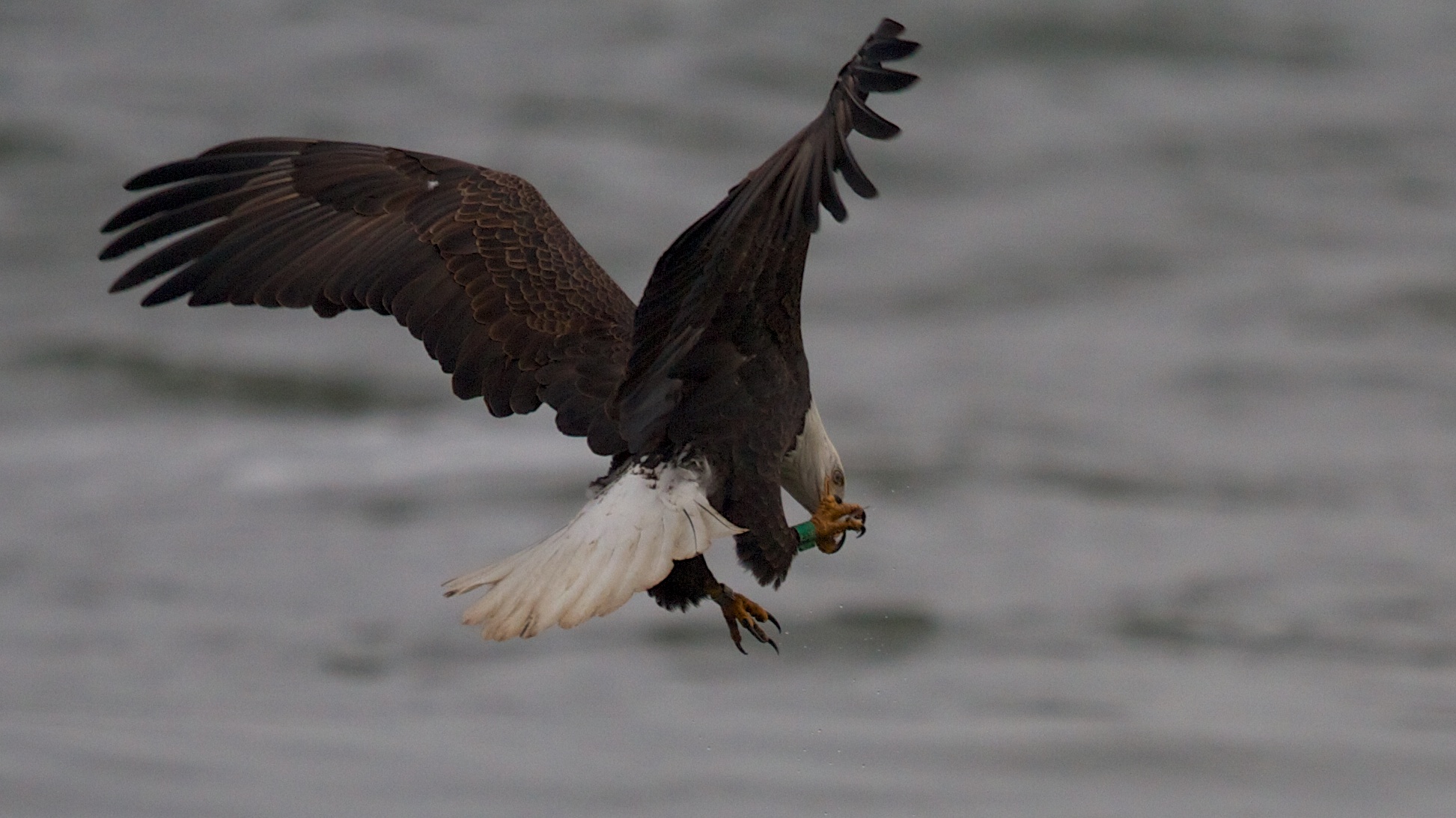
Conowingo Dam is a popular spot for eagles this time of year due to the abundance of fish. Kevin noted that the eagles were catching smaller fish than usual and eating them on the fly. The photo below on the right shows C96 moving the fish from his talons to his bill. Kevin reports that he (C96) would then circle back around looking for more fish and got his share of food that day. It is good to know that C96 has survived and is healthy.

  • The Duke Farms eagle cam is up and the pair is getting the nest ready for the 2014 nesting season.


NJ banded eagle at Conowingo Dam, MD © Kevin Smith
Duke Farms eagle nest at banding May 18, 2009 © Mick Valent

New Jersey’s Bald Eagle Population is Flying High

© Thomas Gorman
© Thomas Gorman
2013 New Jersey Bald Eagle Project Report

by Larissa Smith, Wildlife biologist/Volunteer Manager

2013 was a good year for the New Jersey bald eagle population.  A total of 148 nests were checked during the season and 119 were found to be active (with eggs).  A record high of 177 young were produced. Eagle nests can now be found in all but two of New Jersey’s 21 counties.

As we wrap up the 2013 season eagle pair’s are already reported to be working on nests for the 2014 nesting season.  I would like to thank all of the dedicated eagle project volunteers as well as all others involved in the eagle project.

The 2013 New Jersey Bald Eagle Project Report has all the details on the 2013 nesting season.

Photos From the Field

FRESHWATER MUSSELS LIVING ON OTHER SPECIES & OTHER SPECIES LIVING WITHIN MUSSELS

By Michael Davenport, Marine Species & GIS Programs Manager

Left: a killifish with attached glochidia.  Right: a crayfish taking shelter within a mussel shell.  © Mike Davenport
Left: a killifish with attached glochidia. Right: a crayfish taking shelter within a mussel shell. © Mike Davenport

The images above were taken during a recent survey of the Raritan River in Somerset County.  The image on the left is a Banded Killifish with the larval stage of freshwater mussels attached (the small black dots on the side of the fish are the larval mussels, known as glochidia).  Glochidia are parasites of fish, and some other aquatic animals, which will drop-off at the end of their larval stage, and then complete their life cycle in the bottom of the river, stream, or lake as the adult mussels most people are familiar with.  The host fish not only provides a meal for the glochidia, but also enables mussels to travel further than they can as an adult.

The image on the right is a crayfish which took shelter within the old shell of a freshwater mussel, in this case an Eastern Elliptio.  Other freshwater invertebrates may reside within old mussel shells, such as snails and aquatic insects.

To learn more about freshwater mussels in New Jersey, visit our Freshwater Mussel site.

New Jersey’s Endangered Species List Continues to Grow

NEW JERSEY’S STATUS REVIEW OF TERRESTRIAL MAMMALS HAS BEEN COMPLETED

By Michael Davenport, Marine Species & GIS Programs Manager

Little brown bat thumbhugger
A little brown bat, one of several bat species which will be added to the state’s list of Endangered species. Photo by MacKenzie Hall.

The state’s Endangered and Nongame Species Program (ENSP) has recently completed a status review of the state’s terrestrial mammal species.  As a result of this review, an additional four species (all bats) have been recommended for listing as Endangered in New Jersey (eastern small-footed myotis, little brown bat, northern myotis, and tricolored bat).  An additional four bat species (big brown bat, hoary bat, red bat, and silver-haired bat) and a rodent (the meadow jumping mouse) have been recommended for listing as Special Concern.  These additional listings are largely due to the impact of White-nose Syndrome, especially on cave-dwelling bats.  However, additional increasing threats, such as wind turbines, were also factors.

Although these status changes have been recommended, it may take several more months or even years before the changes to the lists are made official through a formal rule-making process.  The most recent status review for birds, for instance, was completed in 2005 but it wasn’t until 2012 that the status changes decided upon within that status review went into effect.

The process for determining a species’ state status is known as the “Delphi” method of species status review and it is a process which Conserve Wildlife Foundation of NJ (CWF) staff assists the state with.

The ENSP endeavors to complete a review of all species currently included on the Endangered and Nongame lists every 5-10 years.  In addition, other species groups not currently included on those lists may be reviewed for status as well.  At any given time, there may be several status reviews being conducted.

The first step taken in conducting a status review is to identify experts and invite them to participate as a member of a review panel.  Members of the panel may be comprised of experts within academia, government agencies, non-profits, or private consultants as well as others.

Once a sufficient number of experts have agreed to participate, staff within the ENSP and CWF will compile background material for the species being reviewed.  This may include reports, survey data, and data contained within the state’s Biotics database which is the electronic warehouse for all imperiled species data in New Jersey.  This background data, as well as a list of the species being reviewed, and definitions of the status options, are then sent to the panelists for Round 1 of the review.

Delphi reviews are comprised of multiple “Rounds”.  For each round, each panelist will choose a status for each species based upon that panelist’s expertise as well as the background material.  The panelist then sends their selections and justification regarding each species to ENSP or CWF staff who compile the results submitted by all panelists.  The review is completed anonymously, so the panelists do not know the identities of the other participants.

For each species, the panel must reach consensus of at 85% of the respondents for a species’ status to be determined.  If consensus is not reached during the first round, that species will move on to be reviewed in Round 2.  For each new round, the panelists’ status choices during the prior round, as well as all the comments made, are available to the panel, so that reviewers can consider the weight of evidence and other reviewers’ opinions on status as they prepare to vote again.  This continues until consensus is reached for all species under review.

Once consensus is reached for all species or, if after four rounds have passed and consensus could not be reached for some species, ENSP or CWF staff take the compiled Delphi results to the Endangered and Nongame Species Advisory Committee (ENSAC).  ENSAC reviews the results and makes the final recommendations on status for those species for which consensus was not reached by the expert panel.  Based upon ENSAC’s recommendations, any changes to the Endangered and Nongame lists must go through a formal rule-making process before those changes can be made official.

The Delphi review process is a science-based, anonymous review by those with the most expertise on the species within New Jersey.  A great deal of thought and time go into preparing for and carrying out a review and CWF has played a major role in assisting with the process.  From the blue whale to fairy shrimp, each species will ultimately receive a state status, leading the way for conservation action.

Re-sighting New Jersey Eagles

Looking for green bands.

by: Larissa Smith, wildlife biologist/volunteer manager

One way we can track eagles is with transmitters which I’ve discussed in previous blogs. Since 2011 three eagle chicks have been outfitted with satellite transmitters to track their movements. Two of the birds have since died. To follow the movements of the third eagle go to http://www.merrillcreek.com/eagletracking.html

Eagle banded C/84 © Peter Stegemann

Another way to track eagles is by banding them.  The NJ Endangered and Nongame Species Program has been banding eagles with green (NJ specific) bands since 1987.  Eagles are banded when they are six weeks of age and get a green NJ band on one leg and a silver federal band on the other.  The state band has a letter over a two digit number. The band information is entered into the National Bird Banding Lab database and when someone finds an injured or dead eagle they can report the band. Most of the information that comes in from these bands are from dead or injured birds. The bands tell us when and where the the bird was banded. By using spotting scopes people can sometime see that a bird has green band but many times are unable to read the number.  We know that  23 pairs of eagles nesting in New Jersey have at least one bird in the pair that was banded in NJ.

Eagle banded D/64© Justin Pursell

Sometimes we are lucky to get re-sightings from photographers with high powered lenses who can focus in on the band.  Just in the past week we’ve gotten three sightings of NJ birds.  One eagle has been seen on Long Island with a green band and reported by Peter Stegemann. He has seen this bird all last summer and fall with another eagle and they might be nesting this season. This would be the first pair of eagles to nest on Long Island since DDT wiped out the eagle population. By zooming in on the photo ENSP principal biologist Kathy Clark was able to read the letter and first number as C/8.  The second number couldn’t be read but by going through the banding records it was determined that this eagle was banded in 2009 at the Princeton nest.

Eagle banded D/39 © Kristen Nicholas


Another NJ banded bird (D/64) was photographed by Justin Pursell in Schwenksville, PA on April 7th, 2013. The eagle hasa nest in the area.  The bird was banded May 10, 2004 at the Hopewell West nest in Cumberland County.  Kristen Nicholas took a photo of a third  year NJ banded bird at Lake Tappan Northern NJ/Lower NY on March 20, 2013. The green band is D/39  a third year male which was banded in 2011 at the Oradell Reservoir in Bergen County NJ.

While it’s great to get re-sightings of NJ banded birds we don’t want to get them at the expense of the eagles. These photos were taken by photographers with high powered lenses. People should view eagles from a safe distance so as not to disturb them, especially when they are nesting.  Disturbance to a nest can cause the eagles to abandon the eggs/young or cause the young to prematurely jump from the nest.

To report a banded eagle please contact Larissa Smith Larissa.Smith@conservewildlifenj.org

Tracking eagles in NJ

Merrill Creek female with transmitter May 29, 2102© Kathy Clark
Update On Merrill Creek Birds

By Larissa Smith Wildlife Biologist/Volunteer Manager

Back in August I wrote a blog update on two eagles fitted with transmitters at Merrill Creek Reservoir.

http://www.conservewildlifenj.org/blog/2012/08/06/a-year-in-the-life-of-a-juvenile-eagle/

The male eaglet was fitted with the transmitter in July 2011.  In September 2011, the male flew as far west as Harrisburg, PA, and in January 2012 spent a few days in the upper Chesapeake Bay in Maryland.  After that he spent the majority of his time in New Jersey and eastern Pennsylvania.

In early January, 2013, biologists became concerned when the signal from the transmitter was not moving.  A team of biologists from the ENSP’s Clinton office went out to search the area but were not able to locate the bird.  Another attempt was made on January 18th and the bird was found dead in the shoulder of the highway.  The carcass was saved for later examination to determine the cause of death, though we suspect it was struck by a vehicle.  The transmitter was still attached to the bird, and it will be refurbished and placed on another eaglet this nesting season.

So far, two out of the three eaglets outfitted with transmitters have not survived.  Juvenile eagles have a high rate of mortality as they learn to live on their own and aren’t yet the most skilled hunters or fliers.  We are learning a lot about these young eagles and their habitat choices and migratory movements.  Unfortunately, we are also learning that they face many perils in the wild, as we have seen with the first eagle infected with West Nile virus, and the second struck by a vehicle.

In May, 2012, a transmitter was placed on the largest of three eaglets in the Merrill Creek nest.  She fledged in July and remained in the nest area until September 10, when she took a quick flight south.  She continues to be tracked around the southern tip of the Delmarva Peninsula in coastal Virginia, a favorite wintering area for many immature eagles.  To follow her movements (and to see the movements of the other eagles) go to: http://www.merrillcreek.com/eagletracking.html.

Keeping Wildlife Range Maps Current

RECENT UPDATES TO SPECIES RANGE MAPS

By Michael Davenport, Marine Species & GIS Programs Manager

The former and revised range maps for the Checkered White butterfly in New Jersey.

Just as world maps get updated with the addition of new countries (most recently South Sudan in 2011), wildlife range maps also need to be revised occasionally as new information becomes available.

There are 173 range maps available on Conserve Wildlife Foundation’s on-line field guide web pages for New Jersey’s endangered, threatened, and special concern species.  Although some of these maps were created only two years ago, 23 range maps were in need of minor to major revisions since new data had become available.  The range maps are based upon data within the NJ Department of Environmental Protection’s Biotics database, the official statewide database of rare wildlife.  While some new data was received from biologists’ surveys, a portion of it was received from the general public who submitted Rare Wildlife Sighting Report Forms for their own personal observations.

One of the most striking range map revisions is the Checkered White Butterfly.  Previously documented only at Newark Airport, this species has now also been documented in southern New Jersey.  Whether or not this disjunct population has been there all these years and not reported (flying under the radar so to speak), or this represents a recent natural range expansion or introduction is unknown at this point.

Take a tour of our on-line field guide – revised maps are labeled “2012”.

A year in the life of a juvenile eagle…

Male eagle with transmitter sighted June 28, 2012 at Spruce Run Reservoir, NJ © William Gumulak
Update on tracking NJ eagles

by Larissa Smith, Wildlife Biologist/Volunteer Manager

In June of 2011 two chicks (male & female) from the Merrill Creek Reservoir eagle nest in Warren County were fitted with solar-powered transmitters that are monitored via satellites. The males movements have been tracked for over a year starting when he left the nest in June.  You can see the eagles movements by going to: http://www.merrillcreek.com/eagletracking.html  In September the male flew as far West as Harrisburg, PA and in January spent a few days at the upper Chesapeake Bay in Maryland.  He has spent the majority of his time in New Jersey and Eastern Pennsylvania. It is very interesting to see where the eagle is spending his time and the type of habitat he is using.  When you go to the map you can zoom in to get a close up look at his locations.

Unfortunately the female chick died in October due to starvation. She tested positive for West Nile Virus which could have contributed to her death.  The transmitter was recovered from the female and in May of this year the transmitter was placed on the largest of three chicks, a female, in the Merrill Creek nest.  She just recently left the nest and is still in the area of the nest taking short flights. To follow her movements go to http://www.merrillcreek.com/eagletracking.html


Female eagle with transmitter placed May 29, 2012 © Kathy Clark