By Michael Davenport, Marine Species & GIS Programs Manager
The rusty-patched bumble bee, a species believed to be extirpated within New Jersey.
Conserve Wildlife Foundation of NJ (CWF) has just launched several new web pages devoted to those species which have been lost from New Jersey (and the world in some cases). Ten species are profiled – five which are extinct and five which are extirpated from the state. Although their stories are sad, they are also warnings for what may happen to other species which are currently struggling to survive within the state, especially those already on the state’s endangered species list. CWF’s wildlife conservation projects attempt to avoid more species becoming extinct or extirpated in New Jersey.
CWF would like to thank Joseph Wotasek, a junior at Centenary College majoring in Graphic Design, who volunteered his time and skills in creating images of the ten profiled species for the new web pages.
NATURE WATCHING ISN’T JUST FUN, IT CAN BE USEFUL TOO
By Michael Davenport, Marine Species & GIS Programs Manager
Like many birdwatchers, although I still enjoy seeing the neighborhood cardinal in my yard, it’s the sightings of rarely encountered species, especially those classified as endangered, threatened, or special concern, which really keep my eyes scanning around during a hike.
Observations of Special Concern species, such as this Eastern Box Turtle, may be reported to the NJ Endangered Species Program. Photo by Mike Davenport.
Many birdwatchers, or nature enthusiasts of other species groups such as reptiles or butterflies, share their encounters with rare species on websites or bulletin boards. In addition, several organizations, such as the Cornell Lab of Ornithology or NJ Audubon, recruit “citizen scientists” who collect species observation data and submit that data electronically via websites such as eBird. That data is important for those organizations’ scientific research and assists scientists in analyzing population trends over years. However, more often than not, it never finds its way to New Jersey’s state biologists nor the state regulators whose task it is to protect rare species habitat in the state.
The New Jersey Endangered and Nongame Species Program (ENSP) collects data for, not just rare birds, but all of the state’s endangered, threatened, and special concern species. A Rare Wildlife Sighting Report Form is available on ENSP’s website for download as well as instructions for completing the form. A complete list of all of the species tracked by the state can be downloaded here.
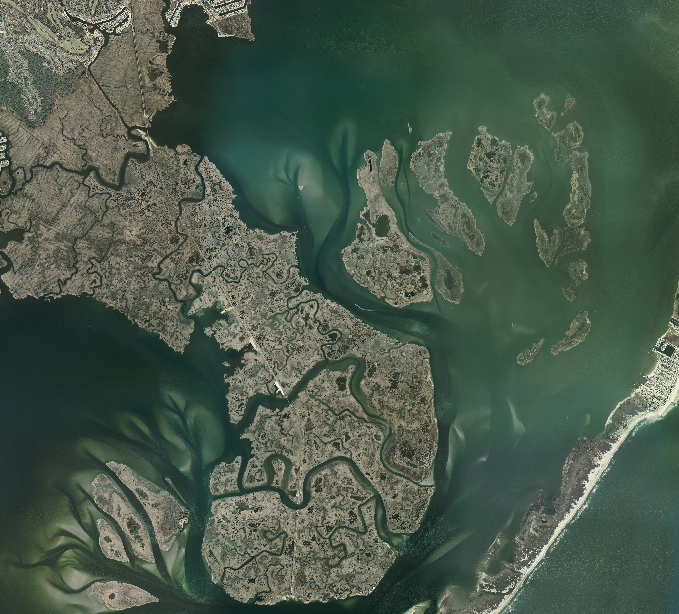
A map of the location of your observation, such as this one, should be sent with your Rare Wildlife Sighting Report Form.
Rare species data within the state’s database plays a critical role in wildlife and habitat conservation. It is the foundation of the NJ DEP’s Landscape Project, a GIS product that maps critical areas for imperiled species based upon species locations and land-use classifications. The resulting maps allow state, county, municipal, and private agencies to identify important wildlife habitats and protect them in a variety of ways. This information is used to regulate land-use within the state and assists in preserving endangered and threatened species habitat remaining in New Jersey.
Reporting your rare wildlife observation is easy. Simply complete the form, attach a map of where the animal was observed, as well as any photographs taken, and then mail or e-mail the form and map to ENSP at the address provided on the form. For more details about the state’s rare species mapping, please visit our webpage.
It’s that time of year again when we reflect on the year that is ending and look forward to the future. Many species of wildlife such as osprey and bald eagles, had a banner year while others like several species of bats continued to struggle. What will 2012 hold for NJ’s rare wildlife? While we can’t predict the future, we have thought about what we would like to happen to help these animals survive and hopefully thrive in our state.
This year, I have great hopes of laying all the groundwork (design, funding, pre-construction monitoring) for at least one road-culvert project that will protect migrating amphibians. Every spring we bring scores of volunteers onto the roads to reduce frog and salamander roadkills, but special “critter culverts” will take over that job permanently! – MacKenzie Hall, Wildlife Biologist
To secure the support of New Jersey’s Congressional Delegation for full funding for the federal State Wildlife Grants program that will allow for the continued implementation of the State’s Wildlife Action Plan – the blueprint for rare wildlife protection in our state. And, to get out in the field more to see the exciting projects that Conserve Wildlife Foundation staff are working on. – Margaret O’Gorman, Executive Director
To get Little Egg Harbor Twp to reduce the speed limit on Great Bay Blvd to help reduce the amount of female terrapins that are hit-by-car. – Ben Wurst, Habitat Program Manager
Despite the tremendous effort by CWF and the various management cooperators around the state, New Jersey’s piping plover population has only increased slightly the past two years. We have, however, had two good years in a row of producing young, so here’s hoping we finally see a significant jump in the breeding population in 2012! – Todd Pover, Beach Nesting Bird Project Manager
To complete a status review for NJ’s freshwater mussel species. – Mike Davenport, Marine Species and GIS Programs Manager.
To create a robust speakers bureau that can present programs throughout the state about the important work that we do. – Maria Grace, Education & Outreach Manager
Last summer both New Jersey and Delaware had rare occurrences of sea turtles nesting or attempting to nest on their beaches. In Stone Harbor, New Jersey this past August, a sea turtle crawled onto the beach and dug two holes in an attempt to nest in an area fenced off for beach nesting birds. Unfortunately, the sea turtle did not lay any eggs and eventually crawled back into the ocean. Although no one witnessed the event, the turtle left strong evidence behind – its tracks! CWFNJ’s Beach Nesting Bird Program Manager along with other agency biologists was at the scene to evaluate the tracks. Each sea turtle species has a different track pattern and leaves behind a different shape at their nesting site (their body pit). It was determined that it was likely a state endangered loggerhead sea turtle (Caretta caretta) that attempted to nest. Continue reading “Rare sea turtle nesting!”
USING CARTOGRAPHY TO ILLUSTRATE WHERE SPECIES LIVE
By Michael Davenport, Marine Species & GIS Programs Manager
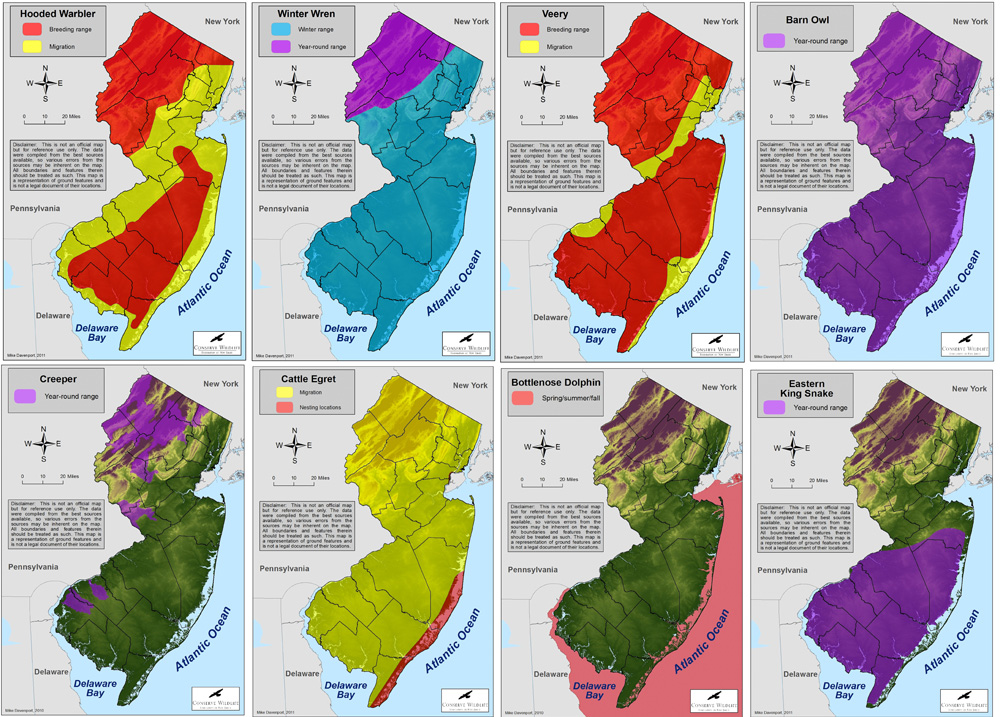
Several range maps found on the CWF on-line field guide.
Conserve Wildlife Foundation of NJ (CWF) staff have been busy updating the CWF website’s on-line field guide with additional species’ profiles in order to add descriptions for New Jersey’s Species of Special Concern. One important component of the on-line field guide, like almost any other field guide, is the inclusion of a range map.
Our Online Field Guide
The CWF on-line field guide is specific to New Jersey, so the only portion of each species’ range illustrated is that portion within the boundary of the state. For a species’ full range, there are numerous additional sources of information. CWF, being focused on New Jersey wildlife, is uniquely able to provide more specific range information based upon the data available to our staff as well as our first-hand knowledge.
The range maps within the on-line field guide are created using Geographic Information Systems (GIS) software and multiple sources of data. First, we begin with the raw species observation data which is maintained within the NJ Endangered and Nongame Species Program’s (ENSP) Biotics database, a database which CWF staff maintains in partnership with ENSP. Then, like any range map, some generalization needs to be made to account for the fact that animals cannot be observed 24 hours a day, 365 days a year. In order to do so, data such as land cover types, hydrology, and/or topology is considered in order to fill-in the areas between observation points or omit other areas. Continue reading “Creating Range Maps for NJ Wildlife”
On Friday May 13th the eagle banding team met to visit two eagle nests in Cumberland County. The first nest visit went smoothly, two healthy chicks were banded, blood samples and measurements were taken. The second nest was located on an island out in the salt marsh. As we approached the island we could see that the nest looked somewhat small and it looked like some nesting material had fallen out of the tree. As we got closer to the nest tree both of the adult eagles appeared and were making their alarm calls (which is normal) when we go out to band an active nest. As Mick Valent, Principal Zoologist with the Endangered and Nongame Species Program, prepared to climb the tree we started to look for prey items which we collect at each nest. One of the eagle project volunteers made a sad discovery, the remains of a 4-5 week old eagle chick. We then knew that something had happened to the nest. As Mick got closer to the nest he told us that there wasn’t a nest and it must have fallen. But the adults behavior indicated that there was still a live chick. We thought perhaps that the second chick was still alive on the ground, so we started to search. Mick made his way up to the nest remains and we heard him yell, “there is a chick”. It was decided that the chick would be brought to the ground banded and examined. The nest would then be rebuild so that the chick could be put back up into the nest.
Erica Miller a veterinarian from Tri-State Bird Rescue and Research examined the bird. It had a full crop which means that it was being fed. The only indication of its trial was a sore on the bottom of its foot pad from holding on tight to the remaining nest.
Meanwhile Mick began constructing a new nest base with large branches that were sent up using rope. Jeremy Webber with the NJ Forest Service is training to climb nest trees and was able to assist in the nest building. Once a base platform was constructed the remaining nesting material was put up on the platform and then tied down so that it wouldn’t slide off the platform. Softer material was sent up in a bag for the final touches. The chick was then sent back up and placed in his new home.
We estimate that the nest had fallen in the past two weeks. The chick wouldn’t have been able to hang on much longer especially with any high winds or rain storms. The nest volunteers went out the next day and reported that the chick was fine and the adults were at the nest. It may have been Friday the 13th but it was this chicks lucky day!
Having accurately mapped rare species data is essential for insuring that critical habitat for those species remains protected. For that reason, I recently accompanied Kris Schantz, a biologist from the NJ Endangered and Nongame Species Program, in documenting two timber rattlesnake den locations in northern New Jersey using a GPS (global positioning system) unit. Our goals were to see if the rattlesnakes had emerged from hibernation, survey how many were present, and to accurately map their locations in the heavily wooded area less than 30 miles outside New York City.
Timber rattlesnakes (Crotalus horridus horridus), like other reptiles, are cold-blooded. In order to survive through the long, cold winter in New Jersey, they hibernate in dens. Research has shown that rattlesnake dens in the northern part of the state can vary from rocky outcroppings with crevices, ledges or boulders to forest interior dens consisting of a few rocks and a hole in the ground. In New Jersey’s Pinelands, however, rattlesnake dens are quite different. Rattlesnake dens in the Pinelands are usually underground crevices near bodies of water, often underneath large tree roots.
Rattlesnakes will almost always use the same den year after year. In addition, rattlesnake young typically follow the scent trail of their mother in order to find their way to her den their first fall, or may follow any timber rattlesnake to a suitable den. As a result, a good den site may provide a winter refuge for a number of rattlesnakes of all age classes, as well as other species of snakes.
Since the goal of our mission was to map den locations, we had to make sure we arrived at the den site once it was warm enough for the rattlesnakes to come out of their crevasses to bask but before they had enough warm weather to travel away from the den site. Timing was crucial. After a week with some fairly warm days mixed with very cool nights and a few cool days, we ventured out during the last week of April on a day when the air temperature climbed into the lower 80’s.
The first den site we visited required a fairly long hike through a rocky, deciduous forest. Fortunately, Kris had visited both den sites several years earlier so she had a good idea of where we needed to go. We were fortunate to find two individuals at the den site, one yellow-phase juvenile and one yellow-phase sub-adult or young adult. While I GPSed the den site, Kris attempted to determine their sex based on their appearance (the young adult was a female but the juvenile’s sex could not be determined).
GPS units work when there is an unobstructed line of sight to four or more GPS satellites. With 7-8 satellites being detected by the GPS unit, my task of mapping the site was fairly easy and took little time. The trees had yet to leaf-out so my GPS unit had a clear signal from above. We also observed a northern black racer (Coluber constrictor constrictor) at the den site.
The second den site required a much longer and more strenuous hike accompanied by swarms of black flies. At that location, we observed three rattlesnakes – one black-phase adult (sex undetermined), one yellow-phase adult male, and one yellow-phase sub-adult or young adult (sex undetermined). GPSing this location took a little more effort though due to the terrain both because it was more difficult to get to the site and once there, the terrain made getting a clear signal on the GPS unit a little more tricky and it took far longer than at the first den.
Out of the five rattlesnakes we observed, only one ever rattled. Rattlesnakes rely on their camouflage as their first line of defense. Even when we were close by, they remained motionless. At no point did any of the snakes approach us or attempt to strike. The only two individuals which moved at all during our survey, moved away from us into rock crevasses and that was likely due to our prolonged presence staring at them.
Snakes, and venomous snakes in particular, have an undeserved bad reputation. At no point during our survey did I ever have any fear of being bitten by a rattlesnake. In all honesty, I was actually far more afraid of being bitten by a tick instead (I only found about four or five on me during the entire day).
Last year Conserve Wildlife Foundation of NJ started a new project that was focused on reducing the amount of terrapins that were killed by motor vehicles. The project began because of one individual terrapin that I encountered on Great Bay Blvd in 2009. I observed the female terrapin as she walked along the edge of the Blvd. I saw this as being odd. Typically they cross the road and often at a speedy pace (probably because they know the apparent danger from crossing roads). I stopped and saw that she had an injury to her lower mandible, probably from a motor vehicle. I knew that she needed help.
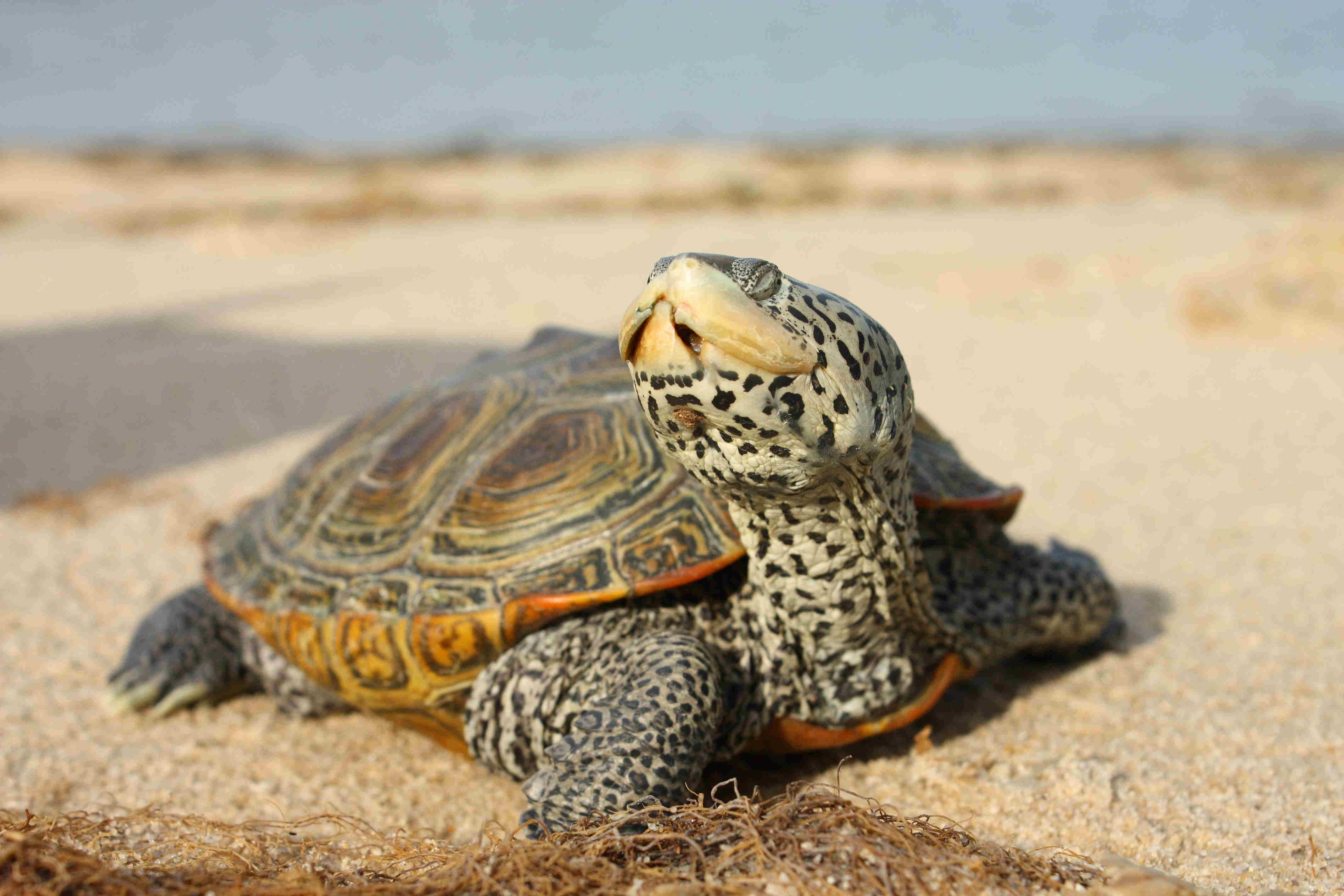
Terrapins face a variety of threats in their environment. An untold number are trapped in crab traps that are not fitted with Bycatch Reduction Devices (BRDs), some are hit by speeding boats and jet skis, and many more are injured or killed while attempting to cross roads. Along Great Bay Blvd. in Little Egg Harbor several studies have documented the amount of live and dead individuals on the road.
As soil and coastal waters begin to warm, terrapins begin to become active again. In late April/early May hatchlings begin to emerge from nest cavities where they overwintered. Adults also begin to become active, but mostly remain in the waters where they live until June when females emerge to lay eggs in nests they dig on land.
The penninsula that surrounds Great Bay Blvd. is pristine habitat for terrapins in southern Barnegat Bay.
Last year we raised enough funding to develop and print an educational brochure, purchase and install “Terrapin X-ING” signs, and install 4,000 feet of barrier fencing. The fencing was placed along the first stretch of road where the highest mortality rates were recorded. The fence proved to be effective at reducing road kills and increasing awareness of terrapins. The fence was removed in late 2010. This year it will be installed again along the same portion of road with help from a local construction company, Sambol Construction. After this season, we hope to keep the fence up year-round and hope to fence the whole first section of the road (and possibly more).
This year to help reduce the amount of terrapins that are hit by motor vehicles, we are recruiting volunteers to act as “Terrapin Stewards.” Stewards will be asked to routinely drive, walk, or bike down Great Bay Blvd. during the summer months from June to mid-July (especially on weekends, holidays and when there is a full or new moon). Volunteers will educate the public about terrapins, their threats in the environment, and our project. Volunteers will also help terrapins safely cross roads and help record locations of live or dead animals. No more than 10 volunteers will be recruited this year.
Our Message to visitors:
The habitat that surrounds Great Bay Boulevard is very important to the reproduction of northern diamondback terrapins, a species in decline in New Jersey. Female terrapins often nest along the soft shoulders of roadways. Sometimes they enter the roadway to reach these suitable nesting areas where they lay their eggs. Research has shown that dozens of female terrapins are killed by motor vehicles each year along Great Bay Boulevard. Please help conserve terrapins by driving carefully while traveling along the road.
If you’d like to participate you are required to attend a training session on May 3rd @ 6pm at the Jacques Cousteau National Estuarine Research Reserve. Volunteers will fill out paperwork and learn more about terrapins and our project. You must register to attend this training/information session.
Kestrels are the smallest falcon (about the same size as an American Robin) in North America. Its plumage is striking with rufous coloration its back and tail. Although the American kestrel is widespread, meaning they live year round throughout much of the United States, the northeastern kestrel population is declining. Today the kestrel is listed as a Species of Special Concern in New Jersey (not yet endangered or threatened but on its way).
Kestrels are found in open, grassy habitats – especially ones that have cavities for nesting and perches for hunting. Kestrels can be seen hovering in grasslands, pastures and parklands or perched along the road on telephone lines. The decline of kestrels in New Jersey is likely due to destruction of grasslands from development. Also, nesting cavities are lost. As we clean up our fields, we remove trees with nest cavities the kestrels use.
Researchers have not determined the exact reason for kestrel declines but, we do know that the availability of cavities for nesting appears to be a limiting factor. Conserve Wildlife Foundation of New Jersey, in partnership with the Endangered and Nongame Species Program implemented a nest box installation and monitoring program in 2006.
The Allegheny woodrat is a state endangered species. It was added to the endangered species list in 1991. There is one remaining population of these small mammals left in the state and they need our help this winter.
This season we are going to help the woodrat by providing it with food. We will distribute acorns, beech nuts, hickory nuts or any other nuts from native New Jersey trees in the area the woodrats live. By providing them with food we will help them survive the winter.
Collecting nuts while learning about the habits and habitat needs of the Allegheny woodrat is a great service learning project! Have your students collect native tree nuts throughout the community and help to protect one of NJ’s rarest wildlife residents.
We are collecting nuts now through November 24th to distribute to the woodrat’s location throughout the winter. If you would like to contribute to the woodrat’s winter food pantry, please drop off nuts from native New Jersey trees to the Endangered and Nongame Species Program’s office in Clinton, New Jersey.
Please contact Maria Grace at Conserve Wildlife Foundation at (609) 984-0621 for specific instructions.