CWF Biologists Travel to Brazil to Study Red Knots

On our Expedition to Study Shorebirds along the Northern Coast of Brazil

By: Dr. Larry Niles, LJ Niles Associates LLC

Ana Paula with Red Knot

The largest mangrove forest in the world covers the Brazilian coastline at the equator near the mouth of the Amazon river. The forest extends out into the Atlantic in long peninsulas tipped by wind swept and mostly inaccessible beaches. The forest, beaches and their long intertidal mud and sandy low tide flats support the largest wintering population of shorebirds in the hemisphere, perhaps the world. The red knot, a listed species in both North and South America, also uses this remote tropical coast.

Boat Trip Route
Boat Trip Route
Catamaran
Catamaran


With scientists from the U.S., Canada, England and Brazil, we will attempt a large scale mapping of this important habitat using state-of-the-art satellite mapping. We will do this from a 50-foot catamaran and two zodiacs hopping from one mangrove estuary to another and conducting bird surveys targeting key areas over a 150 mile-section of the coast. We will be the first to survey some areas. Our goal is to figure out the main threats to both bird and habitat.


To understand the importance of this area one has to think about it like a shorebird. Although born in the Arctic they actually spend only a few months there. They spend a few months moving from their nesting area to their wintering area. They spend the rest of their lives, the majority of their year in the wintering area. A threat to the wintering area would be grave.


Most of our survey zone is part of the Reentrancias Maranhenses, a protected area of the state of Maranhao, Brazil. Our catamaran captained by William Thomas will leave from a small town near the city of Sao Luis, Brazil. From there we will sail along the coastline moving in and out of the mangrove islands to survey shorebirds, habitat and marine invertebrates. We will “geo reference” all data, or take detailed coordinates so the data can be reproduced on satellite mapping.

Satellite Map
Satellite Map


Satellite maps aren’t really maps as most people understand — pictures or drawings of a section of the earth — they are digital files of remotely sensed data, they are only wavelengths of light that must be interpreted to represent actual habitat. We will train the satellite data so that each habitat will be represented by a combination of spectral data — colors in sense.

Environmental disturbance. Photo by Mark Peck.

Once completed, we can relate the habitat maps with information on birds, their prey and equally important, the threats to the birds and prey. For example, shrimp farming is growing in this area. Entrepreneurs are stripping the intertidal zone of mangrove forest, diking the area and then growing shrimp. Once the area accumulates too much waste and chemicals, they abandon the site and move on to damage another mangrove forest. We will determine which areas are of importance to the birds and potential targets for shrimp farmers. But there is more: oil spills, disturbance from tourists, water pollution are among many.


Over the next three weeks, we will be reporting on our work on this blog.

Log of Red Knot DbY7 with geolocator.


Learn more:


Dr. Larry Niles has led efforts to protect red knots and horseshoe crabs for over 30 years.

New Jersey’s Bald Eagle Population Continues to Soar

Conserve Wildlife Foundation of New Jersey releases results of 2015 State Bald Eagle Report

by Lindsay McNamara, Communications Manager

A bald eagle flies over the Holgate Unit of Edwin B. Forsythe NWR on Long Beach Island. © Northside Jim

Conserve Wildlife Foundation of New Jersey today released the 2015 Bald Eagle Report, highlighting the number of nesting pairs, active nests and nest productivity for the raptors throughout New Jersey with data collected by New Jersey Department of Environmental Protection Division of Fish and Wildlife biologists, CWF biologists and committed volunteers.


“With 161 pairs of bald eagles this past year — up from just a single nest in the early 1980’s — the dramatic ongoing recovery of bald eagles across the northeast continues to inspire so many of us,” said David Wheeler, Conserve Wildlife Foundation Executive Director. “The thrill of seeing a bald eagle fly across the sky is unparalleled. This report captures how these eagles are continuing their All-American return.”


The report notes that thirteen new eagle pairs were found this season, nine in the south, two in Central Jersey and two in Northern New Jersey.


With a wingspan of six to seven feet, bald eagles are larger than most birds. The bald eagle is restricted to North America and is usually found within close proximity to open water. In New Jersey, bald eagles reside year-round, usually remaining in the area surrounding their nest. They begin courtship and nest building in late December and January, adding to their existing nest. Over time, some nests can reach 10 feet across and weigh up to 2,000 pounds.


Conserve Wildlife Foundation partners with Duke Farms on a webcam that provides a live look at a bald eagle nest in Hillsborough, New Jersey. This spring, the EagleCam will allow viewers an up close and personal view into the lives of a pair of bald eagles as they breed, incubate, and raise young. Between the general public and classrooms up and down the east coast, the EagleCam has many fans – over 10 million viewers and growing!


The federal government removed the bald eagle from its list of Endangered Species in August of 2007, but the bald eagle’s official New Jersey status remains state-endangered for the breeding season and state-threatened for the non-breeding season.


“One of our encouraging findings is that the population of wintering bald eagles has grown along with the nesting population over the past decade,” said Conserve Wildlife Foundation eagle biologist Larissa Smith. “This growth reflects the increasing populations in New Jersey and across the northeast, as recovery efforts continue to pay off for eagles. In addition to our fellow scientists in New Jersey and nearby states, I’d like to thank the wonderful eagle project volunteers who make keeping track of all these nests possible.”


The Division of Fish and Wildlife’s Endangered and Nongame Species Program (ENSP) bald eagle recovery efforts, implemented in the early 1980’s, have resulted in a steady recovery of New Jersey’s bald eagle population. ENSP biologists, Conserve Wildlife Foundation of New Jersey staff, and volunteer observers continue to locate and monitor bald eagle nests and territories each year to analyze the state of the population. The state’s eagle population would not be thriving without the efforts of the dedicated eagle volunteers who observe nests, report sightings, and help protect critical habitat.


Highlights of the 2015 New Jersey Bald Eagle Project Report are found below or view the complete report online.


2015 Report Highlights

  • The statewide population increased to 161 territorial pairs in 2015, up from 156 last year.
  • Thirteen new eagle pairs were found this season, nine in the south, two in central and two in northern New Jersey.
  • One hundred-fifty pairs were known active (meaning they laid eggs), up from 146 last year.
  • One hundred twenty-two nests (81%) were known to be successful in producing 199 young, for a productivity rate of 1.33 young per known-outcome active nest, which is above the required range of 0.9-1.1 young per nest for population maintenance.
  • One chick, orphaned from a Maryland nest, was fostered into a Cumberland County nest and fledged, bringing the total fledged to 200.
  • Twenty-eight (19%) nests failed to fledge young.
  • The Delaware Bay region remained the state’s eagle stronghold, with 40% of all nests located in Cumberland and Salem counties.


Learn More:


Lindsay McNamara is the Communications Manager for Conserve Wildlife Foundation of New Jersey.

Walking the Land

CWF Biologists’ Winter Field Work

by Kelly Triece, Private Lands Biologist

Walking the Land. Photo by Kelly Triece

Even during these cold winter months Conserve Wildlife Foundation biologists are out in the field! The winter is often the best time of year to fully see the land and make accurate assessments on potential management. My role as a Private Lands Biologist along with our partner the U.S. Department of Agriculture, Natural Resources Conservation Service (USDA-NRCS), is to work with private landowners and help them manage their property for the benefit of wildlife and to conserve other natural resources.


Often times this means walking the property with landowners who are interested in enhancing or providing habitat for wildlife. On our walk, we look for invasive species, erosion concerns, existing hydrology, native vegetation and the potential to enhance the property for wildlife. We make recommendations on how to best manage the land for wildlife, but ultimately it is up to the owner.


Winter Field Work
Potential enhanced waterfowl and amphibian habitat.

This winter, I have met with several landowners whose goal is to provide waterfowl and amphibian habitat on their land. We have also visited forested lands to determine their suitability to create Golden-winged Warbler habitat, an endangered songbird.


Not every day is a close encounter with wildlife! But helping private landowners learn about sustainable land management and implement conservation goals on their property may help provide food, water and breeding grounds for many of New Jersey’s native wildlife species.


Learn More:


Kelly Triece is the Private Lands Biologist for Conserve Wildlife Foundation.

Rare White Pelicans Seen in Monmouth County, New Jersey

Sandy Hook Christmas Bird Counters Delighted by White Pelicans

by Lindsay McNamara, Communications Manager

"American White Pelican" by Manjith Kainickara - originally posted to Flickr as American White Pelican. Licensed under CC BY-SA 2.0 via Commons - https://commons.wikimedia.org/wiki/File:American_White_Pelican.jpg#/media/File:American_White_Pelican.jpg
“American White Pelican” by Manjith Kainickara – originally posted to Flickr as American White Pelican.

My alarm was set for 4:00 AM on December 20, a Sunday morning. I woke up excited and eager to start the day. My phone started going off with text messages from friends about our meeting location. As any birder will tell you, this scenario is far from uncommon we love our birds! and will likely wake up at any time on any day for a chance to add another species to our life list.


I woke up early to look for owls to tally in the Sandy Hook Christmas Bird Count (Highlands and Atlantic Highlands territories are included in the Sandy Hook count). Our team drove through Hartshorne Woods Park in Highlands, New Jersey, in search of the nocturnal raptors. I thought the highlight of my day would be hearing two great horned owls calling to each other as first light came over the woods. While this was exciting (and definitely worth getting up at 4:00 AM for), I was in for another treat.


By 7:00 AM, our team grew into a group of six “bird nerds.” We were surveying the Navesink River, counting waterfowl, herons, songbirds and gulls, when Monmouth County Audubon Society‘s Rob Fanning yelled “three white pelicans”and sure enough, the pelicans were flying around the Oceanic Bridge in Rumson! I missed them the first time, but luckily the birds came back around and we were all able to watch them fly and swim through the scope. We shouted, laughed, smiled and high fived each other. One of my favorite aspects about birding is how quickly wildlife brings people together. Suddenly, we were the dream team.


Three White Pelicans. Photo by Lisa Fanning

According to Cornell Lab of Ornithology, American white pelicans are one of the largest North American birds considerably larger than a bald eagle, but smaller than a California condor. They feed from the water’s surface, dipping their beaks into the water to catch fish, such as minnows, carp and suckers. White pelicans often upend, like a large dabbling duck, in this process. They do not plunge-dive the way Brown Pelicans do.


They are superb soarers (they are among the heaviest flying birds in the world) and often travel long distances in large flocks by soaring. Adult American White Pelicans are snowy white with black flight feathers visible only when the wings are spread.


Northern breeding populations migrate to southern California, the Gulf States, Mexico, and Central America. White pelican populations breeding in Texas and Mexico are resident populations.


White Pelicans in Flight. Photo by Lisa Fanning.
White Pelicans in Flight. Photo by Lisa Fanning

The pelicans, first spotted by Rob, were the first Sandy Hook Christmas Bird Count (CBC) record in the 39-year count history! We saw the “three amigos” again later in the day at Many Mind Creek in Atlantic Highlands flying towards Staten Island.


Incidentally, three white pelicans were reported on December 27 in Connecticut. Our team wonders if those are our buddies. Monmouth County Audubon Society’s Lisa Fanning also stated that there have been up to five in Maryland, but she believes a small population may winter there. There are a number of winter records in eBird, mostly of a handful of birds (one report of up to 21 on January 1, 2012) at Blackwater NWR in Maryland.


During the 39th Sandy Hook CBC, 101 species were tallied. Each year, from December 14 through January 5, tens of thousands of volunteers throughout the Americas collect data used by scientists to study the long-term health and status of bird populations across North America. CBC informs strategies to protect birds and their habitat, and helps identify environmental issues with implications for people too. Find a count near you on Audubon’s website.


Lindsay McNamara is the Communications Manager for Conserve Wildlife Foundation of New Jersey.

New Jersey Tiger Season

Biologists and volunteers survey for New Jersey Eastern Tiger Salamanders

by Larissa Smith, biologist/volunteer manager


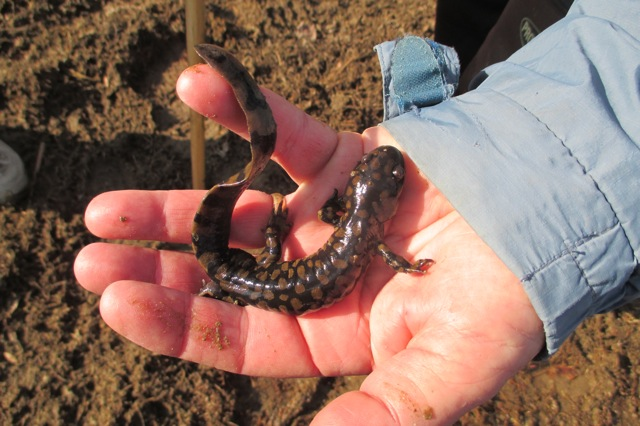
It’s the time of year when Conserve Wildlife Foundation biologists and volunteers along with Endangered and Nongame Species biologists start to survey for New Jersey’s “tigers,” and by tigers I don’t mean the big striped cats, we’re talking about the Eastern Tiger Salamanders. These large mole salamanders spend most of their life burrowed under the ground and in December begin to emerge to migrate to vernal pools and breed. Eastern Tiger Salamanders are endangered in New Jersey and only found in 15 pools in the most southern part of the state.


Last week dedicated volunteers Wayne Russell, John King and myself went out to check on a few known breeding pools.  The water level in the ponds was lower than usual due to the lack of rain, but John found an adult male in one of the pools.

Tiger Salamander found 12__9_15@ W. Russell
Tiger Salamander found 12/9/15 Photo by W. Russell

We were delighted to find a male in the pool so early in December. At another known breeding pool we found the partial remains of two Eastern Tiger Salamanders that had obviously been eaten by a predator. But the good news was that we also found two tiger salamander egg masses in the same pool.


Predation is just one of the challenges that these salamanders face. Tiger Salamanders themselves are targeted by collectors for the pet trade which is why their breeding locations are kept a secret. Their habitat is declining due to habitat loss and fragmentation, development, pollution, changes in hydrology, and climate change.


Learn More:


Larissa Smith is a wildlife biologist and volunteer manager for Conserve Wildlife Foundation of New Jersey.


Providing Young Forest Habitat for the Golden-winged Warbler

CWF and partners have created or restored over 225 acres of Golden-winged warbler habitat in New Jersey since 2012

 by Kelly Triece, Private Lands Biologist

Golden Winged Warbler. Photo by D. Kenny.

Take a look at this Golden-winged warbler — a Neotropical Migrant songbird that breeds in New Jersey. This songbird is a species of special conservation concern in the United States and endangered in New Jersey, experiencing population declines due to loss of young forest habitat.

 
Did you know? In the past 30 years, over 11,000 acres of upland shrub and emergent wetland habitat have been lost to succession in New Jersey. This habitat is important for Golden-winged warblers because it is their primary breeding habitat. Fortunately, their secondary habitat, upland forests, have remained stable in the state.


Therefore, it has been the goal of many wildlife management agencies to continue to create young forest habitat, while protecting upland forests as well.

 
Conserve Wildlife Foundation and our partners (Natural Resources Conservation Service, New Jersey Division of Fish and Wildlife and New Jersey Audubon Society), have worked with private landowners to create or restore over 225 acres of Golden-winged warbler habitat since 2012 in New Jersey.


Our managed forests have a statistically significant higher diversity of birds than unmanaged sites!

Young forest habitat managed for Golden-winged Warbler. Photo by Kelly Triece.
Young forest habitat managed for Golden-winged warbler. Photo by Kelly Triece.

Young forest habitat, also known as scrub-shrub habitat, is new or regenerating forest that is less than 20 years old. Young forest habitat is important for many birds, especially the Golden-winged warbler. The open canopy of a young forest also helps provide food such as berries and insects to newly fledged birds, wild turkey, ruffed grouse, reptiles, black bears, bobcats, and butterflies.


Golden-winged warbler home range

The breeding range of the Golden-winged warbler extends along the Appalachians from the northern portion of Georgia in the south to Vermont in the north. The winter range for this species is southern Mexico and Central and South America.


Follow us in February 2016 when biologist Kelly Triece travels to Honduras to see the Golden-winged Warbler in its winter habitat!


Learn more and get involved:


Kelly Triece is the Private Lands Biologist for Conserve Wildlife Foundation of New Jersey.

New Jersey Little Brown Bat Resighted!

by Stephanie Feigin, Wildlife Ecologist

Little brown bats (c) Stephanie Feigin

“Luci,” a little brown bat banded in July 2014 at 2008 Women & Wildlife Award Winner Barbara Brummer’s pond house (a New Jersey maternity site) was recently resighted!


Biologists doing a hibernaculum survey in New York State found Luci in a mine in one of New York’s largest little brown bat hibernaucula about 70 miles north from her summer roost site in New Jersey!


“She is spending the winter with 37,000 of her closest friends.” – Carl Herzog Wildlife Biologist, New York State Department of Environmental Conservation, Wildlife Diversity Unit

New Jersey’s Field Guide to Freshwater Mussels is Here!

CONSERVE WILDLIFE FOUNDATION OF NEW JERSEY RELEASE A NEW STORY MAP: “FRESHWATER MUSSELS OF NEW JERSEY

By Michael Davenport, GIS Program Manager

Freshwater mussels are distant relatives of marine mussels with a life cycle which includes a larval stage where they hitch a ride on fish as a parasite. There are a dozen species native to New Jersey and some species are known to live for over 100 years. This is an often overlooked group of species which deserves greater attention since many species are imperiled and because they are indicator species of water quality.

Conserve Wildlife Foundation of New Jersey (CWF) has partnered with the NJ Endangered and Nongame Species Program to create and release our latest Story Map, “Freshwater Mussels of New Jersey.”

Musselscreenshot

This Story Map is a web-based field guide to New Jersey’s freshwater mussel species. The field guide explores the diversity of this group of species, how to identify them, their life history, threats and conservation measures, as well as providing range maps for each species. This is the only freshwater mussel field guide specific to the state of New Jersey and developed by state biologists.

Photos and interactive range maps are available for all 12 of New Jersey’s native species as well as several non-native species found within the state. Several short videos are also included which demonstrate different methods of surveying for freshwater mussels.

Funding for the creation of this Story Map was provided in part through a New Jersey Division of Fish & Wildlife grant.

Piping Plover Population Rebounds from Historic Low in New Jersey

Conserve Wildlife Foundation of New Jersey releases 2015 report

by Todd Pover, Beach Nesting Bird Project Manager

Photo by Northside Jim

Conserve Wildlife Foundation today released the 2015 Piping Plover Breeding Report, highlighting the number of nesting pairs, pair productivity, and coast-wide distribution for this endangered shorebird, from data collected by New Jersey Division of Fish and Wildlife (NJDFW) biologists, CWF biologists, and other partners.


“The rebound in New Jersey’s piping plover breeding population and a second consecutive year of robust chick productivity was a much needed outcome,” said Conserve Wildlife Foundation Beach Nesting Bird Project Manager Todd Pover. “We need to continue our intensive management for a number of years to sustain any recovery, but we were very pleased to have finally broken the recent cycle of low nesting success and the record low number of nesting pairs in 2014.”


The piping plover – a small sand-colored shorebird that nests in New Jersey as part of its Atlantic Coast range from North Carolina up to Eastern Canada – face a number of threats, including intensive human recreational activity on beaches where they nest, high density of predators, and a shortage of highly suitable habitat due to development and extreme habitat alteration.


Federally listed as a threatened species in 1986, piping plovers have since recovered in some areas of the breeding range. Yet piping plovers continue to struggle in New Jersey, where they are listed by the state as endangered.


“As a species dependent on natural beach habitat, piping plovers face a particularly daunting challenge along New Jersey’s heavily developed and dynamic coast,” said Conserve Wildlife Foundation Executive Director David Wheeler. “Our dedicated scientists, partners, and volunteers are working tirelessly to ensure piping plovers remain a beloved and healthy presence along the Jersey Shore and beyond.”


CWF, in close coordination with NJDFW’s Endangered and Nongame Species Program, oversees piping plover conservation throughout New Jersey. Staff and volunteers help erect fence and signage to protect nesting sites, monitor breeding pairs frequently throughout the entire nesting season from March to August, and work with public and municipalities to educate them on ways to minimize impacts. Although conservation efforts on the breeding ground remain the primary focus, in recent years, CWF has also begun to work with partners all along the flyway, in particular on the winter grounds in the Bahamas, to better protect the at-risk species during its entire life-cycle.


2015 Report Highlights:


  • The population of breeding piping plovers increased 17% to 108 pairs in 2015, as compared to 2014. Despite the increase, the population still remains below the long-term average (118 pairs) since federal listing in 1986 and well below the peak.
  • The statewide fledgling rate, which includes data collected by partners at 19 active nesting sites throughout the state, was 1.29 fledglings per pair, down slightly from 2014 (1.36 fledglings/pair), but still one of the highest statewide levels since federal listing. Furthermore, both years were above the 1.25 fledgling rate believed necessary to maintain the range-wide Atlantic Coast population of piping plovers.
  • Statewide pair-nest success, the percentage of pairs that successfully hatch at least one nest, was high at 79%, well above the average since federal listing. Although population and productivity are ultimately the most important measures of recovery success, hatch success is an important metric to demonstrate the effectiveness of on-the-ground management.
  • Northern Monmouth County, as a region, continued to account for the largest percentage of pairs in the state (55 pairs or 51%), with Gateway National Recreation Area – Sandy Hook Unit accounting for most of those pairs.
  • The region comprised of North Brigantine Natural Area and the Holgate and Little Beach Units of the Edwin B. Forsythe National Wildlife Refuge accounted for the other significant concentration of breeding pairs in the state (43 pairs or 40% of the statewide total).
  • Holgate had the largest jump in abundance for any individual site, doubling its breeding pairs to 24 in 2015 (up from 12 in 2014). This increase was the result of highly suitable overwash habitat created at the site by Hurricane Sandy and the high breeding success that helped spur.
  • Cape May County, the southernmost region of the state, consisting of Ocean City to Cape May Point, continued its long-term downward trend, accounting for just 8 pairs in 2015, compared to 11 pairs in 2014 and 43 pairs in 2004 at its peak.


Learn More:


Todd Pover is the Beach Nesting Bird Project Manager for Conserve Wildlife Foundation of New Jersey.


Osprey Pair Get A New Home

Students install a new nesting platform for Avalon ospreys

by: Larissa Smith, Wildlife Biologist/Volunteer Manager

Volunteers and Students from Cape May County Technical School

One lucky pair of ospreys received a brand new nesting platform due to the effort of volunteers and students from the Cape May County Technical School! Dedicated osprey project volunteer Matt Tribulski reached out to CMC Tech Natural Science teacher Hanna Toft, regarding replacement of an aging platform in the Avalon back bay. Hanna is an osprey project volunteer and bander and incorporates the osprey project into her curriculum. The nest that was replaced was an old four poster that was unstable and not predator proof. The nest was located at the edge of the water causing the birds to get off the nest every time a boat or jet ski went by (which in the summer is quite frequently).


Hanna had a platform available that her students had built last year. We couldn’t have picked a better day for the install, the weather was gorgeous and warm for November. We met Hanna and eight of her students out on the water. The new platform was placed further back from the water and has a predator guard. The students removed the old platform, leaving some posts for the ospreys to perch.


We hope that the birds like their new home when they return in the spring.


Thank you to Matt, Hanna and her students for all of their help!

[slideshow]

Learn More:


Larissa Smith is the Volunteer Manager/Wildlife Biologist for Conserve Wildlife Foundation of New Jersey.