New Jersey Eagle Nesting in PA

the story of “Jersey Girl”

Larissa Smith: Wildlife Biologist/Volunteer Manager
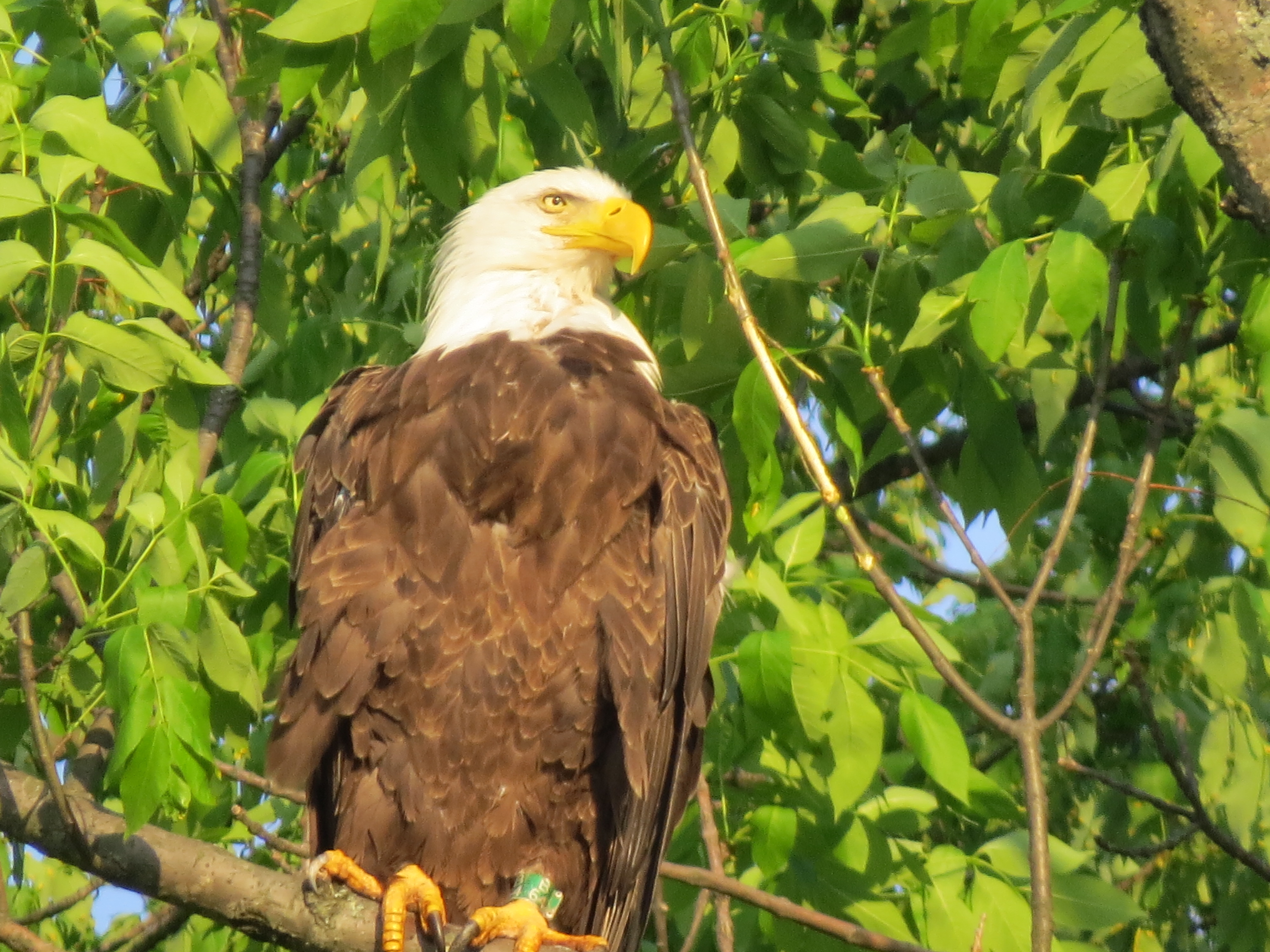
NJ banded bird B-64 taken in PA @ Linda Oughton

Each year biologists with the NJ ENSP & CWF band chicks at eagle nests though out NJ. Each chick gets a green (NJ) band on one leg and a silver federal band on the other.  The Green band indicates that the bird was banded in NJ and the letter over the number combination is recorded so we know where and when.  There are at least 20 pairs of eagles nesting in NJ where at least one of the adults is a NJ banded bird.  Over the past few years we’ve gotten reports of NJ birds seen in other states and if we’re lucky (and someone has a really good camera) the green band can be read.

We recently heard from Linda Oughton who lives in PA.  She  has a pair of eagles nesting near her home and was able to get a photo of the perched female with green band B/64.  She was able to tell us that this pair has been nesting for the past three years near her development in Montgomery County and raised and fledged four young for two of those years. They were active this season and had two chicks, which unfortunately didn’t survive due to the severe winter weather.  Before nesting in this tree they nested for three years at another location where they raised seven young.  The banded eagle is a female which is known because she is larger than her mate (female eagles are larger than the males).

B-64 with two chicks raised and fledged in 2013 @ L. Oughton

B/64 was one of three chicks banded in 2004 at the Hopewell West nest which is located in Cumberland County along the Cohansey River. Linda has named  B/64 “Jersey Girl”  and she keeps everyone in the development where she lives informed about the nest. No doubt that this former NJ bird is well loved and protected.

“A Birder’s Guide to Everything” Special Screening and Meet the Director Event

tumblr_n0ufsohYAm1rwqh7io1_1280“Absolutely anyone can be a birder.” says Ben Kingsley in the new movie, A Birder’s Guide to Everything, directed by Rob Meyer, a coming of age comedy about teenage bird watchers.

This main-stream movie is an important public engagement tool to raise awareness for the conservation of birds and to hopefully excite some people into picking up a set of binoculars and start the addicting hobby of bird watching.

The Fledging Birders Institute will be hosting a special screening and meet the director event on Thursday, April 24th at the AMC Deptford 8 Theatre in Deptford, NJ beginning at 6:30 pm.

More info, and to purchase tickets, can be found here.


Bald Eagle Released in Gloucester County

NJ banded eagle at Conowingo Dam, MD © Kevin Smith

Yesterday, Conserve Wildlife Foundation of NJ and NJ Endangered & Nongame Species Program staff released a rehabilitated bald eagle back into the wilds of NJ.   Eagles, as well as other raptors, have made a huge comeback in NJ, down to just a few birds in the 1980’s.  Today, CWF, with the help of volunteers, monitors approx. 150 nests.

Check out the ABC News video of the Bald Eagle Released in Gloucester County

Searching for Snowy Owls

By Charlene Smith, Program Coordinator

On a cold blustery January morning I decided to brave the elements in the hopes of catching a glimpse of the Snowy Owl irruption occurring in our area.  Since as early as December, the owls have been showing up all along the east coast hanging out by our beaches as it is similar to the barren habitat that they are accustomed to in the Canadian Arctic. The reason why we are seeing so many snowy owls this year is because of good productivity on their breeding grounds.  There was a huge supply of lemmings this past summer that created an abundance of young. Most likely the owls that we have been seeing are juveniles who don’t have their own territories and have moved south possibly looking for food.

On my 45 minute ride out to Sandy Hook, I keep thinking that I was crazy to be doing this. What are the chances that I could spot this rare owl on a 7 mile stretch of Barrier Island?  The odds were against me but I had a hunch on where to look.  I arrived at Sandy Hook, grabbed my newly purchased Nikon binoculars and my Canon camera and took off in the hopes of finding an owl and catching a few shots.

Snowy Owl at Sandy Hook, one of many owls that are overwintering in New Jersey. (c) Charlene Smith

As I walked along the paved path that runs along the water, I scanned the tops of the buildings for a large white bird.  I noticed a few people gazing up and pointing to something in the distance. I hit the jackpot!  I quickly came upon the group and locked my binoculars to the top of a chimney in absolute amazement and disbelief. There sat perched a beautiful snowy owl with faded barring, its eyes half closed, half open. With every noise it would rotate its head around in the direction of the intruding sound. We patiently waited for the owl to take off in flight and when it decided to move, we gasped in awe. It flew over to some pilings by the water and waddled cautiously up the wooden beams, occasionally starring back at the crowd of onlookers.  It was clearly annoyed by the group watching its every move and in an instant it decided to fly off while the people with their telephoto lens and binoculars followed suit. I was chilled to the bone and couldn’t feel my fingers anymore. As much as I wanted to follow the owl I decided it best to appreciate the wildlife from afar and respect its boundaries. I was grateful for the experience and that I could proudly tout that I saw a snowy owl in New Jersey of all places. This is a once in a lifetime occurrence and I recommend taking the time to find a snow owl, but onlookers beware – Keep your distance and respect the owls boundaries.

The Cornell Lab of Ornithology is keeping track of snowy owl sightings with their eBird project, a real-time online bird checklist program.  Another interesting site is Project SNOWstorm, a site dedicated to collecting important data regarding this season’s snowy owl irruption. Scientists are affixing solar-powered GPS transmitters to snowy owls, which records the owls’ location every 30 minutes via cell phone towers.  Almost nothing is known about the local and landscape-level movements of snowy owls on their wintering grounds, nor about their nocturnal hunting activity and range size so information from these transmitters will help to discover more about their habits and habitats.

Living with eagles as your neighbors

Brochures now available

by Larissa Smith: Wildlife Biologist/Volunteer Coordinator

Bald Eagle Project Brochures.

The New Jersey Bald Eagle nesting population is on the rise with 148 nesting pairs monitored in 2013 and 177 young fledged.  As the eagle nesting population increases so do the incidences of eagles nesting in close proximity to humans and human activity. It’s exciting to have a pair of bald eagles nesting and people often want to get a closer look but this can cause disturbance to the nesting eagles and have detrimental impacts. Over half of NJ’s eagle nests are located on private property which makes it important to advise and educate land owners, land managers about living with eagles.

To address this issue CWF received a grant to produce two informational brochures about co-existing with bald eagles in NJ. One is a general brochure for anyone interested in eagles in NJ and the other is specifically for landowners/land managers with eagle nests located on their property.  The brochures contain information on eagle history, living with eagles as you neighbors, how to be a good eagle watcher or steward, as well as phone numbers for information and law enforcement. As the eagle project volunteers monitor their nests they will have these brochures available to educate interested people.

2014 NJ Bald Eagle Nesting Season Has Begun

by: Larissa Smith; Wildlife Biologist/Volunteer Manager

Eight pairs of NJ eagles are currently incubating (sitting on eggs). The earliest pair to start incubating was confirmed on January 12th, so the birds been keeping the eggs warm throughout the snow and cold weather. Eagle Project volunteers report that pairs all over the state are busy working on their nests in preparation for egg laying.

Want to see eagles and other raptors and learn all about them? The Cumberland County Winter Eagle Festival is February 8th, 2014.

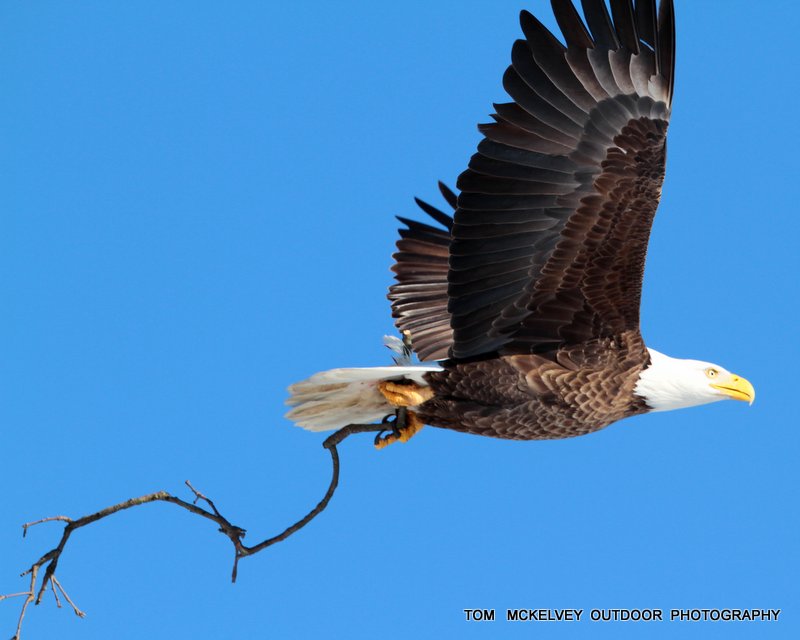
The following photos were taken by Eagle Project Volunteer Tom McKelvey.

Adult with nesting material. ©Tom McKelvey
A pair works on their nest. ©Tom McKelvey


New Jersey’s Bald Eagle Population is Flying High

© Thomas Gorman
© Thomas Gorman
2013 New Jersey Bald Eagle Project Report

by Larissa Smith, Wildlife biologist/Volunteer Manager

2013 was a good year for the New Jersey bald eagle population.  A total of 148 nests were checked during the season and 119 were found to be active (with eggs).  A record high of 177 young were produced. Eagle nests can now be found in all but two of New Jersey’s 21 counties.

As we wrap up the 2013 season eagle pair’s are already reported to be working on nests for the 2014 nesting season.  I would like to thank all of the dedicated eagle project volunteers as well as all others involved in the eagle project.

The 2013 New Jersey Bald Eagle Project Report has all the details on the 2013 nesting season.

Continuing to Track NJ Eagles.

Update on the Merrill Creek birds.

by: Larissa Smith, Wildlife Biologist/Volunteer Manager

Back in February I gave an update on the Merrill Creek birds that had been fitted with transmitters.  http://www.conservewildlifenj.org/blog/2013/02/01/tracking-eagles-in-nj/

We continue following the movements of the female that had the transmitter placed on May 29th, 2012. She spent the winter down at the Delmarva Penninsula in coastal Virginia and then headed up north and spent a large portion of the summer in Maine. She is starting to head south and on September 2nd was in Connecticut.

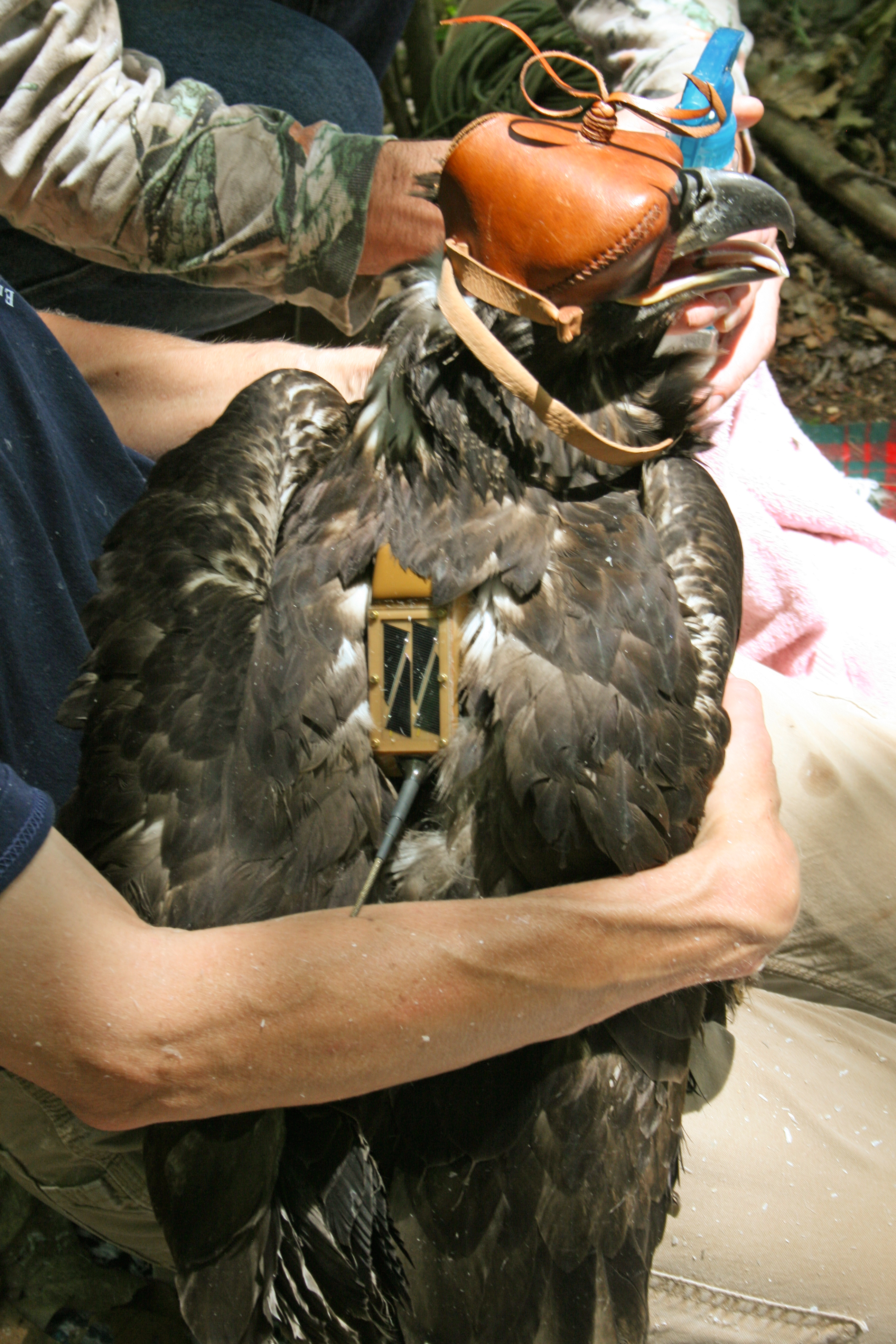
On May 31, 2013 the largest of three chicks at the Merrill Creek Reservoir nest, a female, was fitted with a transmitter.

Merrill Creek chick with transmitter May 29th, 2013

This transmitter is different than the ones previously used in that it uses GSM technology. Instead of using satellites to pick up the bird’s location, the transmitter will transmit data via cell phone towers. The data is then transmitted over the internet and delivered as an email to a mobile device or computer. This new technology transmits more data, costs less and allows users to have instant access to the data through smart phones or computers. Since fledging this bird has been on the move spending time in NY, PA and back to NJ and as of September 3rd was back near the nest site.

To follow both these eagles movements  go to: http://www.merrillcreek.com/eagletracking.html.


Conserve Wildlife Foundation’s New Shorebird Site

Find beautiful photographs like this one of a red knot preening on our new shorebird page. © Jan van de Kam
Find beautiful photos like this one of a red knot preening on our new shorebird page. © Jan van de Kam


Wondering how you can learn more about shorebirds? Look no further.


Despite its part in one of the world’s most incredible migrations, the annual arrival of tens of thousands of shorebirds in Delaware Bay remains relatively unknown to many New Jersey residents. Only recently have shorebirds received some news coverage, but it’s not good news – their numbers are declining rapidly. Scientists have begun to fear that without concerted conservation efforts, species like the red knot may soon go extinct.


Check out the vibrant new migration map on CWF's new shorebird page! © NJDFW
Check out the vibrant new migration map on CWF’s new shorebird page. © NJDFW

The Delaware Bay Shorebird Project, a study led by the New Jersey Division of Fish & Wildlife’s Endangered and Nongame Species Program, has documented shorebird activity in Delaware Bay for nearly thirty years. The result has been an extensive knowledge base that documents every aspect of shorebird life – from measuring food availability and weight gains to tracking migration routes and breeding success – in New Jersey and beyond. Now, as a longtime partner on this project, the Conserve Wildlife Foundation of New Jersey is proud to introduce a new way to learn about these wonderful birds and the work underway to save them: a brand new shorebird site!


CWF's Larry Niles holds a red knot with a geolocator. Read about this research and more on our new shorebird page. © Jan van de Kam
CWF’s Larry Niles holds a red knot with a geolocator. Read about this research and more on our new shorebird page. © Jan van de Kam

These new additions are loaded with content to bring you up to date on all the latest developments in the protection of shorebirds. Learn about these special birds on the Key Species page, and find detailed descriptions about their appearance, life cycle, and where to see them on their own pages in our online Field Guide. Check out the Media page for videos, photos, news articles, scientific publications, and more. Take an in-depth look at all the different areas of shorebird study currently underway on the Research page, and click on the Conservation page to discover how these birds are being protected. Finally, visit our Get Involved page to learn how you can become part of the efforts to help save these remarkable species from extinction.


Be sure to check out all the new additions at:  http://www.conservewildlifenj.org/protecting/projects/shorebird/