Why are You Thankful for New Jersey’s Wildlife?

By: Lindsay McNamara, Communications Coordinator

BannerTGiving

This holiday season, Conserve Wildlife Foundation of New Jersey asked our friends, supporters and volunteers, What is special about NJ’s wildlife to you? Why are you thankful for New Jersey’s wildlife? Friends of wildlife shared their thoughts by tweeting us, leaving us a comment on our Facebook page or sending us an email at info@conservewildlifenj.org. We encouraged everyone to use:  #thanksnjwildlife 
Here is a collection of some of the responses we received:

Bill Nigh on Twitter shared that “wildlife gives me perspective.”

Judy Floam wrote over e-mail, “I only spend one week a year in New Jersey (at the beach) but I love to watch the gulls and sandpipers, and go on seine netting expeditions at Island Beach State Park.”

“Why are we thankful for New Jersey’s wildlife? Each and every creature is special to us although the coyote and the bats have a special place in our hearts. We’re grateful to the bats for keeping insect pests at bay and enjoy watching them leave their roost at dusk. Amazing. The coyotes are very musical and we appreciate their part in balancing nature. We’re grateful that the staff and volunteers at Conserve Wildlife work diligently to protect natural habitats. Thank you!”
— Joe & Linda Jedju shared through e-mail.

“Is this really New Jersey? It’s a question I have asked myself numerous times while living in NJ but never so much as over the last three years. It was three years ago that we purchased a small house on a lake in Sussex County. The waters of the lake are pristine and they teem with beavers, herons, numerous waterfowl, and too many different fish to mention. We watch amazing sunsets over the Appalachian Trail. We sit awe struck as foxes and bears routinely traverse our yard. Hummingbirds and beautiful finches occupy our yard and the wildflowers that grow there. We have watched as Bald Eagles circle high above and slowly spiral down to snatch a fish from the surface of the lake. We have sat in the cool evenings and watched the Milky Way appear as a swath of white across a darkening night sky. We watch as some of our endangered friends the bats dance crazy patterns in the night air, feasting on insects. Is this really NJ? Is it the stereotype of landfills, factories, pollution, and exits on the Parkway? Most definitely not! The rich diversity of animal and plant life leave us awe struck on a daily basis. I could also go on and on about our beautiful shoreline, Island Beach State Park, the Pine Barrens, and numerous other ecosystems that make our state so incredible. NJ’s amazing Wildlife is not limited to amusement parks and bars!
David Claeys shared his story over e-mail.

Love what you’re reading? Feeling inspired? Consider getting involved with Conserve Wildlife Foundation:

Lindsay McNamara is the Communications Coordinator for Conserve Wildlife Foundation of New Jersey.

Atlantic City Electric Holds Avian Protection Educational Event

Details Measures Taken to Help Protect Wildlife and Improve Reliability

By: Lindsay McNamara, Communications Coordinator

Photo Credit: Atlantic City Electric. Pictured left to right are Ben Wurst, wildlife biologist, Conserve Wildlife Foundation of New Jersey; Ed Kaminski, senior supervising engineer, ACE; Cristina Frank, lead environmental scientist, ACE; and Mike Garrity, senior supervising scientist, ACE.

Atlantic City Electric (ACE), in collaboration with the Conserve Wildlife Foundation of New Jersey, recently held an Avian Protection Educational Event to promote a better understanding of how Atlantic City Electric helps protect birds and other animals, while also helping improve electric service reliability for customers.

ACE environmental scientists Cristina Frank and Mike Garrity detailed the various types of migratory and breeding birds that may perch or nest on power lines, including ospreys, which frequently nest on utility poles. They discussed various types of devices placed on wires and other infrastructure designed to minimize the risk of birds and other wildlife from coming in contact with electric wires and equipment.

“Hundreds of thousands of birds migrate through Cape May County each year,” said Cristina Frank, lead environmental scientist, Atlantic City Electric and head of the company’s Avian Protection Program. “We conduct field studies to determine areas throughout Cape May County and our entire service territory to determine which areas are of the greatest risk to birds and other wildlife.”

ACE senior supervising engineer Ed Kaminski explained how avian protection is an integral part of the design phase before constructing any new infrastructure projects or upgrading existing infrastructure.

“We are in constant communication with our environmental team, and, when necessary, we’ll enhance our infrastructure to minimize the risk to birds while helping reduce the number of related power outages to create a more reliable electric system for customers,” Kaminski said.

Atlantic City Electric recently completed infrastructure enhancements in Cape May, Ocean City and Strathmere, N.J., that addressed risks to avian wildlife. As a result, the company has not seen any bird-related incidents since in these areas.

Also as part of the event, Ben Wurst, a wildlife biologist with the Conserve Wildlife Foundation of New Jersey, discussed the foundation’s role in helping manage and protect ospreys through man-made nesting platforms that provide a safer nesting alternative than utility poles. ACE partners with Conserve Wildlife to identify and address risks to birds throughout its service territory.

Birds routinely use power line poles and towers as perches to establish territorial boundaries, nest, hunt, rest, find shade and feed. Utility poles often provide perching or nesting opportunities in areas where few natural perches or nest sites can be found. If the configuration and location of utility structures are in areas where birds are attracted by favorable habitat or are in a migratory path, the chance of electrocution and/or collisions increase.

Learn more:

Lindsay McNamara is the Communications Coordinator for Conserve Wildlife Foundation of New Jersey.

Happy World Shorebirds Day!

American Oystercatcher
American Oystercatcher. © Jim Gilbert

On behalf of our friends – the piping plovers, red knots, American oystercatchers, least terns, ruddy turnstones, black skimmers, and many others – Conserve Wildlife Foundation wishes you a happy World Shorebirds Day.

  • For your viewing pleasure, check out our brand new Oystercatcher Story Map.
  • To learn more about our beach nesting birds work, click here.
  • You can click here to learn about our migrating shorebirds work.
  • And if you haven’t seen the Delaware Bay beach restoration video yet, enjoy it here!

Finally, you can help support our shorebirds work with a donation, or through volunteering on one of our shorebird projects.

Click here to make a donation to our shorebird work here!


One other fun way to cozy up to a bird this fall is to visit Unreal Birds, and consider making a purchase of those adorable birds. A portion of every purchase benefits CWF!

Story Map Brings Oystercatchers to Life Online

CWF Celebrates World Shorebirds Day With Release of Our First Story Map: “American Oystercatchers Through the Seasons”

By Michael Davenport, GIS Program Manager

Conserve Wildlife Foundation (CWF), today released a new interactive “Wildlife Story Map” in support of this Saturday’s first annual World Shorebirds Day! The Story Map can be viewed here!

ScreenCapture

A Story Map is a web-based interactive GIS map embedded with multimedia content, such as text, photographs, and video. CWF, working with GIS software developer ESRI and with financial assistance provided by a grant from the New Jersey Division of Fish & Wildlife, plans to make this Story Map the first of many, helping engage the public about New Jersey’s rare wildlife in a dynamic and interactive way.

 “American Oystercatchers Through the Seasons” tells the story about a species of migratory bird, the American Oystercatcher, which spends the summer breeding season along the New Jersey coast, but is present year-round along the southern New Jersey coast. Our state represents the northern limit of the species’ winter range. While some New Jersey birds migrate during the winter to Florida, those that breed in New England during the summer may end up spending their winter here in New Jersey.

This Story Map also provides stories about individual banded birds, which have been tracked on journeys between New Jersey and southern states such as Florida, as well as between New Jersey and more northern states, such as Massachusetts.

Make a donation today to support additional Story Maps!


How to Use the Story Map:

On the left side of the Story Map page are several “buttons” which will allow you to flip through the different seasons in an oystercatcher’s life: Breeding, Migration, and Wintering.  Each page provides information and photos and a map specific to that portion of the bird’s life cycle. By clicking on an individual point within the map, a box containing more specific information, and a photo in some cases, will pop-up. The map also provides the ability to zoom-in and out in order to see areas of interest in more detail.

This Story Map is especially exciting since it helps celebrate the first annual World Shorebirds Day. This event seeks to “…raise global public awareness about the conservation of, and research about, shorebirds. About half of the world’s shorebird populations are in decline, and the rate of habitat loss is worse than ever before” (World Shorebirds Day 2014).

World Shorebirds Day hopes to accomplish the following:

  • To raise public awareness about the need to protect shorebirds and their habitats throughout their life cycles;
  • To raise public awareness about the need for ongoing shorebird research;
  • To connect people with shorebirds through important shorebird sites around the world;
  • To get shorebird enthusiasts to introduce shorebirds to more birdwatchers;
  • To raise awareness about the need for increased funding for shorebird research, monitoring and conservation.

CWF’s shorebird leadership ranges from the American Oystercatcher celebrated in this Story Map, to the beach nesting birds along the Atlantic Coast, to the red knots and ruddy turnstones along the Delaware Bay.

Your support can help CWF develop additional Story Maps on other rare wildlife. Support our work on Story Maps on the American Oystercatcher and other important shorebirds in honor of World Shorebirds Day by supporting research, education, and public awareness efforts carried out by CWF:

We hope that this will be the first of many Story Maps that CWF will use in order to communicate the many fascinating stories that New Jersey’s wildlife have to tell.

Make a donation today to support shorebirds today!


How To Identify and Find Barn Owl in New Jersey


barn owlMichael Britt, avid birder and writer, highlights the Barn Owl (Tyto alba). This medium-sized owl, most widely known for its ‘heart-shaped’ face, is the only member of the Tytonidae family found in North America. In this story, he shares how to identify these owls, when are where to look for them, and offers personal accounts of his most memorable encounters with these beautiful birds.

  • To read the full story, click here.
  • For more information on barn owls and CWF’s efforts to protect these birds, click here.

Update on Duke Farms Eagle Cam

Juvenile eagle, D-98 recovered dead in Maine

by Larissa Smith, Wildlife Biologist/Volunteer Manager

Duke Farms eagle chicks in nest after banding on May 14, 2014

On July 27th the juvenile male, D-98, was found dead by residents of Little Sebago Lake in Maine. He was banded at six weeks of age along with his two siblings one male and one female at the Duke Farms eagle nest which was broadcast live online.

His body was found floating in the lake by residents who reported the band numbers to the National Bird Banding Lab. We then received the report that he was found dead and were able to contact the finders for more information. Residents of the lake which is NW of Portland, reported seeing him near an active eagle nest located on the lake. The nest had chicks which had fledged in early July. On July 25th residents reported seeing a juvenile with a green band sitting in a tree near a boat house;

“The youngster had been in a small tree next to our boat house for quite a long time when an adult, carrying a fish, swooped in over the folks sunning on the beach and attacked the young bird. It dropped the fish in the process. The adult flew off leaving the fish and the juvenile behind. Thanks to a cell phone photo, we know that the youngster had the band colors of the later retrieved juvenile”.

While we don’t know for certain we can assume that the juvenile’s death was in some part due to injuries that occurred when it was attacked by the adult.  It is always sad to report on the death of an eagle especially one that hundred’s of Duke Farms eagle cam viewers watched “grow-up”, but it is the reality of life in the wild. The mortality rate for first year eagles is fairly high as they are still learning to hunt and survive on their own.  It is very unusual to receive this much information on the details surrounding an eagles death.  D-98 made an approximately 390 mile trip up to Maine.  He probably found plenty of food at the lake which is why he was hanging around, but ended up in another eagles territory.  Hopefully the remaining two juveniles from the Duke Farms nest have better luck and survive their first year.


Piping Plover Population Reaches Lowest Levels in Decades


Plover populations at Malibu Beach in Egg Harbor Township are near a record-low this year due to predation, recreation activities and habitat loss. (c) Edward Lea

New Jersey’s Piping Plover population is at its lowest levels in decades, which raises serious concerns, but they also had one of their most successful years ever statewide in producing chicks. There is hope this will jump start the population again. To read the full article, click here.

  • To watch the video about this years Piping Plover population, click here
  • To learn more about CWF’s efforts to protect these birds, click here.

Jersey City Magazine spotlights Falcon Cam!


Peregrine falcon by Bonnie Talluto
Nesting female peregrine at 101 Hudson St. © Bonnie Talluto

Jersey City Magazine and the Hudson Reporter spotlight CWF’s beloved Falcon Cam in this month’s issue. The webcam, on the roof of  101 Hudson Street in downtown Jersey City, boasts countless dedicated viewers who just can’t stop watching!

Shorebird Week: Iconic Red knot B95 Resighted on the Delaware Bay

by Stephanie Feigin, CWF Program Coordinator

This marks the second story in Shorebird Week! Our first blog post, on Tuesday, introduced the film “A Race Against Time” and directed you to a free viewing of the film on our website. Today’s blog post, will highlight an incredible news story about a resighting of the iconic Red knot B95 on the Delaware Bay! And tomorrow’s blog post, will highlight volunteer’s incredible efforts to save stranded horseshoe crabs!

This story highlights the iconic Red knot, B95, being resighted on the Delaware Bay. B95, nicknamed Moonbird, is at least 20 years old, which makes him the oldest Red knot on record. He received his nickname because he has flown the equivalent of the distance between the earth and the moon and at least halfway back in his lifetime.

Iconic Red knot shorebird B95

One of Conserve Wildlife Foundation’s partners, Manomet Center for Conservation Science, highlights this bird in an fascinating news story about his resighting and the research efforts being done by the CWF biologist Dr. Larry Niles and Amanda Dey, senior biologist with the Endangered and Non-game Species Division of N.J. Fish and Wildlife and their team to restore the Delaware Bay.

To read this news story, click here

For more information on CWF’s Shorebird project and the research being done, visit our website.

And make sure to check out the film about CWF’s efforts to restore the Delaware Bay Shore beaches, “A Race Against Time” as well!

Shorebird Week: Film Celebrates Beach Restoration for Red Knots and Horseshoe Crabs

by Stephanie Feigin, CWF Program Coordinator

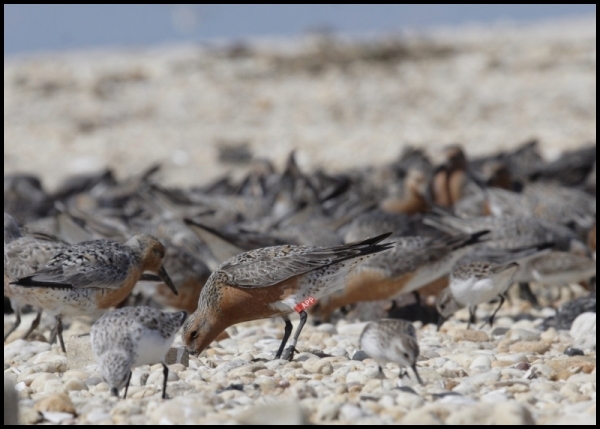
A banded red knot searches for food on a Delaware Bay beach.

This week for Animal Week, we will be spotlighting Shorebirds in the Media! Endangered red knots, ruddy turnstones, and other magnificent birds travel from South America to the Canadian Arctic during their migration, and make an important stopover along the Delaware Bay Shore from May to June.

The 2014 Shorebird film, “A Race Against Time” celebrates the Delaware Bay Beach Restoration

The film can now be enjoyed for free on our website:

Click here to enjoy this film! 

Greener New Jersey Productions this spring produced a 30-minute film documenting the ambitious campaign by Conserve Wildlife Foundation, American Littoral Society and other partners to restore Delaware Bayshore beaches decimated by Hurricane Sandy. This project ensures that the at-risk horseshoe crabs and globally migrating shorebirds relying on this habitat can survive.

Conserve Wildlife Foundation of New Jersey and the Endangered and Nongame Species Program (ENSP) of the New Jersey Department of Environmental Protection’s Division of Fish & Wildlife, and New Jersey Audubon have partnered for many years to conduct research on Delaware Bay shorebirds in order to prevent their decline.