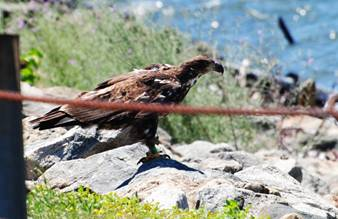
CWF Spotlight on Theresa Laverty, Field Technician

Theresa Laverty, Field Technician, Beach Nesting Bird Project

It’s another cloudy day and I scan the beach with my binoculars. No dogs. Only a handful of fishermen dot the water line. I return my focus to the small area towards the dune line, where a high concentration of shells lies. Look for two intact clamshells just in line with where the beach entrance should be. Without the binoculars, I find the location. It is not until I use my binoculars, however, do I spot the Piping Plover incubating a four-egg nest in that exact spot. Camouflage works wonders, I remind myself.

Since late April, I have been working as a seasonal beach nesting bird field technician. Our four main species of focus are Piping Plover, American Oystercatcher, Least Tern, and Black Skimmer. While the latter two species form colonies where they lay their eggs, the former two species defend territories as pairs. All four can be found on the same beach, however, which leads to lots of interesting interspecific and intraspecific interactions. Oystercatchers chasing plovers, terns dive bombing oystercatchers, etc., etc.… My job is not focused on those behaviors, however. My tasks include bimonthly surveys of the tern/skimmer colonies and recording the nesting success of plovers and oystercatchers. How many eggs are laid, how many eggs are predated, how many eggs hatch, how many chicks are predated, and, everyone’s favorite scenario, how many chicks fledge (i.e. reach the stage where they can fly)? Some of the birds are also banded, which allows for individual identification and adds another layer to nesting success when the birds return year after year.

A big part of my job is also dealing with the public, and as with any field site, there are those that appreciate what I do and those that are against it. While I prefer the former, I am well aware of the arguments from both sides having grown up in Ocean City myself. I am particularly interested in human-wildlife interactions, so I really appreciate the opportunity to work with the local community. I began working in the field of ecology and conservation biology in college, but most of my previous work has been international. I looked at crocodilian diets in Peru, studied the behavior of mountain gorillas in Uganda, researched the effects of landscape management on carnivore and wildlife populations in Kenya’s savannas, but this has been my first experience working with birds and working in what is basically my backyard.

With chicks now hatching up and down the New Jersey coastline, I feel busier than ever trying to ensure these little guys have a chance to beat the odds and make it to fledging. Some days that means a lot of physical work- expanding fenced off areas to give them a little more of a buffer between the public- or sometimes it means a lot of social interaction- enforcing the law of no dogs on the beach or keeping children from chasing after the chicks at the water’s edge, where the birds feed. I know that when I leave New Jersey to begin graduate school this August, it will be hard to say goodbye to an amazing summer back home. This is an incredible opportunity to apply my skill set and wildlife conservation goals back here at home and watch these often overlooked birds through this nesting season and hope for continued success in the years to come.

Shorebirds, Horseshoe Crabs and Stewards…

together on the Delaware Bay

by Larissa Smith, Wildlife Biologist/Volunteer Coordinator

Shorebird Steward Liz Hermosa shows beach visitors a clump of horseshoe crab eggs on Cook's beach.
Shorebird Steward Liz Hermoso shows beach visitors a clump of horseshoe crab eggs on Cook’s beach.

Once again migratory shorebirds, including the NJ endangered red knot, have returned to the Delaware Bay to feed on horseshoe crab eggs.  This annual phenomenon brings people from around the world to the Delaware Bay beaches.

Beaches are closed during the migration from May 7th through June 7th to protect the shorebirds from disturbance when feeding.  Just as the birds return each year so do volunteer Shorebird Stewards who educate the public about the beach closures , shorebirds and horseshoe crabs on nine beaches in Cape May and Cumberland County.  Now is a great to come out to the beaches to view shorebirds and crabs and say “hi” to the stewards.

This year the hot spots for shorebirds  in Cape May County  are Reed’s , Cook’s  and Kimble’s Beaches and  Fortescue in Cumberland County.


Tracking eagles in NJ

Merrill Creek female with transmitter May 29, 2102© Kathy Clark
Update On Merrill Creek Birds

By Larissa Smith Wildlife Biologist/Volunteer Manager

Back in August I wrote a blog update on two eagles fitted with transmitters at Merrill Creek Reservoir.

http://www.conservewildlifenj.org/blog/2012/08/06/a-year-in-the-life-of-a-juvenile-eagle/

The male eaglet was fitted with the transmitter in July 2011.  In September 2011, the male flew as far west as Harrisburg, PA, and in January 2012 spent a few days in the upper Chesapeake Bay in Maryland.  After that he spent the majority of his time in New Jersey and eastern Pennsylvania.

In early January, 2013, biologists became concerned when the signal from the transmitter was not moving.  A team of biologists from the ENSP’s Clinton office went out to search the area but were not able to locate the bird.  Another attempt was made on January 18th and the bird was found dead in the shoulder of the highway.  The carcass was saved for later examination to determine the cause of death, though we suspect it was struck by a vehicle.  The transmitter was still attached to the bird, and it will be refurbished and placed on another eaglet this nesting season.

So far, two out of the three eaglets outfitted with transmitters have not survived.  Juvenile eagles have a high rate of mortality as they learn to live on their own and aren’t yet the most skilled hunters or fliers.  We are learning a lot about these young eagles and their habitat choices and migratory movements.  Unfortunately, we are also learning that they face many perils in the wild, as we have seen with the first eagle infected with West Nile virus, and the second struck by a vehicle.

In May, 2012, a transmitter was placed on the largest of three eaglets in the Merrill Creek nest.  She fledged in July and remained in the nest area until September 10, when she took a quick flight south.  She continues to be tracked around the southern tip of the Delmarva Peninsula in coastal Virginia, a favorite wintering area for many immature eagles.  To follow her movements (and to see the movements of the other eagles) go to: http://www.merrillcreek.com/eagletracking.html.

Photos From the Field

Oystercatcher Technician shows diversity of tasks in wildlife conservation

By Alfred Breed, CWF Technician

My official job title with Conserve Wildlife Foundation of New Jersey is  “American Oystercatcher Technician”.  As such I am tasked during nesting season with monitoring Oystercatcher nesting sites, and during migratory season with locating flocks of Oystercatchers, counting them, resighting marked birds in each flock, recording data of field survey results and reporting our NJ counts and resights to a central database that holds data from the other reporting states in the migratory flyway.

As is usually the case in any job that has a “description”, the phrase “and other such tasks as assigned” is included as a catch-all for things that aren’t specifically listed in the description, but can be an important part of the duties of the position nonetheless. In my case these ancillary tasks are different each day, and often involve three of my favorite things: wildlife (of course!), science, and gear.  Working around my Oystercatcher surveys, which can only be conducted at high tide, I might be tasked to go to a location anywhere in the state and survey for a particular species of plant or animal; or to site select, construct, install, use, maintain, and troubleshoot various types of data collection or other equipment throughout South Jersey.

Trucks, trailers, boats and kayaks are the big-ticket items that I use every day, but I’m lucky enough to use a large variety of other cool tools and equipment as well. Driving is often a big part of my day, with travel times between sites eating up significant portions of the workday.  Sometimes I’m a wildlife EMT or ambulance driver, saving sick or injured animals from their immediate predicament and/or transporting them to various certified rehabilitation facilities located throughout the state.

Best of all is when I’m asked to assist visiting scientists or other conservation partners in their work, which can mean bio-sampling or banding.  Direct human/wildlife interaction is only appropriate when it is  for valid scientific or conservation management purposes, and is sanctioned and a permit issued by the appropriate governing body.  To be a staff member and so to be included in these sanctioned and permitted activities is a rare privilege indeed.

Each day is different, always interesting, occasionally exciting, and always personally rewarding as I play a small part in the management of threatened and endangered wildlife and the habitat that we share.

2012 is a Record year for nesting bald eagles in NJ.

NJ Bald Eagle population continues to increase.

by: Larissa Smith Wildlife Biologist/Volunteer Manager

Three chicks at the Kettle Creek nest © Alex Tongas

In 2012 a new record high of 135 eagle pairs were monitored during the nesting season. One hundred and nineteen of those were active which means they laid eggs.  A total of 165 young were produced this year and fledged (left the nest). That is 46 more than 2011’s 119 young produced.  Twenty-seven new eagle pairs were found this season, 15 in the south, 2 in central and 10 in northern NJ.  While all of these numbers are good news for NJ eagles they still need protection.  The two major threats that bald eagles in NJ face today are disturbance and habitat loss.

The NJ Bald Eagle Project has a dedicated group of volunteers who monitor nests throughout New Jersey.  They help to prevent disturbance at nest sites by educating the public about eagles.  The success of the eagle project is directly related to these wonderful volunteers.

Spruce Run Reservoir © A. W. Gumulak

More details on the 2012 nesting season will be available in the 2012 NJ Bald Eagle Project report.


Have You Seen This Bird?

LOOKING FOR HELP FROM BIRDWATCHERS TO FILL-IN DATA GAPS

By Michael Davenport, Marine Species & GIS Programs Manager

Young barn owls. Photo by MacKenzie Hall.

Conserve Wildlife Foundation staff work with the New Jersey Endangered and Nongame Species Program (ENSP) to manage and populate the state’s official database of rare wildlife, known as Biotics.  Currently, this database contains over 35,000 animal and plant records within New Jersey.  ENSP and CWF currently collect and enter data for the state’s 173 endangered, threatened, and special concern species.

There are several species of birds for which more observation data would be useful; and it’s likely that birdwatchers or other nature watchers may have the data needed.  Most good birdwatchers keep logs of what they’ve observed, when, and where.  It would be helpful if anyone with detailed observation data for the species listed at the end of this blog could submit their data for potential inclusion in the Biotics database.

To submit your observation data, please complete a Rare Wildlife Sighting Report Form.  The form is available on ENSP’s website for download as well as instructions for completing the form (a map must be attached when submitted).  In addition to the species listed below, please feel free to submit one or more forms for any of the state’s endangered, threatened, or special concern species.  A complete list of all of the species tracked by the state can be downloaded here.

If you have a large amount of data to submit, please contact Mike Davenport of Conserve Wildlife Foundation at (609) 292-3795 – alternative data submission options may be available (such as submitting Excel spreadsheets or GIS files).

Barn Owl (Tyto alba)
Nashville Warbler (Oreothlypis ruficapilla)
Saltmarsh Sparrow (Ammodramus caudacutus)
Sharp-shinned Hawk (Accipiter striatus)
Spotted Sandpiper (Actitis macularius)
Whimbrel (Numenius phaeopus)
Winter Wren (Troglodytes hiemalis)

A year in the life of a juvenile eagle…

Male eagle with transmitter sighted June 28, 2012 at Spruce Run Reservoir, NJ © William Gumulak
Update on tracking NJ eagles

by Larissa Smith, Wildlife Biologist/Volunteer Manager

In June of 2011 two chicks (male & female) from the Merrill Creek Reservoir eagle nest in Warren County were fitted with solar-powered transmitters that are monitored via satellites. The males movements have been tracked for over a year starting when he left the nest in June.  You can see the eagles movements by going to: http://www.merrillcreek.com/eagletracking.html  In September the male flew as far West as Harrisburg, PA and in January spent a few days at the upper Chesapeake Bay in Maryland.  He has spent the majority of his time in New Jersey and Eastern Pennsylvania. It is very interesting to see where the eagle is spending his time and the type of habitat he is using.  When you go to the map you can zoom in to get a close up look at his locations.

Unfortunately the female chick died in October due to starvation. She tested positive for West Nile Virus which could have contributed to her death.  The transmitter was recovered from the female and in May of this year the transmitter was placed on the largest of three chicks, a female, in the Merrill Creek nest.  She just recently left the nest and is still in the area of the nest taking short flights. To follow her movements go to http://www.merrillcreek.com/eagletracking.html


Female eagle with transmitter placed May 29, 2012 © Kathy Clark


Landowner Recognized…

for his contributions to the NJ Bald Eagle Project

by: Larissa Smith, Biologist/Volunteer Manager

Landowner Robert Johnson with Eagle Project volunteers Earl and Mary Ellen Holton.

Landowners are an important component of the NJ Bald Eagle Project since fifty-six percent of  eagle nests are found on private property in NJ.  This year we recognized a landowner for his contributions to the project over the years.  Mr. Robert Johnson has had a pair of eagles nesting on his property in Cumberland County since 2003.  He has always been very protective of the pair and makes sure that they aren’t disturbed during the nesting season as well as keeping the nest observers updated on any activity that he has seen or any problems. He helps the volunteers by cutting the grass in his field so that they can drive in and park when monitoring the nest. This year when the volunteers truck got stuck in the mud at another close by nest Mr. Johnson came with his backhoe and pulled them out.

Mr. Johnson received a certificate of appreciation and an  eagle frame handmade by CWF biologist Ben Wurst www.reclaimednj.com.  The photo in the frame was of Mr. Johnson holding an eagle chick during a eagle banding on his property.

On behalf of the NJ Bald Eagle Project we thank Mr. Johnson for his dedication to NJ eagles.


Interview with Joanna Burger, “Life Along the Delaware Bay” co-author

How long have you been involved in the Delaware Bay?

I first censused shorebirds in Delaware Bay in the late 1970s as part of a project to determine how important Delaware Bay, Barnegat Bay, and Raritan Bay were to migrant shorebirds, and we discovered the masses of shorebirds foraging there. After that, birders flocked in masses to see the thousands of shorebirds using the bay. Well over 100,000 knots, and large numbers of other shorebirds regularly moved through the bay, and the numbers have declined since then.

How did you get interested in the region and its wildlife?

I have loved the shore and all the wildlife along it since coming to New Jersey. The whole Jersey shore teems with a wide diversity of birds, as well as other creatures. We have some of the largest and healthiest colonial waterbird colonies along the Atlantic Coast, and the Delaware Bay ecosystem is among the most enchanting and interesting ecosystems along the US East Coast. Once I came to Rutgers, I began studying birds along the Atlantic coast and along Delaware Bay. Since the shorebirds move through Delaware Bay in the early spring, I can study them there as well as the colonial nesting birds in Barnegat Bay.

Why should the shorebirds that move through Delaware Bay be protected?

The shorebirds that move through the bay each May and early June have migrated from a long distance, and have yet to fly to the Arctic to breed. These are long distances, and the ones that arrive from South America have depleted their body of all fat. Knots, for example, may weigh as little as 100 grams when they arrive, and have to nearly double their weight so that they can fly to the Arctic to breed. They not only have to reach the Arctic, but they need enough food resources (body fat) to lay eggs as there is little food when they first arrive.

Basically the shorebirds have 10 days to 2 weeks to nearly double their body weight. That is a lot of pressure, and they need safe places to roost at night, and to forage during the day.


What has the shorebird work shown us?

We have learned how important the Bay is to the survival of Red Knots, Sanderlings, Sempalmated Sandpipers, Turnstones, and others; how critical it is to protect the foraging shorebirds so they can gain weight; how long the flights of Red Knots are (in distance and in time); and our recent work with geolocators has even shown us how many knots can actually begin incubation once they reach the Arctic. The use of geolocators has allowed us to know where Red Knots are during their entire cycle, from Delaware Bay to the Arctic, from the Arctic to their wintering grounds (some going as far as Tierra del Fuego), to their return to Delaware Bay.

You work on laughing gulls – what should the reader know about these birds that makes them so interesting to you?

Laughing Gulls are native to New Jersey, and the breeding population in New Jersey is the largest along the Atlantic coast. Laughing Gull increased in the 1960s through the 1980s largely because open garbage dumps provided an easily accessible food supply, and young that might otherwise have starved after the breeding season, did not. Thus, the population slowly increased. But then there were massive efforts to control Laughing Gulls at Kennedy Airport, and thousands were killed. The combination of this effort, along with the closing of garbage dumps has resulted in a decline of Laughing Gulls in New Jersey.

While it may appear that Laughing Gulls are competing with the shorebirds for horseshoe crab eggs on Delaware Bay, the main problem is that when people (or dogs, boats) disrupt foraging shorebirds and gulls, the gulls can return more quickly than the shorebirds, and so they can displace the shorebirds from the best foraging places. It is thus very important to keep people and dogs off the shorebird foraging beaches when the shorebirds are present.

Why did you get involved with writing “Life Along the Delaware Bay?”

I feel very strongly that Delaware Bay is one of the East Coast’s Jewels. It needs to be understood and protected for both the natural ecosystem and for our human needs. The shorebirds, and the Delaware Bay ecosystem, can survive and do very well in the presence of people if we manage the Bay in a manner that is positive for both the ecosystem and people. The bay should flourish, allowing oystermen to farm their oysters, commercial fishermen to have sufficient fish stocks, for recreational fishermen to have good catches, for people to walk and swim, and for all of us to enjoy the Bay, while also allowing the natural ecosystem to flourish.

This will not happen, however, unless people love and appreciate the Bay. There are many many books on Chesapeake Bay, but none on Delaware Bay that takes the broad ecosystem approach that our book does. But more importantly, this is a wonderful and beautiful book that allows us all to appreciate and celebrate the bay.

The creation of the book was a joint effort among scientists, photographers, conservationists and environmentalists, commercial interests, and others who all hellped contribute pictures, ideas, writing, and the support to produce the book, and I am grateful for everyone’s support.

What would you like the reader of “Life Along the Delaware Bay” to learn about this important ecosystem?

That it is one of New Jersey’s truly wild and wonderful places. A place where recreational, commercial, and ecological interests can survive and flourish together. We must preserve it for generations of children, as well as the generations of crabs, fish, and birds that live there.


“Life Along the Delaware Bay” can be purchased through CWF’s online store.


Using a Decoy to Study Endangered Warblers

BANDING GOLDEN-WINGED WARBLERS

By Michael Davenport, Marine Species & GIS Programs Manager

Conserve Wildlife Foundation Intern, Nelson Melendez, and I recently had an opportunity to assist Endangered & Nongame Species Program Biologist Sharon Petzinger in her research on golden-winged warblers, a species just added to the state’s list of Endangered species this year.  We were banding males which had been observed previously and had already claimed breeding territories.  They were being banded in order to obtain data regarding their distribution and habitat use, as well as other life history information.

Only males were being targeted for banding.  Males are territorial during the breeding season and do not tolerate the presence of other male golden-winged warblers.  Therefore, in order to catch a male, we would use their own territorial instincts to lure them into a mist net (a mist net looks a little like a volley ball net with much finer netting which becomes invisible to birds if set-up properly).

Once a mist net was set-up near a known golden-winged’s territory, Sharon used a custom-painted “toy” bird to play the role of an unwelcome male visitor.  She also used a call play-back, a recording of a male golden-winged’s song.  The song would lure the male near the net, and the decoy should bring him right into the net.

We went to several locations in northwest New Jersey where golden-winged warblers had been observed earlier in the year to set-up the mist net.  On this particular day, however, luck was not with us for no golden-winged warblers were caught.  Several other species were captured however, such as a veery, chestnut-sided warbler, and a Brewster’s warbler.  The Brewster’s warbler is actually a hybrid of a golden-winged warbler and a blue-winged warbler.  Another hybrid form between those two species is known as Lawrence’s warbler.

CWF Intern, Nelson Melendez, holding a chestnut-sided warbler. Photo by Mike Davenport.

The veery and chestnut-sided warbler were released from the net unharmed.  Before the Brewster’s was released, a small aluminum band was placed on its leg and measurements such as wing length and weight were taken.

Warblers are often an overlooked group of birds by some birdwatchers due to their small size and relative difficulty in observing.  They are stunningly beautiful however, which becomes apparent when you have the opportunity to view them up-close.  They are a very diverse species group with a variety of interesting life histories.  There is currently one species (the golden-winged) listed as Endangered in the state and 11 additional species listed as Special Concern.  To learn more about them, please visit our on-line field guide links below.


NJ’s Rare Warblers

Golden-winged Warbler (Vermivora chrysoptera)
Blackburnian Warbler (Dendroica fusca)
Black-throated Blue Warbler (Dendroica caerulescens)
Black-throated Green Warbler (Dendroica virens)
Canada Warbler (Wilsonia canadensis)
Cerulean Warbler (Dendroica cerulea)
Hooded Warbler (Wilsonia citrina)
Kentucky Warbler (Oporornis formosus)
Nashville Warbler (Oreothlypis ruficapilla)
Northern Parula (Parula americana)
Worm-eating Warbler (Helmitheros vermivorum)
Yellow-breasted Chat (Icteria virens)