Updated Story Map Showcases Bald Eagle Nest Locations from 1985-2015
by Brian Henderson, GIS Specialist
Photo by Northside Jim
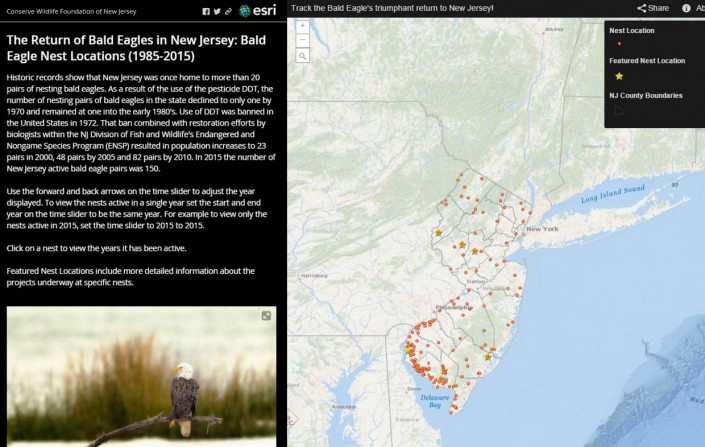
Our story map The Return of Bald Eagles in New Jersey has been updated based on the 2015 Bald Eagle Project Report. The story map shows the locations of every eagle nest known to be active (meaning they laid eggs) in New Jersey since 1985 — the year when there was only a single nest in the entire state. The map presents an animated depiction of where eagles have nested each year, so you can track the bald eagle’s triumphant return to the Garden State! Viewing the animation shows you how eagle nests spread from a single point in Cumberland County across all of New Jersey through the years.
The story mapalso highlights a number of Feature Nests which include more detailed information about the projects underway at specific nests, such as the Duke Farm nest which has been featured on our EagleCam since 2008.
The number of nesting pairs of bald eagles has steadily increased each year. This trend continued in 2015 with a record 150 active pairs, which was a slight increase over 146 such pairs recorded in 2014. In 2015, there were 122 nests that successfully fledged at least one young compared to 115 successful nests in 2014 and the 199 total young fledged in 2015 was only slightly less than the record 201 young fledged in 2014.
CWF biologist Kelly Triece to visit Honduras to observe Golden-winged Warblers in their Wintering Habitat
by Kelly Triece, Private Lands Biologist
Golden-winged Warbler. Photo by D. Kenny Golden.
CWF is headed down to Central America to see one of New Jersey’s native songbirds! This time of year the Golden-winged Warbler (GWWA) is in Central and South America. The GWWA is Neotropical Migrant songbird that breeds in New Jersey, but migrates south for the winter. This songbird is a species of special conservation concern in the U.S. and endangered in New Jersey, experiencing population declines due to loss of young forest habitat.
Conserve Wildlife Foundation biologist Kelly Triece will be traveling to Honduras next week to observe the GWWA in its wintering habitat. While she is there, she will be learning more about the wintering habitat requirements of the Golden-winged Warbler as well as the current threats and challenges facing the species in this part of the world.
Young forest habitat managed for Golden-winged Warbler. Photo by Kelly Triece.
The management of early successional habitat, or young forest habitat, is important in New Jersey because it provides breeding habitat and post-fledging habitat for the Golden-winged Warbler. In the past 30 years, over 11,000 acres of upland shrub and emergent wetland habitat have been lost to succession in New Jersey.
Today, 80% of New Jersey forests are between 60-99 years old, while only 5% of the forests are between 0-19 years old. In a naturally occurring system, where fire, wind, flooding and other disturbances are not controlled by humans, this age class would be more evenly distributed. Through management and proper forestry techniques, more diversity can be created to balance the age of the forest.
The Golden-winged Warbler is not the only scrub-shrub dependent bird species considered to be at-risk. About 85% of shrub obligate birds and 35% of forest birds are on the decline in North America. Some of the declining species are Prairie Warbler, Field Sparrow, Northern Bobwhite and American Woodcock. Additionally, woodland breeding birds are also at risk because many rely on young forest habitat for post-fledging. Therefore, the management of young forest habitat is not only specific to the Golden-winged Warbler, it is also important for many other avian species. Furthermore, other wildlife such as insects, reptiles and mammals will benefit from increased flowering plants and foraging habitat.
CWF and our partners — Natural Resources Conservation Service, New Jersey Division of Fish and Wildlife and New Jersey Audubon Society — have worked with private landowners to create or restore over 225 acres of Golden-winged Warbler habitat since 2012 in New Jersey. Our managed forests have a statistically significant higher diversity of birds than unmanaged sites!
Stay tuned for Photos from the Field next week as Kelly travels to Central America!
Insight into a Nocturnal and Enigmatic New Jersey Raptor
by Melanie Mason, Assistant Biologist
Barn Owls (Tyto alba) are one of the most widespread avian species in the world. Despite this impressive distribution, their numbers have been decreasing in parts of their range, and New Jersey is no exception. The extent of their decline isn’t fully known since barn owls are nocturnal and enigmatic, so it’s difficult to estimate their numbers. Although barn owls can travel great distances to disperse after fledging and to find prey, they don’t truly migrate. Therefore, there isn’t a breadth of migration data to sift through in order to triage their downward trend either.
The first step in species conservation is to understand its biology. Because barn owls aren’t migratory, they don’t have the intense energy requirements needed to fuel long distance treks to warmer climates, but the trade-off is they are at the mercy of their local prey abundance and availability. If you look at a distribution map of North American barn owls, you’ll see that New Jersey is close to the northernmost extent of their range. In fact, the majority of their subspecies/races are found in lower latitudes. Unlike their tropical kin, however, northern owls have to frequently survive freezing conditions and in order to do so, need food and lots of it!
Catching enough prey through New Jersey winters can be a challenge in and of itself, but if owls lack sufficient fat stores because of an unfavorable prey year (think hurricanes, floods, droughts, etc), they can easily succumb to cold conditions and die from exposure. The reality is that many young owls do not survive their first winter — a very steep learning curve.
Their preferred prey is meadow vole which are close relatives of lemmings — made famous for their explosive populations during favorable years. In order to respond to sweeping changes in prey availability, the reproductive strategy of barn owls is atypical for most raptors. Where small clutches and high parental investment are the norm, instead, barn owls are capable of breeding year round in favorable conditions (generally fall/spring here in New Jersey) and can have large clutches in order to respond quickly to prey availability. Another uncommon and well-documented strategy is polygyny — where one male sires and provides for multiple nests.
These reproductive strategies are important since barn owls are not a long lived species and typically do not survive much longer than five years. Their saving grace is their ability to “bounce back” and quickly repopulate local areas. This is where we can help!
Barn owls get their name from their close association with humans. They hunt in marshes, fields and grasslands typically favored for agriculture. They frequently nest in structures like old barns, buildings and silos. Constructed structures such as barns and nest boxes are generally preferred over natural cavities (dead or hollow trees for example) because they are safer from predators, more protected from the elements and have a vast supply of mice and voles at their doorstep. As silos and old barns fall down or are torn down in favor of newer, longer lasting metal structures, these nest boxes are even more critical to provide nesting opportunities.
The goal of our barn owl project is to provide safe nesting structures for barn owls in suitable habitat throughout the state. We also hope to gain insight into owl occupancy and nesting success in previously un-monitored areas of New Jersey.
Four ways to help barn owls:
Report any sightings, any time of year. While we are most interested in bolstering the breeding population, identifying winter habitat is critical as well.
Barn owls are better for the environment than barn cats since they are native and don’t kill songbirds, so consider housing barn owl instead! They’ll alleviate your rodent problem without the cost of feeding and risk of unwanted litters.
Don’t use rodenticides! They can harm or kill barn owls (and many other species too), plus owls often do a better job than poisons and are safer for everyone.
The generous support of Washington Crossing Audubon Society provided quite literally the nuts and bolts of the fledgling nest box project by facilitating purchase of supplies for nest box construction — a million times thank you!
Update from Brazil: “We are Going to Have to Science the ‘Heck’ Out of This”
by Dr. Larry Niles, LJ Niles Associates LLC
We came to Brazil to conduct a rigorous scientific study of the wintering population of shorebirds in a place where the land and sea act against any rigorous protocol. It would be easier to just go out and count birds and identify their habitats and prey, but our charge is more difficult.
The survey wraps around satellite imagery, strange unintelligible wavelength data coming from satellites hovering over the earth that can be transformed into brilliant and useful maps in the right hands. Those hands belong to Professor Rick Lathrop and his post doc Dan Merchant. Rick leads the Center for Remote Sensing at Rutgers and he and I have collaborated on projects ranging from municipal habitat conservation planning to Arctic red knot habitat mapping. He has created one of the most alarming maps that every person from New Jersey should know about.
The mapping of Reentrancias Maranhenses, an internationally recognized site of ecological importance is especially tricky. Our research platform is a 50-foot boat and we will be out of cell and internet contact for much of the time. Our method of collecting data for the mapping was devised by the whole team, but especially with the help Professor David Santos of the University of Maranhao, my colleague Dr. Joe Smith and Humphrey Sitters of the International Wader Study Group.
Our 50-foot catamaran
It focuses on collecting bird and habitat information using randomly selected survey points. In other words, we will try to pick places at random to survey so that when we combine them we will have a sample that represents the entire area, not just the places we surveyed. It’s like trying to figure how many different kinds of chocolates are in a valentine. If you take them all from one side then you might have sampled the chocolate covered cherry section leading to believe they are all one kind. But if you choose chocolates at random than you will find the box includes other kinds, caramel or fruit or nutty chocolates. This is making me hungry, but you get the point.
The area of our box we is very large, bigger than New Jersey, and it grows and shrinks every day with the tides. So, sampling is tricky business because a sample at low tide, when the tide is out exposing vast areas of intertidal mud and sand flat, is very different than when the tide is high. So we will be classifying habitat, or stratifying it, so we can focus on limited survey time to get the best sample.
Once collected we can start making maps. All data will be geo referenced – or located precisely with GPS units – so it can be accurately mapped. With this, we will train the satellite maps to outline the habitat best for shorebirds.
All this while exploring areas that have received little scientific scrutiny and under tropical conditions, almost daily rain, a persistent 20 mph wind and summer heat. Add parasites, mosquitoes and diseases like malaria and one can see this a rugged undertaking.
Our crew is up to it. Besides those mentioned above Mark Peck from Royal Ontario Museum, Danielle Paluto from the Brazilian CEMAVE (a counterpart to our USFWS), Steve Gates a veteran of expedition on other SA trips, shorebird expert Dr. Mandy Dey, Stephanie Feigin from Conserve Wildlife Foundation of New Jersey and the author round out a dream team of bird study in difficult places.
On our Expedition to Study Shorebirds along the Northern Coast of Brazil
By: Dr. Larry Niles, LJ Niles Associates LLC
Ana Paula with Red Knot
The largest mangrove forest in the world covers the Brazilian coastline at the equator near the mouth of the Amazon river. The forest extends out into the Atlantic in long peninsulas tipped by wind swept and mostly inaccessible beaches. The forest, beaches and their long intertidal mud and sandy low tide flats support the largest wintering population of shorebirds in the hemisphere, perhaps the world. The red knot, a listed species in both North and South America, also uses this remote tropical coast.
Boat Trip RouteCatamaran
With scientists from the U.S., Canada, England and Brazil, we will attempt a large scale mapping of this important habitat using state-of-the-art satellite mapping. We will do this from a 50-foot catamaran and two zodiacs hopping from one mangrove estuary to another and conducting bird surveys targeting key areas over a 150 mile-section of the coast. We will be the first to survey some areas. Our goal is to figure out the main threats to both bird and habitat.
To understand the importance of this area one has to think about it like a shorebird. Although born in the Arctic they actually spend only a few months there. They spend a few months moving from their nesting area to their wintering area. They spend the rest of their lives, the majority of their year in the wintering area. A threat to the wintering area would be grave.
Most of our survey zone is part of the Reentrancias Maranhenses, a protected area of the state of Maranhao, Brazil. Our catamaran captained by William Thomas will leave from a small town near the city of Sao Luis, Brazil. From there we will sail along the coastline moving in and out of the mangrove islands to survey shorebirds, habitat and marine invertebrates. We will “geo reference” all data, or take detailed coordinates so the data can be reproduced on satellite mapping.
Satellite Map
Satellite maps aren’t really maps as most people understand — pictures or drawings of a section of the earth — they are digital files of remotely sensed data, they are only wavelengths of light that must be interpreted to represent actual habitat. We will train the satellite data so that each habitat will be represented by a combination of spectral data — colors in sense.
Environmental disturbance. Photo by Mark Peck.
Once completed, we can relate the habitat maps with information on birds, their prey and equally important, the threats to the birds and prey. For example, shrimp farming is growing in this area. Entrepreneurs are stripping the intertidal zone of mangrove forest, diking the area and then growing shrimp. Once the area accumulates too much waste and chemicals, they abandon the site and move on to damage another mangrove forest. We will determine which areas are of importance to the birds and potential targets for shrimp farmers. But there is more: oil spills, disturbance from tourists, water pollution are among many.
Over the next three weeks, we will be reporting on our work on this blog.
Conserve Wildlife Foundation of New Jersey today released the 2015 Bald Eagle Report, highlighting the number of nesting pairs, active nests and nest productivity for the raptors throughout New Jersey with data collected by New Jersey Department of Environmental Protection Division of Fish and Wildlife biologists, CWF biologists and committed volunteers.
“With 161 pairs of bald eagles this past year — up from just a single nest in the early 1980’s — the dramatic ongoing recovery of bald eagles across the northeast continues to inspire so many of us,” said David Wheeler, Conserve Wildlife Foundation Executive Director. “The thrill of seeing a bald eagle fly across the sky is unparalleled. This report captures how these eagles are continuing their All-American return.”
The report notes that thirteen new eagle pairs were found this season, nine in the south, two in Central Jersey and two in Northern New Jersey.
With a wingspan of six to seven feet, bald eagles are larger than most birds. The bald eagle is restricted to North America and is usually found within close proximity to open water. In New Jersey, bald eagles reside year-round, usually remaining in the area surrounding their nest. They begin courtship and nest building in late December and January, adding to their existing nest. Over time, some nests can reach 10 feet across and weigh up to 2,000 pounds.
Conserve Wildlife Foundation partners with Duke Farms on a webcam that provides a live look at a bald eagle nest in Hillsborough, New Jersey. This spring, the EagleCam will allow viewers an up close and personal view into the lives of a pair of bald eagles as they breed, incubate, and raise young. Between the general public and classrooms up and down the east coast, the EagleCamhas many fans – over 10 million viewers and growing!
The federal government removed the bald eagle from its list of Endangered Species in August of 2007, but the bald eagle’s official New Jersey status remains state-endangered for the breeding season and state-threatened for the non-breeding season.
“One of our encouraging findings is that the population of wintering bald eagles has grown along with the nesting population over the past decade,” said Conserve Wildlife Foundation eagle biologist Larissa Smith. “This growth reflects the increasing populations in New Jersey and across the northeast, as recovery efforts continue to pay off for eagles. In addition to our fellow scientists in New Jersey and nearby states, I’d like to thank the wonderful eagle project volunteers who make keeping track of all these nests possible.”
The Division of Fish and Wildlife’s Endangered and Nongame Species Program (ENSP) bald eagle recovery efforts, implemented in the early 1980’s, have resulted in a steady recovery of New Jersey’s bald eagle population. ENSP biologists, Conserve Wildlife Foundation of New Jersey staff, and volunteer observers continue to locate and monitor bald eagle nests and territories each year to analyze the state of the population. The state’s eagle population would not be thriving without the efforts of the dedicated eagle volunteers who observe nests, report sightings, and help protect critical habitat.
The statewide population increased to 161 territorial pairs in 2015, up from 156 last year.
Thirteen new eagle pairs were found this season, nine in the south, two in central and two in northern New Jersey.
One hundred-fifty pairs were known active (meaning they laid eggs), up from 146 last year.
One hundred twenty-two nests (81%) were known to be successful in producing 199 young, for a productivity rate of 1.33 young per known-outcome active nest, which is above the required range of 0.9-1.1 young per nest for population maintenance.
One chick, orphaned from a Maryland nest, was fostered into a Cumberland County nest and fledged, bringing the total fledged to 200.
Twenty-eight (19%) nests failed to fledge young.
The Delaware Bay region remained the state’s eagle stronghold, with 40% of all nests located in Cumberland and Salem counties.
Sandy Hook Christmas Bird Counters Delighted by White Pelicans
by Lindsay McNamara, Communications Manager
“American White Pelican” by Manjith Kainickara – originally posted to Flickr as American White Pelican.
My alarm was set for 4:00 AM on December 20, a Sunday morning. I woke up excited and eager to start the day. My phone started going off with text messages from friends about our meeting location. As any birder will tell you, this scenario is far from uncommon — we love our birds! and will likely wake up at any time on any day for a chance to add another species to our life list.
I woke up early to look for owls to tally in the Sandy Hook Christmas Bird Count (Highlands and Atlantic Highlands territories are included in the Sandy Hook count). Our team drove through Hartshorne Woods Park in Highlands, New Jersey, in search of the nocturnal raptors. I thought the highlight of my day would be hearing two great horned owls calling to each other as first light came over the woods. While this was exciting (and definitely worth getting up at 4:00 AM for), I was in for another treat.
By 7:00 AM, our team grew into a group of six “bird nerds.” We were surveying the Navesink River, counting waterfowl, herons, songbirds and gulls, when Monmouth County Audubon Society‘s Rob Fanning yelled “three white pelicans”and sure enough, the pelicans were flying around the Oceanic Bridge in Rumson! I missed them the first time, but luckily the birds came back around and we were all able to watch them fly and swim through the scope. We shouted, laughed, smiled and high fived each other. One of my favorite aspects about birding is how quickly wildlife brings people together. Suddenly, we were the dream team.
Three White Pelicans. Photo by Lisa Fanning
According to Cornell Lab of Ornithology, American white pelicans are one of the largest North American birds — considerably larger than a bald eagle, but smaller than a California condor. They feed from the water’s surface, dipping their beaks into the water to catch fish, such as minnows, carp and suckers. White pelicans often upend, like a large dabbling duck, in this process. They do not plunge-dive the way Brown Pelicans do.
They are superb soarers (they are among the heaviest flying birds in the world) and often travel long distances in large flocks by soaring. Adult American White Pelicans are snowy white with black flight feathers visible only when the wings are spread.
Northern breeding populations migrate to southern California, the Gulf States, Mexico, and Central America. White pelican populations breeding in Texas and Mexico are resident populations.
White Pelicans in Flight. Photo by Lisa Fanning
The pelicans, first spotted by Rob, were the first Sandy Hook Christmas Bird Count (CBC) record in the 39-year count history! We saw the “three amigos” again later in the day at Many Mind Creek in Atlantic Highlands flying towards Staten Island.
Incidentally, three white pelicans were reported on December 27 in Connecticut. Our team wonders if those are our buddies. Monmouth County Audubon Society’s Lisa Fanning also stated that there have been up to five in Maryland, but she believes a small population may winter there. There are a number of winter records in eBird, mostly of a handful of birds (one report of up to 21 on January 1, 2012) at Blackwater NWR in Maryland.
During the 39th Sandy Hook CBC, 101 species were tallied. Each year, from December 14 through January 5, tens of thousands of volunteers throughout the Americas collect data used by scientists to study the long-term health and status of bird populations across North America. CBC informs strategies to protect birds and their habitat, and helps identify environmental issues with implications for people too. Find a count near you on Audubon’s website.
Lindsay McNamara is the Communications Manager for Conserve Wildlife Foundation of New Jersey.
CWF and partners have created or restored over 225 acres of Golden-winged warbler habitat in New Jersey since 2012
by Kelly Triece, Private Lands Biologist
Golden Winged Warbler. Photo by D. Kenny.
Take a look at this Golden-winged warbler — a Neotropical Migrant songbird that breeds in New Jersey. This songbird is a species of special conservation concern in the United States and endangered in New Jersey, experiencing population declines due to loss of young forest habitat.
Did you know? In the past 30 years, over 11,000 acres of upland shrub and emergent wetland habitat have been lost to succession in New Jersey. This habitat is important for Golden-winged warblers because it is their primary breeding habitat. Fortunately, their secondary habitat, upland forests, have remained stable in the state.
Therefore, it has been the goal of many wildlife management agencies to continue to create young forest habitat, while protecting upland forests as well.
Conserve Wildlife Foundation and our partners (Natural Resources Conservation Service, New Jersey Division of Fish and Wildlife and New Jersey Audubon Society), have worked with private landowners to create or restore over 225 acres of Golden-winged warbler habitat since 2012 in New Jersey.
Our managed forests have a statistically significant higher diversity of birds than unmanaged sites!
Young forest habitat managed for Golden-winged warbler. Photo by Kelly Triece.
Young forest habitat, also known as scrub-shrub habitat, is new or regenerating forest that is less than 20 years old. Young forest habitat is important for many birds, especially the Golden-winged warbler. The open canopy of a young forest also helps provide food such as berries and insects to newly fledged birds, wild turkey, ruffed grouse, reptiles, black bears, bobcats, and butterflies.
Golden-winged warbler home range
The breeding range of the Golden-winged warbler extends along the Appalachians from the northern portion of Georgia in the south to Vermont in the north. The winter range for this species is southern Mexico and Central and South America.
Follow us in February 2016 when biologist Kelly Triece travels to Honduras to see the Golden-winged Warbler in its winter habitat!
Volunteers and Students from Cape May County Technical School
One lucky pair of ospreys received a brand new nesting platform due to the effort of volunteers and students from the Cape May County Technical School! Dedicated osprey project volunteer Matt Tribulski reached out to CMC Tech Natural Science teacher Hanna Toft, regarding replacement of an aging platform in the Avalon back bay. Hanna is an osprey project volunteer and bander and incorporates the osprey project into her curriculum. The nest that was replaced was an old four poster that was unstable and not predator proof. The nest was located at the edge of the water causing the birds to get off the nest every time a boat or jet ski went by (which in the summer is quite frequently).
Hanna had a platform available that her students had built last year. We couldn’t have picked a better day for the install, the weather was gorgeous and warm for November. We met Hanna and eight of her students out on the water. The new platform was placed further back from the water and has a predator guard. The students removed the old platform, leaving some posts for the ospreys to perch.
We hope that the birds like their new home when they return in the spring.
Thank you to Matt, Hanna and her students for all of their help!
by Laura Hardy and Pam Prichard, Beach Nesting Bird Field Technicians
“Where’s Waldo” – Black Skimmer Edition, as the colony takes flight. Photo by Sushanth Allapalli.
by Laura Hardy:
New Jersey’s largest breeding colony of black skimmers is an uncommon joy. I’ve stood many hours this season totally bemused by these boisterous barking birds. I’m thrilled when, en masse, the colony takes flight right over my head, in the purest National Geographic moment I might ever experience. However, as the colony’s primary monitor, my job isn’t to be dazzled by the birds – those candy-corn bills, the funny barking calls, the gorgeous choreography of their flight – instead it’s to conduct biweekly counts of the birds in order to monitor the colony’s size and productivity.
Every summer for the past several years, about 1,000 black skimmer pairs have nested on the little stretch of beach known as Seaview Harbor Marina; nearly 2,600 birds at its peak this season. Black skimmers, plus least and common terns, gather there in an incredibly noisy colony. Piping plovers and American oystercatchers nest on site also.
Laura Hardy, one of the blog authors, pauses as she attempts to count a colony of several thousand black skimmers. Photo by Donna L. Schulman.
Have you ever tried to count thousands of raucous swirling birds while being dive-bombed by hot-tempered terns? The first time I tried, I didn’t know how or where to start. I started over at least eleven times that first day just to be sure I was right. Even still, my boss saw my number and said I had probably underestimated the size of the colony. Argh!
During the next count, I briefly considered multiplying my tally by some random number like 1.4297363 in order to accurately reflect the number of birds my boss thought I should be seeing. Instead, he bought me a step stool that made seeing the birds much easier. Nesting adults had become obscured by growing vegetation in the colony — but the stool made me even more of a target for the dive-bombing terns.
During the next couple of count periods, as the colony continued to grow, I worried that I was compensating for the natural tendency to underestimate by over-estimating. The last two or three counts, with the colony at its peak and chicks all over the beach, I thought for sure I was hallucinating – there simply could not be that many birds!
Finally, all kidding aside, I’ve come to believe there is some art to the task but, for the most part, I approach counting as methodically as possible. I count individual birds in the colony, by species, and then check my accuracy by counting in groups of five or ten birds, then 50 or 100. It takes some practice to be able to visualize what 100 or 500 birds look like, but it’s useful to be able to estimate the number of birds you see in a quick glance because the colony will flush any number of times during a typical count day.
Counting is further complicated by the need to estimate the number of birds on nests, and then later in the season, the number of chicks that are near-fledging or already fledged (able to fly). I also had the opportunity to test my accuracy against aerial photos of the colony and was pleasantly surprised with the accuracy of my on-the-ground count.
All of this counting and recounting is important because it allows us to measure the reproductive success of the colony. Black skimmers, and all of our beach-nesting birds, put a huge amount of effort into breeding and the numbers show the Seaview colony had a very productive season with a minimum of 1,000 fledglings so far, but likely as many as 1,500… and still counting!
A recently fledged black skimmer chick stands out against the colony. Photo by Laura Hardy.
by Pam Prichard:
To those of us that monitor beach nesting birds in Monmouth County, black skimmers were known only by a simple drawing on our AREA CLOSED signs that are attached to the fencing erected each spring to help protect endangered piping plovers and least terns. This season, however, held an exciting surprise as we witnessed the formation of a significant new back skimmer colony in New Jersey. Sandwiched between two immensely popular and busy beaches (Belmar and Avon), the portion of Belmar’s beach along the Shark River Inlet played host to hundreds of least terns, common terns, a pair of American oystercatchers – and our very own celebrity skimmers.
The skimmers quietly started arriving in mid-June, a few at a time. Were they just hanging out? Or were they actually going to start laying eggs? As more appeared day by day before our incredulous eyes, the reality became undeniable. The skimmers were nesting, for the first time since this habitat was set aside to be “natural.” And wow, what a colony it became, with nearly 200 adult Skimmers!
The nests were somewhat hidden among sea rocket and seaside goldenrod in the middle of the site, and didn’t attract too much attention at first. It wasn’t until the chicks began to hatch and grow that the real show began. The adults brought the chicks out to the front of the beach and their fan base began to form.
Black skimmer fledglings executing their “infamous” sand flop. Photo by Pamela Jo Capone.
In the early mornings, the bird paparazzi (photographers) would arrive. Word had spread about the appearance of these strange looking, charismatic, comical yet majestic, and very photogenic birds. Everyone wanted a photo of adults skimming the water for fish or the tide line for crustaceans. They wanted to capture that moment when a chick was being brooded or fed. When the colony would all fly up at once, swooping and circling, making their distinctive barking puppy sounds, it was a stunning sight to see and hear. And let’s not forget the distinctive way they kick up sand, or flop down, as if their bill was just too heavy to hold up for one second longer. More than one person asked me if they were dead, and I admit, I would often hold my breath, until I thankfully saw some movement!
In addition to the steady stream of photographers, beachgoers visited the site every day to check on the busy colony and find out the latest news. People gathered in front of the fence to watch, enraptured, and to talk about what was going on. They returned day after day, bringing friends, and forging new friendships. Children looked through the scope to see the littlest of chicks, camouflaged so well in the sand. Many people told me they had never seen anything like this in Belmar. The black skimmers were the talk of the town!
A resident told me of growing up and playing behind a truck as it sprayed DDT. He said it has been wonderful to see so many species rebound in New Jersey, species like the osprey, eagle and now black skimmers right in Belmar. As of this date (they are not quite done yet), we have had nearly 150 skimmer chicks make it to the fledgling (flying) stage, no small accomplishment. The beach loving public here truly embraced the black skimmers, giving us lots of positive feedback. We all look forward to the return of our “celebrities” again next year.