Mapping Rattlesnake Dens in Northern New Jersey

PROTECTING WILDLIFE BY MAPPING THEIR HABITAT

By Michael J. Davenport, Marine Species & GIS Programs Manager

A juvenile timber rattlesnake at a den site. © Mike Davenport

Having accurately mapped rare species data is essential for insuring that critical habitat for those species remains protected.  For that reason, I recently accompanied Kris Schantz, a biologist from the NJ Endangered and Nongame Species Program, in documenting two timber rattlesnake den locations in northern New Jersey using a GPS (global positioning system) unit.  Our goals were to see if the rattlesnakes had emerged from hibernation, survey how many were present, and to accurately map their locations in the heavily wooded area less than 30 miles outside New York City.

Using a GPS unit to map a rattlesnake den. © Mike Davenport

Timber rattlesnakes (Crotalus horridus horridus), like other reptiles, are cold-blooded.  In order to survive through the long, cold winter in New Jersey, they hibernate in dens.  Research has shown that rattlesnake dens in the northern part of the state can vary from rocky outcroppings with crevices, ledges or boulders to forest interior dens consisting of a few rocks and a hole in the ground.  In New Jersey’s Pinelands, however, rattlesnake dens are quite different.  Rattlesnake dens in the Pinelands are usually underground crevices near bodies of water, often underneath large tree roots.

Rattlesnakes will almost always use the same den year after year.  In addition, rattlesnake young typically follow the scent trail of their mother in order to find their way to her den their first fall, or may follow any timber rattlesnake to a suitable den.  As a result, a good den site may provide a winter refuge for a number of rattlesnakes of all age classes, as well as other species of snakes.

Since the goal of our mission was to map den locations, we had to make sure we arrived at the den site once it was warm enough for the rattlesnakes to come out of their crevasses to bask but before they had enough warm weather to travel away from the den site.  Timing was crucial.  After a week with some fairly warm days mixed with very cool nights and a few cool days, we ventured out during the last week of April on a day when the air temperature climbed into the lower 80’s.

The first den site we visited required a fairly long hike through a rocky, deciduous forest.  Fortunately, Kris had visited both den sites several years earlier so she had a good idea of where we needed to go.  We were fortunate to find two individuals at the den site, one yellow-phase juvenile and one yellow-phase sub-adult or young adult.  While I GPSed the den site, Kris attempted to determine their sex based on their appearance (the young adult was a female but the juvenile’s sex could not be determined).

GPS units work when there is an unobstructed line of sight to four or more GPS satellites.  With 7-8 satellites being detected by the GPS unit, my task of mapping the site was fairly easy and took little time.  The trees had yet to leaf-out so my GPS unit had a clear signal from above.  We also observed a northern black racer (Coluber constrictor constrictor) at the den site.

The second den site required a much longer and more strenuous hike accompanied by swarms of black flies.  At that location, we observed three rattlesnakes – one black-phase adult (sex undetermined), one yellow-phase adult male, and one yellow-phase sub-adult or young adult (sex undetermined).  GPSing this location took a little more effort though due to the terrain both because it was more difficult to get to the site and once there, the terrain made getting a clear signal on the GPS unit a little more tricky and it took far longer than at the first den.

Out of the five rattlesnakes we observed, only one ever rattled.  Rattlesnakes rely on their camouflage as their first line of defense.  Even when we were close by, they remained motionless.  At no point did any of the snakes approach us or attempt to strike.  The only two individuals which moved at all during our survey, moved away from us into rock crevasses and that was likely due to our prolonged presence staring at them.

Snakes, and venomous snakes in particular, have an undeserved bad reputation.  At no point during our survey did I ever have any fear of being bitten by a rattlesnake.  In all honesty, I was actually far more afraid of being bitten by a tick instead (I only found about four or five on me during the entire day).

For more information on timber rattlesnakes, visit Conserve Wildlife Foundation’s on-line field guide to New Jersey’s rare species at:  http://www.conservewildlifenj.org/species/fieldguide/view/Crotalus%20horridus%20horridus/
Help protect terrapins in southern Ocean County!

Volunteers needed to help protect terrapins in southern Barnegat Bay

By Ben Wurst, Habitat Program Manager

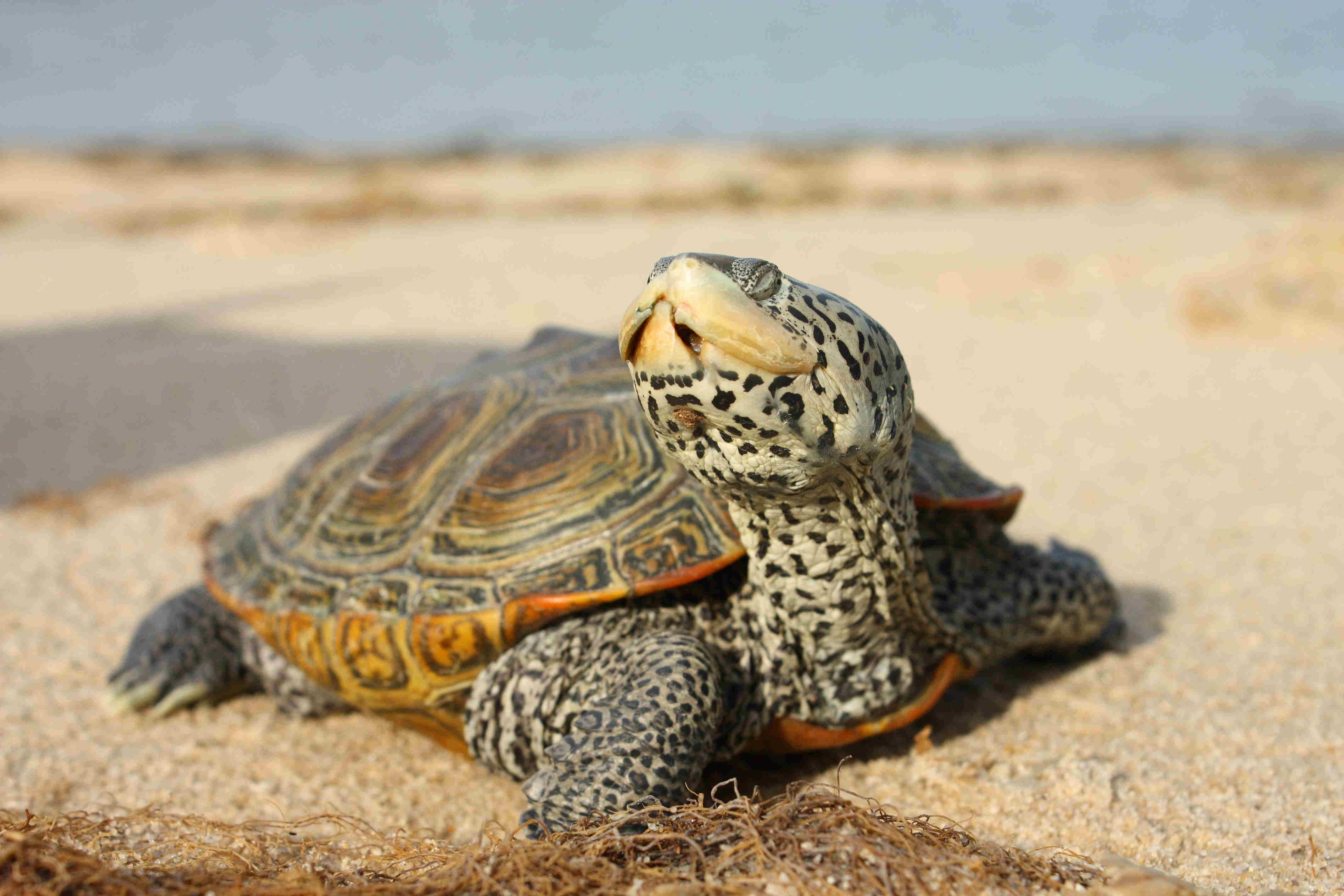
A rehabilitated adult female northern diamondback terrapin that was released in late 2009 after being injured by a motor vehicle along Great Bay Blvd. © Ben Wurst

Last year Conserve Wildlife Foundation of NJ started a new project that was focused on reducing the amount of terrapins that were killed by motor vehicles. The project began because of one individual terrapin that I encountered on Great Bay Blvd in 2009. I observed the female terrapin as she walked along the edge of the Blvd. I saw this as being odd. Typically they cross the road and often at a speedy pace (probably because they know the apparent danger from crossing roads). I stopped and saw that she had an injury to her lower mandible, probably from a motor vehicle. I knew that she needed help.

Terrapins face a variety of threats in their environment. An untold number are trapped in crab traps that are not fitted with Bycatch Reduction Devices (BRDs), some are hit by speeding boats and jet skis, and many more are injured or killed while attempting to cross roads. Along Great Bay Blvd. in Little Egg Harbor several studies have documented the amount of live and dead individuals on the road.

As soil and coastal waters begin to warm, terrapins begin to become active again. In late April/early May hatchlings begin to emerge from nest cavities where they overwintered. Adults also begin to become active, but mostly remain in the waters where they live until June when females emerge to lay eggs in nests they dig on land.

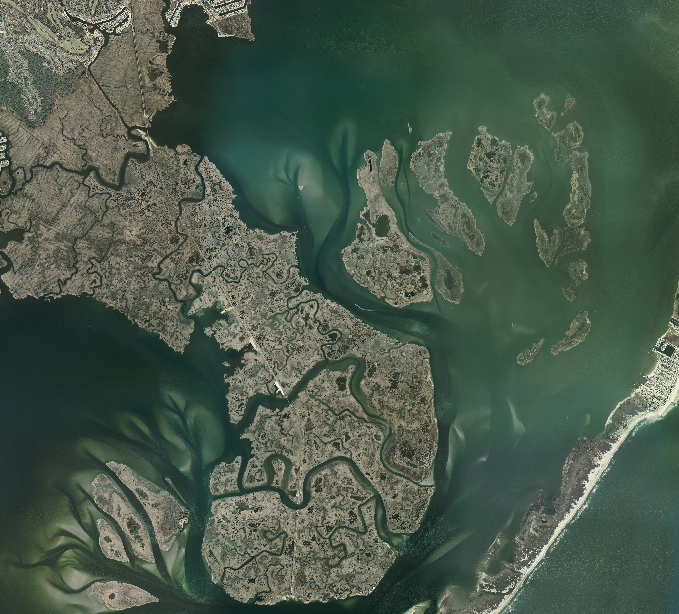
The penninsula that surrounds Great Bay Blvd. is pristine habitat for terrapins in southern Barnegat Bay.

Last year we raised enough funding to develop and print an educational brochure, purchase and install “Terrapin X-ING” signs, and install 4,000 feet of barrier fencing. The fencing was placed along the first stretch of road where the highest mortality rates were recorded. The fence proved to be effective at reducing road kills and increasing awareness of terrapins. The fence was removed in late 2010. This year it will be installed again along the same portion of road with help from a local construction company, Sambol Construction. After this season, we hope to keep the fence up year-round and hope to fence the whole first section of the road (and possibly more).

This year to help reduce the amount of terrapins that are hit by motor vehicles, we are recruiting volunteers to act as “Terrapin Stewards.” Stewards will be asked to routinely drive, walk, or bike down Great Bay Blvd. during the summer months from June to mid-July (especially on weekends, holidays and when there is a full or new moon). Volunteers will educate the public about terrapins, their threats in the environment, and our project. Volunteers will also help terrapins safely cross roads and help record locations of live or dead animals. No more than 10 volunteers will be recruited this year.

Our Message to visitors:

The habitat that surrounds Great Bay Boulevard is very important to the reproduction of northern diamondback terrapins, a species in decline in New Jersey. Female terrapins often nest along the soft shoulders of roadways. Sometimes they enter the roadway to reach these suitable nesting areas where they lay their eggs. Research has shown that dozens of female terrapins are killed by motor vehicles each year along Great Bay Boulevard. Please help conserve terrapins by driving carefully while traveling along the road.

If you’d like to participate you are required to attend a training session on May 3rd @ 6pm at the Jacques Cousteau National Estuarine Research Reserve. Volunteers will fill out paperwork and learn more about terrapins and our project. You must register to attend this training/information session.

Species in Decline

New Status Listing provides protection for 108 species in New Jersey

By Mike Davenport, Marine Species & GIS Programs Manager

A juvenile sanderling probing the sand for food. © Mike Davenport

Our website features profiles on every one of New Jersey’s 73 Endangered or Threatened species in our Online Field Guide.  Now, we’re beginning to profile New Jersey’s Species of Special Concern.  The term “Species of Special Concern” applies to species that warrant special attention because of some evidence of decline, inherent vulnerability to environmental deterioration, or habitat modification that would result in their becoming a Threatened species. This category may also be applied to species that meet those criteria and for which there is little understanding of their current population status in the state.  There are currently 108 species within New Jersey with the Special Concern status.  So far, we have profiles for 18 of those species.

Please check back periodically as we update the website with more information.

Photo from the Field

Counting bats or the lack thereof

by Ben Wurst, Habitat Program Manager

It is clear to me that White-nose syndrome (WNS) has decimated a large portion of the bat population in New Jersey, or at least at a site where I count bats for the Summer Bat Count. In 2008 (before WNS), I counted 261 bats at the Chatsworth General Store in August. Counting bats may seem like a daunting feat, but at dusk (when there is still a little light) the bats fly out of their daytime roosts. Sometimes, 1-2 at a time or in bursts of 3-4 or more. In August 2009, I counted 169 bats at the store. This past Sunday, I only counted 23 bats. To say the least these results are alarming. I hope that at other locations in New Jersey people are still seeing bats and I hope that WNS does not continue to decimate the population.

A photo of the bat houses installed on the Chatsworth General Store where many of the bats roost during the day. Many more used to roost in the attic. This image was captured using a technique referred to as HDR. © Ben Wurst.

Human/Wildlife Interactions

Juvenile eagle released back into the wild

by Ben Wurst, Habitat Program Manager

The eagle in a carrier to be transported from Sandy Hook to The Raptor Trust. Image courtesy National Park Service.

Last Tuesday I met with Debra and Gail, volunteers with The Raptor Trust in northern New Jersey to help release a juvenile eagle. The release was coordinated by Kathy Clark with the Endangered and Nongame Species Program and Cathy with the Raptor Trust. They transported the eagle for more than 2 hours to see it return to the wild. I was merely there because I have experience with handling birds of prey (in case anything were to happen).

The eagle was found on Gunnison Beach in late June inside Gateway National Recreation Area on Sandy Hook.The eagle was spotted by park visitors on the beach. The eagle was distressed but had no injuries. Jeanne McArthur–Heuser, NPS transported the eagle to the Raptor Trust, located in Millington, New Jersey.

Many juvenile raptors or birds of prey are not 100% successful at catching prey. Some rely on their parents for food until they learn the skills to catch prey that they will use for the rest of their lives.

The eagle takes flight after being rehabilitated at the Raptor Trust. © Debra Falanga

The eagle was rehabilitated at the Raptor Trust for 6 weeks. It was a male and was banded with a federal USGS bird band for future tracking. At the Raptor Trust it got plenty of rest and relaxation under their care. I met Gail and Debra in Millville where we traveled south towards Newport. We released the eagle at a location determined by Kathy Clark in Cumberland County at Nantuxent Wildlife Management Area. The release was uneventful (which is good!!!). We basically stood behind and to the sides of a large dog crate and opened the door. I held the door open and lifted up the back to try and encourage the eagle to leave the crate. After about 45 seconds, the eagle hopped out of the crate and immediately took off into the distance with a strong flight.

Without the care of the National Park Service, The Raptor Trust, and the Endangered and Nongame Species Program, this eagle might not have survived! This is a clear example of how we are all connected and how delicate the balance of nature is! We hope this eagle lives on and is able to flourish in New Jersey!

Lost Connection

To the internet, not wildlife!

By Ben Wurst, Habitat Program Manager

The office where I work, inside Tuckahoe Wildlife Management Area in northern Cape May County, recently lost its connection to the world wide interweb. The office is home to the NJ Division of Fish and Wildlife staff and three CWF employees. Since the demise of our connection to the world wide interweb the office has been ghostly quiet. Some have chosen to work at home, use some vacation time, or get some field work done. I just wrapped up my primary field season surveying osprey nests along the Atlantic Coast of NJ so I chose to be constructive, literally. I started constructing some artificial nesting platforms for ospreys. Normally I do this in the winter when field work is very limited, but finishing these now will give me a chance to install them this fall. Late summer and fall are the best times to install platforms. The water and air are warm and the winds are calm, so boots and bulky clothes aren’t required. So, I’m glad the internet is down because it gave me a reason to construct these platforms earlier than usual.

An osprey platform sits while I work on the finishing touches. This image was shot using a technique referred to as HDR. © Ben Wurst

Two platforms will be going up in Lavallette, one near Tuckerton, and the other has yet to be determined (possibly Sea Isle). Stay tuned for more updates and photos!


Monitoring Oystercatchers in New Jersey

Banding American Oystercatchers

By Christopher Haxter, Seasonal Steward

American Oystercatcher. © Chris Davidson

The American Oystercatcher (Haematopus palliates) may not get as much attention as some other species since it’s not listed as endangered or threatened in New Jersey. However, it is listed as a species of special concern because the population is thought to be in decline. On Stone Harbor Point, the site I mainly monitor for my job, I spend a good deal of time finding oystercatcher nests and chicks. Together with Piping Plovers and Least Terns, oystercatchers constitute a large portion of the beach nesting birds found on “the Point”.

Oystercatchers are hard to miss; they stand nearly one and a half feet tall, are boldly colored, and have very loud calls. On average, they lay three eggs per nest, and incubate their eggs from April-June and care for their chicks from May-July. They tend to have much more trouble with predators and flooding during the egg laying stage. Once hatched, the chicks tend to have better survival rates. As of right now on Stone Harbor Point we have at least ten pairs of American Oystercatchers with offspring. One pair is still incubating a nest, nine pairs are brooding a total of thirteen chicks, and one pair has successfully fledged two chicks.

One of the ways to track these birds year after year is to put colored bands on their legs that are marked with letters and numbers so individual birds can be identified. Tom Virzi, one of our research partners (from Rutgers University), has been studying oystercatchers in New Jersey since 2004. Last week I had the privilege of helping two of his interns, Jason Pietrzak and Allison Anholt, band some oystercatcher chicks on Stone Harbor Point.

CWF Seasonal Chris Haxter holding captured American Oystercatcher chick in preparation for banding. Photo courtesy of Tara Hewitt.

The first step was to capture the chicks. Since the chicks can’t fly yet, all we had to do was surround and grab them. Sometimes easier said than done – the two chicks we went after were already a month old, so they were quite fast. Once captured we inspected the chicks, making sure they were healthy and their legs were fully grown. The band that goes around the leg of the chick is a small orange plastic cylinder with a black number/letter code (each state participating in this banding project has a unique color). After banding, we took measurements, including beak/head/wing length, and then collected a few feathers so the chicks could be sexed using DNA analysis.

The chicks were surprisingly calm throughout the process and the parents stood near us watching carefully. When we were finished we released the chicks back to the parents and kept an eye on them to make sure the parents accepted the chicks.

Adult oystercathers are also banded, but because they can fly the process is much different and involves some trickery. To try to capture the adults we set up a decoy, played some oystercatcher calls, and placed a board lined with many tiny nooses in the sand to capture the foot of the bird. When the adults defend their territory and fight with the decoy they get caught in the trap. We did attempt this but were not successful this time.

When a banded bird is re-sighted, and the code is observed and recorded, we are able to follow them for years. The data gathered from banding oystercatchers is essential in studying their long term habits, population trends, chick survival rates, and movement patterns.