Using a Decoy to Study Endangered Warblers

BANDING GOLDEN-WINGED WARBLERS

By Michael Davenport, Marine Species & GIS Programs Manager

Conserve Wildlife Foundation Intern, Nelson Melendez, and I recently had an opportunity to assist Endangered & Nongame Species Program Biologist Sharon Petzinger in her research on golden-winged warblers, a species just added to the state’s list of Endangered species this year.  We were banding males which had been observed previously and had already claimed breeding territories.  They were being banded in order to obtain data regarding their distribution and habitat use, as well as other life history information.

Only males were being targeted for banding.  Males are territorial during the breeding season and do not tolerate the presence of other male golden-winged warblers.  Therefore, in order to catch a male, we would use their own territorial instincts to lure them into a mist net (a mist net looks a little like a volley ball net with much finer netting which becomes invisible to birds if set-up properly).

Once a mist net was set-up near a known golden-winged’s territory, Sharon used a custom-painted “toy” bird to play the role of an unwelcome male visitor.  She also used a call play-back, a recording of a male golden-winged’s song.  The song would lure the male near the net, and the decoy should bring him right into the net.

We went to several locations in northwest New Jersey where golden-winged warblers had been observed earlier in the year to set-up the mist net.  On this particular day, however, luck was not with us for no golden-winged warblers were caught.  Several other species were captured however, such as a veery, chestnut-sided warbler, and a Brewster’s warbler.  The Brewster’s warbler is actually a hybrid of a golden-winged warbler and a blue-winged warbler.  Another hybrid form between those two species is known as Lawrence’s warbler.

CWF Intern, Nelson Melendez, holding a chestnut-sided warbler. Photo by Mike Davenport.

The veery and chestnut-sided warbler were released from the net unharmed.  Before the Brewster’s was released, a small aluminum band was placed on its leg and measurements such as wing length and weight were taken.

Warblers are often an overlooked group of birds by some birdwatchers due to their small size and relative difficulty in observing.  They are stunningly beautiful however, which becomes apparent when you have the opportunity to view them up-close.  They are a very diverse species group with a variety of interesting life histories.  There is currently one species (the golden-winged) listed as Endangered in the state and 11 additional species listed as Special Concern.  To learn more about them, please visit our on-line field guide links below.


NJ’s Rare Warblers

Golden-winged Warbler (Vermivora chrysoptera)
Blackburnian Warbler (Dendroica fusca)
Black-throated Blue Warbler (Dendroica caerulescens)
Black-throated Green Warbler (Dendroica virens)
Canada Warbler (Wilsonia canadensis)
Cerulean Warbler (Dendroica cerulea)
Hooded Warbler (Wilsonia citrina)
Kentucky Warbler (Oporornis formosus)
Nashville Warbler (Oreothlypis ruficapilla)
Northern Parula (Parula americana)
Worm-eating Warbler (Helmitheros vermivorum)
Yellow-breasted Chat (Icteria virens)


Extinct & Extirpated Species of New Jersey

NEW JERSEY’S LOST NATURAL HERITAGE

By Michael Davenport, Marine Species & GIS Programs Manager

The rusty-patched bumble bee, a species believed to be extirpated within New Jersey.

Conserve Wildlife Foundation of NJ (CWF) has just launched several new web pages devoted to those species which have been lost from New Jersey (and the world in some cases).  Ten species are profiled – five which are extinct and five which are extirpated from the state.   Although their stories are sad, they are also warnings for what may happen to other species which are currently struggling to survive within the state, especially those already on the state’s endangered species list.  CWF’s wildlife conservation projects attempt to avoid more species becoming extinct or extirpated in New Jersey.

CWF would like to thank Joseph Wotasek, a junior at Centenary College majoring in Graphic Design, who volunteered his time and skills in creating images of the ten profiled species for the new web pages.

To learn more about extinct and extirpated species, please visit CWF’s website at:  Extinct & Extirpated Species of NJ.

Photo from the Field

by Ben Wurst, Habitat Program Manager

By now most ospreys are back from their wintering grounds in Central and northern South America. Generally the older more experienced birds return first and the younger inexperienced adults follow. Over the past month I’ve been very busy with platform repairs and installations throughout coastal New Jersey. You may not be aware but I maintain a huge number of nesting platforms. In just the past couple weeks I’ve worked as far south as Avalon (where I lead a group of students and their parents from Collingswood to replace an existing platform) and as far north as Bayonne (where I installed 3 platforms with local middle and high school students). Both were memorable experiences for both myself and many of the students. Most of them had never been on a boat or ever had the chance to walk on the saltmarsh.

Maintenance of existing platforms is critical to the continued recovery of ospreys. Over time (and in some cases, not much time) the condition of these nesting platforms is degraded, mainly by the environmental conditions where they’re placed. For the most part the fasteners are what go first from contact with high levels of moisture in the air, after that,  the wood decays (unless a pressure treated or cedar wood is used). One way to help prevent the decay of platforms is to use marine grade stainless steel screws, galvanized bolts, and treated lumber. If we were to lose a large portion of the available nesting platforms in a given year then the population would suffer, so it’s important to make sure existing platforms remain in good condition.

Last week I got out to the “Wildlife Drive” at Forsythe NWR in Oceanville to repair a platform. The platform top had lost a side and could no longer hold nesting material. I built a new top out of salvaged wood that I collect and installed it on Thursday afternoon. The next day a male osprey began to place nesting material in the freshly repaired platform. Talk about perfect timing!

If you’re interested in helping us to maintain osprey nesting platforms, contact me about our new program to “Adopt a Platform.”

An osprey places nesting material in the newly repaired platform at Forsythe NWR. © Howie Williams

Updated Version of the Landscape Project (NJ’s Rare Wildlife Mapping Tool) Released

A CRITICAL CONSERVATION TOOL JUST GOT BETTER

By Michael Davenport, Marine Species & GIS Programs Manager

To coincide with the NJ Department of Environmental Protection’s (DEP’s) adoption this week of revised lists of endangered, threatened, and special concern species in the state, the DEP’s Endangered and Nongame Species Program released an updated version of the Landscape Project earlier this week.

The Landscape Project is a mapping tool, created using Geographic Information Systems (GIS), which displays wildlife habitat throughout the state ranked according to the rarity of the species which occur in specific patches of habitat.  The highest rank (5) is used to indicate habitat for those species which are federally endangered or threatened.  Rank 4 is used for state endangered species, rank 3 for state threatened species, rank 2 for species of special concern, and rank 1 is for suitable habitat patches for which no rare species documentation currently exists.

The Landscape Project Version 3.1 report.

The updated version of the Landscape Project is known as Version 3.1 (V3.1) and it replaces both Version 3.0, which covered the Highlands region only, and Version 2.1, which was applied to the remainder of the state.  Both previous versions were released in 2008.

Several changes have been in the methodology and source data used to create this latest version of the Landscape Project.  First, V3.1 is based upon 2007 Landuse/Landcover data, as opposed to the 2002 data used in previous versions.  Second, over 3,500 new rare species records were used in V3.1 and the newly adopted endangered, threatened, and special concern status changes are reflected.  Also, species not included in previous versions, such as whales, sea turtles, and freshwater mussels, are included.  More detailed information is also available in V3.1 such as the type of occurrence documented (nest, foraging habitat, etc.) and the last year that the occurrence was documented.

Since creation of the first version of the Landscape Project in the mid-1990’s, it has been a valuable tool for conservationists, land managers, state and local governments, as well as others.  Municipalities often refer to it in creation of their Environmental Resource Inventories (ERIs) and land trusts often use it to target areas for open space acquisition.

Continue reading “Updated Version of the Landscape Project (NJ’s Rare Wildlife Mapping Tool) Released”

Photo from the field

Countdown to spring arrival of ospreys

by Ben Wurst, Habitat Program Manager

An empty osprey platform awaits a nesting pair on the Mullica River. © Ben Wurst

It’s hard to believe that in another 6-7 weeks ospreys will be back in New Jersey and ready to begin another nesting season. Over the next few weeks we’ll be busy making repairs to existing nests, moving platforms to more suitable locations, and installing new nests to replace old derelict platforms. We maintain a huge portion of the available nest platforms along the coast and do so with no state funding! All of our funding comes from private donations from individuals, foundations, or grants. Since our osprey project began in 2006, we have installed more than 100 nesting platforms throughout New Jersey. What’s new? This winter we have plans to install three new structures in Bayonne with local high school students. This will be the furthest north that we have ever worked with ospreys. It’s a new and exciting endeavor for CWF. If you enjoy viewing ospreys during your visits to coastal areas of New Jersey during the summer, please consider making a donation today by sponsoring the placement of a platform or by adopting an existing platform.

Nesting Bald Eagles

PLEASE DO not DISTURB
Photo taken with a high powered camera lens from a safe distance © Jeffrey White

by Larissa Smith; biologist/volunteer manager

Bald eagles are beautiful birds so it only makes sense that people want to get a closer look at them.  But often people don’t realize that by innocently stopping to look at an eagle nest they are putting the eggs or young in jeopardy.  As the New Jersey eagle population increases eagles are starting to nest in closer proximity to humans and human activity.  Any activity that causes the eagles to change their normal behavior is “disturbance.”  People walking too close to the nest to get a closer look or take photos will cause the birds to get off the eggs or leave the young unattended.  This leaves the eggs or young exposed to the elements and predators.  The safe distance for viewing is at least 1,000’ from the nest site.  If the birds are looking at you then you are too close.

The best way to see what goes on at an eagle’s nest without the chance of disturbing the birds is to watch them online.  The Duke Farms eagle nest site has had a camera streaming the picture since 2008.  This provides an up close and personal view that you cannot see from the ground.  The Duke Farms eagle cam should be streaming live in the next few weeks.  To view the eagle cam go to www.conservewildlifenj.org

If you have any questions about eagles or their nests or would like to report a nesting pair, please contact Larissa Smith.


“Essential Life” Exhibit at New Jersey State Museum

 Now through February 19th at the New Jersey State Museum.
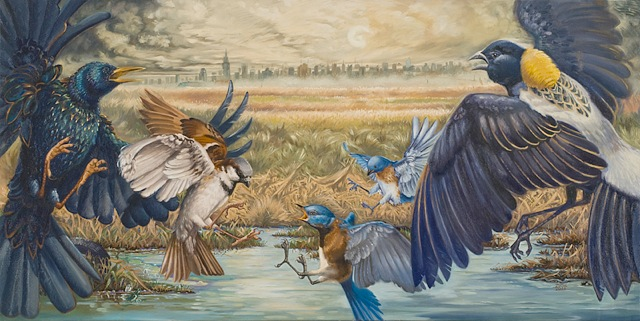
Fight or Flight. © Tricia Zimic

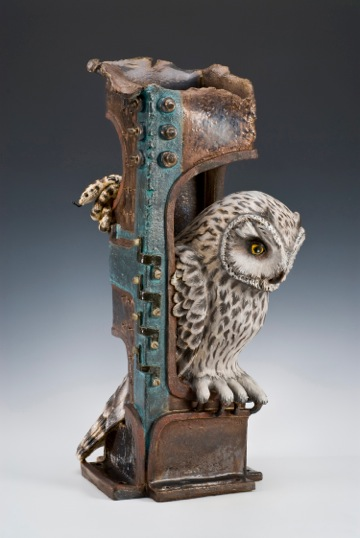
“Essential Life,” a new art exhibition at the New Jersey State Museum in Trenton is one artist’s response to the decay of our environment and its impact on the indigenous wild creatures that once lived there.  Tricia Zimic champions these animals, both in her exquisite sculptures and paintings and through her work on an ambitious conservation project on a 2,110-acre site in New Jersey. Zimic creates pieces that are startling and provocative. Through painting, clay, fiberglass, and found objects, she depicts creatures that have been displaced by urban and suburban sprawl: a black bear and its cubs foraging for pizza in the meadowlands, a red wolf traversing a highway or owls inhabiting a metal beam. Zimic offers viewers examples both of animal resourcefulness and population collapse.

Short-eared owl & northern pine snake sculpture. © Tricia Zimic

Tricia Zimic trained at the Parson’s School of Design where she studied with artists including Maurice Sendak and Frank Giorgini. Her ceramic work is installed in public and private collections worldwide. Prior to starting her career in fine arts, the artist worked for many years as an illustrator of young adult books including the iconic Nancy Drew series. Through her current work in narrative art, Zimic seeks to communicate a message of renewal and conservation. We hope you will have the opportunity to view Ms. Zimic’s 35  inspirational sculptures and paintings. The exhibition will run until February 19, 2012, at the New Jersey State Museum, located at 205 West State Street, Trenton, NJ.  Open Tue- Sat. 9 am – 4:45.


Fracking in the Delaware River Basin

The Potential Impact to our Natural Resources

by Stephanie Egger, Wildlife Biologist

Figure 1: A diagram of how the hydraulic fracturing process works to extract natural gas

Many residents of New Jersey may have heard about hydraulic fracturing of the Marcellus Shale and the potential ecological  impacts to the Delaware River Basin. The following provides an overview of the process of hydraulic fracturing and impacts to our natural resources in New Jersey.

The Mar­cel­lus Shale is sed­i­men­tary rock buried thou­sands of feet under the ground.  It extends from upstate New York south through Penn­syl­va­nia and to West Vir­ginia and west to parts of Ohio.  The nat­ural gas in the shale is trapped in tiny spaces and fis­sures within the rock.

Hydraulic fracturing or fracking uses high-pressure pumps to inject a mix of water, sand, and chemicals into drilled wells that will fracture the shale rock to open cracks and release natural gas (Figure 1).  A well can be repeatedly fracked and each gas field incorporates many wells.  The process takes an enormous amount of water using an average of 4.5 million gallons of water to frack a well and a well can potentially be fracked up to 18 times.  Many chemicals are used in this process, some of which are known to be toxic and known carcinogens (e.g. benzene, glycol ethers).  Some chemicals are unknown because they are still considered proprietary by the industry.  Many of the chemicals cannot biodegrade so if released into the air or water they are there to stay. Continue reading “Fracking in the Delaware River Basin”

Creating Range Maps for NJ Wildlife

USING CARTOGRAPHY TO ILLUSTRATE WHERE SPECIES LIVE

By Michael Davenport, Marine Species & GIS Programs Manager

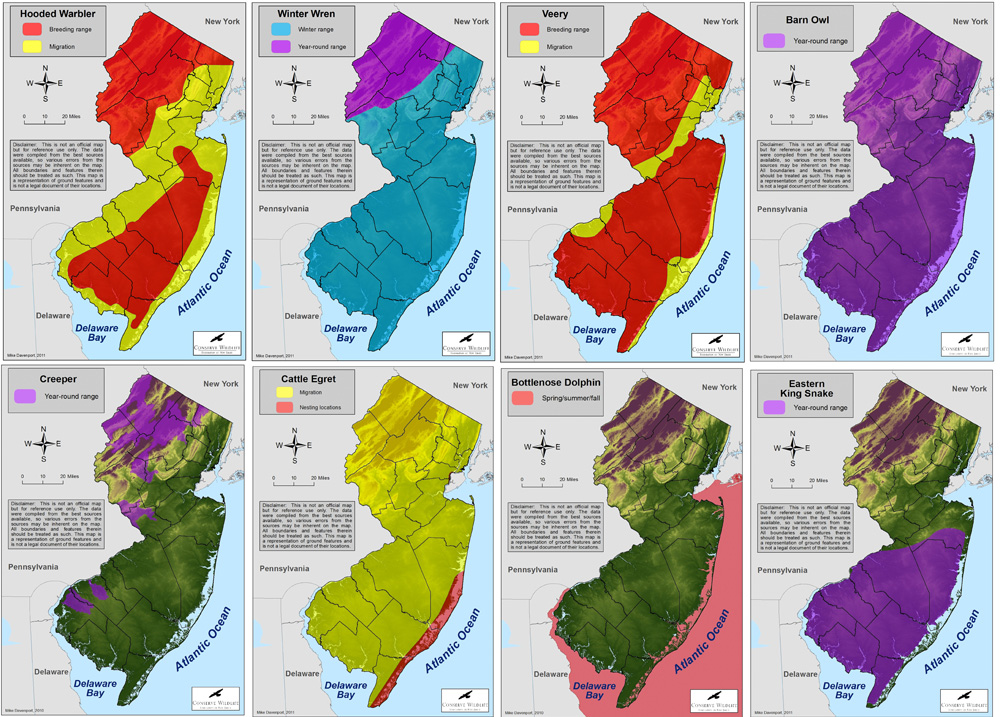
Several range maps found on the CWF on-line field guide.

Conserve Wildlife Foundation of NJ (CWF) staff have been busy updating the CWF website’s on-line field guide with additional species’ profiles in order to add descriptions for New Jersey’s Species of Special Concern.  One important component of the on-line field guide, like almost any other field guide, is the inclusion of a range map.

Our Online Field Guide

The CWF on-line field guide is specific to New Jersey, so the only portion of each species’ range illustrated is that portion within the boundary of the state.  For a species’ full range, there are numerous additional sources of information.  CWF, being focused on New Jersey wildlife, is uniquely able to provide more specific range information based upon the data available to our staff as well as our first-hand knowledge.

The range maps within the on-line field guide are created using Geographic Information Systems (GIS) software and multiple sources of data.  First, we begin with the raw species observation data which is maintained within the NJ Endangered and Nongame Species Program’s (ENSP) Biotics database, a database which CWF staff maintains in partnership with ENSP.  Then, like any range map, some generalization needs to be made to account for the fact that animals cannot be observed 24 hours a day, 365 days a year.  In order to do so, data such as land cover types, hydrology, and/or topology is considered in order to fill-in the areas between observation points or omit other areas. Continue reading “Creating Range Maps for NJ Wildlife”

Freshwater Invertebrate Surveys

SEARCHING FOR FRESHWATER MUSSELS & CRAYFISH AT MANASQUAN RESERVOIR

By Michael J. Davenport, Marine Species & GIS Programs Manager

Searching for freshwater mussels and crayfish using a viewing scope. © Mike Davenport

New Jersey is home to at least 16 species of freshwater bivalves (freshwater mussels and clams), half of which are listed as endangered or threatened within the state.  The presence of freshwater mussels within a water body is an indication of water quality so determining where they occur is important for protecting water resources within the state.  In fact, the NJ DEP’s “Category One” (C1) designation for some state waterways is often based on the presence of some freshwater mussel species.  C1 waters are protected from any measurable change in water quality because of their exceptional ecological significance, exceptional recreational significance, exceptional water supply significance, or exceptional fisheries resources.

Last week, I accompanied the Endangered and Nongame Species Program’s freshwater mussel biologist, Jeanette Bowers-Altman, and another survey team member to conduct a preliminary survey of the Manasquan Reservoir in Monmouth County for both freshwater mussels and crayfish.  I had visited the reservoir several times before and had confirmed the presence of at least three bivalves: the Asian clam, eastern floater, and paper pondshell.  Of those three species, only the eastern floater is native to New Jersey.

We surveyed several areas around the perimeter of the reservoir.  We took readings of the water’s temperature, pH, and dissolved oxygen as well as documenting the substrate type and GPS coodinates.  Unfortunately for our survey efforts, the water level was higher than ideal for locating mussels and the only species which we found was the paper pondshell.  However, the clarity of the water and the nature of the substrate indicate that future efforts, when the water level is lower, may be more productive.

A Chinese mystery snail (Cipangopaludina chinensis) found at Manasquan Reservoir. © Mike Davenport

One interesting find was a rather large (~2.5 inches) freshwater snail which I have never encountered previously.  Thanks the ID skills of Jay Cordeiro at the University of Massachusetts – Boston, the snail has been identified as the Chinese mystery snail (Cipangopaludina chinensis), a non-native species introduced to the U.S. via San Francisco in the late 1800’s.  It has since spread into at least 37 U.S. states and 4 Canadian provinces and was first documented in New Jersey in 1926.  According to Jay, the species has been “implicated in vegetation decline, competition with native species, and are hosts for certain parasites.  Current populations are spread through the aquarium trade or on ornamental aquatic plants.”

For more information regarding New Jersey’s rare mussel species, please visit CWF’s on-line field guide at:  http://www.conservewildlifenj.org/species/fieldguide/