Osprey nest needs urgent repairs

A productive nest on the Navesink River needs a helping hand!

by Ben Wurst, Habitat Program Manager

UPDATE: We have learned that the pole has been straightened!! Thank you all for the support!!!

Many North American ospreys have already departed from their wintering grounds in Central America, N. South America, and the Caribbean and are on migration to their summer breeding grounds. In New Jersey, most ospreys nest along the Atlantic Coast, from Sandy Hook to Cape May and arrive in mid-late March. One nest (083-A-007) is on a decommissioned channel marker (#21) on the Navesink River, off Fair Haven. The nest was first found in 2006 and in 2013 the nesting pair successfully produced three young. Considering the current condition of the nest pole, they were really lucky to produce any young at all!
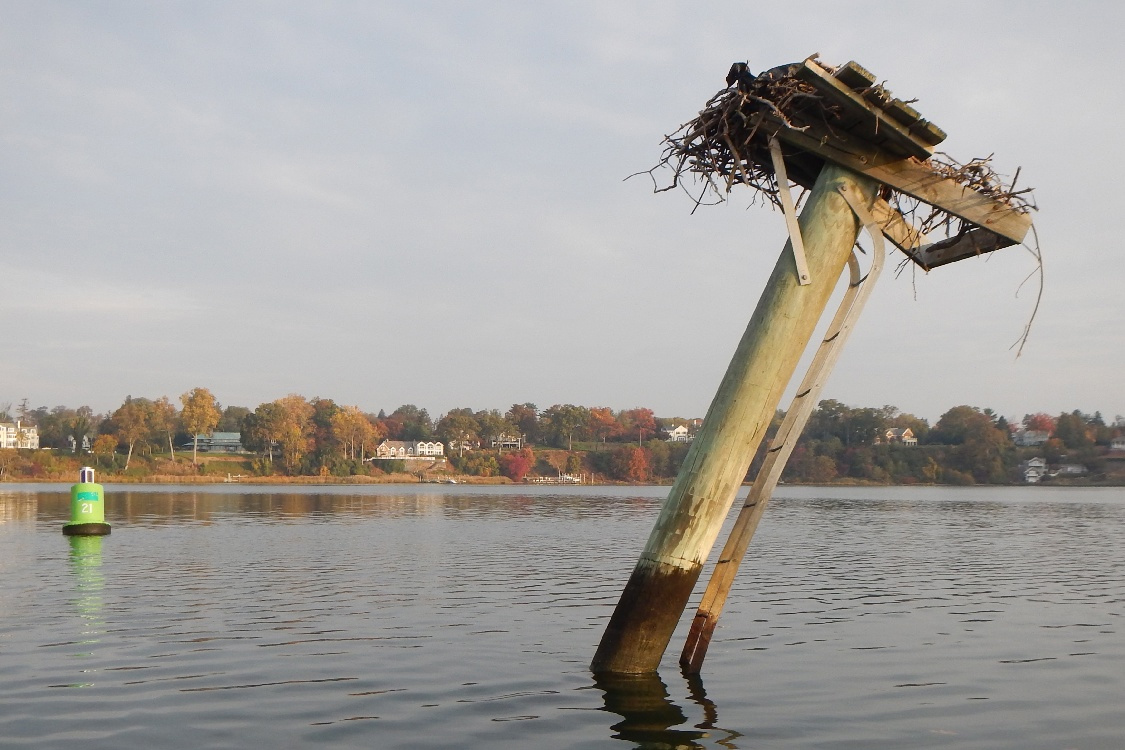
083-A-007 on the Navesink needs some TLC!

This platform was one of many that sustained damage by Superstorm Sandy. We pledged to repair any and all platforms that were reported as damaged by the Storm and did; however, we don’t have the equipment or boats to repair a leaning platform in open water, like 083-A-007. Since it was damaged we have been contacted by many concerned citizens who watch the pair that nests here. We’re sharing this story to help garner support to repair the nest pole.

Ospreys mate for life and return to the same nest site, year after year.  They will build their nest at an angle to compensate for the lean, but young are still in jeopardy of falling out of it. Our goal is to get it fixed before the pole falls over. Lastly, this is an important nest site in the region. There is very little preserved open space in this region of Monmouth County and very few osprey nests.

We need your help!

Ospreys return to their nesting grounds in mid-late March in New Jersey. © Howie Williams

Last year we tried reaching out to local marine construction and bulkheading companies but had no luck getting anyone to even return our calls. Then we contacted the Bureau of Coastal Engineering’s Aids to Navigation and they did not have equipment in the area to make the needed repairs last fall (we’ve since called them again to get their assistance and are waiting to hear back).

Do you know any local bulkheading or marine construction companies who work in the Fair Haven/Rumson area? If you do, please see if they can provide some assistance so this pair of ospreys have a safe place to nest!

Contact us if you know anyone who can help:

BAHAMAS PIPING PLOVER PROJECT

WINTERING PIPING PLOVER SURVEYS ON ABACO

By Todd Pover, Beach Nesting Bird Project Manager and Stephanie Egger, Wildlife Biologist

IMG_3492
The Bahamas piping plover survey tally board in the “central command” room at Schooner Bay Institute.

An integral part of this Bahamas trip entailed surveying several sites not previous covered on Abaco and revisiting some sites not checked since the 2011 International Piping Plover Census. Although we didn’t find large concentrations of piping plovers at any one new site, we did make some noteworthy discoveries.

One of the most exciting find was the resight of a piping plover that was banded on the breeding grounds last summer in Massachusetts as part of a flight behavior study. New Jersey also participated in this research and we briefly thought it might be one of the birds banded in our home state – but it turned out that it was banded (and nested) on Chapin Beach, Cape Cod and is wintering at Schooner Bay, Abaco (amongst 15 other piping plovers found on our survey). Continue reading “BAHAMAS PIPING PLOVER PROJECT”

New Jersey’s 1st Annual Super Bowl

This Week, Play in New Jersey’s Super Bowl…of Wildlife

wildlife superbowl

This Sunday, for the first time ever, New Jersey will host the Super Bowl. Millions await the drama between two evenly matched high-flying teams.

You mean the Seahawks versus Broncos in the NFL Super Bowl?

Guess again.

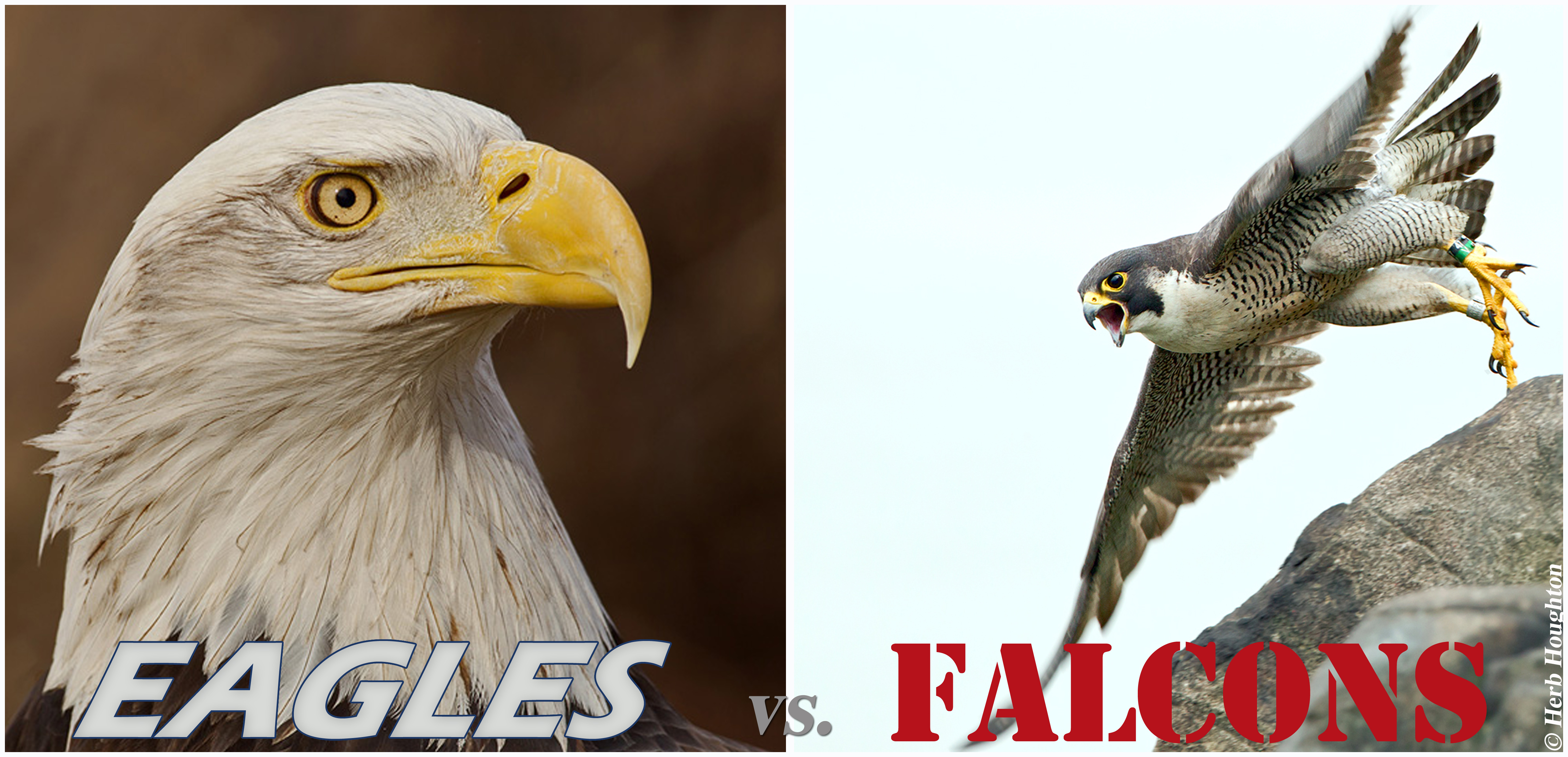
Try the Falcons versus Eagles in the CWF Super Bowl!

As in peregrine falcons, the fastest animal on earth, against the bald eagles, the symbol of All-American grandeur. These two “teams” have overcome incredible odds to make it to the biggest stage imaginable: the Conserve Wildlife Foundation of New Jersey (CWF) battle for the first annual state wildlife championship. The winner will be announced on Monday morning, after a week of Facebook “likes” and donations in favor of the Falcons, or of the Eagles.

All donations will help support CWF’s work on that species, with falcon support dedicated to our Jersey City webcam program and eagle support helping our statewide stewardship work. At stake is not the NFL’s Lombardi Trophy, but an extra boost in CWF’s efforts to protect one of these imperiled species and ensure its inspiring recovery continues.

Surviving the Regular Season

How did these CWF champions make it this far? From their home stadium in downtown Jersey City (and 23 other nests across New Jersey), the Falcons have soared through the season in a continued recovery from decades of struggle against opponents like DDT and pollution. The Falcons then entered the CWF playoffs with momentum, defeating the Bobcats, Terrapins, Ravens, and Fishhawks (ospreys) in succession to reach this big stage.

Their opponent, the Eagles, play the majority of their home games on the windswept Delaware Bayshore, but also play at 118 other nests across the state. Like the Falcons, the Eagles had decades with seemingly no hope because of DDT and a rapidly changing landscape. Yet the Eagles bounced back with an inspiring few seasons, capped by victories over the Bog Turtles, Plovers, Tigers (salamanders), and Dolphins.

Among the teams that continued struggling this season were the Rattlers, the Bats, the Tree Frogs, the Skippers (butterflies), and the Goldenwings (warblers). Conversely, the Seals and Snowy Owls had strong winter seasons. Two closely rivaled teams, the Red Knots and the Horseshoe Crabs, overcame the loss of their stadium to Hurricane Sandy with a newly built New Jersey home that greatly improved their odds of success.

Now that the game is on – what are the rules for the CWF Super Bowl?
Do you win, too, if you support the winning team?

All supporters of the winning team will be eligible for a drawing to join a banding of the winning raptor this summer, with eligibility weighted by donations and points – the greater the donation or support, the greater your chance of winning! But EVERYONE is eligible, even for as simple as a Facebook like!

As for you non-football fans out there…just as the NFL Super Bowl attracts attention far beyond regular football fanatics, our CWF Championship is meaningful to all of us who care about imperiled wildlife in New Jersey. Here is a chance to ensure that a magnificent raptor – a bald eagle or a peregrine falcon – continues to grace New Jersey’s skies. Either way, score a win for New Jersey’s wildlife!

So consider this the opening kickoff! Getting out on the field is as easy as clicking a link in this email – but choose wisely. The champion awaits!

Introducing the 2013 Women & Wildlife Honorees!

Introducing the 2013 Women & Wildlife Honorees.

Through our annual Women & Wildlife Awards we recognize women who represent a broad range of wildlife protectors in our state:

  • Tracy Leaver, who rehabilitates orphaned and injured animals, including bobcats and bears;
  • Linda J. Mead, who has a distinguished record in permanently preserving over 15,000 acres of natural habitats, farms, and open space for New Jersey’s wildlife;
  • Jo Ann Frier-Murza, who played an important role in protecting our most charismatic wildlife as part of the New Jersey Division of Fish and Wildlife;
  • Pat Sutton, who has educated about the natural world in New Jersey, especially in Cape May, for over 30 years; and
  • Dr. Edith Wallace, who has devoted more than half a century to inspiring people, young and old, to make the wild places of New Jersey part of their everyday experiences.

At the event we will also commemorate the 40th Anniversary of New Jersey’s Endangered Species Conservation Act. This landmark legislation directed the Department of Environmental Protection to protect, manage and restore the State’s endangered and nongame wildlife species and allowed state biologists to bring key species back from the brink of extinction – species such as the bald eagle, peregrine falcon, and osprey.

When: Wednesday, December 4th, 6:00 p.m. – 8:30 p.m.

Where: Trenton Country Club, 201 Sullivan Way, Ewing, New Jersey

Tickets: $75 individual ticket

$250, $500 and $1,000 sponsorships will be listed in the event program

All proceeds will benefit our work to protect our rare and imperiled wildlife!

For more information, please contact Liz Silvernail at (609) 292-3707.

Continuing to Track NJ Eagles.

Update on the Merrill Creek birds.

by: Larissa Smith, Wildlife Biologist/Volunteer Manager

Back in February I gave an update on the Merrill Creek birds that had been fitted with transmitters.  http://www.conservewildlifenj.org/blog/2013/02/01/tracking-eagles-in-nj/

We continue following the movements of the female that had the transmitter placed on May 29th, 2012. She spent the winter down at the Delmarva Penninsula in coastal Virginia and then headed up north and spent a large portion of the summer in Maine. She is starting to head south and on September 2nd was in Connecticut.

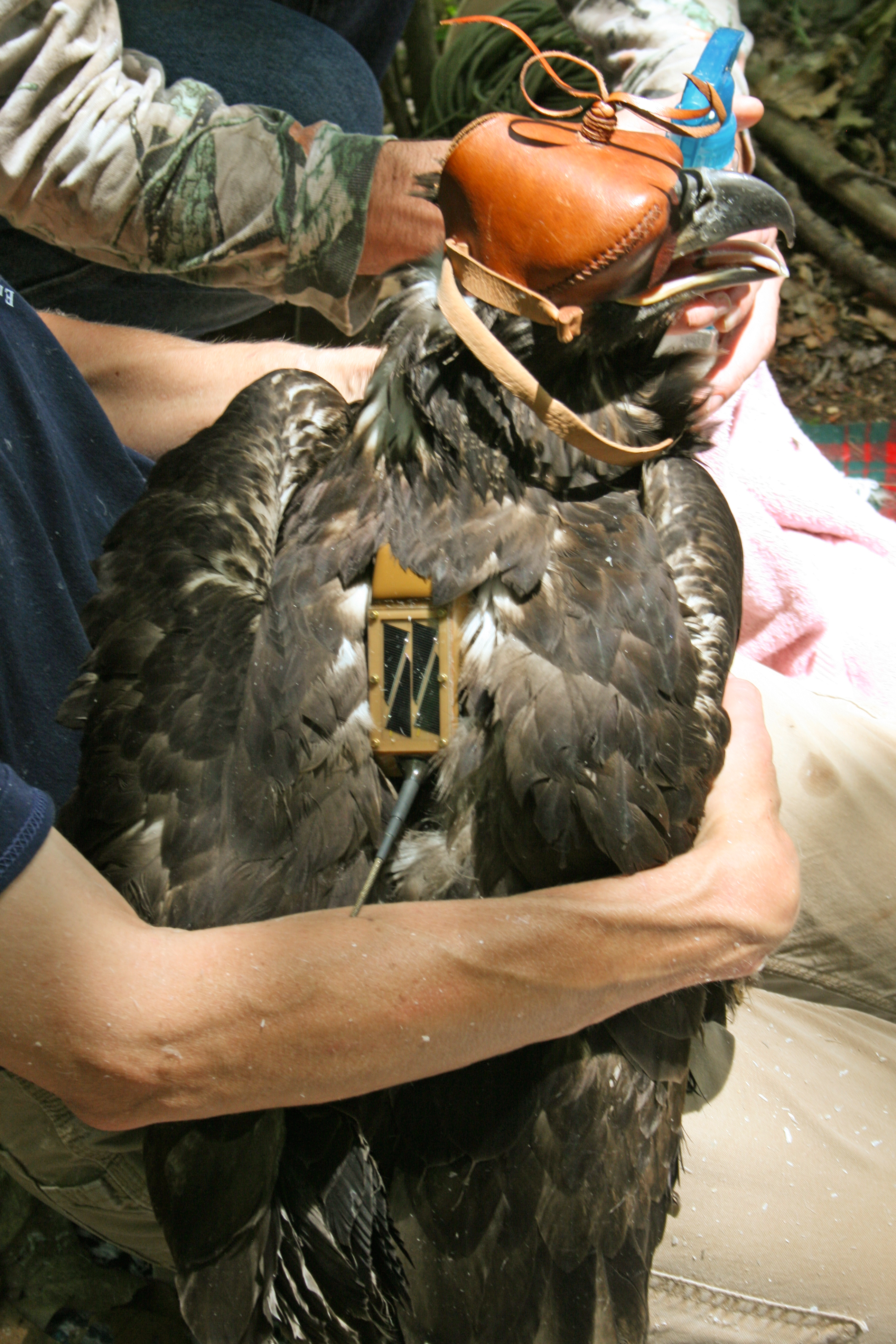
On May 31, 2013 the largest of three chicks at the Merrill Creek Reservoir nest, a female, was fitted with a transmitter.

Merrill Creek chick with transmitter May 29th, 2013

This transmitter is different than the ones previously used in that it uses GSM technology. Instead of using satellites to pick up the bird’s location, the transmitter will transmit data via cell phone towers. The data is then transmitted over the internet and delivered as an email to a mobile device or computer. This new technology transmits more data, costs less and allows users to have instant access to the data through smart phones or computers. Since fledging this bird has been on the move spending time in NY, PA and back to NJ and as of September 3rd was back near the nest site.

To follow both these eagles movements  go to: http://www.merrillcreek.com/eagletracking.html.


Photo From the Field

by Larissa Smith, Wildlife Biologist/Volunteer Manager

Shark River Juvenile © Tom McKelvey

Eagle Project Volunteer Tom McKelvey captured this photo of one of the juveniles that fledged from the Shark River eagle nest in mid-June.  So far this nesting season 157 young eagles have fledged from NJ nests. The juveniles will remain in the nest area for the next few months while they develop their flight and hunting skills.


Have You Seen This Bird?

LOOKING FOR HELP FROM BIRDWATCHERS TO FILL-IN DATA GAPS

By Michael Davenport, Marine Species & GIS Programs Manager

Young barn owls. Photo by MacKenzie Hall.

Conserve Wildlife Foundation staff work with the New Jersey Endangered and Nongame Species Program (ENSP) to manage and populate the state’s official database of rare wildlife, known as Biotics.  Currently, this database contains over 35,000 animal and plant records within New Jersey.  ENSP and CWF currently collect and enter data for the state’s 173 endangered, threatened, and special concern species.

There are several species of birds for which more observation data would be useful; and it’s likely that birdwatchers or other nature watchers may have the data needed.  Most good birdwatchers keep logs of what they’ve observed, when, and where.  It would be helpful if anyone with detailed observation data for the species listed at the end of this blog could submit their data for potential inclusion in the Biotics database.

To submit your observation data, please complete a Rare Wildlife Sighting Report Form.  The form is available on ENSP’s website for download as well as instructions for completing the form (a map must be attached when submitted).  In addition to the species listed below, please feel free to submit one or more forms for any of the state’s endangered, threatened, or special concern species.  A complete list of all of the species tracked by the state can be downloaded here.

If you have a large amount of data to submit, please contact Mike Davenport of Conserve Wildlife Foundation at (609) 292-3795 – alternative data submission options may be available (such as submitting Excel spreadsheets or GIS files).

Barn Owl (Tyto alba)
Nashville Warbler (Oreothlypis ruficapilla)
Saltmarsh Sparrow (Ammodramus caudacutus)
Sharp-shinned Hawk (Accipiter striatus)
Spotted Sandpiper (Actitis macularius)
Whimbrel (Numenius phaeopus)
Winter Wren (Troglodytes hiemalis)

Marine Debris

Threatens NJ’s wildlife

by Ben Wurst, Habitat Program Manager

Trash collected from 112 osprey nests from as far north as Monmouth and south to Atlantic City, New Jersey. © Ben Wurst

Marine debris (specifically plastics) have become a  serious problem in coastal areas throughout the world, especially in the Pacific Ocean where gyres create large floating “garbage patches.” I work out on the back bays and salt marshes throughout the coastal region of New Jersey as I help to monitor and manage ospreys and their nesting platforms. Every time I’m out I encounter trash. Most of it accumulates along the wrack line on the higher portions of the marsh where storm surges, high winds, and during spring tides (during full and new moon phases) push it onto the marsh. This debris then makes its way into the nests of ospreys because this is where they collect most of their nesting material.

Continue reading “Marine Debris”

New Jersey’s Wildlife on Display

CWF Facebook Cover Photo Contest – Vote Today!

We recently decided to have a photo contest to choose a new cover photo for our Facebook page. We wanted to do this as a way to engage people with our work and generate some conversations around the wildlife photographs we received.

Black Skimmer by Zachary Kirby.

We were thrilled to receive an amazing response to the contest and today we opened voting on 89 photos submitted from across New Jersey. Yes, we received a lot of photos of ospreys which speaks to their photogenic quality and the fact that many photographers are down the shore this season. We also received photographs of a wide range of species – mostly birds but also reptiles, amphibians, insects and a mammal.

The album of 89 photos represents New Jersey’s biodiversity in all its glory. The album also represents New Jersey’s geography and clearly illustrates how habitats occur across the state from the busiest beaches to urban parks and from National Wildlife Refuges to suburban backyards.

Check out our Facebook page  and the cover photo contest album.  Be sure to LIKE our page and cast your vote for a new cover photo (just “like” the photos you want to vote for).  You can vote for as many photos as you want.

The photo with the most likes becomes our cover photo. Voting closes on Friday at 12:00 pm.

A year in the life of a juvenile eagle…

Male eagle with transmitter sighted June 28, 2012 at Spruce Run Reservoir, NJ © William Gumulak
Update on tracking NJ eagles

by Larissa Smith, Wildlife Biologist/Volunteer Manager

In June of 2011 two chicks (male & female) from the Merrill Creek Reservoir eagle nest in Warren County were fitted with solar-powered transmitters that are monitored via satellites. The males movements have been tracked for over a year starting when he left the nest in June.  You can see the eagles movements by going to: http://www.merrillcreek.com/eagletracking.html  In September the male flew as far West as Harrisburg, PA and in January spent a few days at the upper Chesapeake Bay in Maryland.  He has spent the majority of his time in New Jersey and Eastern Pennsylvania. It is very interesting to see where the eagle is spending his time and the type of habitat he is using.  When you go to the map you can zoom in to get a close up look at his locations.

Unfortunately the female chick died in October due to starvation. She tested positive for West Nile Virus which could have contributed to her death.  The transmitter was recovered from the female and in May of this year the transmitter was placed on the largest of three chicks, a female, in the Merrill Creek nest.  She just recently left the nest and is still in the area of the nest taking short flights. To follow her movements go to http://www.merrillcreek.com/eagletracking.html


Female eagle with transmitter placed May 29, 2012 © Kathy Clark