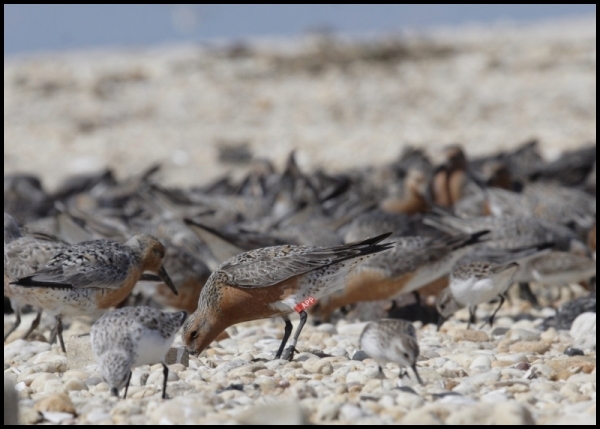
This marks the second story in Shorebird Week! Our first blog post, on Tuesday, introduced the film “A Race Against Time” and directed you to a free viewing of the film on our website. Today’s blog post, will highlight an incredible news story about a resighting of the iconic Red knot B95 on the Delaware Bay! And tomorrow’s blog post, will highlight volunteer’s incredible efforts to save stranded horseshoe crabs!
This story highlights the iconic Red knot, B95, being resighted on the Delaware Bay. B95, nicknamed Moonbird, is at least 20 years old, which makes him the oldest Red knot on record. He received his nickname because he has flown the equivalent of the distance between the earth and the moon and at least halfway back in his lifetime.
Iconic Red knot shorebird B95
One of Conserve Wildlife Foundation’s partners, Manomet Center for Conservation Science, highlights this bird in an fascinating news story about his resighting and the research efforts being done by the CWF biologist Dr. Larry Niles and Amanda Dey, senior biologist with the Endangered and Non-game Species Division of N.J. Fish and Wildlife and their team to restore the Delaware Bay.
A banded red knot searches for food on a Delaware Bay beach.
This week for Animal Week, we will be spotlighting Shorebirds in the Media! Endangered red knots, ruddy turnstones, and other magnificent birds travel from South America to the Canadian Arctic during their migration, and make an important stopover along the Delaware Bay Shore from May to June.
The 2014 Shorebird film, “A Race Against Time” celebrates the Delaware Bay Beach Restoration
The film can now be enjoyed for free on our website:
Greener New Jersey Productions this spring produced a 30-minute film documenting the ambitious campaign by Conserve Wildlife Foundation, American Littoral Society and other partners to restore Delaware Bayshore beaches decimated by Hurricane Sandy. This project ensures that the at-risk horseshoe crabs and globally migrating shorebirds relying on this habitat can survive.
Conserve Wildlife Foundation of New Jersey and the Endangered and Nongame Species Program (ENSP) of the New Jersey Department of Environmental Protection’s Division of Fish & Wildlife, and New Jersey Audubon have partnered for many years to conduct research on Delaware Bay shorebirds in order to prevent their decline.
This story marks the fourth of five blog stories spotlighting New Jersey’s Diamondback Terrapin – and educating people on the research and efforts being done to protect these fascinating reptiles!
Part 1, Monday, was an introduction into the world of the Diamondback Terrapin.Part 2, Tuesday, featured CWF’s research efforts to protect the terrapins.Part 3, Wednesday, looked at great places to view these beautiful turtles .Part 4, today’s blog post, will highlight some important ways you can help protect the Diamondback Terrapins. Part 5, Friday, will showcase some other important regional research being done by our partners.
Steps You Can Take to Protect the Diamondback Terrapins!
by Ben Wurst, CWF Habitat Program Manager
A female terrapin pauses while crossing Great Bay Blvd in Little Egg Harbor, NJ.
We all can make a difference to help conserve northern diamondback terrapins. This beautiful species is a symbol of our coast – and now more than ever, we need to be sensitive to our incredible coastal estuary ecosystems!
Here are some ways that you can help make a difference to protect this amazing species:
Slow down, don’t tailgate, and be aware while driving in coastal areas from May through July.
If you see a terrapin on the road, pull over, put on your hazard lights and carefully help the turtle cross in the direction it is going. Please be careful and use your best judgement and do not get in front of a motor vehicle to stop them on area roads. Do not jeopardize your own safety for a turtle.
If you go crabbing and use commercial-Maryland style crab pots, use BRDs or “bycatch reduction devices” to prevent terrapins from getting trapped in them. Use line that sinks to prevent a crab pot from becoming lost. Abandoned crab pots can trap and kill a ton of marine life over time, including blue claw crabs, many species of fish, and terrapins.
Talk to others to educate them about terrapins and their role in the ecosystem. You can learn all about them in our Online Field Guide!
Volunteer with CWF to patrol roadways and take part in other volunteer actions in Southern Ocean County, Atlantic County, and Cape May County! We really need your help – so please contact us if you, your business, or your civic group is willing to help save the incredible diamondback terrapin!
Donate to CWF’s diamondback terrapin program. Any amount would help greatly! Click here and note Terrapin in the PayPal note, or you can mail a contribution to Conserve Wildlife Foundation, 501 East State Street, P.O. Box 420, Mailcode 501-03E, Trenton, NJ 08625-0420. Be sure to note Terrapin in the check’s subject line.
This story marks the third of five blog stories spotlighting New Jersey’s Diamondback Terrapin – and educating people on the research and efforts being done to protect these fascinating reptiles!
Part 1, Monday, was an introduction into the world of the Diamondback Terrapin.Part 2, Tuesday, featured CWF’s research efforts to protect the terrapins.Part 3, today’s blog post, will look at great places to view these beautiful turtles.Part 4, Thursday, will highlight some important ways you can help protect the Diamondback Terrapins. Part 5, Friday, will showcase some other important regional research being done by our partners.
by Ben Wurst
During full and new moon cycles females terrapins are hard NOT to see on Great Bay Blvd. in Little Egg Harbor, NJ.
During their nesting season, Northern diamondback terrapins are usually pretty easy to spot along the coast of New Jersey, and throughout their range. They are beautiful turtles with very unique coloration.
Individuals vary in coloration, but in general, their upper shell, or carapace, is dark with a diamond shaped pattern on it. Their lower shell, or plastron, is a light yellow/green color. Their skin is a grey color with black spots that vary highly between individuals. Almost all have a light upper mandible.
From May through July, spotting a terrapin is pretty easy!
Females leave the protection of the coastal waterways to find suitable nest sites to lay eggs. They seek areas with sandy soil, like dunes, parking lots and road shoulders. When our barrier islands were developed, roads were created to access those islands.
The creation of these roads also increased the amount of available nest sites for terrapins. But the development itself actually decreased the amount of suitable nesting habitat for them overall. Much of our coast is now bulkheaded.
Bulkheading restricts the natural movement of terrapins and limits their ability to find suitable nest sites. So, now they must take what they can get: roadsides. Nesting on the edges of roads is a perilous journey for terrapins. The vehicles that travel on those coastal roads may have careless drivers behind the wheel.
Terrapins may be found in many different places along the coast, especially roads that criss-cross saltmarsh. Use extreme caution in trying to spot terrapins on active roads used by vehicles – not only to avoid driving over terrapins, but for your own safety and that of other drivers or pedestrians.
Some widely used locations include Avalon Boulevard and other west-east highways connecting the mainland with barrier islands and peninsulas. Many coastal areas in Cape May also feature high numbers of terrapins, while Monmouth County, Ocean County, and Meadowlands coastal regions feature plenty of terrapins as well.
However, one of the best places to view terrapins during their nesting season is inside the 5,000+ acre Great Bay Blvd. Wildlife Management Area, Little Egg Harbor, NJ. The WMA is located along the coast and is accessible by motor vehicle from the 5 mile long road that ends at the Rutgers Marine Field Station. The road was originally planned to connect the mainland with Atlantic City in the early 1900s. Luckily that plan fell through and the last bridge was never built (road is also called 7 Bridges Road, after the 7th bridge that was never built). There is plenty to see and do out on GBB, at all times of the year. A wide variety of wildlife can be observed from the road, including ospreys, terns, oystercatchers, herons, egrets, and shorebirds. Lots of outdoor recreation opportunites await as well, including crabbing, fishing, and kayaking. There are boat ramps along the road, and all the owners of the local marinas are very nice, including Capt. Mike’s, Rand’s Boats, and Cape Horn Marina.
Terrapins can be timid if approached, especially when nesting. Please keep your distance when near a nesting female. You wouldn’t want to cause a female to abandon laying eggs in a nest cavity! If she is unable to cover up her eggs with soil then they might become an easy meal for a gull or crow… Watching them nest is fun to watch as they excavate down and lay 8-12 eggs.
If you see one on the road and there is no traffic, slow down or stop and let it cross. If there is traffic coming, stop your vehicle, put on your hazard lights and carefully get out and move the terrapin in the direction it is heading. Terrapins can bite, so be careful and pick it up from the side of it’s shell (called the bridge). Use 1-2 hands to ensure you have a good grip. Sometimes they use their legs to try and get you to let go! Put it on the soft shoulder to be out of harms way. If you have a GPS or a smartphone, record the location and submit us a sighting via our online terrapin sighting form. Data collected from the form will help guide future conservation efforts for them in NJ.
Other great viewing areas:
Gateway National Recreation Area – Sandy Hook Unit
Island Beach State Park
Edwin B. Forsythe NWR – Oceanville
Wetlands Institute – Stone Harbor
Reeds Beach
Fortescue Beach
Ben Wurst is a wildlife biologist for Conserve Wildlife Foundation of New Jersey.
Join us on this fascinating journey into the world of the Diamondback Terrapin
Last week, I drove slowly down a road with no buildings or homes on either side, with only vast salt marsh as far as the eye could see. Over the course of the roughly 10-mile round trip, I passed maybe four other cars. But there was another kind of traveler that I found in abundance – 22 diamondback terrapins crossing the road on the way out, and another 18 of these gorgeous turtles on the way back (although I’m sure I saw some of them twice)!
Amazingly enough, this was a drive along the New Jersey coast in June. If you haven’t guessed it, I was on Great Bay Boulevard in Little Egg Harbor. And if you haven’t been there, now is the time to go – it is a true wildlife spectacle that you have to see to believe.
New Jersey’s coast is filled with wonders during the summer months – wonders that go beyond its crowded beaches, boardwalks, and traffic jams! Believe it or not, the coast still has plenty of nature to be found, often in total seclusion. And diamondback terrapins offer as amazing a wildlife story as any.
So today we kick off Terrapin Week! Read our first installment below for an up-close look at the terrapin’s habitat, appearance, range and status. Then stay tuned for a brand new story each day this week by our terrapin biologists Ben Wurst and Stephanie Egger, with topics including our biologists’ research projects, how our volunteers are making a difference, terrapins across the East Coast, and New Jersey locations where you have the best chance of seeing terrapins in the wild!
David Wheeler
Executive Director, Conserve Wildlife Foundation of NJ
Meet the Terrapin
by Stephanie Feigin, CWF Program Coordinator
Northern diamondback terrapins(Malaclemys terrapin terrapin) are native to New Jersey and inhabit the many miles of coastal salt marshes and estuaries along the Atlantic Coast and Delaware Bay. They exclusively inhabit coastal salt marshes, estuaries, tidal creeks and ditches with brackish water (a mix of both salt and freshwater) which is bordered byspartinagrass. They are the only turtle species in the world that is specially adapted to spend its entire life in this type of water.
The northern diamondback terrapin is a medium-sized turtle that varies in length from only 4 to 5.5” in males to 6 to 9” in females. Terrapins have a gray, brown, or blackcarapace(top of shell) and a lighterplastron(bottom of shell), which is a greenish-yellow. The skin is light to dark gray with black spots and other dark markings. Both sexes have a light colored upper mandible. They are named for their diamond shaped pattern on their carapace. Adult terrapins primarily eat mollusks and crustaceans, including snails, fiddler crabs, and mussels. They also eat blue crabs, green crabs, marine worms, fish, and carrion.
Terrapins are cold-blooded, or ectothermic. Theyhibernateduring the winter and bury themselves at the bottom of or in the banks of creeks and ditches. Studies have shown that terrapins also exhibit a high level of site fidelity or they return to the same territoryevery year, some even occupy the same small creeks year after year. Terrapins have a very small home range, from Cape Cod, Massachusetts to Cape Hatteras, North Carolina.
Female Northern Diamondback terrapin (c) Jonathan Carlucci
In 2001, a status review of reptiles in New Jersey recommended that the Northern diamondback terrapin be listed as a species ofspecial concernin New Jersey. The listing as special concern “warrants special attention because of some evidence of decline” (NJ ENSP-Species Status Listing) and little is known about their actual population status in New Jersey. However, terrapins are still harvested for food in New Jersey and the total harvested annually is not known. Since Terrapins are still considered a “Game” species subject to harvest, the Special Concern designation was never officially applied to the species and will not be until they are re-classified as a “Non-game” species.
Major threats to the health of the population include; habitatloss, mortality from being drowned in crab traps, and road mortality. Each year hundreds of terrapins are killed by motor vehicles throughout their range and here in New Jersey. The Conserve Wildlife Foundation (CWF) and their biologists are working hard to protect these incredible reptiles with their many conservation efforts. We are asking you to “Be Terrapin Aware” while driving along roads in New Jersey’s coastal region, and stay tuned for more posts during Terrapin Week about our efforts to protect these turtles!
Three nestlings produced at the Osprey Cam nest are banded for future tracking!
by Ben Wurst, Habitat Program Manager
In the late afternoon of June 24, 2014, I kicked off the 2014 Osprey Nesting Surveys by banding the three nestings at the Osprey Cam nest. I was joined by Ann Marie Mason Morrison, with Friends of Forsythe NWR, our founding partner with the Osprey Cam, and two U.S. Fish and Wildlife Service interns, Jessie and Kirsten who helped bring out all the equipment needed to the nest (two 20′ ladders).
This is one of the most difficult nests to reach in all of New Jersey! It either takes a boat (at high tide) or two 20′ ladders (at low tide) to cross a 15′ wide ditch on the coastal salt marsh. Anyone who has crossed the ditch can attest to how difficult it is. Now you can watch and see what when into banding these three nestlings. A portion of the video was cut when I was attempting to repair the sound at the camera equipment box. At the same time the nest was cleaned of harmful plastic debris that the birds used as nesting material. A total of 3 balloons and a plastic bag were removed from the nest. The three young were banded with USGS bird bands (1088-04358,59 & 60) for future tracking. Check out a photo that I got of “the runt.” Enjoy!
This week the annual nesting season of northern diamondback terrapins began. Females leave protection of our coastal estuaries to seek out suitable nest sites, course gravel and sand, which is often along roadsides. These individuals often cross roads to get to these nest sites. Please be courteous of terrapins and slow down, leave a greater following distance, and help a terrapin cross when you see one on the road.
Three eggs have hatched at the Osprey Cam nest at Forsythe NWR in Oceanville.
It’s been a hectic spring (to say the least). I’ve been swamped with field work since early April. Time has been flying by!!
The osprey pair nesting at the nest with our Osprey Cam on it has successfully hatched three young. The eggs hatched at ~37 days and in the order they were laid. Ospreys exhibit asyncronous hatching, which helps make sure that only the strongest young survive to fledge. In years with a good supply of fish then all young will survive. When there is harsh weather or a lack of prey (fish) then the oldest and strongest will survive, this is often called natural selection. The last two catches, from the male, have been very large white perch. There has been so much food that the young all get their fill. Sometimes the runt won’t get fed right away, but if he peeps a lot and begs for food, then he will get his share too.
Regarding the trash in the nest:
We are watching the plastic in the nest and will take action if necessary to remove it. Our policy is only to act when a bird is in a life threatening situation. Us entering a nest creates disturbance which might cause even more harm (more so when a bird is potentially entangled). Extreme care (and patience) must be taken in these types of situations. Trust us. We’d LOVE to not see the trash in the nest, BUT this is a teachable moment for all who are watching the Osprey Cam. Please share our post on social media and encourage your friends to pick up the next piece of litter they see or to not release balloons! If we all act, then we can all make a difference!
With Memorial Day Weekend upon us, summer is unofficially here for New Jerseyans. That means plenty of tourists enjoying shore, sand, surf, and sun – but it also means other types of annual summer visitors to our coast: bottlenose dolphins, sea turtles, and whales. However, what may be inspiring sightings from a healthy distance can become tragic encounters when marine animals become stranded or entangled in nets.
This story marks the fifth of five blog stories spotlighting New Jersey’s marine mammals and sea turtles – and educating people how to help animals in need, rather than make a bad situation worse.
Part 1, Monday, revealed the bottlenose dolphin die-off striking the Eastern Seaboard. Part 2, on Tuesday, featured a Question-and-Answer on the dolphin mortality event with NOAA’s Mendy Garron. Part 3, on Wednesday, looked at how people can safely help stranded wildlife. Part 4, yesterday, investigated the fascinating condition of cold-stunned sea turtles. Part 5, today’s blog entry, discusses the importance of reporting marine mammal and sea turtle sightings and how to do so.
By Michael J. Davenport, Marine Species & GIS Programs Manager
Conserve Wildlife Foundation (CWF) staff work with the New Jersey Endangered and Nongame Species Program (ENSP) to manage and populate the state’s official database of rare wildlife, known as Biotics. Currently, this database contains over 39,000 animal and plant records within New Jersey. ENSP and CWF currently collect and enter data for the state’s 182 endangered, threatened, and special concern species.
Although much of the information within Biotics on imperiled species is received from CWF and ENSP biologists, a great deal of useful data is also submitted by the public since, although NJ is a relatively small state, the biologists are unable to survey all areas at all times. The biologists rely on these “citizen scientists” to help them monitor areas which they are unable to and/or locate the presence of species in areas in which they were previously unknown to occur. Wildlife watchers who observe rare wildlife may report such observations by submitting a Rare Wildlife Sighting Report Form which then gets processed and mapped by CWF staff.
Rare species data within the Biotics database plays a critical role in wildlife and habitat conservation within New Jersey. It is used for a number of scientific and conservation efforts such as the state’s Landscape Project and Critical Wildlife Habitat Mapping, environmental review, research (GIS modeling), status review (determining whether a non-listed species should become listed as endangered or threatened and vice versa), and it also assists biologists in targeting future survey efforts to new areas.
A Rare Wildlife Sighting Report Form is available on ENSP’s website for download as well as instructions for completing the form – there is also a Marine Wildlife Sighting Report Form, specifically for reporting sighting of marine mammals and sea turtles. A complete list of all of the species tracked by the state can be downloaded here.
Reporting your rare wildlife observation is easy. Simply complete the form, attach a map of where the animal was observed (a map is not necessary for marine sightings; geographic coordinates may be submitted instead), as well as any photographs taken, and then mail or e-mail the form and any additional documentation to ENSP at the address provided on the form. For more details about the state’s rare species mapping, please visit our webpage.
Observations of dead, dying, or stranded marine mammals or sea turtles should be reported to the Marine Mammal Stranding Center at 609-266-0538. Keep in mind, however, that a seal on the beach is not necessarily sick or injured. Resting on the beach is normal behavior for seals. They may haul-out onto beaches, jetties, or floating docks to rest or escape predators. So, a seal on land is not necessarily a seal in distress. Obvious indications of illness or injury are open wounds, entangled fishing line, or lack of responsiveness to their surroundings.
With Memorial Day Weekend upon us, summer is unofficially here for New Jerseyans. That means plenty of tourists enjoying shore, sand, surf, and sun – but it also means other types of annual summer visitors to our coast: bottlenose dolphins, sea turtles, and whales. However, what may be inspiring sightings from a healthy distance can become tragic encounters when marine animals become stranded or entangled in nets.
This story marks the fourth of five blog stories spotlighting New Jersey’s marine mammals and sea turtles – and educating people how to help animals in need, rather than make a bad situation worse.
Part 1, on Monday, revealed the bottlenose dolphin die-off striking the Eastern Seaboard. Part 2, on Tuesday, featured a Question-and-Answer on the dolphin mortality event with NOAA’s MendyGarron. Part 3, yesterday looked at how people can safely help stranded marine mammals without making the mistake of being a “hero”. And Part 5, tomorrow, will reveal the importance of reporting sightings – both for live or dead marine mammals.
MARINE MAMMAL & SEA TURTLE WEEK: Sea turtles navigate a dangerous path, from entanglements to cold-stunning
By Sara DeAngelo, Conservation Intern
Over 100 first responders along the coast of New Jersey attended Conserve Wildlife Foundation’s marine mammal stranding workshops this past month. Speakers and interactive discussions educated the first responders on how to handle a marine mammal or sea turtle stranding.
The term “stranding” is used for sea turtles and marine mammals that are found along the beach dead or alive. Their death or injury may be resulting from a predator, parasites, pollution, entanglement, etc. In most stranding cases, the cause of the animal stranding itself is unknown. Determining the cause of the animal stranding will help us understand what is going on in the ocean that may be harmful to certain populations.
Sea turtles, however, face a unique set of challenges. We have four species of sea turtles that may be found in New Jersey waters during the summer. Loggerheads are the most common, while green sea turtles and Atlantic leatherbacks – massive creatures weighing as much as a small car – are less frequently seen but not uncommon. Kemp’s Ridley sea turtles are the rarest visitors.
Most of these sea turtles come to New Jersey during the summer months and enjoy the warmer waters. Yet when our seasons change and the waters cool, some sea turtles may lag behind rather than returning south for warmer waters. These turtles can face “cold stunning”.
In colder waters, sea turtles do not have the capability of warming their own bodies. If a turtle is cold stunned, it looks as if it is dead because its heart rate decreases, it becomes lethargic, circulation decreases, and it may be in shock or have pneumonia.
This condition can even result in a common mistake of a passerby or first responder believing a turtle is dead, when it is actually just “cold-stunned”. Unless the sea turtle clearly looks like it has been dead for a while, it is best to report the turtle to a marine mammal and sea turtle stranding hotline.
A green sea turtle. Photo by Cordell Brown.
Sea turtles can also get entangled in fishing nets. At the Conserve Wildlife Foundation workshops this month, first responders were informed to, upon sighting of an entangled or stranded animal, immediately call the Marine Mammal Stranding Center located in Brigantine, NJ, by calling 1-609-266-0538. They could also contact NOAA’s Northeast Region Marine Mammal and Sea Turtle Stranding and Entanglement Hotline by calling 1-866-755-6622.
Boaters who encounter an entangled sea turtle should try to remain near the turtle until help arrives if possible. On shifting seas, it could be hard for the expert responding to the call to locate the animal without the initial person spotting it standing by to direct them there.
One warning was made very clear in the workshop: boaters should never get into the water with a sea turtle or stranded marine mammal. It is extremely dangerous for both the responder and for the animal.
Should the sea turtle be on the beach itself, other tips are helpful for the first responders. While waiting for the trained rescue staff, the first responders were urged to secure the scene, try to keep people at least 100 feet away, and not to touch the animal. Keeping curious beachgoers distant from the animal will minimize stressing out the animal even more. The responders were told that calling the local police department may help enforce the directions to keep back from the animal.
A Kemp’s ridley turtle. Photo courtesy of Jenkinson’s Aquarium.