by Larissa Smith, Wildlife Biologist/Volunteer Manager
Duke Farms eagle chicks in nest after banding on May 14, 2014
On July 27th the juvenile male, D-98, was found dead by residents of Little Sebago Lake in Maine. He was banded at six weeks of age along with his two siblings one male and one female at the Duke Farms eagle nest which was broadcast live online.
His body was found floating in the lake by residents who reported the band numbers to the National Bird Banding Lab. We then received the report that he was found dead and were able to contact the finders for more information. Residents of the lake which is NW of Portland, reported seeing him near an active eagle nest located on the lake. The nest had chicks which had fledged in early July. On July 25th residents reported seeing a juvenile with a green band sitting in a tree near a boat house;
“The youngster had been in a small tree next to our boat house for quite a long time when an adult, carrying a fish, swooped in over the folks sunning on the beach and attacked the young bird. It dropped the fish in the process. The adult flew off leaving the fish and the juvenile behind. Thanks to a cell phone photo, we know that the youngster had the band colors of the later retrieved juvenile”.
While we don’t know for certain we can assume that the juvenile’s death was in some part due to injuries that occurred when it was attacked by the adult. It is always sad to report on the death of an eagle especially one that hundred’s of Duke Farms eagle cam viewers watched “grow-up”, but it is the reality of life in the wild. The mortality rate for first year eagles is fairly high as they are still learning to hunt and survive on their own. It is very unusual to receive this much information on the details surrounding an eagles death. D-98 made an approximately 390 mile trip up to Maine. He probably found plenty of food at the lake which is why he was hanging around, but ended up in another eagles territory. Hopefully the remaining two juveniles from the Duke Farms nest have better luck and survive their first year.
A humpback whale – named Jerry by researchers – spyhops off New York City. Photograph: Artie Raslich/Gotham Whale
Cleaner waters along the New Jersey and New York coasts are increasing the abundance of Humpback Whales and Great White Sharks. These waters now contain more nutrients and less garbage, and have encouraged rises in fish populations – thus attracting more whales and sharks to the area. To read this full article, click here
For more information on marine mammals in New Jersey, click here.
U.S. Coast Guard and staff from the Marine Mammal Stranding Center rescued an 800-pound leatherback sea turtle off of the coast of Southern New Jersey. For more information on sea turtles facing risks along our coastline, click here.
To read the full article on this video, click here.
When it comes to choosing which Island Beach State Park Programs are best for you, it’s tough to decide from so many great options!
So today we bring you the expert naturalists and educators who teach the programs. Hear their own evocative stories behind each program then decide what’s best for you!
Part 1, Monday, summarized these exciting programs.Part 2, Tuesday, highlighted the Harvest the Bay Day happening this Saturday, August 9 from 3-8pm. Part 4, Thursday, will be a round table interview with the Island beach State Park naturalists. AndPart 5, Friday, will feature a personal account from one of CWF’s interns who works at Island Beach State Park.
John Leonard, Park Naturalist, Island Beach State Park
As a Park Naturalist for THE best park within the NJ Parks and Forestry system I’ve been able to do some wickedly fun and educational things within its borders for the past five years. From fishing its shores for monster striped bass, to kayaking and seining the waters of Barnegat Bay. Nothing satisfies me more than sharing those experiences and seeing the smiles with the thousands of visitors who visit our park daily. But what if I told you, the adventurous few, we have a program that happens only twice a summer, and is scheduled during a time and at a place where the park becomes virtually deserted. Alone. On a barrier island. Far from the lights and crowds you are accustomed to at the Jersey Shore. Tempted?
The Full Moon Hike begins deep in the park, 3.5 miles past our bathing beaches at our Nature Center, a building many say is haunted by old souls of the sea. After a quick introduction of your guides at dusk we begin our educational journey, slowly working our way westward through the dense maritime forest. Quietly walking all our senses slowly awaken. The sounds of far off birds, rustling of mammals and amphibians in the undergrowth searching for a meal, pungent odors of decaying matter all come into focus. Learning as we walk, taking note of all our surroundings. As we reach Barnegat Bay we are rewarded by a liquid orange sun dipping slowly beneath the horizon illuminating the sky in a spectrum of color, a perfect time to observe the bay and all its glory.
Retracing our steps with natural light fading we begin our trek ocean side. Dense, dark forest gives way to the moonscape like terrain of our secondary, then primary dune system. A place that seems inhabitable, but in fact are home to our famed red fox. In addition to being extremely important barriers of ocean storm surge, these dunes have been rumored to hold buried treasure from pirates as far back as the 1600’s.
As we cross that final dune we leave the quiet solitude of the secondary dunes and are rewarded with an impressive elevated view of the ocean and sands which we’ve all come to love. Immediately we feel the air temperature drop, we hear thundering waves crashing on our pristine shores and view a brilliant burning fire just waiting for us to enjoy. Here we are free to enjoy the beach, collect shells or simply gather around the fire and enjoy the dancing flames as the yellow full moon slowly rises above the waves in the eastern sky. As an added bonus for all guests big and small, we are comforted by the melty goodness of roasting marshmallows, decedent chocolate and lightly sweet graham crackers to enjoy.
“Seining tours are a fun, interactive way for kids and adults to gain first hand experience with the marine life in our area. They are also an invaluable tool for school groups learning about coastal ecology” – Becca Hanson, Seasonal Supervisor
Did you know that IBSP offers free daily seining tours every day, twice a day? Pull a seine net through the Barnegat Bay and discover the amazing creatures who live here. Can you scare away hungry predators by growing twice your size in less than 6 seconds? A pufferfish can! Scoop up some silversides, the ‘french fries of the bay’, and understand the importance of this abundant fish in the Barnegat Bay food chain. Meet the snails, our bottom-feeding friends who keep the bay clean. What’s today’s catch of the day?
The Snorkel/Kayak Program at Island Beach State Park is a mix of snorkeling and kayaking in the Barnegat Bay. After a brief introduction and overview of the necessary kayaking skills, participants start the tandem kayaking adventure. All snorkel gear and kayak gear are provided. Park educators explain the ecology and importance of the Barnegat Bay and its ecosystems, and also review the different species that can be expected while snorkeling. When the tide is right, kayaks are anchored on a nearby sand bar and participants can snorkel in the adjacent deeper channel. Participants may see a variety of species, such as pipefish, crabs, flounder, hermit crabs, schools of bait fish, as well as different types of aquatic vegetation. This tour is new at the park and is becoming increasingly popular! Come join us for this unique underwater ecosystem viewing experience!
“From my personal experience with this program I find that it gives the children a wonderful hands-on approach to understanding the natural balance that takes place at Island Beach State Park.”- Josephine, Park Educator
Nature toddlers during craft time
This program is specifically designed for children ages 3 to 5 years old and takes place at the Nature Center. Age-appropriate hands-on activities, stories, crafts and hikes guide your child’s natural curiosity as they explore the animals and plants of Island Beach State Park. Natural Educators provide an educational hour of fun for parents and their children.
“From an educators stand point, I find that this program truly enriches the child’s love of learning. This program is supported with appropriate children’s literature and affords the children the opportunity to learn hands on; which in my experience is the most beneficial. It is delightful to take part in helping to create memories that are sure to last for a life time!” – Lisa, Park Educator
This program is specifically designed for children ages 6 to 12 years old and takes place at the Nature Center. With the help of Natural Educators, children get the chance to explore the outdoors, make crafts, listen to stories, learn about animals, and investigate the local ecosystem. This is a two hour program that explores different topics each week such birds, turtles, jellyfish, and much more!
IBSP Kayak Tours
Most people come to Island Beach State park to enjoy the swimming beaches. They drive to Ocean Beach Area 1 or 2, spend a few hours on the beach and go home feeling satisfied with their visit to the park. Little do they know they have only scratched the surface in terms of what this park has to offer!
Kayak tours are one of the more popular activities provided by IBSP park educators. Below is a list of tours and a brief description of each:
Learn about the history of Island Beach dating back to the first recorded description in 1609 by Robert Juet, the first mate to Henry Hudson, the parks involvement in the Revolutionary war, the War of 1812, pirates in the park, all the way to present day uses. All of this is done while kayaking around the Island visiting important historical landmarks and enjoying the beautiful Island ecosystems.
“The sunset paddle is one of my favorite programs offered at the park. Being on the water, witnessing the natural serenity of the area and its inhabitants, and watching the brilliant colors of the sunset is an experience like no other.” – Kelly Scott, Park Naturalist
Enjoy a peaceful and relaxing evening paddle through the famous Sedge Islands and watch the sunset over Barnegat Bay. This is prime time for observing the parks different wildlife species, including egrets, herons, gulls, turtles and maybe even a lingering fox watching from shore.
Learn about one of the largest estuaries in NJ by kayak! Park educators will discuss the bay’s geology, ecological function and importance, and local flora and fauna. In addition, the Eco-tour also includes a seining event to observe marine life and park educators will teach the “clammers dance.”
Expert Park Natural Educators will guide you on a peaceful paddle through the dynamic Barnegat Bay estuarine ecosystem. Discover the diversity of birds that inhabit Island Beach State Park in the summer. We will discuss migration patterns and year-round residents. Keep an eye out for additional birding tour during the upcoming fall migration!
Nature Center/Interpretive Center
Do you want to see wildlife close-up – and spend a day at the beach? Then come visit the Island Beach State Park Nature Center!
Once a coast guard building, the Nature Center showcases a unique combination of amazing views and lots of interactive fun for the whole family. Our Nature Center is home to a wide variety of local creatures from our 2 year old albino corn snake Newton, to our baby diamondback terrapins. Dont forget to take in the spectacular view from the top floor where the bay, the ocean, and Barnegat Bay lighthouse are all visible.
Just across from the Nature Center is the Forked River Interpretive Center where visitors can enter the world of yesterday and explore the incredible history of Island Beach State Park. Visitors can learn about the massive effort to bring Ospreys back to the Island, the historic Reeds Hotel and many other amazing stories and tales of life as it used to be on this breathtaking island.
Before you leave, make sure you take a visitors guide and check out the Summer Programs offered by IBSP Park Naturalists and educators! Let us show you how much fun nature can be!
“Surfing Safari is by far the most popular WILDCHILD program offered at IBSP. Space is limited, and classes typically fill up fast. Register early to reserve your spot!” – Tom Seager, Park Educator
Surf’s Up Dude!
Learn about waves, what they are, where they come from, and why they break. Paddle out with expert Natural Educators and IBSP Lifeguards, and maybe you’ll be hangin’ 10 by the end of the summer! Drop off your child for two hours of fun!
The nonprofit Conserve Wildlife Foundation of New Jersey seeks an Environmental Education Coordinator to lead our fast-growing education program and support our program work. The successful candidate will be an enthusiastic, knowledgeable professional with experience in environmental education, strong communication skills, multi-tasking ability, and the motivation to be a successful self-starter.
Part 1, Monday, was an introduction to these exciting programs.Part 3, Wednesday, gave the “Insider’s Look” into the amazing outdoor programs, told through the words of the experts teaching the programs at Island Beach State Park. Part 4, Thursday, was a roundtable interview with the Island Beach State Park naturalists. AndPart 5, Friday, will feature a personal account from one of CWF’s interns who works at Island Beach State Park.
The rich ecological resources of Barnegat Bay and IBSP, coupled with high numbers of visiting park patrons serves as the perfect backdrop for our Harvest the Bay Festival. IBSP, has two extensive natural areas, coupled with two large points of recreational usage and a marine conservation zone, making it an easy link to demonstrate the function of healthy coastal ecosystem, the effects of human interaction and beneficial aspects of management. Each year, the park hosts over 1 million guests that that engage in boating, clamming, fishing, swimming, and hiking along the 10 miles of shoreline.
Barnegat Bay acts as an early life history nursery for many species of fish/invertebrates that are both recreationally and commercially significant in terms of harvest. The bay supports healthy aquatic flora including submerged aquatic vegetation and phytoplanktonic growth. Subsequently, early life history stages of coastal bivalves, crustaceans and forage fish occur along the bay because of high levels of primary productivity. However, some fisheries resources in Barnegat Bay have experienced a decline in recent years. Despite healthy levels of biological productivity in Barnegat Bay, anthropogenic effects do require monitoring and education to better promote coastal stewardship including coastal development along the watershed, increased nutrient loading, decreases in dissolved oxygen/pH, habitat loss, and the effects of over-harvesting marine resources.
The Harvest the Bay Festival was designed to promote the value of shellfish and finfish as food resources in Barnegat Bay by highlighting their ecological, economic and social importance. Vendors from governmental, non-profit and private organizations will be present to discuss with the public, the importance of Barnegat Bay to their mission. Also, local restaurant vendors will be present to display locally caught food selections of Barnegat Bay and the adjacent coastal ocean. Ultimately, the goal of the Harvest the Bay Day is to celebrate the importance of Barnegat Bay and educate the public about its significance, while promoting the following Harvest the Bay educational programs:
Harvest the Bay Clamming
Harvest the Bay-Clamming is one of the best ways to experience Barnegat Bay. Join park educators and learn about the anatomy of Quahog clams, their ecological importance in the bay, harvesting restrictions, and more. The program provides clam rakes or you can use your feet! Learn the skills and “clam-dance” of the baymen that still live in the area. While clamming, you are also likely to encounter some of the birds of Island Beach State Park such as the Osprey and Oyster Catcher.
Harvest the Bay Crabbing
Discover the fascinating life cycle of the Blue Claw Crab, its niche in the ecosystem, when and how to harvest them, and what you can do to assure their populations remain at a healthy level.
Harvest the Bay Fishing
Bluefish, Fluke, Black Drum – the bay is host to a variety of local fish. Explore the role of finfish in the bay’s ecosystem and discover techniques for successful fishing. Cast a line into the bay and reel in your catch of the day!
The Jersey Shore has changed immeasurably over the past century. But one place gives you the chance to recapture the beauty and wild feeling that once encompassed the entire coast – Island Beach State Park.
At Island Beach State Park, you can still find hands-on adventures along the Atlantic Coast and the Barnegat Bay. You can still be immersed in the nature of coastal beach dunes, maritime forest, and vast saltmarsh. You can still find wildlife like osprey, red fox, diamondback terrapins, piping plover, sea turtles, and an incredible array of fish and shellfish.
This week CWF is highlighting the hands-on interactive learning programs offered at Island Beach State Park. This marks the first of five blog stories that will spotlight these programs.
Part 1, Today, will be an introduction to these exciting programs.Part 2, Tuesday, will highlight the Harvest the Bay Day happening this Saturday, August 9 from 3-8pm. Part 3, Wednesday, will give the “Insider’s Look” into the amazing outdoor programs, told through the words of the experts teaching the programs at Island Beach State Park.Part 4, Thursday, will be a roundtable interview with the Island Beach State Park naturalists. AndPart 5, Friday, will feature a personal account from one of CWF’s interns who works at Island Beach State Park.
CWF is excited to partner with New Jersey State Parks and offer incredible programs about New Jersey’s natural world at Island Beach State Park.
Become a WILDCHILD, take a sunset kayak tour, try your hand at surf-fishing, go bird watching, or enjoy a movie night at the park! Whatever you decide, you will be guided by professional educators and naturalists who have plenty of natural and wildlife stories to share with you.
At nearly 10 miles long, Island Beach is New Jersey’s most expansive stretch of undeveloped barrier island. Our programs help you to connect with the beauty of this ecosystem and its ample natural resources. Have your kids participate in a WILDCHILD program including surfing, surf-fishing, and island exploration. Try and catch the big one during a surf-fishing class or discover the beauty of Barnegat Bay through kayaking.
Ben Wurst prepares to band two osprey nestlings for future tracking. Photo courtesy Eric Sambol
By now many young ospreys have taken to the wing. While they still rely on their nests to perch at night and their parents for food, these juveniles take to the skies to learn the skills needed to survive to adulthood. Our nesting surveys have been completed, birds banded, and our sunburn and green bites are healing! Over the next week I will start to enter and summarize data that I’ve collected and data from our volunteer “banders” who help cover the most densely populated colonies. From my surveys, which range from Mantoloking to Atlantic City, I’d say that productivity is down in some areas and up in others, as compared to last year. But, ospreys still had a decent year. I would NOT call it a BAD year!
By far my own survey effort was not as great as last year, when we conducted a census of all nesting ospreys in NJ, by publishing our nest locations on our partners website, called Osprey Watch. This year I battled broken boats, a severe cold (still didn’t slow me down), harsh south winds, and thunderstorms to get to as many nests as I could, especially on Barnegat Bay. Why Barnegat Bay? We all have heard that Barnegat Bay is dying. Overloaded with excess nutrients from stormwater runoff, which is killing off the eelgrass beds that provide shelter for many juvenile fish, aka future osprey prey. This project will help us learn about osprey foraging habitat on N. Barnegat Bay. Are more birds foraging in the ocean in those areas, as opposed to birds that nest closer to LBI and LEHT? Hopefully our ospreys will help shed some light on the health of the bay. Lastly, the project would not be possible without the generous support of Northside Jim, chief blogger/extraordinary photographer at “Readings from the Northside” and his many followers. With their support we were able to purchase (100) and deploy (60) a red auxiliary band on young birds. These bands are engraved with an alpha-numeric code which will make identifying birds much easier than only the aluminum USGS band. In the coming weeks Jim will be giving us some assistance with setting up a nice little website where people can learn all about the bands, the birds, and most importantly: report re-sightings of these awesome new bands!
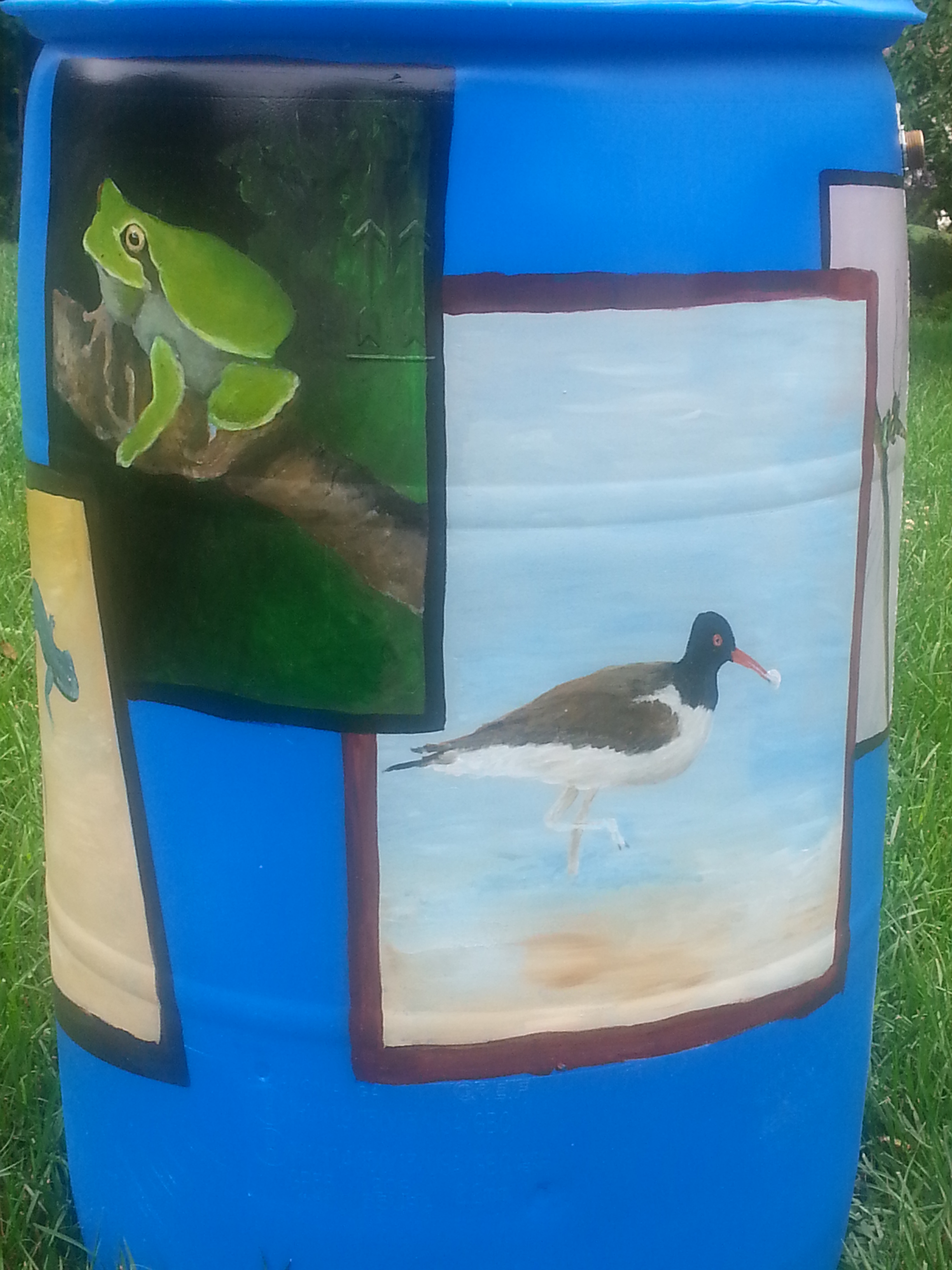
On May 30, 2014 EarthShare New Jersey launched the exciting new Rain Barrel Auctions program. Thanks to a donation of barrels from Ocean Spray Cranberries, Inc. in Bordentown, N.J., each of the 24 members of EarthShare New Jersey will have one designed which captures the important work each of these charities do for our environment. The auctions are designed to raise awareness and funds for the local members of EarthShare New Jersey.
Rain Barrels offer a long-term, sustainable way to collect and store the rain water that drains from our roofs and gutters. The water can then be used around the home, in the garden, or even for hydration as long as it is adequately filtered and cleaned. Each of the rain barrels being auctioned off are not only functional, but exquisite one of a kind works of art designed by artists from across the state. The program will run until the end of 2014.
The rain barrel designed for CWF was recently posted on eBay. CWF is very excited to have been selected for this effort, and we hope this rain barrel raises awareness and the sale is a success! The proceeds for this rain barrel will be split with CWF and EarthShare.
EarthShare is a national non-profit federation with 25 years of experience in connecting people and workplaces with effective ways to support critical environmental causes. Together we’ve raised more than $300 million for programs that care for our air, land, water, wildlife and public health — in your community, across the U.S. and around the world. EarthShare develops and manages employee engagement and giving campaigns to increase support for its member organizations and help our workplace partners achieve their philanthropic and CSR goals.
Conserve Wildlife Foundation is a non-profit and an EarthShare local member organization. Together CWF and EarthShare work to create a sustainable environment through education, conservation, preservation and community awareness. Through ongoing statewide and community activities we address so many important issues.
Check out our rain barrel, with beautiful artwork by Diane Novobilsky, here!
Ospreys are a common sight along the New Jersey shore during summer months.Each year myself and other dedicated volunteers conduct surveys of osprey nests by boat. Photo by Northside Jim.We use ladders to access nests. Photo by Northside Jim.We count the number of young produced.While checking nests the adults circle nests and often dive bomb banders, like myself.Dive bombed like this. Photo by Northside Jim.And this… Photo by Jim Northside Jim.Young are banded for future tracking.This year a color auxiliary band is being deployed on young that are produced on Barnegat Bay.The bands will allow us and “Osprey Watchers” to ID individuals birds and we will learn a great deal about their dispersion, site fidelity, life span, etc…While checking nests, with or without young, we clean out any trash that we find. Photo by Northside Jim.After surveying a nest the adults return to care for their young.


 Part 1