DONATIONS TO BENEFIT CWF WILDLIFE EDUCATION PROGRAMS
By Emily Hofmann
Newark 5th-graders enjoy a day at the beach exploring nature as part of CWF’s WILDCHILD Program for underserved youth.
Connecting kids with the natural world around them does wonders for their health and self-esteem, builds leadership skills, and often fosters a love of science at a very young age.
And nothing awakens that environmental awareness like wildlife!
Conserve Wildlife Foundation’s exciting hands-on programs – classroom presentations, field trips, live wildlife, and webcam lessons – teach children about the state’s rare wildlife and the need to protect it. And while some schools can cover the costs of these lessons, far too many can’t afford programs and field trips.
Through December 31, all donations to Conserve Wildlife Foundation to support our education and outreach to under-served schools will be generously matched by the Merrill G. & Emita E. Hastings Foundation. This will greatly strengthen CWF’s ability to provide equitable opportunities for children in at-risk areas to become environmental stewards.
Thanks to that generosity, a donation of $25 will be worth $50, and a donation of $100 will be worth $200.
Learning about the eagles, ospreys, bats, peregrine falcons, butterflies, and other animals that might share their neighborhood engages kids with their environment,” says Liz Silvernail, CWF Director of Development. “Our education helps open children’s eyes to the wonders of wildlife and nature, regardless of whether their school can pay for our programming.”
This holiday season, CWF encourages supporters to give the gift with an enduring legacy for the next generation of scientists!
WORLD IS EXPERIENCING A DECLINE IN POLLINATORS, NEW JERSEY IS NO EXCEPTION
By Kendall Miller
New Jersey is not exempt from the worldwide decline in pollinators. We face the challenge of protecting wildlife in a highly modified and populated landscape. But the fight is not without hope.
A milestone has been reached for wildlife conservation in Hawaii – and is a win for the world of conservation as a whole. This month, seven species of bees indigenous to the Hawaiian archipelago were added to the endangered species list and brought under federal protection. These are the first species of bees to be listed in the country.
Hylaeus assimulans is one of the seven species of yellow-faced bee to receive Endangered Species Act protection. (Photo: John Kaia. Picture taken from Xerces Society.)
It’s that time of year again. The trees around us, in our yards, on our streets, and in our forests are shedding their leaves with each gentle breeze or strong gust of wind. A dazzling display of colors drew tourists to gaze at our Northeast forests. After the brief but beautiful show, the leaves drift to the ground to litter the forest floor.
Our red, white, and black oaks, red and sugar maples, american beech, hickory, and cherries and other deciduous trees that dominate New Jersey forests all drop their broad leaves on cue. The few evergreen firs, spruce, and pines that we have hold on to their needle-leaves and contribute to the little greenery we have in the landscape until the following spring. Continue reading “Autumn in New Jersey: Why Do Trees Shed Their Leaves?”
Under the sweltering September sun, our team discovers the earth at our fingertips. We ready the manure, topsoil, and mulch, wield the pickax and trowel, and labor the wheelbarrow through the trees and up the slope of a tidal berm.
We plant 250 native shrubs and 580 native herbaceous plugs. We hammer in nest boxes, install pollinator houses, construct mounds of brush for local and migrating wildlife, and create nesting habitat for northern diamondback terrapin, an at-risk turtle species.
We lose ourselves in nature for the day.
A migrating butterfly flits past leisurely and I look up from the soil to wipe my brow. Suddenly I remember exactly where this newly vibrant natural ecosystem is. Nearly overhead, I can watch never-ending streams of commuters and tractor trailers motor past over one of the busiest bridges in the nation – the Newark Bay Bridge. Just across the bay, I can see heavy industry. Out beyond the fence, more industry – ancient, tireless, modern progress marching forward.
Yet on this morning, and those that follow, we now have ecological progress here as well, in a place that was written off entirely not so long ago. The Newark Bay region has suffered a century and a half of environmental degradation at the hands of industry and unbridled development.
This active industrial site is home to Firmenich Inc., one of the largest manufactures of fragrances in the world. We have transformed the land today to invite wildlife partners to help balance the scales of the region’s damaged ecology.
Green Darner dew laden on Echinacea.
These partners are vital to our environment, to our health, to the world around us. They are the butterflies and bees, the wasps and beetles, the flies and moths that make up an army of pollinators that in coordinated effort provide humanity with the lungs of our planet. Without these pollinators, native plants could not sink carbon dioxide and impart oxygen to our surroundings, every minute of every day. Without these pollinators, the bread baskets of the world would wither away, no longer filled with grains, fruits, and vegetables.
The natural partnerships don’t stop with the pollinators born forth from meadow creation. These partners extend to migrating songbirds and mighty raptors, small mammals and diamondback terrapins.
“If we give nature an inch, it’s going to take a yard. Give it a chance and nature will return,” says biologist Blaine Rothauser, who is directing the restoration for GZA Environmental. “Wildlife just needs an opportunity.”
Immature night heron with crab.
Nature’s inspiring return builds upon decades of ecological recovery in the region. Thanks to President Nixon’s Clean Water Act of 1973, the water began to get cleaner. Improving the water quality reanimated the food chain from the bottom up – phyto- and zooplankton, invertebrates and crustaceans reappeared. In turn, a fishery was reborn, which ushered in the return of herons, ibis, osprey, turtles, and even harbor seals – seen sunning on the banks of tidal shores in winter!
Yet much of the land around the water’s edge is still wanting.
“The restoration site is an important buffer habitat to a large portion of undeveloped tidal bay directly adjacent to the Firmenich complex,” says Rothauser. “Today we have 60 people planting a native community of shrubs, trees and plants on a formerly sterile lawn and an unnaturalized earthen berm. It is vital work that makes a real difference.”
The team has also created opportunities for rare species to nest. Above our heads, an osprey platform has been installed, empowering this magnificent fish-eating raptor to continue its recovery along Newark Bay and many other New Jersey waterways, industrial and remote alike.
A barn owl box offers one of our most mysterious nighttime predators the opportunity to set up shop in a beneficial area – where there is no shortage of rabbits and field mice to help control.
Close up of a barn owl.
Across the pond, a purple martin condominium-like house offers the ample space necessary for these communal swallows to reside, a home base where they can feast on flying insects.
With the first phase of the project almost complete, the second phase will seek to transform the site’s holding ponds into ecologically productive floating wetlands, bringing herons and egrets and other wading birds.
Ultimately, this project is envisioned as one that can be replicated just about anywhere along Newark Bay – or any industrial waterfront for that matter. All it takes is the willingness to look at a site’s land from a different perspective – and in so doing, to understand that the ecological benefits of bringing back many wildlife species aren’t negated by losing economic tradeoffs.
Instead they can mean parallel economic benefits. Natural pest control. Fewer landscaping and pesticide costs. Increased employee morale and productivity, with a newfound opportunity to recharge body and mind with a rejuvenating break outside, enjoying natural beauty and the engagement of your senses.
Images above from left to right – Killdeer, 12 Spotted Skipper, and American Kestrel.
New Jersey has long served as a primary engine for America’s industry and commerce – and in return has often been derided as the “Which exit?” land of nothing but turnpike and smokestacks. The Meadowlands just to the north of here bore the brunt of that reputation, yet in recent decades has made a mind-blowing ecological recovery to become a wildlife – and ecotourism – destination.
The waters flow south from the Meadowlands along the Hackensack and Passaic Rivers, and they come together in the Newark Bay. Now, that next wave of wildlife recovery and habitat restoration has arrived just downstream – along the Newark Bay waterfront.
For wildlife, it’s where the action is.
David Wheeler is the executive director of Conserve Wildlife Foundation and author of the book, Wild New Jersey: Nature Adventures in the Garden State.
This Halloween, while you are with friends and family celebrating a spooky evening of fun, I ask you to take a moment and think about one more thing – Halloween without bats. I want you to think about bats today not as the spooky creatures of the night that some people normally think of them as, but as incredible mammals that are invaluable to our ecosystem. In New Jersey, all of our 9 bat species are insectivores. They can eat thousands of insects in one night, protecting our crops and forests from insect destruction, and they pollinate many important foods that we love. A study published in Science magazine estimates that bats’ insect-eating services may be worth as much as $53 billion to US agriculture alone.
Photo courtesy of Blaine Rothauser.
Despite the many environmental and economic benefits bats provide, bat populations around the world are still declining. Bats face many threats, including habitat loss and destruction, human persecution, wind energy development, and White-Nose Syndrome.
Little brown bats. Photo courtesy of Stephanie Feigin.
Devastatingly, we have lost over 6 million bats nationwide due to the spread of White Nose Syndrome (WNS) – a disease caused by a cold-loving fungus called Pseudogymnoascus destructans or Pd. It attacks hibernating bats, disturbing them during hibernation when the bats’ immune response is low, and prevents them from conserving enough stored energy to survive until spring. WNS also causes dehydration and unrest as well as severe wing damage that can prevent bats from flying. Much is still unknown about White-nose syndrome, its spread, and its consequences. The federal government, states, several universities, and organizations like ours are working hard to track and understand this disease.
Big brown bat emerging from barn. Photo courtesy of Mackenzie Hall.
In New Jersey, about 50,000 bats were killed by WNS in the first year (2009) – and we now estimate over 60 tons of mosquitoes and other night-flying insects go undevoured each year from loss of bats. Though bats are one of the most beneficial animals to humans they are still poorly understood and underappreciated, which is why today I ask you to think of them in a new light. Today, think about bats for all of the wonderful benefits they provide, think of them as amazing animals that work hard at night to protect our ecosystems, because we need to make a change.
To protect the bats we still have, it is important that people understand the stress these bats are under. It is important that we re-think how we view bats, remove the spooky stigmas that surround them and appreciate their importance to us. So today, think about bats think about how important they are, how badly we need to protect them and how scary a world without bats would be.
Big brown bat. Photo courtesy of Stephanie Feigin.
Stephanie Feigin is a wildlife ecologist for Conserve Wildlife Foundation.
While many have been busy mourning the end of summer in anticipation of colder weather and longer nights, the changing leaves outside are indicative of an incredible natural process that too often goes unappreciated – not for its lack of beauty, but the science behind it.
Some years it feels as though we barely get to experience the fall season before we jump into winter, but the fall foliage this year has been a beautiful spectacle so far. Here at CWF, we are suddenly presented with a magnificent backdrop of oranges, reds and yellows in our field work with so many wildlife species in our mountains and forests.
Yet as you go outside to explore and enjoy the season, it might be worth asking, why exactly do leaves change color?
To put it simply: Trees are preparing for winter.
Throughout the spring and summer months, leaves work overtime to provide and store nutrients for the tree. How? The sun triggers the production of chlorophyll, which is a pigment found inside leaves that gives them their green color. Over the warm months, chlorophyll absorbs sunlight and converts carbon dioxide and water into oxygen and carbohydrates, respectively. This complex process is known as photosynthesis and is vital to the health of the tree.
As the days shorten and the nights get longer, exposure to the sun is naturally limited and the production of chlorophyll slows considerably, until eventually it is broken down completely. As the chlorophyll is absorbed by the tree for the long winter ahead, other pigments that exist in the leaves become more visible, ultimately exposing the red, orange and yellow hues we see during the fall.
So, the next time you go outside to marvel at the beautiful fall colors, don’t forget to appreciate just how hardworking nature truly is!
Corrine Henn is a communications coordinator for Conserve Wildlife Foundation
This fall, Conserve Wildlife Foundation partnered with Firmenich and GZA Environmental to provide pollinator plants to build an entirely new butterfly and rain garden on the Waldorf School campus in Princeton.
Firmenich volunteers stationed the plants around the garden and planted them on their annual global volunteer day. Plants include aromatic lavender, bright black-eyed susans and echinacea, shrubs like winterberry holly and spice bush, and trees such as common hackberry and sweet bay magnolia. These plants are all native to the local environment and provide essential nectar sources for pollinators.
From left to right, bee on lavender photo from Andrew Wilkinson through Flickr Creative Commons and eastern blue-tail visiting black-eyed susan Vicki Deloach through Flickr Creative Commons.
The space for the new garden was a previously fallow section of the school’s one acre garden. It was overgrown and somewhat sprawling until the project came about. Facilities manager Kevin Jones and gardening teacher Suzanne Cunningham both prepared the space for its transformation into a rich habitat of native plants.
Left. After planting, an unused and fallow area of the school’s garden is now home to several different types of native plants.
“Pollinators are in decline, which is very unfortunate since we rely on them as irreplaceable contributors to our health, our food, our environment, and our economy,” said David Wheeler, CWF Executive Director. “We are so thrilled to partner on this exciting and vital habitat project, particularly where the youngest generation can experience the beauty and vitality of nature first-hand.”
The Waldorf School of Princeton has built three butterfly gardens, which serve to create a safe environment for local pollinators, such as monarch and swallowtail butterflies, honeybees, and hummingbirds. To this end, a honeybee colony has made it’s home in one of their trees and has grown to host over 2,000 wild honeybees! The school has been honored by the National Wildlife Federation as a Certified Wildlife Habitat, as well The Bronze Award from Eco-Schools USA program. They are certified from Monarch Watch as a Monarch Waystation.
The Waldorf School of Princeton is founded on principles of sustainability, environmental stewardship, and community cooperation. The school’s major green initiatives reflect the needs of their beautiful campus and the ability of their students to participate in the greening process. The Waldorf School of Princeton has the area’s oldest school garden, over 30 years old, which houses crops, herbs, flowers, and fruit trees.
Team works through threat of downpour to strengthen Delaware Bay’s resiliency and ecology
By Emily Hofmann, Project Coordinator
Although the weather was on the brink of being rainy and bleak, that did not stop a team of dedicated biologists and volunteers from building an oyster reef on the Delaware Bayshore this past Saturday. Committed volunteers and young people braved the weather to work alongside American Littoral Society and Conserve Wildlife Foundation to build a near-shore oyster reef at Dyers Cove, at the end of Dyers Creek Road in Newport, Cumberland County, New Jersey.
This reef – like the one at South Reeds Beach – was built to protect restoration work done after Hurricane Sandy and provide habitat. Constructed to prevent sand loss from wind-driven waves and create calmer water for spawning horseshoe crabs, this is the third of five such reefs that have been built by the Littoral Society and CWF. The conservation organizations will continue to monitor whether the reef breakwaters help reduce beach erosion and create calmer water for spawning horseshoe crabs.
Due to the heavy rain over the course of the week, the conditions were not ideal. Low-tide never went below waist deep, so it was hard to construct the reef accordingly. But that did not stop the team!
“Every oyster reef we’ve built so far on the Delaware Bay incorporated a different restoration strategy. We have had to adapt new strategies with what has worked best in the past and with what will realistically work based on site conditions. By blending the successes from the previous reefs with innovative approaches, we have been able to construct three reefs to date,” said Capt. Al Modjeski, Habitat Restoration Program Director for the American Littoral Society.
The bayshore beaches need restoration and improved resiliency so that horseshoe crabs have proper breeding grounds. Crab eggs feed migratory shorebirds, like the Red Knot, which stops in New Jersey each spring on its long journey from South America to the Arctic Circle. The Red Knot and other shorebirds help bring $11 million in tourist dollars to New Jersey’s Delaware Bayshore region each year.
“New Jersey’s Delaware Bayshore hosts an annual wildlife spectacle of global significance – the time-honored migration of Red Knots to reach the eggs of these ancient horseshoe crabs,” said David Wheeler, Conserve Wildlife Foundation of New Jersey Executive Director. “Volunteer projects like this help connect the people of New Jersey with these endangered shorebirds and the largest population of horseshoe crabs in the world.”
“Originally, this event was a bare-bones volunteer effort of placing shell bags off the Dyers Cove eastern beach,” said Capt. Al. “But thanks to a donation from Betancourt, Van Hemmen, Greco & Kenyon, we will have a ‘shell-a-bration’ that celebrates the ecology and community of the Delaware Bayshore.”
In 2015, over 130 volunteers and veterans built an oyster reef at South Reeds Beach in the first annual Shell-a-Bration. That same year, Veterans Day on the Bay dedicated the reef to all veterans and highlighted veteran involvement in the effort to restore New Jersey’s Delaware Bayshore. The second annual Shell-a-Bration, held in April 2016, saw a handful of dedicated volunteers brave a blizzard to build a reef at Moore’s Beach. The third annual Shell-Bration will be held this coming Spring 2017.
“There are many strategies to defend our Delaware Bayshore, but one of the best and most productive are these oyster reefs,” stated Dr. Larry Niles, a biologist with the American Littoral Society and Conserve Wildlife Foundation of New Jersey. “They not only replicate a lost but important habitat on Delaware Bay – reefs once covered much of the bayshore – but they provide just enough protection to make a difference in how long our beaches persist against the unrelenting forces of nature. In a way, we are fighting nature with nature.”
Over 200 attend kickoff for three-year art exhibit scheduled for venues across New Jersey and New York
This weekend the nonprofit Conserve Wildlife Foundation attracted over 200 art and wildlife enthusiasts to the premiere showing of their Rare Wildlife Revealed: The James Fiorentino Traveling Art Exhibition at D&R Greenway Land Trust in Princeton.
More than 200 supporters, including Governor Tom Kean (and four of our Species on the Edge Art & Essay Contest winners), attended our Opening Reception for the premiere exhibition of Rare Wildlife Revealed: The James Fiorentino Traveling Art Exhibition at D&R Greenway Land Trust on September 30th.
Former Gov. Tom Kean headlined the program, along with the nationally recognized artist Mr. Fiorentino, Conserve Wildlife Foundation (CWF) executive director David Wheeler, and D&R Greenway president & CEO Linda Mead. CWF field biologists were also present to discuss their innovative work protecting and restoring the region’s vulnerable wildlife species, many species of which were featured in Mr. Fiorentino’s paintings, as well as a live peregrine falcon, the fastest animal on earth, displayed by Mercer County Wildlife.
The event also honored several 5th-grade winners of the statewide Species on the Edge Art and Essay Contest, who were congratulated by the former Governor and Mr. Fiorentino before a cheering audience to conclude the program.
Crowd gathered at the art opening reception at D&R Greenway.
Mr. Fiorentino has painted 25 stunning watercolor images of at-risk wildlife species from New Jersey for this exhibition, from the bobcat and bald eagle to the Pine Barrens tree frog and little brown bat. The exhibition will travel around New Jersey and the Northeast over the next three years.
At 15, Mr. Fiorentino became the youngest artist to be featured in the National Baseball Hall of Fame with paintings of baseball legends like Reggie Jackson, Cal Ripken Jr. and Ted Williams; his sports art has since graced national magazines and landed him in interviews with ABC World News Tonight and countless other news studios. Now 39, Fiorentino’s Conserve Wildlife Foundation exhibit is being hosted at D&R Greenway through October 14.
“Renowned as one of the best sports artists in the country, Jim’s works hang in major museums,” says Governor Kean, who met the artist while serving as president of Drew University—Fiorentino was a student there in the 1990s, when his sports figures started receiving national attention. He was featured on ABC World News and in The New York Times. “In recent years he has turned to wildlife. Jim has created an amazing body of work… Many of the creatures he paints are endangered, and Jim celebrates their uniqueness and beauty.”
Fiorentino’s realistic paintings depict some of the state’s most endangered and vulnerable species. Among other venues, the exhibition will be shown at Salmagundi Club at 47 Fifth Avenue in New York next spring.
“Mr. Fiorentino’s incredibly evocative artwork inspires viewers by reconnecting them with the natural world all around us,” says Conserve Wildlife Foundation executive director and wildlife author David Wheeler. “His watercolor paintings help to educate and engage viewers about the precipitous declines that many of these vulnerable wildlife species have suffered, and helps us bring attention to the very tangible steps that people can take to save these species.”
Gov. Kean and Wheeler wrote the foreword and introduction, respectively, for the art exhibition hardcover book accompanying the exhibition. Through October, sales of the original paintings, limited edition digital prints, the exhibition book, and wildlife merchandise will benefit Conserve Wildlife Foundation and D&R Greenway Land Trust.
“The subject of disappearing New Jersey wildlife speaks directly to the work that we do to protect habitats,” says D&R Greenway President & CEO Linda Mead. “As an admirer of James Fiorentino’s artistic talent, I am thrilled that we were selected as the premiere venue for this exhibition.”
Fiorentino started painting animals when he was 10, and he later became a trustee for the Raptor Trust in Millington, N.J.
“We rehabilitate 4,000 wild birds a year and release about half that number,” says Fiorentino. “These wild birds have had a tremendous influence on me. I enjoy getting close to birds of prey, and it brought me back to nature art.” Before going back to his studio to paint the details, Fiorentino sketches the animals up close, sometimes holding them, taking in their details.
His two young sons enjoy being in nature, the oldest son joining his father to draw wildlife, especially butterflies—proving that humans, too, benefit from having wildlife in their midst. “I am awed by what we see in our own backyard: the Eastern box turtle, great horned owl, pileated woodpeckers, foxes, hawks and butterflies,” says Fiorentino. “It’s an amazing backyard ecosystem.”
Eastern Box Turtle by James Fiorentino.
Rare Wildlife Revealed: The James Fiorentino Traveling Art Exhibition is sponsored by Omni Distribution, LLC, Flying Fish Brewing Company, Merrill G. & Emita Hastings Foundation, Studio 7 Fine Art Gallery, and Somerset Patriots.
Conserve Wildlife Foundation has been a long-time partner with D&R Greenway, exhibiting our Species on the Edge fifth-grade art and essay contest winners annually in D&R Greenway’s Olivia Rainbow Gallery. This year, the fifth graders art will be exhibited simultaneously with the Fiorentino exhibit.
The Garden State annually hosts swarms of southbound Monarch Butterflies
By: Kendall Miller, Project Coordinator
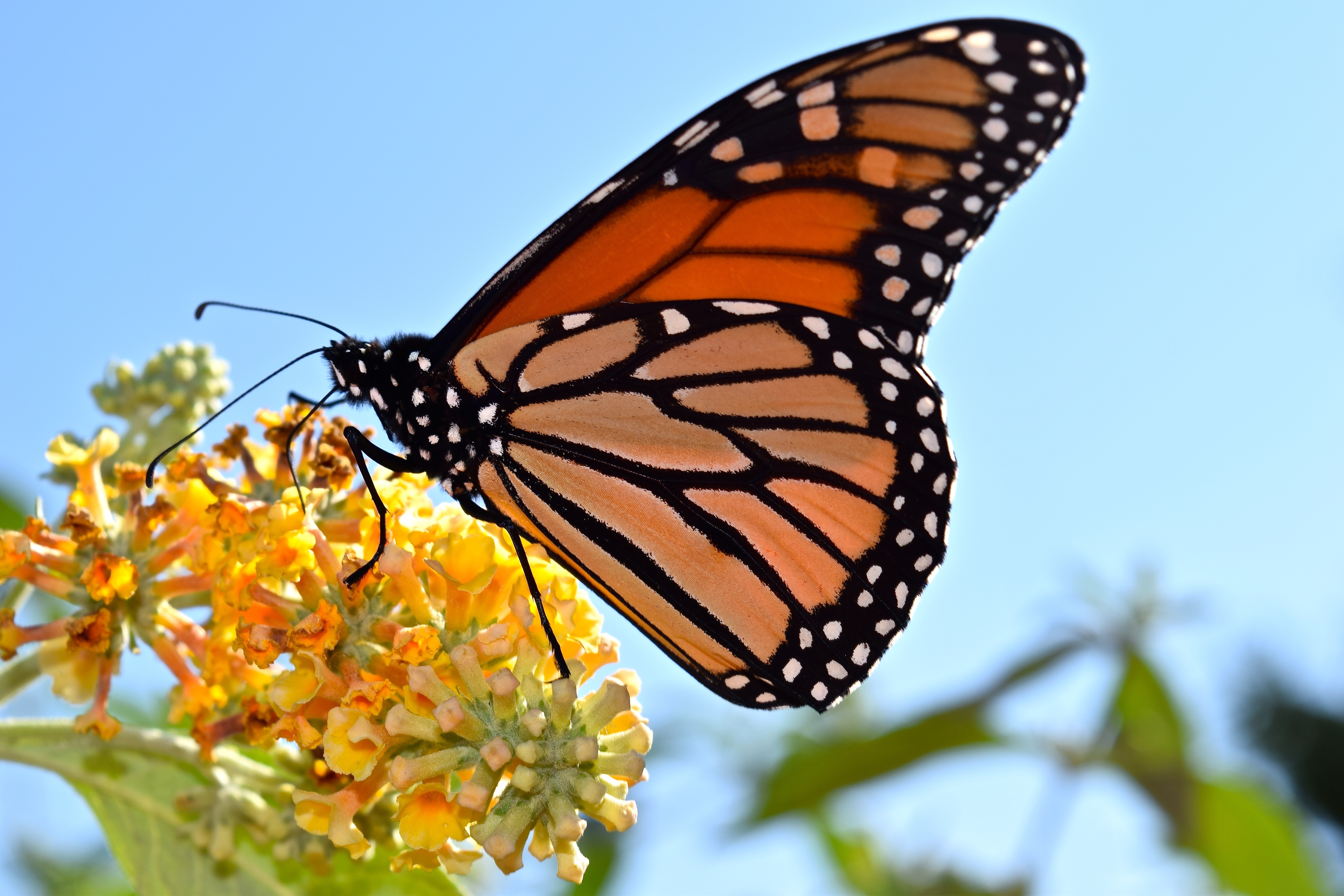
Monarch butterfly refueling in Cape May as it prepares for fall migration to Mexico. Photo courtesy of Lindsey Brendel.
Monarch has been a conservation buzz-word for the past decade when data revealed that the population had appeared to be on the decline. Then in 2013, the population of wintering monarch butterflies in Mexico reached an all-time low that jolted scientists, environmentalists, and enthusiasts across the nation.
Monarch abundance in wintering grounds is measured as area in hectares. They roost in large colonies in the Transvolcanic Mountains in Mexico. The 2013-2014 overwintering population experienced the lowest recorded area to date, at 0.67 ha. From MonarchWatch.org.
This marvelous and iconic lepidopteran is found throughout the continental United States. Its 3,000 mile long migration is an amazing natural phenomenon. The news of population declines in Mexican wintering sites inflamed concern and incited action. Many groups have since created partnerships, implemented programs, and conducted research to understand more about this widely known yet still mysterious insect.
The location of wintering monarchs was a complete mystery until 1975 when the remote wintering sites were discovered in transvolcanic mountain ranges in Mexico. Much is still to be discovered about the migration pathways even within the United States, and doing so will answer questions which will inform conservation and management of this species which faces multiple threats during every aspect of its expansive journey.
Glider pilots have observed monarch butterflies at an altitude of 1200 meters (Gibo 1981). Migratory flights at these altitudes can allow insects to disperse against wind directions found at lower altitudes.
But first, a little bit about biology and the annual life cycle
The monarch’s annual lifecycle is a really marvelous and multifaceted journey – it can be thought of as a multigenerational relay race.
From the Xerces Society. Map depicts the known general migration routes of monarch butterflies.
Monarch butterflies, just like other lepidopterans, metamorphosis from caterpillar to butterfly. The big thing that sets them apart is the migration they make annually. (Although there are many other species of moths and butterflies, and other insects as well that migrate – the monarch is arguably the most well recognized example http://texasento.net/migration.htm).
Temporal cues and an innate determination drive these ambitions fliers to travel as far north as the Canadian border. In the search for milkweed and favorable temperatures – possibly to avoid disease pressures – monarchs fly north to reproduce and recolonize across North America each year.
They leave overwintering grounds in Mexico in early spring. Along their route the monarchs will mate and reproduce. Their lives are lived within a short couple weeks, and their offspring will continue the migration northwards in search of food and milkweed.
When the seasons shift in late summer and early fall, the last generation of monarchs will begin a southbound journey, instinctively traveling to wintering sites in Mexico (there are a few populations that overwinter in California and Florida – but the large majority are thought to return to Mexico). This generation will be responsible for making the longest trek of the migration to wintering grounds. These monarchs enter reproductive diapause – the state where the body will temporarily pause reproduction – until the following spring. These monarchs will spend the winter roosting in trees in Mexico until spring when they will take up the first leg of the relay north.
This last generation from the previous year now makes up the first generation of the present year – and will pass the baton on to their offspring as the cycle starts anew.
The role of the Garden State
So what part does New Jersey play in the grand scheme of this massive population?
The Atlantic coast migration was once characterized as “aberrant”, a fluke of sorts – the result of southbound monarchs being blown off course. Research and monitoring conducted in Cape May and published by Walton and Brower (1996) in The Journal of the Lepidopterist’s Society have supported the hypothesis that a migration along the Atlantic coast is part of the monarch’s normal fall migration.
What does a monarch have in common with a hawk? Walton and Brower (1996) have proposed the idea that monarch butterflies could display similar flight patterns to that of migrating hawks. Utilizing an elliptical flight path during the fall south-bound migration, the model suggests that these birds take advantage of prevailing winds by first traveling east and then west, thus providing a quicker and more energetically-efficient route. Could monarch do the same?
New Jersey – Southern New Jersey and Cape May in particular – is historically recognized as a concentration area for southbound monarchs during the fall migration to wintering grounds. Hamilton (1885) [expressed his wonder of the] characterized the September 1885 monarch migration at Brigantine, New Jersey as “almost past belief … millions is but feebly expressive … miles of them is no exaggeration.” Reports of trees “more orange than green” is no exaggeration, as monarchs congregate en masse in prime roosting spots to warm and rest.
But why is this important? The monarchs migrating through Cape May seem to be representative of the entire North Eastern population – and therefore it offers the opportunity to collect quantitative data on populations in addition to other annual counts. The fourth of July counts focus on quantitatively monitoring the Northeastern population of monarchs as they arrive in the spring and summer. Therefore this data can be used to analyze population trends.
What part can New Jersey residents play?
Monarchs are traveling across New Jersey May through October. There are plenty of simple ways you can help protect this iconic species.
Plant native species of flowering plants – monarchs and other insects (like bees) rely on a healthy diversity of nectar sources. Planting a wildflower garden is a quaint, ecological-friendly way to create habitat, and not to mention, make less work watering and money spent purchasing plants. Check out the Native Plant Society or Jersey Friendly Yards to get started. http://npsnj.org/ http://www.jerseyyards.org/
Share this article, talk about environmental issues, and get informed. Show your support and share your concern for the wellbeing of this (and other) species!
Rear monarchs. At home or in classrooms, rearing wild monarchs and releasing them is a rewarding and educational way to contribute.
Participate in tagging and monitoring projects. Monitoring and tagging projects take place in the summer and fall for New Jersey Monarchs. You can also contribute simply by reporting your sightings on these websites.
Report sightings and tag monarchs with Monarch Watch.

 Conserve Wildlife Foundation’s exciting hands-on programs – classroom presentations, field trips, live wildlife, and webcam lessons – teach children about the state’s rare wildlife and the need to protect it. And while some schools can cover the costs of these lessons, far too many can’t afford programs and field trips.