The U.S. Fish and Wildlife Service has reopened the public comment period on a proposal to list the northern long-eared bat as endangered under the Endangered Species Act (ESA). Comments will be accepted through Thursday, December 18, 2014.
The public is invited to submit comments one of two ways:
(2) By hard copy: Submit by U.S. mail or hand-delivery to: Public Comments Processing, Attn: FWS–R5–ES–2011–0024; Division of Policy and Directives Management; U.S. Fish and Wildlife Service, MS: BPHC; 5275 Leesburg Pike, Falls Church, VA 22041-3803.
The Northern Long Eared Bat, like many other bat species in the United States, is in danger of extinction due to White-Nose Syndrome, impacts to hibernacula, summer habitat loss and wind farm operation. Listing a species as endangered, under the protections of the Act, increases the priority of the species for funds, grants, and recovery opportunities.
Leave Dead and Dying Trees Standing: Where possible and not a safety hazard, leave dead or dying trees on your property. Northern long-eared bats and many other animals use these trees.
Install a Bat Box: Dead and dying trees are usually not left standing, so trees suitable for roosting may be in short supply and bat boxes can provide additional roost sites.
Details Measures Taken to Help Protect Wildlifeand Improve Reliability
By: Lindsay McNamara, Communications Coordinator
Photo Credit: Atlantic City Electric. Pictured left to right are Ben Wurst, wildlife biologist, Conserve Wildlife Foundation of New Jersey; Ed Kaminski, senior supervising engineer, ACE; Cristina Frank, lead environmental scientist, ACE; and Mike Garrity, senior supervising scientist, ACE.
Atlantic City Electric (ACE), in collaboration with the Conserve Wildlife Foundation of New Jersey, recently held an Avian Protection Educational Event to promote a better understanding of how Atlantic City Electric helps protect birds and other animals, while also helping improve electric service reliability for customers.
ACE environmental scientists Cristina Frank and Mike Garrity detailed the various types of migratory and breeding birds that may perch or nest on power lines, including ospreys, which frequently nest on utility poles. They discussed various types of devices placed on wires and other infrastructure designed to minimize the risk of birds and other wildlife from coming in contact with electric wires and equipment.
“Hundreds of thousands of birds migrate through Cape May County each year,” said Cristina Frank, lead environmental scientist, Atlantic City Electric and head of the company’s Avian Protection Program. “We conduct field studies to determine areas throughout Cape May County and our entire service territory to determine which areas are of the greatest risk to birds and other wildlife.”
ACE senior supervising engineer Ed Kaminski explained how avian protection is an integral part of the design phase before constructing any new infrastructure projects or upgrading existing infrastructure.
“We are in constant communication with our environmental team, and, when necessary, we’ll enhance our infrastructure to minimize the risk to birds while helping reduce the number of related power outages to create a more reliable electric system for customers,” Kaminski said.
Atlantic City Electric recently completed infrastructure enhancements in Cape May, Ocean City and Strathmere, N.J., that addressed risks to avian wildlife. As a result, the company has not seen any bird-related incidents since in these areas.
Also as part of the event, Ben Wurst, a wildlife biologist with the Conserve Wildlife Foundation of New Jersey, discussed the foundation’s role in helping manage and protect ospreys through man-made nesting platforms that provide a safer nesting alternative than utility poles. ACE partners with Conserve Wildlife to identify and address risks to birds throughout its service territory.
Birds routinely use power line poles and towers as perches to establish territorial boundaries, nest, hunt, rest, find shade and feed. Utility poles often provide perching or nesting opportunities in areas where few natural perches or nest sites can be found. If the configuration and location of utility structures are in areas where birds are attracted by favorable habitat or are in a migratory path, the chance of electrocution and/or collisions increase.
Data nerds rejoice! Today, Wednesday, November 19 is GIS Day. Geographic information systems (GIS) technology helps our wildlife biologists protect rare species throughout New Jersey. GIS technology is used to create our species range maps and other important tools that show where wildlife occur and what habitat they need to exist.
Conserve Wildlife Foundation is a key player in updating the NJ Endangered and Nongame Species Program’s (ENSP) database of rare wildlife species. The database called “Biotics” is a GIS and Oracle-based system developed by NatureServe, the leading source of information on the precise locations and conditions of rare and threatened species and ecological communities in the Western Hemisphere.
Although CWF and ENSP biologists submit a majority of the data on Biotics, we rely on the help of citizen scientists to fully understand the wildlife picture in New Jersey. Do you want to help biologists monitor certain areas of the state and locate the presence of species of concern? Visit our website to learn how you can get involved.
In addition to the Biotics database, GIS was used to create range maps for all 190 species featured on our online field guide! Check it out.
Have you seen our American Oystercatcher Story Map? GIS was used to create that tool as well! A Story Map is a web-based interactive GIS map embedded with all kinds of content, like text, photographs, and video.
BatCam, the live-action camera that captures a colony of big brown bats living in a family home in Flemington, received plenty of media attention this week. BatCam is hosted on Conserve Wildlife Foundation‘s website, thanks to the Williams family.
The bats’ unusual choice of a summer roost has given this family a unique peek at their lives, from knowing exactly when the bats return from hibernation each spring, to watching them give birth and care for their pups though the summer.
The bats also caught the attention of New Jersey media. Read about the colony of big brown bats:
A live bottlenose dolphin on Tobay Beach in Nassau County, New York. (Photo Credit: APP/Riverhead Foundation for Research and Preservation)
Bottlenose Dolphins, their numbers impacted last year from a nasty virus that rivals the death rate of Ebola in West Africa, are still dying, researchers have found.
The outbreak of morbillivirus, a measles-like virus that causes pneumonia, skin lesions and brain infections, has killed roughly twice as many bottlenose dolphins as the last big outbreak in 1987-88. In New Jersey, 151 bottlenose dolphins died last year — nearly 10 times this year’s toll so far, according to the Marine Mammal Stranding Center in Brigantine.
Morbillivirus is highly contagious. It’s spread through respiration (via blowholes) and direct contact. Experts think the virus may also be spread through skin contact.
Asbury Park Press Reporter Todd B. Bates explores the unusual mortality event:
Pairs of piping plovers — small, critically endangered shorebirds that dart along the sand in search for food — dropped to a record low in New Jersey this year. Just 92 pairs nested in the Garden State, down from 108 last year, BUT the beach-nesting birds spawned a high number of fledged chicks — 1.36 per pair, the third-highest figure since 1986 and above what’s needed to grow and maintain their population in the long-run.
Last week, Asbury Park Press Reporter Todd B. Bates discussed the issue with Conserve Wildlife Foundation’s Beach Nesting Bird Project Manager Todd Pover.
Conserve Wildlife Foundation biologists, Todd Pover and Stephanie Egger educated guests about the Piping Plover “Bahamas Project” and showed the connection between The Bahamas and the U.S. for the endangered beach nesting bird species. One-night-only Plover Pale Ale was served and guests had the opportunity to attend brewery tours and play Plover Quizzo. The winners of Plover Quizzo received prize baskets full of Conserve Wildlife Foundation and Flying Fish Brewing Company merchandise.
“Events like ‘Beer, Birds and The Bahamas’ fulfill the purpose of creating a community space inside the Brewing Company,” said President of Flying Fish Brewing Company Gene Muller. “Our audience and Conserve Wildlife Foundation’s audience go hand in hand. People who appreciate wildlife and the environment also appreciate sustainably produced beer.”
“This innovative project is based on partnerships in both New Jersey and the Bahamas – bringing together distant communities who still share a strong commitment to education and a personal connection to their beaches,” said Conserve Wildlife Foundation Beach Nesting Bird Project Manager Todd Pover. “In the same vein, the event at Flying Fish Brewing was an exciting partner-driven way to promote the project.”
Conserve Wildlife Foundation of New Jersey’s Piping Plover Bahamas Project supports the recovery and long-term survival of Piping Plovers by identifying critical Bahamas wintering habitat for Piping Plovers and other shorebirds of concern on the islands of Abaco and Eleuthera, The Bahamas. Conserve Wildlife Foundation collaborates with a local Bahamas environmental group, Friends of the Environment, to engage the public and increase local awareness of the critical role played by the Bahamas in the full life cycle of the Piping Plover.
The Atlantic Coast population of Piping Plover has been federally listed as threatened in the U.S. since 1986 and endangered in Canada since 1985. Although migration and wintering protection is one of the five main recovery tasks in the U.S. Fish and Wildlife Service’s (USFWS) Piping Plover Recovery Plan (USFWS 1996), until recently protection has primarily been focused on the breeding grounds. Furthermore, population monitoring is well understood on the breeding grounds, but winter use is not as well documented.
Over the past five years the importance of the Bahamas as a major wintering site for Piping Plovers has become increasingly evident.
Conserve Wildlife Foundation of New Jersey and other partners aim to identify critical wintering habitat, provide education and outreach to school children and the public, and build local capacity for future surveys and protection of Piping Plovers in the Bahamas. For more information, please visit our website.
Flying Fish Brewing will donate proceeds from the sale of Plover Pale Ale to the Bahamas Project by Conserve Wildlife Foundation of New Jersey.
Lindsay McNamara is the Communications Coordinator for Conserve Wildlife Foundation of New Jersey.
Hard to believe, but October is already here! And that can only mean one thing – bats! Everyday throughout the month of October, follow CWF on social media and our blog to fly high with these incredible creatures of the night! Each day we will have fun facts, quizzes, and beautiful photos highlighting these amazing animals and the work CWF does to protect them.
Our previous coverage included an overview of bats in New Jersey from our biologist, a look into the threats bats are facing today, a reality check on some myths and legends surrounding bats, and shared some examples in ways you can get involved in our efforts to save bats. This week, for the final week of October, join CWF bat biologist Stephanie Feigin in the field!
Make sure to follow us everyday on Facebook and Twitter and read our blog every Friday for our #31daysofbats!
by Stephanie Feigin
Stephanie Feigin and MacKenzie Hall monitoring a bat roost in an attic
I think it is surprising how little people know about bats considering how beneficial they are to humans. From eating the bugs that bite us and reducing the need for pesticides on our farms, to helping doctors learn the advantages of echolocation to the blind, knowledge of these important creatures should be at least as common as the sight of them flying overhead. Since I have started working on Conserve Wildlife Foundation’s bat projects, I have noticed just how fascinated people can be with bats, and how excited they are to learn more about these elusive creatures of the night.
In giving presentations on bats in New Jersey, I realize how many people still believe the myths about bats and generally regard them as spooky or creepy, not beneficial and cute I enjoy sharing my knowledge and experiences in order to correct the many misconceptions.The first time I saw a bat it was hiding behind a beam in the attic of an old church. I was shocked at how adorable and small the bat was, and I still get that same feeling every time I see some tiny bat ears poking out over top of a beam or tiny bat eyes looking back at me.
Every time I go out, whether it is to monitor a site where CWF has installed bat houses and do a bat count, or to assist other researchers in a banding survey of bats getting ready to hibernate, or even just to walk along the canal by my house with the acoustic detector, I have felt a connection to these animals. I love the dynamics of their roosts, the way they snuggle together for warmth, and the little chatter sounds they make when they are getting ready to go out to hunt for the night.
Keeled calcar on Indiana bat (c) MacKenzie Hall
There is so much to learn and understand about bats. One thing I have especially loved learning is the subtle differences between one bat species from the next. Have you ever looked up and seen a bat flying overhead? But instead of just saying, “Hey, that’s a bat!” Have you ever spent time thinking, “I wonder what type of bat that is?” Well I have, and sometimes it is not that easy to decipher. We have nine different bat species in New Jersey. Some of these are easier to identify than others. The hoary bat, for example, is easily identified because it is largest bat in New Jersey, with bodies measuring from 5 to 6 inches and wingspans reaching up to 17 inches. These bats also have a lower frequency of call, making it easy to read on a sonogram.
Some of our other bat species however, possess very subtle and small differences, making them much harder to distinguish from one another. All four of these species are “cousins” and are part of the Myotis genus. In New Jersey, the bats in the Myotis genus are the little brown bat (Myotis lucifugus), the Indiana bat (Myotis sodalist), the long-eared bat (Myotis septentrionalis), and the eastern small-footed bat (Myotis leibii).
Indiana bat (c) Stephanie Feigin
In my opinion, it is the hardest to identify Indiana bats from little brown bats. One way to do this is by the length of their toe hairs. Indiana bats will have smaller toe hairs than the little brown bats, and they will not extend past their toenails. Indiana bats also have a keeled calcar, or a foot spur of cartilage, that supports the membrane between the foot and tail. This looks like a tiny strip of extra skin on the membrane between the bat’s foot and tail.
Another way to identify which bats are in the area is with the use of an acoustic detector. All of the myotis bats have very similar calls, all in the same frequency range, making it very hard to identify one bat from the other on a sonogram. Even the computer program we use will not take a guess as to which myotis it is because their calls are so similar! Since the first time I went out with the acoustic detector, I have been enthralled by the different chatters of the bats, from the feeding buzz to their chatters to each other while flying and hunting for food. I have gained a new perspective on the world of bats and me developed a true connection to these animals.
Big brown bats (c) MacKenzie Hall
It is exciting to be a part of the bat projects at CWF and to have the opportunity to understand bats further, help research and implement ways to protect them, and educate the public about who these animals really are. They are not creepy, scary rodents who will attack you and fly into your hair. They are adorable, helpful mammals that I think everyone can find a way to appreciate, just like I have.
Stephanie Feigin is a Wildlife Ecologist for the Conserve Wildlife Foundation of New Jersey.
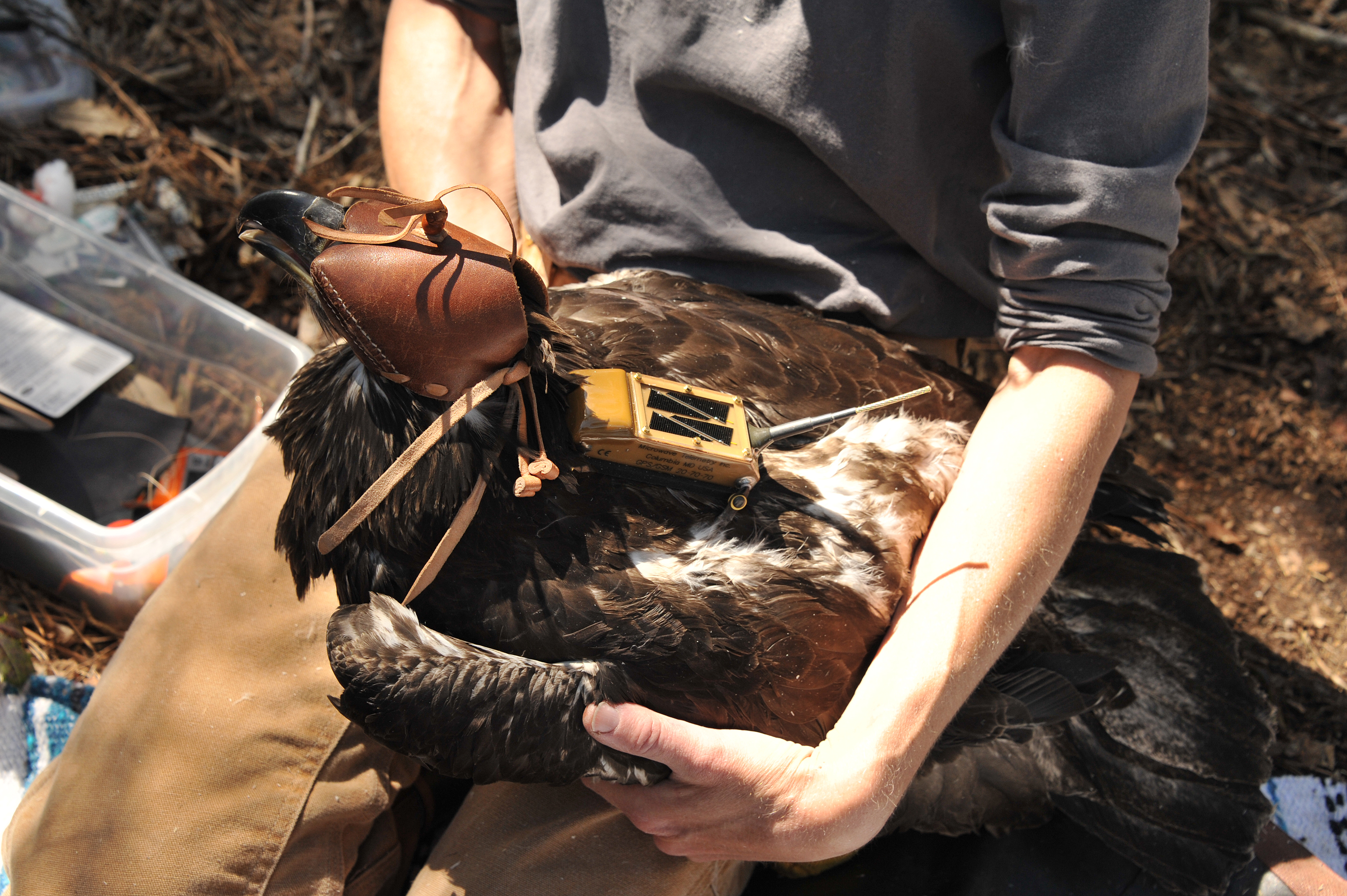
Juvenile male bald eagle (D/95) with GPS transmiter being attached. Kathy Clark/ENSP
Since 2011, the NJDFW Endangered and Nongame Species Program and Conserve Wildlife Foundation have been following the movements of young eagles outfitted with transmitters that have fledged from the Merrill Creek nest in Northern New Jersey. Currently, two eagles are being tracked from the Merrill Creek nest.
During the summer of 2014, two juvenile bald eagles were fitted with a GPS tracking device (a wearable backpack). Biologists chose one eagle from Atlantic County (a male) and one from Cumberland County (a female) to be tagged in this telemetry study. The male hatched at a nest near Nacote Creek in Port Republic, and wears a green band with code D/95. The female is from a nest on the Maurice River; she wears color band E/05.
The male, named “Nacote” (D/95) had a transmitter attached at 8.5 weeks of age on May 6, 2014 and on May 22, he first moved away from the nest tree. He remained within about 1/4 mile for more than one week as he learned flying and landing skills. He made a bold northern movement in late July, and was in Canada until mid-October when he started heading south.
The female, named “Millville” (E/05) was about 8.3 weeks of age when outfitted with the transmitter. The banding date was May 19, and she remained close to the nest until late July, venturing out to Delaware Bay marshes and back in early August. In mid-September she crossed the Delaware River into Delaware and then spent most of September along the Chesapeake Bay in Maryland before crossing over to Virginia.
The last location received for Millville was on November 17, 2014. On the 24th, we received a call that she had been found dead by the side of the road in Delaware. A necropsy was performed and cause of death was determined to be from electrocution due to a collision with electric wires.
We are lucky that a passerby stopped and contacted us, so we know what happened to her and were able to get the transmitter back. There is a high mortality rate for first year eagles as they learn to hunt, fly and survive on their own.
An interactive map showing Nacote’s current location can be viewed on our website. It’ll be interesting to see where he ends up this winter!
White-nose syndrome continues to kill off little brown bats in New Jersey, but there is hope on the horizon for another species of bat – the big brown bat. Reporter James O’Neill explores the changing fortunes of New Jersey’s bats.