Project RedBand: 04/C from LBI to Trinidad and Tobago!

Auxiliary bands help link Barnegat Bay ospreys to their wintering grounds

by Ben Wurst, Habitat Program Manager

04/C was banded at a nest on LBI and re-sighted on the island of Trinidad and Tobago by Nicholas Hassanali.

When I started work on Monday morning I got some amazing news (at least for an osprey lover). One of the young ospreys that I banded on Barnegat Bay was re-sighted on the Caribbean island of Trinidad and Tobago!! To top that cake, the osprey was photographed to confirm its sighting. YES!! Nicholas Hassanali took the above photo and enlarged the red band to read the alpha-numeric code which reads “04/C.” I looked up in my banding records and saw that 04/C was produced at a nest behind the Long Beach Island Foundation for Arts & Sciences in Loveladies, Long Beach Island.

04/C after being banded. He was around 4 weeks old on July 7, 2014.

I banded him (I can tell its a male by the size of the band on its leg and the lack of a brown necklace of feathers on its breast) on July 7th with a CWF donor Bill C. We ventured to four nests by kayak. This was the first survey where I started to deploy the red auxiliary bands on young ospreys. I remember that it was a pleasant day. Not too hot or windy. As we made our way from one sheltered nest on a lagoon to another out on the bay we felt the winds kick up from the south making paddling difficult (especially when you’re towing another kayak with a ladder on top!).

125-A-032: 04/C's nest.
125-A-032: 04/C’s nest.

We decided to return to Bill’s house and take my truck to survey the next two nests, since we could walk to them from a side street. We walked out to one nest and found that it failed, i.e. no young were produced. Then we proceeded onto the next, 04/C’s nest. I remember climbing up the ladder to band the young and did not get a chance to take any better photos because I had to be on my way soon. While up there I remember the male dropped a fish (bunker) and Bill got it and we put it back into the nest. One thing that I will not forget about this day is the smell of smoke and burning plastic. I found out later that day that a lawyer’s office in Ship Bottom was on fire when we were out surveying these nests. Luckily no one was hurt in the fire!

I personally cannot wait to get more reports of our red banded ospreys. The young that were banded this year will not return until 2016 and even then they might not return until the late spring/early summer and will not breed. At least I know that there are people out there watching and admiring our ospreys! As Nick said in a comment on his photo on Flickr, “ I have a great love for Ospreys.” 🙂

Partnership is key!

CWF provides assistance for recovery of osprey in Illinois

by Ben Wurst, Habitat Program Manager

Osprey 11D takes flight for the first time at Lake Shelbyville. Illinois Department of Natural Resources photo.

Besides working to protect and manage New Jersey’s osprey, we also consult with organizations throughout the country to assist with other ongoing recovery projects. One particular project is in Ilinois. Here the osprey is listed as endangered and recovery has been slow. Last year a long-term recovery project was started and we provided assistance by mapping suitable nest platform locations along the Kankakee River at the Exelon Generation/Dresdan Station (SW of Chicago). The recovery project has a huge amount of support and partners. This was how our osprey recovery project was so successful in the 1980s, by partnering with many different organizations. We provided technical guidance on platform construction and installation to Michael Campbell (System Engineer at Exelon). Michael led the hack box construction effort and assisted with building/installing nesting platforms at the Dresdan Station. A total of ten young ospreys were successfully hacked this year. The young were collected at Joint Base Langley-Eustis in Virginia and driven to IL. Michael was awarded for his efforts to help the osprey recover in Illinois and we are honored that he chose Conserve Widlife Foundation as a receipent for a $3,750 grant! Thank you!

Looking to help make a difference? We provide recources for you to help our ospreys in New Jersey. We offer technical assistance to private consulting firms, individuals, school groups, environmental commissions, Boy Scouts, Girl Scouts, and anyone else who is interested in constructing and installing osprey nesting structures.

In New Jersey, we work with the NJ Division of Fish and Wildlife to help manage and monitor a very large database of existing nesting structures. We can help you choose the most suitable location to place a platform so it will not negatively impact any other species that live in the coastal area of the state. We can provide maps, platform plans (see link below), and in some cases an actual platform. Please do not hesitate to contact us for more information or if you have a question.

Story Map Brings Oystercatchers to Life Online

CWF Celebrates World Shorebirds Day With Release of Our First Story Map: “American Oystercatchers Through the Seasons”

By Michael Davenport, GIS Program Manager

Conserve Wildlife Foundation (CWF), today released a new interactive “Wildlife Story Map” in support of this Saturday’s first annual World Shorebirds Day! The Story Map can be viewed here!

ScreenCapture

A Story Map is a web-based interactive GIS map embedded with multimedia content, such as text, photographs, and video. CWF, working with GIS software developer ESRI and with financial assistance provided by a grant from the New Jersey Division of Fish & Wildlife, plans to make this Story Map the first of many, helping engage the public about New Jersey’s rare wildlife in a dynamic and interactive way.

 “American Oystercatchers Through the Seasons” tells the story about a species of migratory bird, the American Oystercatcher, which spends the summer breeding season along the New Jersey coast, but is present year-round along the southern New Jersey coast. Our state represents the northern limit of the species’ winter range. While some New Jersey birds migrate during the winter to Florida, those that breed in New England during the summer may end up spending their winter here in New Jersey.

This Story Map also provides stories about individual banded birds, which have been tracked on journeys between New Jersey and southern states such as Florida, as well as between New Jersey and more northern states, such as Massachusetts.

Make a donation today to support additional Story Maps!


How to Use the Story Map:

On the left side of the Story Map page are several “buttons” which will allow you to flip through the different seasons in an oystercatcher’s life: Breeding, Migration, and Wintering.  Each page provides information and photos and a map specific to that portion of the bird’s life cycle. By clicking on an individual point within the map, a box containing more specific information, and a photo in some cases, will pop-up. The map also provides the ability to zoom-in and out in order to see areas of interest in more detail.

This Story Map is especially exciting since it helps celebrate the first annual World Shorebirds Day. This event seeks to “
raise global public awareness about the conservation of, and research about, shorebirds. About half of the world’s shorebird populations are in decline, and the rate of habitat loss is worse than ever before” (World Shorebirds Day 2014).

World Shorebirds Day hopes to accomplish the following:

  • To raise public awareness about the need to protect shorebirds and their habitats throughout their life cycles;
  • To raise public awareness about the need for ongoing shorebird research;
  • To connect people with shorebirds through important shorebird sites around the world;
  • To get shorebird enthusiasts to introduce shorebirds to more birdwatchers;
  • To raise awareness about the need for increased funding for shorebird research, monitoring and conservation.

CWF’s shorebird leadership ranges from the American Oystercatcher celebrated in this Story Map, to the beach nesting birds along the Atlantic Coast, to the red knots and ruddy turnstones along the Delaware Bay.

Your support can help CWF develop additional Story Maps on other rare wildlife. Support our work on Story Maps on the American Oystercatcher and other important shorebirds in honor of World Shorebirds Day by supporting research, education, and public awareness efforts carried out by CWF:

We hope that this will be the first of many Story Maps that CWF will use in order to communicate the many fascinating stories that New Jersey’s wildlife have to tell.

Make a donation today to support shorebirds today!


Project RedBand is a go!

Time to get outside and watch some ospreys!

by Ben Wurst, Habitat Program Manager

A pair of ospreys produced at a nest on Barnegat Bay were banded with a red auxiliary band. © Northside Jim

A lot has changed throughout the 40 project history of the New Jersey Osprey Project. From a low of only 53 osprey pairs (statewide) in 1973, today there are more than 540 pairs that return here each year to feed, nest, and raise young. In the beginning work to re-establish their population was a trementous undertaking. Ospreys, a  were loaded with environmental contaminents (DDT, which caused the thinning of egg shells), their habitat was bulldozed, and early on birds were shot for their feathers and eggs. Once the Endangered Species Conservation Act of 1973 ospreys were afforded protection they deserved, and work by biologists like Pete McLain were underway to restore the population in New Jersey.  Continue reading “Project RedBand is a go!”

How To Identify and Find Barn Owl in New Jersey


barn owlMichael Britt, avid birder and writer, highlights the Barn Owl (Tyto alba). This medium-sized owl, most widely known for its ‘heart-shaped’ face, is the only member of the Tytonidae family found in North America. In this story, he shares how to identify these owls, when are where to look for them, and offers personal accounts of his most memorable encounters with these beautiful birds.

  • To read the full story, click here.
  • For more information on barn owls and CWF’s efforts to protect these birds, click here.

Piping Plover Population Reaches Lowest Levels in Decades


Plover populations at Malibu Beach in Egg Harbor Township are near a record-low this year due to predation, recreation activities and habitat loss. (c) Edward Lea

New Jersey’s Piping Plover population is at its lowest levels in decades, which raises serious concerns, but they also had one of their most successful years ever statewide in producing chicks. There is hope this will jump start the population again. To read the full article, click here.

  • To watch the video about this years Piping Plover population, click here
  • To learn more about CWF’s efforts to protect these birds, click here.

Photo from the Field

Running the numbers

by Ben Wurst, Habitat Program Manager

Ben Wurst prepares to band two osprey nestlings for future tracking. Photo courtesy Eric Sambol

By now many young ospreys have taken to the wing. While they still rely on their nests to perch at night and their parents for food, these juveniles take to the skies to learn the skills needed to survive to adulthood. Our nesting surveys have been completed, birds banded, and our sunburn and green bites are healing! Over the next week I will start to enter and summarize data that I’ve collected and data from our volunteer “banders” who help cover the most densely populated colonies. From my surveys, which range from Mantoloking to Atlantic City, I’d say that productivity is down in some areas and up in others, as compared to last year. But, ospreys still had a decent year. I would NOT call it a BAD year!

By far my own survey effort was not as great as last year, when we conducted a census of all nesting ospreys in NJ, by publishing our nest locations on our partners website, called Osprey Watch. This year I battled broken boats, a severe cold (still didn’t slow me down), harsh south winds, and thunderstorms to get to as many nests as I could, especially on Barnegat Bay. Why Barnegat Bay? We all have heard that Barnegat Bay is dying. Overloaded with excess nutrients from stormwater runoff, which is killing off the eelgrass beds that provide shelter for many juvenile fish, aka future osprey prey. This project will help us learn about osprey foraging habitat on N. Barnegat Bay. Are more birds foraging in the ocean in those areas, as opposed to birds that nest closer to LBI and LEHT? Hopefully our ospreys will help shed some light on the health of the bay. Lastly, the project would not be possible without the generous support of Northside Jim, chief blogger/extraordinary photographer at “Readings from the Northside” and his many followers. With their support we were able to purchase (100) and deploy (60) a red auxiliary band on young birds. These bands are engraved with an alpha-numeric code which will make identifying birds much easier than only the aluminum USGS band. In the coming weeks Jim will be giving us some assistance with setting up a nice little website where people can learn all about the bands, the birds, and most importantly: report re-sightings of these awesome new bands!

Shorebird Week: Iconic Red knot B95 Resighted on the Delaware Bay

by Stephanie Feigin, CWF Program Coordinator

This marks the second story in Shorebird Week! Our first blog post, on Tuesday, introduced the film “A Race Against Time” and directed you to a free viewing of the film on our website. Today’s blog post, will highlight an incredible news story about a resighting of the iconic Red knot B95 on the Delaware Bay! And tomorrow’s blog post, will highlight volunteer’s incredible efforts to save stranded horseshoe crabs!

This story highlights the iconic Red knot, B95, being resighted on the Delaware Bay. B95, nicknamed Moonbird, is at least 20 years old, which makes him the oldest Red knot on record. He received his nickname because he has flown the equivalent of the distance between the earth and the moon and at least halfway back in his lifetime.

Iconic Red knot shorebird B95

One of Conserve Wildlife Foundation’s partners, Manomet Center for Conservation Science, highlights this bird in an fascinating news story about his resighting and the research efforts being done by the CWF biologist Dr. Larry Niles and Amanda Dey, senior biologist with the Endangered and Non-game Species Division of N.J. Fish and Wildlife and their team to restore the Delaware Bay.

To read this news story, click here

For more information on CWF’s Shorebird project and the research being done, visit our website.

And make sure to check out the film about CWF’s efforts to restore the Delaware Bay Shore beaches, “A Race Against Time” as well!

Shorebird Week: Film Celebrates Beach Restoration for Red Knots and Horseshoe Crabs

by Stephanie Feigin, CWF Program Coordinator

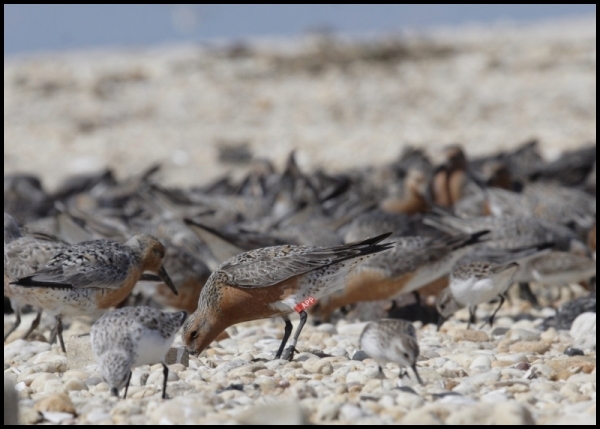
A banded red knot searches for food on a Delaware Bay beach.

This week for Animal Week, we will be spotlighting Shorebirds in the Media! Endangered red knots, ruddy turnstones, and other magnificent birds travel from South America to the Canadian Arctic during their migration, and make an important stopover along the Delaware Bay Shore from May to June.

The 2014 Shorebird film, “A Race Against Time” celebrates the Delaware Bay Beach Restoration

The film can now be enjoyed for free on our website:

Click here to enjoy this film! 

Greener New Jersey Productions this spring produced a 30-minute film documenting the ambitious campaign by Conserve Wildlife Foundation, American Littoral Society and other partners to restore Delaware Bayshore beaches decimated by Hurricane Sandy. This project ensures that the at-risk horseshoe crabs and globally migrating shorebirds relying on this habitat can survive.

Conserve Wildlife Foundation of New Jersey and the Endangered and Nongame Species Program (ENSP) of the New Jersey Department of Environmental Protection’s Division of Fish & Wildlife, and New Jersey Audubon have partnered for many years to conduct research on Delaware Bay shorebirds in order to prevent their decline.


Edwin B. Forsythe NWR Osprey Banding

Three nestlings produced at the Osprey Cam nest are banded for future tracking!

by Ben Wurst, Habitat Program Manager

In the late afternoon of June 24, 2014, I kicked off the 2014 Osprey Nesting Surveys by banding the three nestings at the Osprey Cam nest. I was joined by Ann Marie Mason Morrison, with Friends of Forsythe NWR, our founding partner with the Osprey Cam, and two U.S. Fish and Wildlife Service interns, Jessie and Kirsten who helped bring out all the equipment needed to the nest (two 20′ ladders).

This is one of the most difficult nests to reach in all of New Jersey! It either takes a boat (at high tide) or two 20′ ladders (at low tide) to cross a 15′ wide ditch on the coastal salt marsh. Anyone who has crossed the ditch can attest to how difficult it is. Now you can watch and see what when into banding these three nestlings. A portion of the video was cut when I was attempting to repair the sound at the camera equipment box. At the same time the nest was cleaned of harmful plastic debris that the birds used as nesting material. A total of 3 balloons and a plastic bag were removed from the nest. The three young were banded with USGS bird bands (1088-04358,59 & 60) for future tracking. Check out a photo that I got of “the runt.” Enjoy!