American Oystercatcher – Update on a Species of Special Concern

Latest research filling in the blanks!

By Alfred Breed, CWF Field Technician

Because of the small amount of research undertaken when compared to other more intensely studied bird species, we are still very far from a complete understanding of the American oystercatcher.  For several years staff from Conserve Wildlife Foundation of NJ, along with other partners throughout the state have collected data for both breeding and wintering populations of American oystercatcher in New Jersey.  Very little data has been collected, however, during the non-breeding/migratory season.

Oystercatchers feeding and loafing at alternative high-tide roost site on a vernal marsh pond. © Alf Breed.

That data gap is now beginning to close.  Thanks to a grant provided by the National Fish and Wildlife Foundation, CWF was able to conduct surveys during the post-breeding/migratory season on roosting flocks of American oystercatcher at southern New Jersey Atlantic coastal inlets from Brigantine to Cape May.  This data, when combined with data collected by other researchers range-wide, helps us to discern life-span, survival rates, movement patterns, population numbers, age structure and other important characteristics vital to our better understanding of this species.

For this study research staff surveyed inlet flocks of American oystercatchers between late July and early December 2010.  Flocks were counted and observed for banded birds.  There were just over 400 individual band resights during the survey period, significantly increasing our database of resighted birds. The majority of birds that were resighted were banded in New Jersey, although a number of birds banded in other states were also observed, including from Massachusetts, Delaware, Virginia, Georgia, North Carolina, and South Carolina.

Preliminary analyses of band resights and flock counts suggest seasonal patterns of behavior and show a variety of migration strategies within the species.  Some migrants were sighted only once and seem to be passing through relatively quickly en route to roost sites further south.  Some individuals resighted here in New Jersey were subsequently resighted a short time later on the Florida Gulf Coast at Cedar Key, indicating impressive migration distances covered in a very short time.

Others banded oystercatchers where resighted during the survey more than once here in New Jersey and spent considerable time roosting at or near our southern coastal inlets before moving on as temperatures dropped towards the end of the survey period.  Still others were present during the entire period. New Jersey is the northernmost extent of the wintering range for the Atlantic Coast population of oystercatchers.

Using the spotting scope to re-sight the coded leg-bands. © Alf Breed.

During the survey period, Brigantine, Great Egg Harbor, Corson’s, and Townsend’s inlets all showed a gradual increase in oystercatcher numbers to their peak flock counts towards the middle and end of October, when migrants headed for warmer latitudes and winter residents consolidated into New Jersey’s two primary winter flocks at Absecon and Hereford Inlets. These two primary winter roost sites had their flock counts gradually increase to their peak counts shortly before the end of the survey period. Between 350 and 400 birds were seen in each of these flocks at their peak.

As the primary surveyor for CWFNJ, one unexpected discovery I made early in the survey period was the identification of several alternative high-tide roosting sites at vernal marsh ponds close to, but some distance from, the inlets, and away from previously recorded roost site locations.  Further research may help clarify if these alternative sites are a normal part of early migratory oystercatcher habitat, or are in response to the documented high levels of human disturbance in their normal roosting locations during the tourist season.  Birds were observed regularly feeding at these ponds during the high-tide roost.  It is possible that early in migration season the birds are still actively building reserves of energy to take them safely through the winter, and inhabit the vernal ponds to be close to an easily accessed food source.  Wintering flocks, in contrast, are less likely to be seen feeding during the high-tide roost, and more likely to assume their energy conservation pose, standing on one leg with bill tucked under a wing, and the other leg drawn up tight beneath the body, with little or no feeding activity observed.

As fall progressed and human disturbance tapered off to some degree, the flocks did move to their more traditional roost sites, which are generally the beaches, sandbar islands and bayside sandflats of our inlets.  Frequent shoulder-season human disturbance of the roosting flocks in these areas from watercraft users, beach walkers, anglers, ORVs, and dogs warrants additional systematic quantitative assessment and analysis for possible negative effects on the survival rates of migratory oystercatchers.  Such analysis will aid in the evaluation of the need for the implementation of habitat management actions to mitigate any negative effects discovered.

The American oystercatcher precariously inhabits a narrow ribbon of coastal habitat which is also used by many other threatened and endangered plants and animals.  It thus has strong potential as a “sentinel species” to help us to gauge both the current health of our ecosystem and the success or failure of habitat management actions undertaken.  Continued data collection and analysis will enable us to take science-based steps in our efforts to understand the American oystercatcher, and to preserve and protect the beautiful barrier-island beaches, bays, and adjacent tidal marsh that make up our southern Jersey Shore.

Future Environmentalists….

5th graders adopt a Piping Plover

by Larissa Smith, Biologist/Volunteer Manager

This week I had the opportunity to speak to a group of 5th grade students at the Ocean City Intermediate School. The group of 44 students are in Mrs. Rosander’s science class.   Over the holidays the students earned money for a charity and this year they chose to adopt  a piping plover for their classroom through the CWF Adopt a species program.

As part of the adoption they received a classroom visit by a CWF staff person, which was me. I spoke about NJ’s rare wildlife and of course their adopted species the Piping Plover. The students were already very knowledgeable about NJ Endangered and Threatened species. One of their class assignments was to write an essay or draw a picture of one of NJ’s E & T species. For extra credit they could do both and those were entered in the Species on the Edge Art & Essay contest.  The students had a lot of great questions for me and I think there are some future environmentalists in the group!

It’s Better in the Bahamas – Part 1

The Search for Piping Plovers on their Wintering Grounds

By Todd Pover, Beach Nesting Bird Project Manager

Todd Pover, CWFNJ Beach Nesting Bird Project Manager in search of Piping Plovers in the Bahamas.

One of the most frequently asked questions about piping plovers is, “where do they go in the winter?” In the most general sense, piping plovers that breed along the Atlantic Coast winter from North Carolina to Florida, along parts of the Gulf Coast, and on some Caribbean islands. Where our birds from New Jersey specifically spend the winter is largely unknown.

But research conducted over the past several years suggests that the Bahamas is a particularly important wintering site for piping plovers. Last winter under the auspices of Dr. Cheri Gratto-Trevor from Environment Canada, a total of 57 piping plovers were color banded in the Bahamas. All of the 41 banded piping plovers that were resighted on the breeding grounds last summer were found on sites along the Atlantic coast, including two that nested in New Jersey (Sandy Hook and North Brigantine Natural Area).

Every five years starting in 1991, the U.S. Geological Survey (USGS) has conducted an International Piping Plover Census, which includes both a breeding and wintering component. In 2001, just 35 piping plovers were reported in the Bahamas, although it was noted that there was not a coordinated effort to survey the islands that winter. In 2006, a total of 417 piping plovers were found in the Bahamas on the winter census, a significant increase that was attributed to a more intensive survey effort. Even at that, given that there are hundreds of islands and sand flats in the Bahamas, many of them difficult to access, it is believed even more piping plovers likely winter there.

Piping Plover banded in the Bahamas in the Winter of 2010.

This brings us to 2011, which is once again an international census year. The USGS, in association with the Bahamas National Trust and the National Audubon Society have made the Bahamas a high priority for this year’s winter census. Towards this end, a number of piping plover biologists and researchers that work on the breeding grounds in the U.S. and Canada were asked to assist with the Bahamas survey. The survey was conducted from January 24-February 6, and I was one of about a dozen or so members of the research team fortunate enough to help out.

The USGS has just begun to tally the survey results, but a rough preliminary tally indicates just over 1000 piping plovers being recorded in the Bahamas this winter, a significant increase over previous surveys. If most of those birds are from the Atlantic Coast population, as banding results suggest, at least a quarter of that population may winter in the Bahamas. By all accounts, it appears it very well may be “Better in The Bahamas” for our piping plovers!

Stay tuned. Over the next several weeks, I plan on penning more installments about my Bahamas piping plover adventure, including details about the surveys themselves, the logistical difficulties encountered, and the various local partnerships developed along the way.

Photo(s) From the Field

Bird’s eye view from a peregrine falcon nest site in Atlantic City

by Ben Wurst, Habitat Program Manager

View south from the 23rd floor at the Hilton in Atlantic City, New Jersey. © Ben Wurst

Since 1985, one boardwalk casino has been home to a pair of peregrine falcons. On the 23rd floor of the Hilton (originally named as the Golden Nugget, then Bally’s Grand, The Grand) in Atlantic City a pair of peregrines have nested since 1988. Since then only two females have ever occupied the territory there. The first female nested there until 2002. In October of that year she was found injured after it was believed that she had struck an object. She was transported to The Raptor Trust for treatment, but unfortunately died later that night. She was the oldest nesting peregrine in New Jersey at the time (she was born in 1985 at a nest site in Sedge Island WMA) and was a NJ native falcon. She raised a total of 25 young during the 15 years that she nested there. She was known for her tenacious attitude and brave assaults on biologists and photographers by dive-bombing them “fighter jet style” to protect her young.

Here is an excerpt from the article “Storied A.C. Peregrine Dies: State’s oldest nesting falcon was N.J. native” in our old Conserve Wildlife newsletter from 2002:

“She’d been around nearly as long as I’ve been a biologist,” says Clark. “I felt a kinship from our many years at her nest, banding her young.”

Last June, as Clark was returning the bird’s two chicks to the ledge after she had banded them inside the penthouse suite, the biologist noticed the fierce female accidentally glance one of the building’s structural columns. But Clark will remember more all the times the bird was at her fighterpilot best, strafing Clark, her assistants and the news photographers who bravely clambered out onto the narrow ledge to record what had become a much publicized, annual banding ritual. In fact, in 1997 within a span of several minutes the bird was able to strike the heads of both an assistant biologist and a photographer. That’s why Clark, since then, had been banding the chicks inside.

Ironically, it took her death to solve the final mystery of her existence. In 1994, thanks to a remote-controlled camera, Clark was able to read all but the last digit on her leg band. The numbers confirmed her 1985 hatch date, but without that missing digit she could have been fledged anywhere from Maine to Virginia.

When Clark recovered the fatally injured bird, she recorded the entire banding number, and quickly learned the female had been hatched atop a nest tower erected in Barnegat Bay’s Sedge Islands Wildlife Management Area, just 25 miles north of Atlantic City. One of the first offspring of restored, wild-nesting peregrines in New Jersey, she had been a lifelong resident of the Garden State.” written by Bruce Beans.


Measuring the length of the ledge where deterrent will be installed.

Today, the only other female peregrine to nest on the ledge of the penthouse floor will be 13 years old this summer. She originated from a nest site in coastal Virginia in 1998. In early 2009 we placed a deterrent (wood and pigeon spikes) along a portion of the ledge to deter the pair from nesting. The preferred nest site is a nest tray where the pair can be more closely monitored by casino staff and butlers (Mel and Pete) on the penthouse floor and it also has more protection from harsh weather conditions. The deterrent worked quite well last year, but it wasn’t quite large enough. The female proceeded to nest directly next to our deterrents (see photo below). She was allowed to nest there, but after her young were banded, they were placed in the nest tray on the west side of the building.

Yesterday Kathy Clark, zoologist with the Endangered and Nongame Species Program,  and myself visited the site to measure the ledge where additional deterrent will be placed next week. The nesting pair was present and aggressive as usual. The female dove at us both as we were out on the ledge. The spirit of the old “storied” peregrine has certainly been passed on to this bird. The new deterrents will be installed next week. Peregrines begin nesting in March.

Learn More:
Additional photos from the site visit and from previous years at the Hilton

All About Eagles…

Bald Eagle Project meeting and Cumberland County Eagle Festival

by Larissa Smith, Biologist & Volunteer Manager

CWF volunteer Kevin Buynie with a birdhouse he made © L. Smith
Volunteer Maureen Barrett shows off the new eagle project t-shirt © L. Smith

On Saturday February 5th thirty eagle project volunteers met to discuss the 2011 eagle season.  The meeting took place during the Cumberland County Eagle Festival which is held the first Saturday in February.  It was a rainy day but that didn’t keep the volunteers away.

During the festival there were talks, walks, vendors and educational displays.  Eagle Project volunteer Kevin Buynie made and donated two eagle shaped bird houses to CWF.  We raffled one off at the festival and it was a big hit!

People stopped by the CWF table and reported eagle sightings and a few possible new eagle nests. It is always nice to see how interested people are in eagles, raptors and wildlife in general.

Thank you to everyone who came out to visit us and support our work to monitor and conserve eagles in New Jersey!

A Unique Opportunity

Manasquan Reservoir Osprey nest repairs

by Ben Wurst, Habitat Program Manager

A "natural" osprey nest in a snag on the Manasquan Reservoir. Image courtesy Tanya Dinova, Monmouth County Parks.

On January 17th I was forwarded a message from fellow osprey conservationist and colleague Jon Rosky. Jon has been helping provide nesting structures for ospreys since the early 90s with his Osprey Recovery Project. Tanya Dinova, a naturalist/interpreter at the Manasquan Reservoir Environmental Center contacted Jon to get assistance with a snag (a dead standing tree) that held an osprey nest since 2008 on the reservoir. This past October a storm caused the snag to snap and the nest was lost.

Luckily this occurred during the non-breeding season, otherwise the nestlings would not have survived. Tanya reported that the nest produced 2 young in 2010 and 2 in 2009. Great results for a natural nest that is directly over water! One might argue to not do anything and allow ospreys to find another snag to build a nest on. There are multiple snags in the water that could provide another natural nest site. If we were not going to do anything then this would be the likely outcome. However, many of the snags are not large enough to hold an osprey nest and there is a good chance the nest could fall during the breeding season.

Ospreys return to the same nest site year after year. And young adults return to where they originated to reproduce when they are 3 years old. Ospreys usually live till around 10 years old in the wild. The oldest osprey that was ever encountered in New Jersey was a female that was 18 years old. She sustained injuries from a close encounter with an eagle near Avalon several years ago and did not survive.

Here you can see the extent of the damage to the tree. Image courtesy Tanya Dinova, Monmouth County Parks.

In her message Tanya stressed the importance of having ospreys that nest on the reservoir as an educational resource to visitors of the park. A total of 3 pairs of ospreys nest on the reservoir. Naturalists, like Tanya, educate the public about ospreys, their decline, their importance in the ecosystem, and their return to historic numbers in New Jersey. This is a very important part of the recovery of ospreys in New Jersey and it will help foster awareness for them in the future.

Monmouth County has been an area of interest to me. Since I began working with ospreys in 2004 there were only a few nests in Monmouth County that were monitored. In 2010 there were 14 active nests (not including those on Sandy Hook and the Raritan Bay) where nesting observations were made. These observations help us determine the health of the local and state populations. In 2010, productivity averaged 1.86 young/active (known-outcome) nest. It was recorded at 1.25 in 2009. The population is continuing to grow in Monmouth County and with only limited areas to nest, ospreys are nesting in peculiar locations.

Many ospreys are choosing to nest on cell towers, boat lifts, and other tall structures. Because of habitat loss these are the only a few structures that are available to them. Manasquan Reservoir is an exception. When the dam was installed it killed trees when the water levels rose. This created new nest sites for ospreys from the snags that were left. However, today many snags are beginning to decay and osprey nesting sites are lost.

This situation has created a unique opportunity to collaborate and find a solution. I suggested that instead of installing a new nesting platform, to install a box-top (3×3′ wood box) on top of the snag. The box would allow the ospreys to nest in the same tree and it would provide added stability ospreys rely on to incubate eggs and raise young. We will perform this delicate task before ospreys return in mid-March.

Changes to the Endangered Species List

Rare species Conservation in New Jersey

by Margaret O’Gorman, Executive Director

The golden-winged warbler is uncommon to rare and declining throughout most of its range. © MacKenzie Hall

Yesterday, the New Jersey Department of Environmental Protection released a rule proposing certain changes to endangered species list and other considerations about rare wildlife in the state.

The list of species protected on the Endangered Species list has not been updated since 2003. This new proposal reflects years of work by wildlife biologists engaged in endangered species protection.

The rule change proposes to add five species to the list of endangered species in the state and change the consideration of eight other species to offer different levels of protection for breeding and non-breeding populations.

The species being added to the list are the black rail, golden-winged warbler, red knot, Indiana bat and gray petaltail (a dragonfly). The Indiana Bat is being added because it is on the federal endangered species list and any species on this list also found in New Jersey is, by default, considered endangered in New Jersey. The other species are being added to the list as a result of a review of their status using something called the Delphi Technique.

The Delphi Technique is an iterative process whereby wildlife biologists and academics, using the best available data, come to consensus agreement of the status of the species under consideration. This review is then approved by the Endangered and Nongame Species Council which is made up of wildlife biologists, academics and other interested parties. Delphi Reviews of birds, freshwater mussels, butterflies, dragonflies and damselflies were carried out between 2000 and 2005. The results of these reviews inform this proposed rule change.

In addition to adding five species to the endangered species list, the Department is proposing to modify the endangered status of eight species of birds for either the breeding or non-breeding populations.

A female Northern harrier flies low over the marsh in search of prey. © Steve Byland

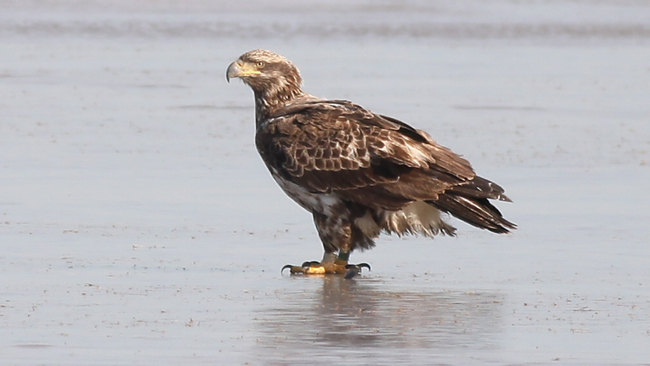
The bald eagle is currently classified as endangered for both breeding and non-breeding populations. The classification of the bald eagle will continue to be endangered for the breeding population, which includes all bald eagles present in the State during the breeding season. However, the non-breeding population, which includes all bald eagles present in the State outside of the breeding season, will be reclassified as threatened.

Six bird species – the pied-billed grebe, northern harrier, northern goshawk, peregrine falcon, short-eared owl and vesper sparrow – currently listed as endangered for both breeding and non-breeding populations will continue to be classified as endangered for breeding populations but will be listed as special concern for their non-breeding populations.

The Endangered Species List is not a one-way street and while we worry about the removal of protections for species, we must recognize and celebrate the recovery and return of these species. In the 1950’s, no peregrine falcons nested east of the Mississippi River, today our non-breeding population is strong and growing. In the late 1980’s, one pair of bald eagles remained in New Jersey, today the winter population is counted in the high 200’s and the breeding population approaches 100 pairs. Species recovery can succeed and with this proposed rule change, we should celebrate these successes.

But, we should mourn the additions to the list and wonder why, since the Endangered Species Act passed in 1973, we still see declining populations and we still add species to the Endangered Species List in New Jersey.

Volunteers Survey NJ’s Eagle Population

Midwinter Eagle Survey

by Larissa Smith, Biologist and Volunteer Manager

An immature eagle at Forsythe NWR in Oceanville. © Eric C. Reuter

The New Jersey midwinter eagle survey takes place each January and is part of the National midwinter eagle survey to monitor population levels.  Another benefit of the midwinter eagle survey is that new eagle nests and nesting pairs are often located.  The target dates for the 2011  survey was January 8th and 9th.  Approximately 75 volunteers participated throughout the state. This year the snowy winter weather on Saturday did  effect  the count due to the heavy snow fall at times and low visibility.  Sunday was clear and sunny which allowed volunteers to get out and survey.

Preliminary results:
  • 194 eagles – southern NJ
  • 24 eagles – northern NJ reservoirs
  • 17 eagles – Delaware Water Gap
  • A total of 235 eagles were observed this year.

This total is lower than 2010s count of 333 eagles which is in large part due to the weather. Full results will be released soon.

Thank you to all the volunteers who braved the snow, cold and windy weather!

Species Spotlight

American Kestrel (Falco sparverius)

Kestrels are the smallest falcon (about the same size as an American Robin) in North America. Its plumage is striking with rufous coloration its back and tail. Although the American kestrel is widespread, meaning they live year round throughout much of the United States, the northeastern kestrel population is declining. Today the kestrel is listed as a Species of Special Concern in New Jersey (not yet endangered or threatened but on its way).

American kestrels are versatile, opportunistic hunters feeding on assorted small prey, such as grasshoppers, lizards, mice, snakes and small birds. © Robert Lin

Kestrels are found in open, grassy habitats – especially ones that have cavities for nesting and perches for hunting. Kestrels can be seen hovering in grasslands, pastures and parklands or perched along the road on telephone lines. The decline of kestrels in New Jersey is likely due to destruction of grasslands from development. Also, nesting cavities are lost. As we clean up our fields, we remove trees with nest cavities the kestrels use.

Researchers have not determined the exact reason for kestrel declines but, we do know that the availability of cavities for nesting appears to be a limiting factor. Conserve Wildlife Foundation of New Jersey, in partnership with the Endangered and Nongame Species Program implemented a nest box installation and monitoring program in 2006.

Eagle Scout helps NJ’s bats

Bat houses provide roosting and maternity sites in South Jersey

by Ben Wurst, Habitat Program Manager

Nicolas built 60 bat houses with materials that were donated to help NJ's bats. Image courtesy Dan Fuzer

New Jersey’s bats got some new maternity and roosting sites near Mt. Holly and the Rancocas Creek late last year. A Boy Scout, Nicolas Fuzer, chose to construct and install bat houses for his Eagle Scout Project after learning more about bats and the perils they face including White-nose syndrome. He hopes that by building and installing these houses NJ’s bats will not have a problem finding adequate areas to roost and reproduce.

Amazingly enough, Nicolas completed the construction of a total of 60 bat houses with the help of his fellow Scouts. He was planning on installing all of the bat houses, some with our help. But after realizing the daunting task of finding suitable habitat and installing all 60 of the bat houses, he decided to donate some to CWF. He installed 20 of houses in suitable habitat near the Rancocas Creek.

The donated bat houses will be installed in areas where we would like to enhance roosting habitat or maternity sites. There is a possibility for us to give away some bat houses to homeowners who 1) Have suitable habitat, i.e. a structure/building that has south/southwest exposure with full sun and at least a 15ft. drop and 2) would participate in our Summer Bat Count where volunteers count bats as they emerge from their roost sites at dusk. If you’re interested in obtaining a bat house from CWF, please contact me for more information.

Thank you Nicolas for all of your hard work and generous donation!!


Benefits of Bats
Nicholas installs a bat house as part of his Eagle Scout Project. Image courtesy Dan Fuzer

Bats have a reputation as being spooky or even dangerous, but they are actually some of the most beneficial animals to people. All of New Jersey’s bats are insectivores. They feed on night-flying insects, including the pesty mosquitoes. A single little brown bat can eat 3,000 mosquito-sized insects a night, and a colony of 150 big brown bats can eat enough cucumber beetles to save farmers almost a billion dollars annually in crop damages and pesticide costs. Without bats, we would be more dependent on toxic chemicals to control unwanted insects. Some garden pests even detect the sounds that bats make while feeding and will avoid areas where bats are present. In turn, guano (bat droppings) makes for a terrific garden fertilizer!

In other areas of the world, bats play a major role in pollinating flowers and dispersing seeds for plants such as bananas, avocados, cashews, and mangoes. By dispersing a wide variety of plant seeds over open areas, bats also help to restore the tropical rainforests following logging, fire, and other disturbances.

Many scientific advancements are owed to bats as well: navigational aids for the blind, blood-clot medication, artificial insemination techniques, low-temperature surgery on people, and military sonar have all been inspired by our night-flying friends.


Learn More: