Freshwater Invertebrate Surveys

SEARCHING FOR FRESHWATER MUSSELS & CRAYFISH AT MANASQUAN RESERVOIR

By Michael J. Davenport, Marine Species & GIS Programs Manager

Searching for freshwater mussels and crayfish using a viewing scope. © Mike Davenport

New Jersey is home to at least 16 species of freshwater bivalves (freshwater mussels and clams), half of which are listed as endangered or threatened within the state.  The presence of freshwater mussels within a water body is an indication of water quality so determining where they occur is important for protecting water resources within the state.  In fact, the NJ DEP’s “Category One” (C1) designation for some state waterways is often based on the presence of some freshwater mussel species.  C1 waters are protected from any measurable change in water quality because of their exceptional ecological significance, exceptional recreational significance, exceptional water supply significance, or exceptional fisheries resources.

Last week, I accompanied the Endangered and Nongame Species Program’s freshwater mussel biologist, Jeanette Bowers-Altman, and another survey team member to conduct a preliminary survey of the Manasquan Reservoir in Monmouth County for both freshwater mussels and crayfish.  I had visited the reservoir several times before and had confirmed the presence of at least three bivalves: the Asian clam, eastern floater, and paper pondshell.  Of those three species, only the eastern floater is native to New Jersey.

We surveyed several areas around the perimeter of the reservoir.  We took readings of the water’s temperature, pH, and dissolved oxygen as well as documenting the substrate type and GPS coodinates.  Unfortunately for our survey efforts, the water level was higher than ideal for locating mussels and the only species which we found was the paper pondshell.  However, the clarity of the water and the nature of the substrate indicate that future efforts, when the water level is lower, may be more productive.

A Chinese mystery snail (Cipangopaludina chinensis) found at Manasquan Reservoir. © Mike Davenport

One interesting find was a rather large (~2.5 inches) freshwater snail which I have never encountered previously.  Thanks the ID skills of Jay Cordeiro at the University of Massachusetts – Boston, the snail has been identified as the Chinese mystery snail (Cipangopaludina chinensis), a non-native species introduced to the U.S. via San Francisco in the late 1800’s.  It has since spread into at least 37 U.S. states and 4 Canadian provinces and was first documented in New Jersey in 1926.  According to Jay, the species has been “implicated in vegetation decline, competition with native species, and are hosts for certain parasites.  Current populations are spread through the aquarium trade or on ornamental aquatic plants.”

For more information regarding New Jersey’s rare mussel species, please visit CWF’s on-line field guide at:  http://www.conservewildlifenj.org/species/fieldguide/

Photo from the Field

Stranded osprey gets helping hand

by Ben Wurst, Habitat Program Manager

I’ve been off work for the past week to spend some time with the newest member of my family, Reed Alexander Wurst. I was planning on heading into the office today to play catch up with a lot of projects that I’ve involved with (having a baby during field season is definitely keeping me busy!). So I started the day by opening up my laptop to download the 90+ emails I’ve gotten in the past week. As I sat down for some breakfast I saw an email from a woman where the subject said “Osprey on our Sailboat and we need help!” Immediately after I saw that I thought, there goes heading into the office… The woman who contacted me was Melissa, who was living on her sailboat that was moored in the harbor at Barnegat Light (BL). She sent me an image and this is what she wrote:

“We read your story in the SandPaper so are contacting you about this situation.

We heard a loud noise around 1am and when we looked with the flashlight we saw this osprey. It tried to fly up and out w/o success and now that it’s light we can see blood and it’s appears that his/her wing is injured.

We are anchored at Barnegat Light across from the town boat ramp. Our boat is Piscator and is the 32′ white and green double-ender.

We have no way to deal with handling this osprey, so really need help!! “

An injured osprey on the deck of s/v Piscator in Barnegat Light, NJ. © Ben Wurst

I called Melissa and I headed up to BL. I met John at the boat ramp and we rode out to the s/v Piscator in his dingy. After the short ride I saw that that osprey had a fracture to it’s left wing in the carpal (wrist) joint. I carefully collected the osprey and saw that she was banded. I looked up the band (788-49090) and she was banded in Sandy Hook on June 30, 2009. This would be her first year back from her wintering areas to breed in New Jersey. Ospreys spend two years after fledging in their wintering areas. One positive aspect is that most two year old birds do not raise young their first year after returning to nest in areas where they originated. So, no young ospreys are dieing b/c of her injury.

I then called Don Bonica with Toms River Avian Care and transported the osprey to Barnegat Animal Clinic where it would temporarily stay. I don’t know if it will heal from its wounds. Ospreys don’t do well in captivity or in rehabilitation settings. I can only hope that its fracture is minor and that it heals quickly!

Melissa knew who to contact after reading a story about my work with ospreys in New Jersey, especially the B. Bay Watershed in The Sandpaper. The story is viewable online until Wednesday, June 15th.

Volunteers needed to help install barrier fence

Protecting Terrapins through conservation along Great Bay Blvd.

by Ben Wurst, Habitat Program Manager

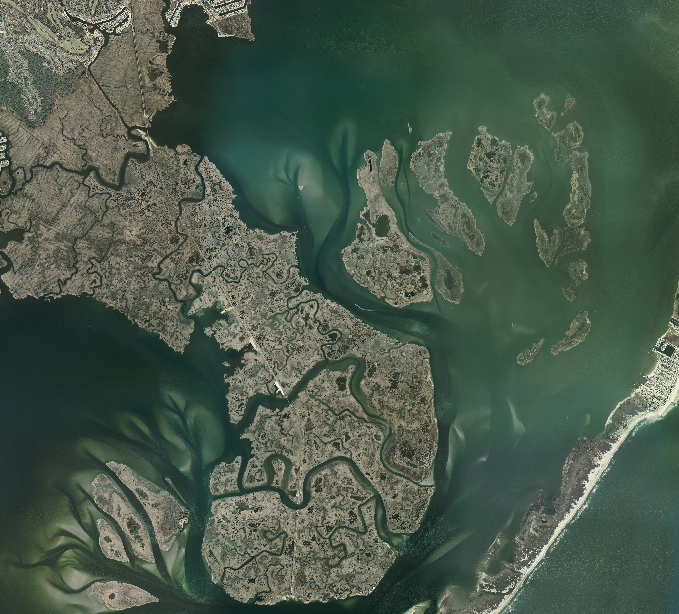
Great Bay Blvd. in Little Egg Harbor, New Jersey. © Ben Wurst

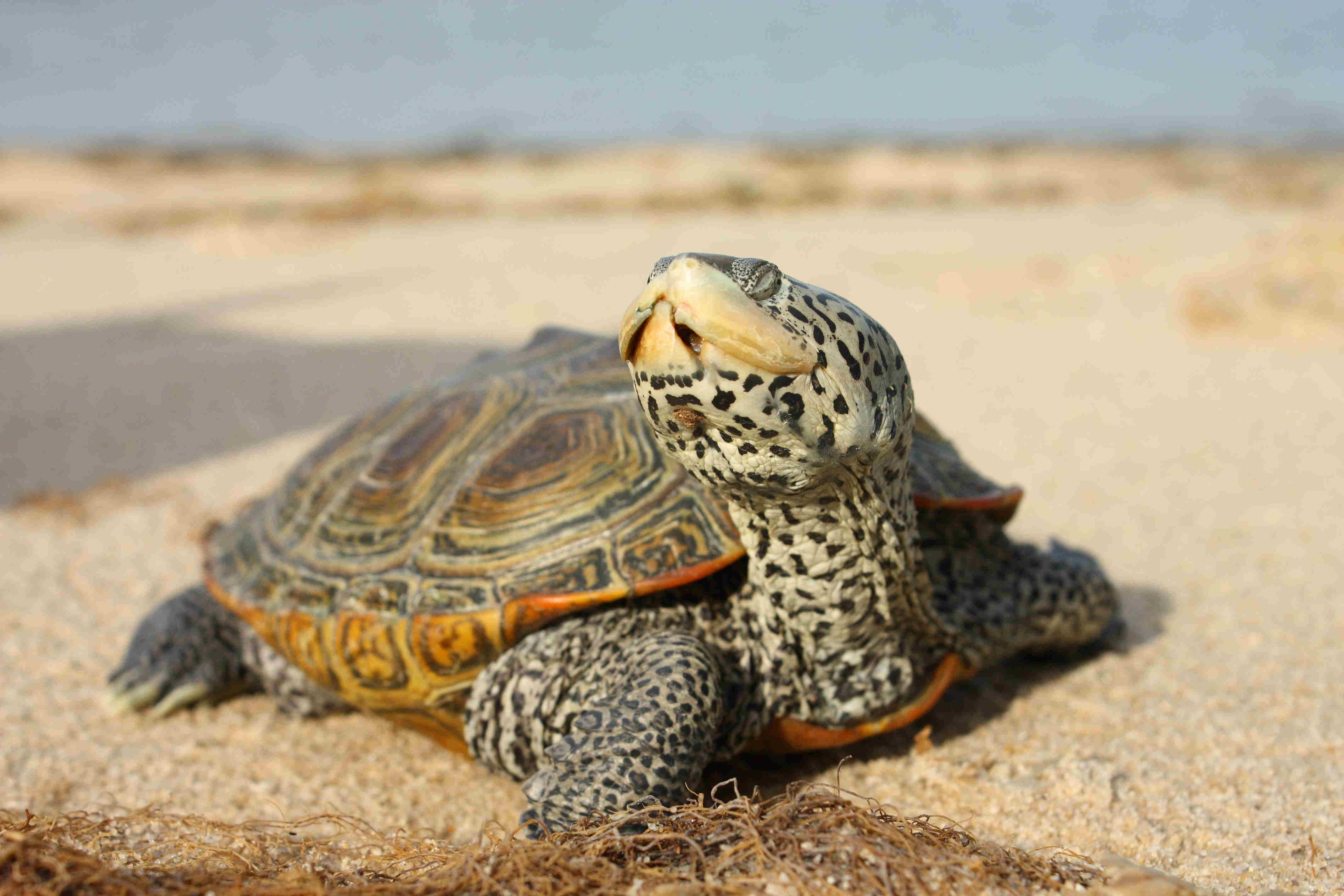
Northern Diamondback Terrapins are native to New Jersey and inhabit the many miles of coastal salt marshes along the Atlantic Coast and Delaware Bay. Terrapins were once very common and were used as a main food source of protein by Native Americans and then European settlers. In the early 1900’s it was hunted so extensively that it almost faced extinction. Luckily, during the 1920’s, use of terrapins for food dropped in popularity. This allowed the population to slightly recover and avoid extinction. However, several major threats still threaten their survival. Habitat loss, mortality from being drowned in crab traps, and road mortality all pose major threats to the health of the population. Each year thousands of terrapins are killed by motor vehicles throughout their range and here in New Jersey, Great Bay Boulevard is no exception.

Great Bay Boulevard or Seven Bridges Road extends approximately 5 miles into estuarine emergent wetlands and northern diamondback terrapin nesting habitat. The boulevard is surrounded by over 5,500 acres of protected coastal habitat (Great Bay Boulevard Wildlife Management Area – Managed by NJ Division of Fish and Wildlife), a relatively unspoiled, estuarine ecosystem. This road, at times, has high a volume of traffic, especially on weekends when boaters and outdoorsmen travel on the road to get to and from one of the several active marinas along the road. Currently during May-August there is no protection to terrapins when they cross Great Bay Blvd. from vehicle traffic. Most terrapins who cross the road are adult females who are laden with eggs and are looking for a suitable nesting site. These females lay their eggs in a sand/gravel mixture where it is easy for them to dig and cover their eggs, like sandy beaches and in scrub-shrub habitat along road edges. Many female terrapins are inadvertently hit-by-car and injured or killed by speeding motorists or people unaware of the summer nesting habits of the terrapin. This high mortality rate has caused the local population to decline and it has also caused the average size of adults to drop significantly over the past 20 years.

How you can help:

Volunteers are needed to help install ~ 4,000 ft. of barrier fencing along Great Bay Blvd to help reduce the amount of road kills. Sambol construction will be helping us by trenching a ditch for us to place the fence in. Volunteers will help lay out fence, install metal posts, hang fence, and back fill trenches.

  • Please pack a lunch and bring plenty of water, sunblock, and bug spray.
  • We are starting work on Friday at 8am, but if we don’t finish, we’ll wrap up work on Saturday morning.
  • We will meet after the first bridge; click here for a Google Map link. You can park here and then we can car pool to the section of the road where the fence will be installed.
  • Please register if you plan to attend by emailing Ben Wurst.

Check out our project page on Facebook and become a fan today!

One Lucky Eaglet!

Eagle banding team rebuilds eagle nest

by Larissa Smith, Biologist & Volunteer Manager

Bald eagle chick in the nest that was repaired.

On Friday May 13th the eagle banding team met to visit two eagle nests in Cumberland County. The first nest visit went smoothly, two healthy chicks were banded, blood samples and measurements were taken.  The second nest was located on an island out in the salt marsh. As we approached the island we could see that the nest looked somewhat small and it looked like some nesting material had fallen out of the tree.  As we got closer to the nest tree both of the adult eagles appeared and were making their alarm calls (which is normal) when we go out to band an active nest. As Mick Valent, Principal Zoologist with the Endangered and Nongame Species Program, prepared to climb the tree we started to look for prey items which we collect at each nest. One of the eagle project volunteers made a sad discovery, the remains of a 4-5 week old eagle chick. We then knew that something had happened to the nest.  As Mick got closer to the nest he told us that there wasn’t a nest and it must have fallen.  But the adults behavior indicated that there was still a live chick. We thought perhaps that the second chick was still alive on the ground, so we started to search.  Mick made his way up to the nest remains and we heard him yell, “there is a chick”.  It was decided that the chick would be brought to the ground  banded and examined. The nest would then be rebuild so that the chick could be put back up into the nest.

Erica Miller a veterinarian from Tri-State Bird Rescue and Research examined the bird. It had a full crop which means that it was being fed.  The only indication of its trial was a sore on the bottom of its foot pad from holding on tight to the remaining nest.

Meanwhile Mick began constructing a new nest base with large branches that were sent up using rope.  Jeremy Webber with the NJ Forest Service is training to climb nest trees and was able to assist in the nest building. Once a base platform was constructed the remaining nesting material was put up on the platform and then tied down so that it wouldn’t slide off the platform. Softer material was sent up in a bag for the final touches.  The chick was then sent back up and placed in his new home.

We estimate that the nest had fallen in the past two weeks.  The chick wouldn’t have been able to hang on much longer especially with any high winds or rain storms.   The nest volunteers went out the next day and reported that the chick was fine and the adults were at the nest.  It may have been Friday the 13th but it was this chicks lucky day!

Mapping Rattlesnake Dens in Northern New Jersey

PROTECTING WILDLIFE BY MAPPING THEIR HABITAT

By Michael J. Davenport, Marine Species & GIS Programs Manager

A juvenile timber rattlesnake at a den site. © Mike Davenport

Having accurately mapped rare species data is essential for insuring that critical habitat for those species remains protected.  For that reason, I recently accompanied Kris Schantz, a biologist from the NJ Endangered and Nongame Species Program, in documenting two timber rattlesnake den locations in northern New Jersey using a GPS (global positioning system) unit.  Our goals were to see if the rattlesnakes had emerged from hibernation, survey how many were present, and to accurately map their locations in the heavily wooded area less than 30 miles outside New York City.

Using a GPS unit to map a rattlesnake den. © Mike Davenport

Timber rattlesnakes (Crotalus horridus horridus), like other reptiles, are cold-blooded.  In order to survive through the long, cold winter in New Jersey, they hibernate in dens.  Research has shown that rattlesnake dens in the northern part of the state can vary from rocky outcroppings with crevices, ledges or boulders to forest interior dens consisting of a few rocks and a hole in the ground.  In New Jersey’s Pinelands, however, rattlesnake dens are quite different.  Rattlesnake dens in the Pinelands are usually underground crevices near bodies of water, often underneath large tree roots.

Rattlesnakes will almost always use the same den year after year.  In addition, rattlesnake young typically follow the scent trail of their mother in order to find their way to her den their first fall, or may follow any timber rattlesnake to a suitable den.  As a result, a good den site may provide a winter refuge for a number of rattlesnakes of all age classes, as well as other species of snakes.

Since the goal of our mission was to map den locations, we had to make sure we arrived at the den site once it was warm enough for the rattlesnakes to come out of their crevasses to bask but before they had enough warm weather to travel away from the den site.  Timing was crucial.  After a week with some fairly warm days mixed with very cool nights and a few cool days, we ventured out during the last week of April on a day when the air temperature climbed into the lower 80’s.

The first den site we visited required a fairly long hike through a rocky, deciduous forest.  Fortunately, Kris had visited both den sites several years earlier so she had a good idea of where we needed to go.  We were fortunate to find two individuals at the den site, one yellow-phase juvenile and one yellow-phase sub-adult or young adult.  While I GPSed the den site, Kris attempted to determine their sex based on their appearance (the young adult was a female but the juvenile’s sex could not be determined).

GPS units work when there is an unobstructed line of sight to four or more GPS satellites.  With 7-8 satellites being detected by the GPS unit, my task of mapping the site was fairly easy and took little time.  The trees had yet to leaf-out so my GPS unit had a clear signal from above.  We also observed a northern black racer (Coluber constrictor constrictor) at the den site.

The second den site required a much longer and more strenuous hike accompanied by swarms of black flies.  At that location, we observed three rattlesnakes – one black-phase adult (sex undetermined), one yellow-phase adult male, and one yellow-phase sub-adult or young adult (sex undetermined).  GPSing this location took a little more effort though due to the terrain both because it was more difficult to get to the site and once there, the terrain made getting a clear signal on the GPS unit a little more tricky and it took far longer than at the first den.

Out of the five rattlesnakes we observed, only one ever rattled.  Rattlesnakes rely on their camouflage as their first line of defense.  Even when we were close by, they remained motionless.  At no point did any of the snakes approach us or attempt to strike.  The only two individuals which moved at all during our survey, moved away from us into rock crevasses and that was likely due to our prolonged presence staring at them.

Snakes, and venomous snakes in particular, have an undeserved bad reputation.  At no point during our survey did I ever have any fear of being bitten by a rattlesnake.  In all honesty, I was actually far more afraid of being bitten by a tick instead (I only found about four or five on me during the entire day).

For more information on timber rattlesnakes, visit Conserve Wildlife Foundation’s on-line field guide to New Jersey’s rare species at:  http://www.conservewildlifenj.org/species/fieldguide/view/Crotalus%20horridus%20horridus/

Photo from the field

Installing a nestbox for peregrine falcons on a water tower

by Ben Wurst, Habitat Program Manager

Ben Wurst and Alf Breed installed this peregrine nestbox on a 120 foot water tower at Bayside State Prison near Delmont, NJ. © Kathy Clark, ENSP

The installation of a custom made nestbox on a water tower is no easy task. Just climbing this tower is a scary feat. First off the tower is over 70 years old and has little safety features on it.  You rely on your own climbing gear and strength to safely climb this tower. After several delays, we successfully got the nestbox up on the water tower where we hope to get peregrines from another nest site to nest.

This site was chosen because it is suitable habitat for peregrines to nest and there are adequate prey resources in the area (pigeons, starlings, and doves). Peregrine nest sites were once along the D. Bayshore in this area, but a recent study conducted in coastal Virginia found that peregrines there were negatively influencing the behavior of migratory shorebirds. This spring the decision was made to remove a nestbox that was located along the Bay to help protect species like the endangered red knot while they feed on horseshoe crab eggs.

I constructed the nestbox from salvaged wood from the Forest Resource Education Center’s sawmill. It’s a mixture of white cedar, western red cedar, and scrap plywood (from construction of bat houses). Reusing salvaged wood is something I am really passionate about. I make all sorts of things from it including picture frames that I sell, furniture, and osprey platforms.


Help protect terrapins in southern Ocean County!

Volunteers needed to help protect terrapins in southern Barnegat Bay

By Ben Wurst, Habitat Program Manager

A rehabilitated adult female northern diamondback terrapin that was released in late 2009 after being injured by a motor vehicle along Great Bay Blvd. © Ben Wurst

Last year Conserve Wildlife Foundation of NJ started a new project that was focused on reducing the amount of terrapins that were killed by motor vehicles. The project began because of one individual terrapin that I encountered on Great Bay Blvd in 2009. I observed the female terrapin as she walked along the edge of the Blvd. I saw this as being odd. Typically they cross the road and often at a speedy pace (probably because they know the apparent danger from crossing roads). I stopped and saw that she had an injury to her lower mandible, probably from a motor vehicle. I knew that she needed help.

Terrapins face a variety of threats in their environment. An untold number are trapped in crab traps that are not fitted with Bycatch Reduction Devices (BRDs), some are hit by speeding boats and jet skis, and many more are injured or killed while attempting to cross roads. Along Great Bay Blvd. in Little Egg Harbor several studies have documented the amount of live and dead individuals on the road.

As soil and coastal waters begin to warm, terrapins begin to become active again. In late April/early May hatchlings begin to emerge from nest cavities where they overwintered. Adults also begin to become active, but mostly remain in the waters where they live until June when females emerge to lay eggs in nests they dig on land.

The penninsula that surrounds Great Bay Blvd. is pristine habitat for terrapins in southern Barnegat Bay.

Last year we raised enough funding to develop and print an educational brochure, purchase and install “Terrapin X-ING” signs, and install 4,000 feet of barrier fencing. The fencing was placed along the first stretch of road where the highest mortality rates were recorded. The fence proved to be effective at reducing road kills and increasing awareness of terrapins. The fence was removed in late 2010. This year it will be installed again along the same portion of road with help from a local construction company, Sambol Construction. After this season, we hope to keep the fence up year-round and hope to fence the whole first section of the road (and possibly more).

This year to help reduce the amount of terrapins that are hit by motor vehicles, we are recruiting volunteers to act as “Terrapin Stewards.” Stewards will be asked to routinely drive, walk, or bike down Great Bay Blvd. during the summer months from June to mid-July (especially on weekends, holidays and when there is a full or new moon). Volunteers will educate the public about terrapins, their threats in the environment, and our project. Volunteers will also help terrapins safely cross roads and help record locations of live or dead animals. No more than 10 volunteers will be recruited this year.

Our Message to visitors:

The habitat that surrounds Great Bay Boulevard is very important to the reproduction of northern diamondback terrapins, a species in decline in New Jersey. Female terrapins often nest along the soft shoulders of roadways. Sometimes they enter the roadway to reach these suitable nesting areas where they lay their eggs. Research has shown that dozens of female terrapins are killed by motor vehicles each year along Great Bay Boulevard. Please help conserve terrapins by driving carefully while traveling along the road.

If you’d like to participate you are required to attend a training session on May 3rd @ 6pm at the Jacques Cousteau National Estuarine Research Reserve. Volunteers will fill out paperwork and learn more about terrapins and our project. You must register to attend this training/information session.

It’s Better in the Bahamas – Part 2

Piping Plovers and Conservation Partners in the Tropics

By Todd Pover, Beach Nesting Bird Project Manager

Todd Pover, CWFNJ Beach Nesting Bird Project Manager and Ellen Jedrey, of Massachusetts Audubon Society “making friends” in the Bahamas

We found the first piping plover nest of the season in New Jersey this week. In the course of our nest searching we also spotted two piping plovers marked with color bands indicating they had been banded in the Bahamas last winter. It is hard to believe that just a month ago these small birds were still settled in for the winter more than 1000 miles from our state.

And as I reported in an earlier installment of this series (It’s Better in the Bahamas – Part 1), I also spent a week in the Bahamas in January/February searching for piping plovers as part of the winter segment of the International Piping Plover Census. As exciting as it was to be part of the survey team scouring the islands and cays of the Bahamas looking for plovers, the Abaco (island) portion of the survey, which I participated in, was just as much about building conservation partners as it was about the survey work itself.

The Bahamas portion of the winter census was sponsored by the U.S. Geological Survey, in close collaboration with the Bahamas National Trust and the National Audubon Society, itself a great partnership. My participation came about because of a partnership I have been cultivating with Massachusetts Audubon Society’s Coastal Waterbird Program. They were already slated to assist with the Bahamas survey and suggested I come along as well.

Even before we boarded a plane to head to the Bahamas, numerous local contacts had been established. Nobody on the Abaco survey team had ever been to the Bahamas and there were dozens of islands and miles of shoreline to be searched. We were headed there to help because of our expertise about piping plovers, not local geography – so in the end the success of the project really hinged on local knowledge and participation to help direct our efforts.

And there was local assistance from the moment we arrived. I was met at the airport by
David Knowles, Chief Park Warden for the Bahamas National Trust on Abaco, who generously took time from his busy schedule to orient me around the island. Within minutes of piling into his car, we were discussing similar problems we faced dealing with cats striking ground nesting birds  – in my case with beach nesting birds and in his case with the Bahama Parrot, whose stronghold is the southern part of Abaco. David was a critical link in establishing key contacts on the island and helping us gain assess to some sites that would have otherwise been off-limits.

Important support came from the Friends of the Environment, a conservation group dedicated to protecting Abaco’s marine and terrestrial environment. They hosted a public information session at their headquarters which allowed our research team to discuss the survey and raise awareness, but also garner feedback from locals as to where our efforts might be focused.

Important advice came from plenty of individuals as well. Woody Bracey, a well-known bird expert from Treasure Cay, shared much needed information prior to and during the census, provided logistical support when it came to housing and transportation, and participated in various segments of the survey. (He was also a great boat captain and brought us to an awesome sand flat on Green Turtle Cay – one of the highlights of our trip). Bruce Wolck provided similar birding expertise and support on Elbow Cay. Beyond that, these folks invited us into their homes to share stories – they were all around great “hosts”.

We were introduced to Loggerhead Productions, a local film production company, who tagged along to shoot footage of plovers and interview us. They are now interested in coming to the states to film piping plovers on their breeding grounds – this connection may lead to a compelling film about plovers sometime down the road.

We met and talked to bonefisherman and boat captains, sometimes hiring them on the spot to transport us out to hard to reach locations (there was no shortage of those). We coordinated with resort managers and even picked the brains of random folks lying under a palm tree if that’s what it took. It truly took a “village” to complete the surveys.

I have talked extensively in the past about developing conservation partnerships – to the extent I fear it is starting to sound like a “soapbox” – but it really is the model we need to follow, especially for migratory species, such as piping plover, that cross state and international borders.

Being so vested in piping plovers that nest in New Jersey, I can get a little possessive about “my” birds. The trip to the Bahamas was a good reminder that they actually spend the majority of the year elsewhere – if anything, the plovers I saw in the Bahamas are “their” birds. That was one of the messages we tried to leave with the groups and individuals we met along the way in the Bahamas. But I guess the real message should be that they are “our” birds. Ultimately, if we are going to be successful in recovering piping plovers, we all have an important conservation role to play, right here in New Jersey and a thousand miles away in the Bahamas.

Photo from the field

Not your typical osprey platform!

by Ben Wurst, Habitat Program Manager

A 30 ft. tall osprey platform is installed at Fort Monmouth in Oceanport, NJ. © Ben Wurst

For the past two years we’ve worked with staff from the Army Corps of Engineers to enhance osprey nesting habitat within the Shrewsbury River Watershed inside Fort Monmouth in Oceanport, New Jersey. We first began work during the summer of 2009 when an osprey nested on a utility pole at the Fort. The pair had eggs when their nest caused $10,000 worth of damage to a transformer. To alleviate the problem the nest was going to be removed from the pole and the nest would have been lost.  Instead Joe Fallon, Chief of the Environmental Division at the Fort decided to install a new pole next to the nest on the live power lines. I met with Joe and gave him a platform “top” and braces to attach to the top of the new pole. After the new pole was installed the nest and eggs were moved. The adults immediately took to the nest platform and successfully raised two young that year. In 2010, they raised another two young that we banded with USGS bird bands.

After completion of work this spring there will be a total of 18 nesting platforms there (not including a nest on a light pole over a baseball field). We hope to use part of this funding to install more nesting structures on several islands to the west of Sea Bright and Monmouth Beach in 2012.

Amphibians on the Move!

By Karena DiLeo, Assistant Biologist

Jefferson Salamander, a species of special concern in New Jersey, crossing to its breeding pools. Photo by MacKenzie Hall.

Well, it’s that time of year again.  As the temperature slowly climb and the ground thaws with spring rains, New Jersey amphibians emerge from their upland habitat and begin their long and increasingly treacherous journey to their spring breeding pools.

This March marked my first official amphibian migration night with Conserve Wildlife Foundation’s Amphibian Crossing Project.  As always, any potential migration night begins with frantic checking for weather updates, a call to volunteers to suit up and meet us at rescue sites, early arrival to set up road signs and safety equipment, and hoping the rains continue…we wait.  We wait as rush hour begins, the traffic steadily increasing as dusk falls, and then it happens: one by one, we spot wood frogs and spotted salamanders on the road edges- hesitating to leave the coverage of the forest almost like they know the roads bisecting their ancestral migration paths may prove an impassable barrier.

This past Thursday, our destination was a rescue site on East Shore Drive in Stillwater Township.  With the help of dedicated volunteers, including boy scouts from local Patriots Path Council, we patrolled almost 250 meters of roadway and rescued 572 frogs, salamanders, and newts in just 2 ½ hours—that’s 229 amphibians per hour!  Within this short span of time we also waved 70 cars through- most of which seemed oblivious to natural phenomenon taking place under their wheels.

Dedicated volunteers patrol roadway. From left to right: Diane Gonski, Doug Hankin, Wayne Bancroft, Eckhardt Debbert, and Paul Cook. Photo by Phil Wooldridge.

By 10pm, migration had slowed and more importantly traffic had too.  So it was on to the next site.  MacKenzie and I wanted to check out how a site on a busy road faired in Liberty Township.  The results were disheartening—within a narrow corridor we saw at least 50 dead frogs and salamanders littering the road.  During the hour we patrolled, 50 spotted salamanders were counted (and moved) trying to cross a road with still significant traffic at 11pm at night.

Wood frog dead on road. Photo by MacKenzie Hall.

If  hundreds of amphibians died within hours in this narrow corridor- imagine how many thousands are killed throughout the state each rainy spring night.  Each individual’s death marks a loss to the population but with females carrying between 200 and 2,000 eggs it marks a significant loss not only to their species future generations but also to the ecosystem as an important food source to other animals.

I knew the importance of amphibian migration and the potential extirpation populations were facing due to roads- I had seen other migration nights but I had never before seen the mass mortalities on a single road.  So please on the next rainy spring night, leave your car in your driveway and instead grab a flashlight and see what you can find or contact CWF and become one of our dedicated Amphibian Crossing volunteers!