First look: Jersey City Falcon Cam

First glimpse from the new Falcon Cam at 101 Hudson St.

by Ben Wurst, Habitat Program Manager
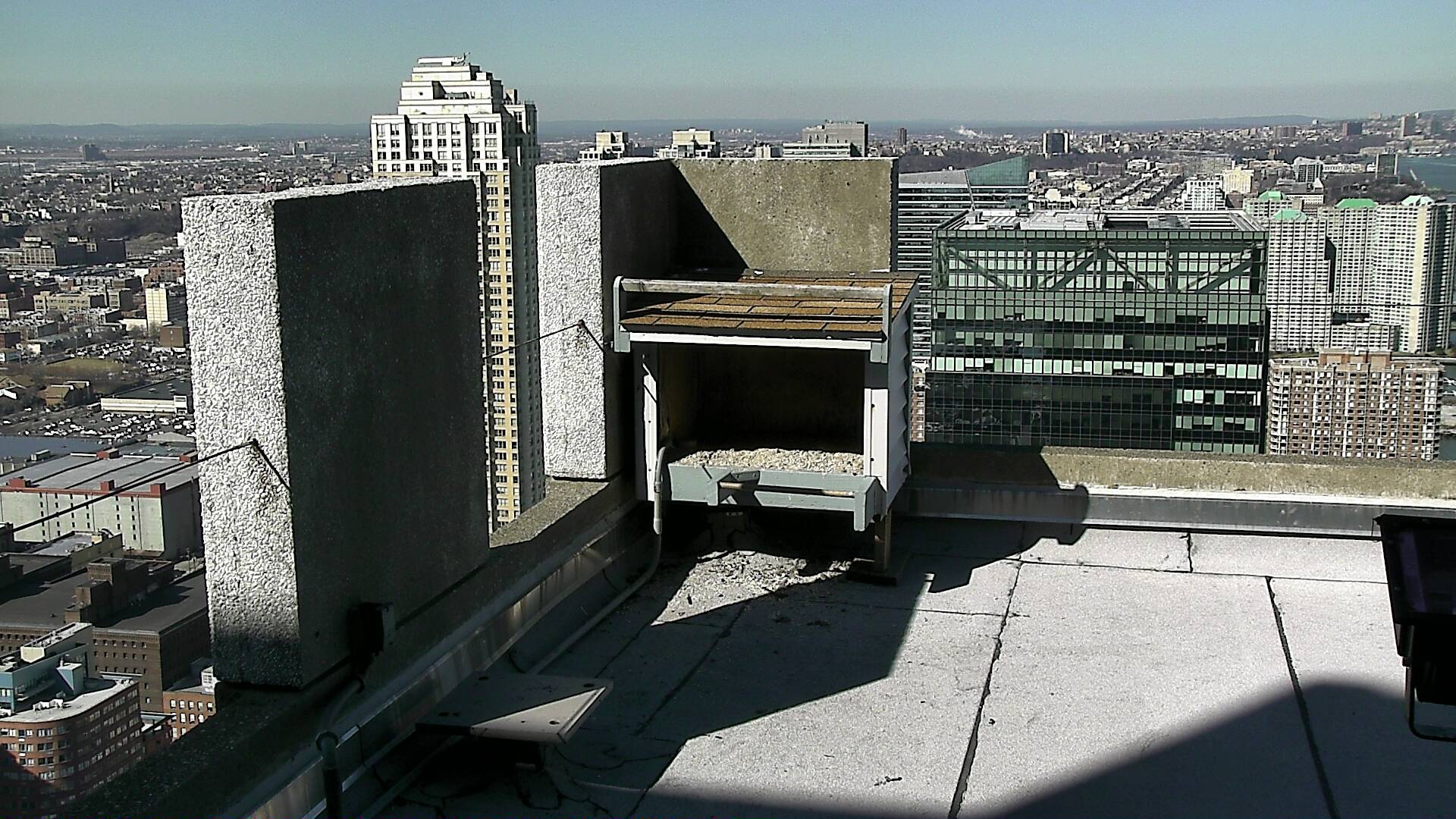
First view from the new camera at the Jersey City peregrine falcon nest.

Yesterday we made the trip to 101 Hudson St. to install the new digital camera system at the Jersey City peregrine falcon nest.  I was joined by Kathy Clark, Supervisory Zoologist with ENSP, Charlene Smith, CWF and Paul Tarlowe, NJDFW, who all helped to remove the old system and to install the new one. Our main goal was to complete any work that took place outside, so if we needed to go back we would not disturb the nesting pair. Last year they laid their first egg on April 4th. After being there for over 5 hours we managed to get two new cameras installed. One camera (a pinhole) gives us an eye level perspective from inside the nestbox. The other (pictured above) will allow us to zoom and pan to see everything on the roof of the building, including the nestbox and the NYC skyline.

We were surprised that the nesting pair, who were present the whole time we were there, were quite passive. These birds, especially the female, are quite aggressive and are known to dive bomb and hit biologist on the head if you go near the nestbox! We were very careful as to not be causing any stress to the birds while there.

The camera is not online yet. We need to go back to the site next week to configure the network settings so that we can stream the camera feed(s).

Thank you to everyone who supported our Save the Jersey City Falcon Cam campaign. Although we have not yet reached our initial $10,000 goal, we believe that fans of the Falcon Cam will give once the camera goes live! So to be clear – contributions are still desperately needed. Please help support the Falcon Cam!

Bonus shots from Zoologist Kathy Clark with the Endangered and Nongame Species Program:

Adult male.
Adult male. Photo by Kathy Clark/ENSP.
Adult female.
Adult female. Photo by Kathy Clark/ENSP.

Plush birds help real birds in New Jersey!

Ever see an adorable bird in the wild and wanted to take it home with you?

by Ben Wurst, Habitat Program Manager

A Stuffed Owl hunts a desolate beach.
Well now you can!

I feel lucky to have had the chance to see a snowy owl on one of New Jersey’s beaches! It was certainly a once in a lifetime experience! Snowy owls are such an intriguing species that we know so little about. Hopefully scientists will learn more about them by studying their movements during this irruption to protect critical habitat for them, like some of the beaches and other habitat types that they overwintered on here in New Jersey.

Since we all LOVE the snowy owls so much, you can now purchase your very own memento of the irruption this winter! The plush snowy owl that you see above was made right here in the US; designed by talented artists and made by hand by craftsmen and women in Upperstate New York. 20% of the sales of these plush birds goes to Conserve Wildlife Foundation of New Jersey to protect REAL birds.

More plush birds are on the way, like ospreys, piping plovers, oystercatchers, and peregrine falcons!

I for one cannot wait to get my hands on a plush osprey!! 🙂

Go Wild for Art!

D & R Greenway exhibit brings wildlife to life

By Jen Smith, CWF Outreach Intern

Annelies van Dommelen, Q

The D&R Greenway Land Trust’s “Wild Creatures: 40 Years of Protecting Endangered Species” exhibit is being featured at the Johnson Education Center in Princeton, NJ.  It is a vivid art-viewing experience that celebrates the U.S. Endangered Species Act and the wildlife it has sought to protect since its inception.

But time is running out to catch this unique blend of science and art!

“The response to the exhibit has been overwhelmingly positive with visitors who are simultaneously delighted by the whimsical creatures, reverent of their noble struggle, and inspired by the recovery efforts undertaken across the globe to save them,” said Diana Moore, curator for the exhibit.

Eight local artists were featured for their work, including Tricia Zimic’s foreboding mobile entitled “A Cautionary Tale.” Henslow sparrows, a Bobolink, and a Peregrine Falcon struggle in an all-to-lifelike storm of fishing wire, plastic and debris. Annelies van Dommelon’s playful yet informative work is also not to be missed. Filling up an entire room with her breathtaking “Bestial Alphabet” viewers can glimpse the A to Z of creatures aided by the Endangered Species Act, many of those depicted being native to New Jersey. More than one viewer compared the exhibit to watching an Aesop’s Fables book come to life.

“This creative exhibit highlights just how special our wildlife is in New Jersey – and why so many species continue to need our protection,” noted David Wheeler, CWF Executive Director. “Each artist brings a unique vision to illustrating the challenges that so many wildlife species face, and to capturing the extraordinary beauty possessed by each species.”

D&R Greenway Land Trust’s mission is to preserve and protect the permanent network of lands they have ensured remain open spaces and to create conditions for a healthy and diverse environment to flourish. In creating public access to these open spaces, it is D&R’s goal and hope that people will develop a greater appreciation for the natural world, and be inspired by conservation ethics and education.  D&R President Linda Mead was honored this past December at Women & Wildlife by CWF for the Greenway’s leadership in protecting wildlife habitat in a region of the state that desperately needed that protection.

“Wild Creatures” will be running now through March 21st. The Johnson Education Center in Princeton, NJ is open 10am – 5pm on weekdays. You can call ahead for availability (609)-924-4646 or visit www.drgreenway.org for more details and driving directions.

More information about Tricia Zimic’s artwork can be found at www.triciazimic.com.

Hurry now before this rare showcase comes to an end!

Osprey nest needs urgent repairs

A productive nest on the Navesink River needs a helping hand!

by Ben Wurst, Habitat Program Manager

UPDATE: We have learned that the pole has been straightened!! Thank you all for the support!!!

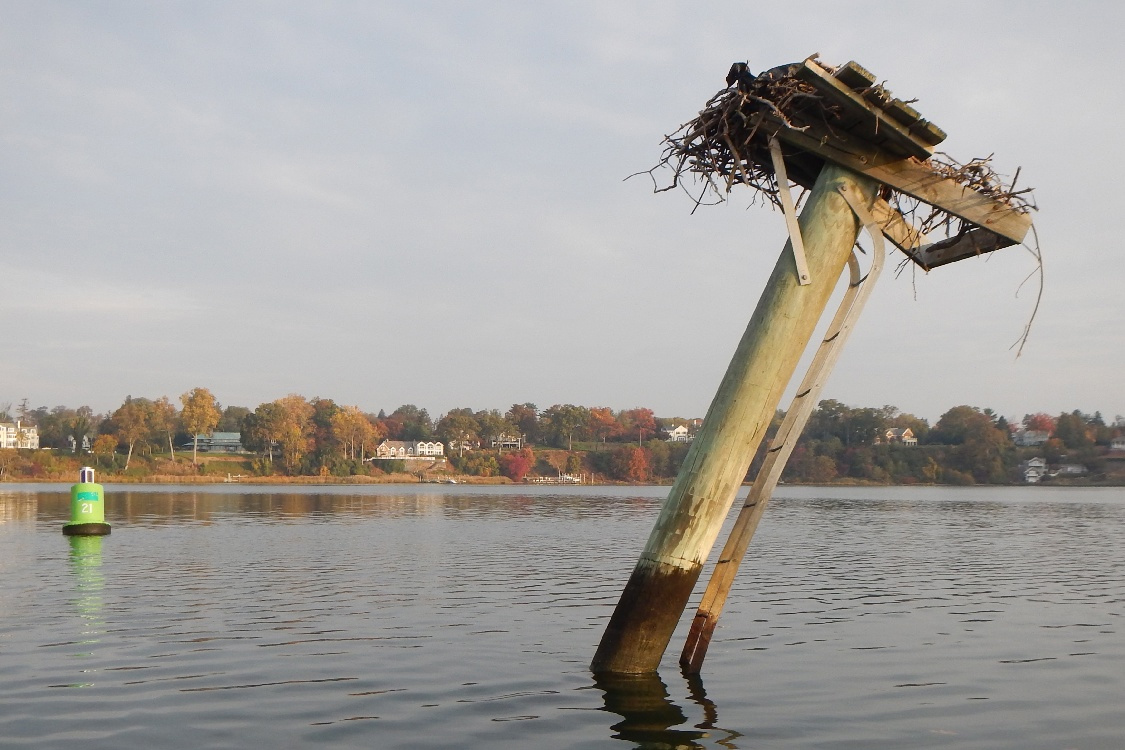
Many North American ospreys have already departed from their wintering grounds in Central America, N. South America, and the Caribbean and are on migration to their summer breeding grounds. In New Jersey, most ospreys nest along the Atlantic Coast, from Sandy Hook to Cape May and arrive in mid-late March. One nest (083-A-007) is on a decommissioned channel marker (#21) on the Navesink River, off Fair Haven. The nest was first found in 2006 and in 2013 the nesting pair successfully produced three young. Considering the current condition of the nest pole, they were really lucky to produce any young at all!

083-A-007 on the Navesink needs some TLC!

This platform was one of many that sustained damage by Superstorm Sandy. We pledged to repair any and all platforms that were reported as damaged by the Storm and did; however, we don’t have the equipment or boats to repair a leaning platform in open water, like 083-A-007. Since it was damaged we have been contacted by many concerned citizens who watch the pair that nests here. We’re sharing this story to help garner support to repair the nest pole.

Ospreys mate for life and return to the same nest site, year after year.  They will build their nest at an angle to compensate for the lean, but young are still in jeopardy of falling out of it. Our goal is to get it fixed before the pole falls over. Lastly, this is an important nest site in the region. There is very little preserved open space in this region of Monmouth County and very few osprey nests.

We need your help!

Ospreys return to their nesting grounds in mid-late March in New Jersey. © Howie Williams

Last year we tried reaching out to local marine construction and bulkheading companies but had no luck getting anyone to even return our calls. Then we contacted the Bureau of Coastal Engineering’s Aids to Navigation and they did not have equipment in the area to make the needed repairs last fall (we’ve since called them again to get their assistance and are waiting to hear back).

Do you know any local bulkheading or marine construction companies who work in the Fair Haven/Rumson area? If you do, please see if they can provide some assistance so this pair of ospreys have a safe place to nest!

Contact us if you know anyone who can help:

A break in the weather

Great Bay Blvd. Osprey Platform Install

by Ben Wurst, Habitat Program Manager

We took advantage of the break in cold/wet weather along the southeast coast of New Jersey and installed a new nesting platform for ospreys this week. The new platform was installed for a pair that previously nested on sensitive equipment used by the Rutgers University Marine Field Station on Great Bay Blvd. in Little Egg Harbor. The equipment was located on a short cluster of pilings near the boardwalk to the Station. It failed to produce young in 2013. More than likely it was predated by raccoon, the main ground predator of osprey young.

A large number of volunteers showed up to help out. The actual install was quite easy considering it could be accessed by the land via Great Bay Blvd. The platform was placed along a tidal creek so that biologists can easily access the nest for future surveys. Rutgers staff will install deterrents on the old nest so birds can’t nest there when they return in late March. You can see the location of the nest on Osprey Watch or drive out on GBB to see it in person.

Thank you to all the volunteers who came out to help!


BAHAMAS PIPING PLOVER PROJECT

WINTERING PIPING PLOVER SURVEYS ON ABACO

By Todd Pover, Beach Nesting Bird Project Manager and Stephanie Egger, Wildlife Biologist

IMG_3492
The Bahamas piping plover survey tally board in the “central command” room at Schooner Bay Institute.

An integral part of this Bahamas trip entailed surveying several sites not previous covered on Abaco and revisiting some sites not checked since the 2011 International Piping Plover Census. Although we didn’t find large concentrations of piping plovers at any one new site, we did make some noteworthy discoveries.

One of the most exciting find was the resight of a piping plover that was banded on the breeding grounds last summer in Massachusetts as part of a flight behavior study. New Jersey also participated in this research and we briefly thought it might be one of the birds banded in our home state – but it turned out that it was banded (and nested) on Chapin Beach, Cape Cod and is wintering at Schooner Bay, Abaco (amongst 15 other piping plovers found on our survey). Continue reading “BAHAMAS PIPING PLOVER PROJECT”

Living with eagles as your neighbors

Brochures now available

by Larissa Smith: Wildlife Biologist/Volunteer Coordinator

Bald Eagle Project Brochures.

The New Jersey Bald Eagle nesting population is on the rise with 148 nesting pairs monitored in 2013 and 177 young fledged.  As the eagle nesting population increases so do the incidences of eagles nesting in close proximity to humans and human activity. It’s exciting to have a pair of bald eagles nesting and people often want to get a closer look but this can cause disturbance to the nesting eagles and have detrimental impacts. Over half of NJ’s eagle nests are located on private property which makes it important to advise and educate land owners, land managers about living with eagles.

To address this issue CWF received a grant to produce two informational brochures about co-existing with bald eagles in NJ. One is a general brochure for anyone interested in eagles in NJ and the other is specifically for landowners/land managers with eagle nests located on their property.  The brochures contain information on eagle history, living with eagles as you neighbors, how to be a good eagle watcher or steward, as well as phone numbers for information and law enforcement. As the eagle project volunteers monitor their nests they will have these brochures available to educate interested people.

2014 NJ Bald Eagle Nesting Season Has Begun

by: Larissa Smith; Wildlife Biologist/Volunteer Manager

Eight pairs of NJ eagles are currently incubating (sitting on eggs). The earliest pair to start incubating was confirmed on January 12th, so the birds been keeping the eggs warm throughout the snow and cold weather. Eagle Project volunteers report that pairs all over the state are busy working on their nests in preparation for egg laying.

Want to see eagles and other raptors and learn all about them? The Cumberland County Winter Eagle Festival is February 8th, 2014.

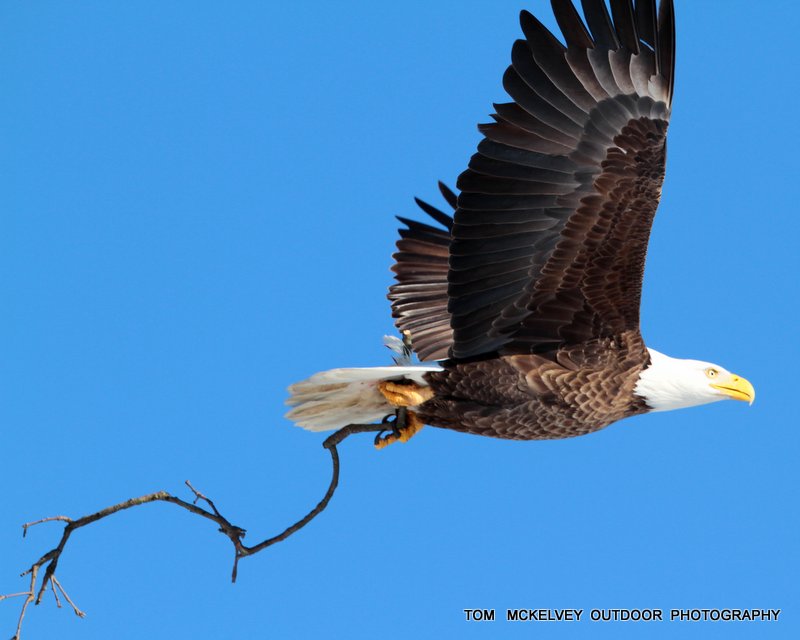
The following photos were taken by Eagle Project Volunteer Tom McKelvey.

Adult with nesting material. ©Tom McKelvey
A pair works on their nest. ©Tom McKelvey


Bahamas Piping Plover Project

Eleuthera Edition

By Todd Pover, Beach Nesting Bird Project Manager
Stephanie Egger, Wildlife Biologist

Piping plover roosting beach on the island of Eleuthera, Bahamas.

Up until now, nearly all of our piping plover conservation work in the Bahamas has been focused on the island of Abaco.  One of the objectives of our Disney Worldwide Conservation Fund grant is to identify other islands and partners where and with whom the model we are developing on Abaco might be implemented as well.  With this in mind, we spent the past several days on the island of Eleuthera.

Although we believe the basic elements of our Abaco work are transferable to other islands, a “one size fits all” approach may not entirely work.  The various major islands are unified under the Bahamas flag, but each also has its own flavor, history, and way of life.  The best analogy would be that they operate much like the individual states in the U.S.

On Abaco, we have been partnering with Friends of the Environment, a non-profit organization with a strong education and outreach component to all of their work – not so different from what we do here at the Conserve Wildlife Foundation.  On Eleuthera we are hoping to partner with the Cape Eleuthera Institute (CEI) and The Island School.  Although education is at the core of their work as well, it is also different in that they carry out and support primary research and host visiting scientists and students at their campus. Continue reading “Bahamas Piping Plover Project”

Duke Farms 2009 Eagle Chick All Grown Up

Jersey banded bird re-sighted in Maryland

by Larissa Smith, Wildlife Biologist/Volunteer Coordinator

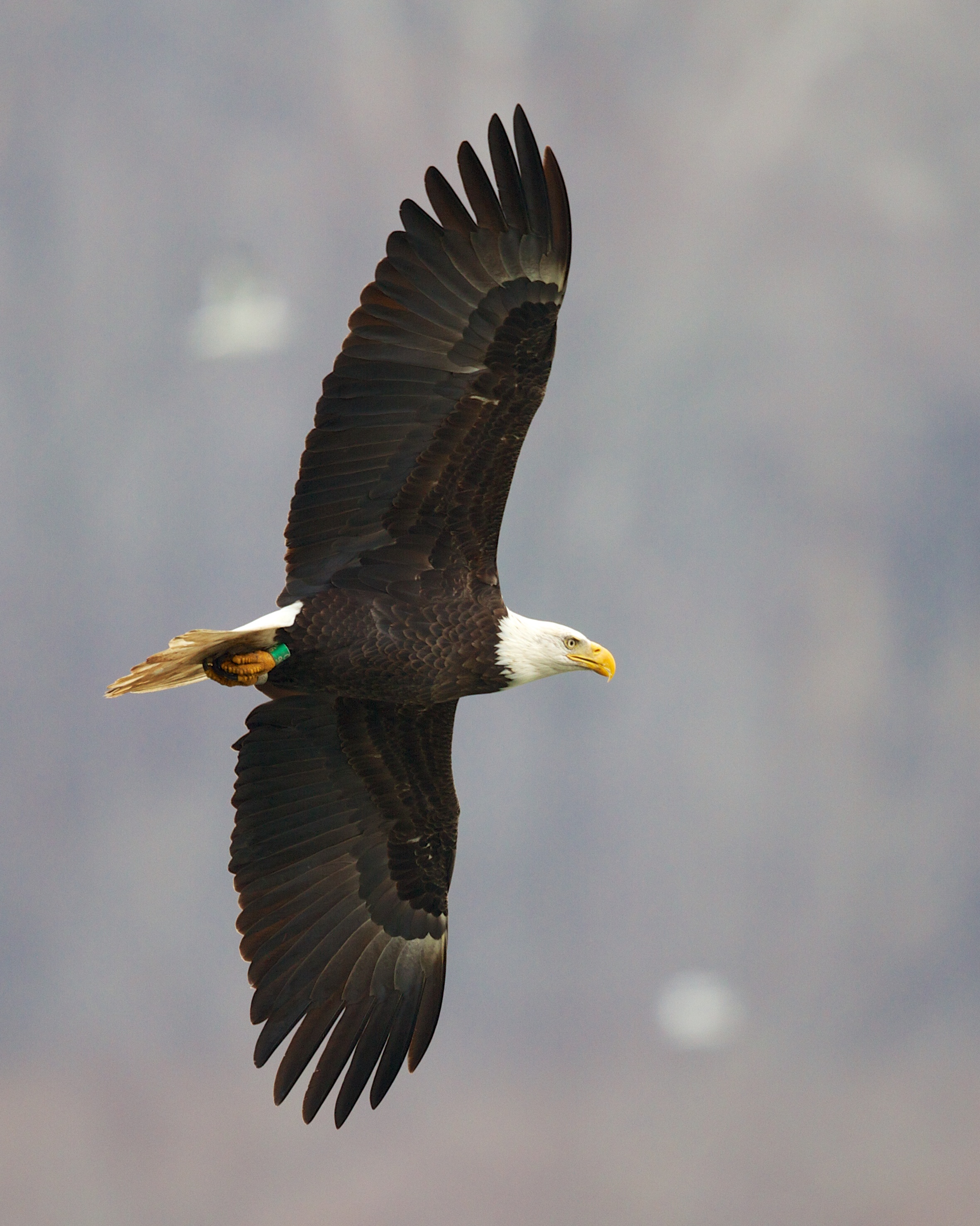
NJ banded eagle at Conowingo Dam, MD © Kevin Smith

The Duke Farms eagle camera was put in place in 2008. Since then it has had quite a following of people interested in seeing the pair raise their young. After the young birds leave the nest it is unknown what happens to them. The mortality rate for first year eagles is fairly high since they are just learning how to fly and hunt on their own.  So it was quite exciting when on December 1, 2013 Kevin Smith photographed a NJ banded bird at Conowingo Dam, Maryland. He was able to zoom in close enough to view the green band which read C96. This bird had been banded on May 18, 2009 at Duke Farms. He was the oldest of three males raised by the pair in 2009 while being watched by eagle cam viewers. Below is a photo of the three chicks in the nest following the banding. The largest bird on the right is C96.  Now at 4 1/2 years old he is almost a mature adult but still has just a slight amount of brown in his tail feathers (photo on left).

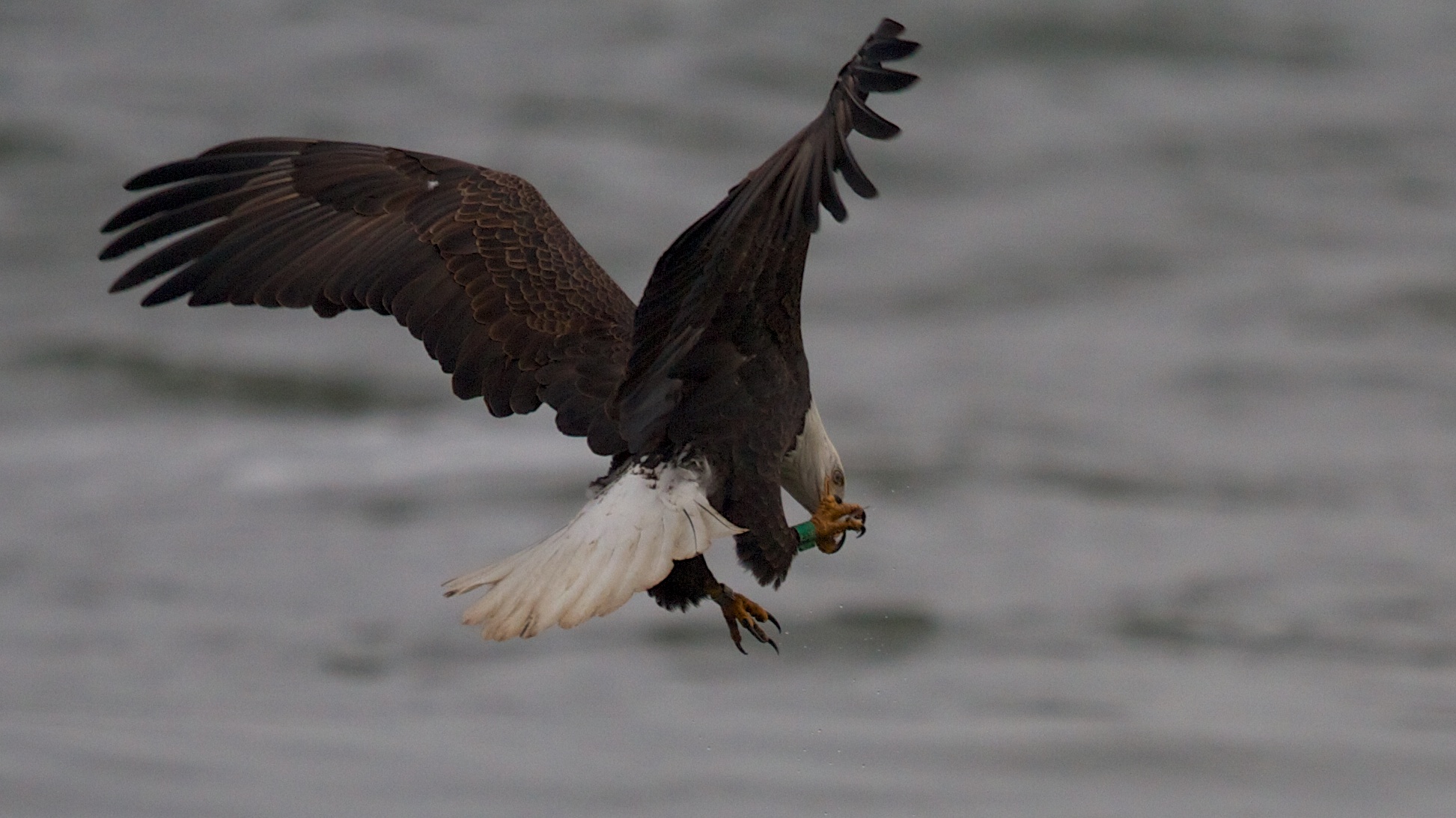
Conowingo Dam is a popular spot for eagles this time of year due to the abundance of fish. Kevin noted that the eagles were catching smaller fish than usual and eating them on the fly. The photo below on the right shows C96 moving the fish from his talons to his bill. Kevin reports that he (C96) would then circle back around looking for more fish and got his share of food that day. It is good to know that C96 has survived and is healthy.

  • The Duke Farms eagle cam is up and the pair is getting the nest ready for the 2014 nesting season.


NJ banded eagle at Conowingo Dam, MD © Kevin Smith
Duke Farms eagle nest at banding May 18, 2009 © Mick Valent