Oyster Reef in Delaware Bay Dedicated to New Jersey Veterans

“Veterans Day on the Bay” brings families, volunteers and veterans to South Reeds Beach on New Jersey’s Delaware Bayshore

by: Lindsay McNamara, Communications Manager

[slideshow]

Conservation organizations leading the efforts to restore New Jersey’s Delaware Bay beaches today organized “Veterans Day on the Bay,” a celebration to dedicate the oyster reef at South Reeds Beach in honor of military veterans’ service to our country.


“We want to dedicate this work to our nation’s armed forces veterans to give them well deserved recognition for their service to all Americans,” stated Dr. Larry Niles, a biologist with American Littoral Society and Conserve Wildlife Foundation of New Jersey who has studied federally-listed Red Knots for three decades. “We also hope to give them an intimate experience of successful wildlife conservation to spark their interest and encourage them and their families to take part in future work.”


Veterans Day on the Bay dedicated the South Reeds Beach oyster reef to all veterans and highlighted veteran involvement in the effort to restore New Jersey’s Delaware Bayshore. Event attendees honored their own military veterans by inscribing that special person’s name on a shell and placing that shell on “Veterans Reef.” Guests also helped study the wildlife living in this new reef with hands-on, interactive marine science activities like seining, trapping, trawling, and species identification.


“Delaware Bay has been so vital to this community for generations, and through this project we hope to strengthen the connections that young and old feel to this incredible natural resource that is home to wildlife of global importance,” said David Wheeler, Executive Director for Conserve Wildlife Foundation of New Jersey. “The living construction of Veterans Reef is a small but meaningful embodiment of all that our military veterans have done in building a strong American defense to give us security and protect the many freedoms we hold dear.”


Volunteers and veterans worked alongside American Littoral Society and Conserve Wildlife Foundation of New Jersey to establish a near-shore oyster reef at South Reeds Beach in Cape May Court House on the Delaware Bayshore in April 2015. The reef was built to prevent sand loss from wind-driven waves. Conservation groups will continue to monitor whether the reef bars help reduce beach erosion and create calmer water for spawning horseshoe crabs.


The South Reeds Beach Oyster Reef is one of the many projects that American Littoral Society and Conserve Wildlife Foundation are working on to restore the ecology and economy of the Delaware Bayshore.


“We are rebuilding habitats along Delaware Bay in order to strengthen the ecology, communities and economy of that area. Grants for the project enabled hiring several military veterans, and they continue to play a valuable role in the work. It is in recognition of the service veterans provide to their country and communities, that we are dedicating the reef at Reeds Beach to them,” said Tim Dillingham, Executive Director for American Littoral Society.


“Congratulations to the American Littoral Society, the Conserve Wildlife Foundation of New Jersey, and the veterans who helped build this oyster reef,” said Amanda Bassow, Northeastern Regional Director for the National Fish and Wildlife Foundation, which helped fund the project in partnership with the Department of Interior. “This project will help Reeds Beach be more resilient to the impact of future storms, while also providing important habitat in Delaware Bay.”


Shorebirds, like the federally listed Red Knot, depend on an uninterrupted supply of horseshoe crab eggs when they stopover in Delaware Bay during their migration. In recent years, countless horseshoe crab eggs have been lost because of the devastating storms that swept away the beach habitat they depend on.


“Restoring beach habitat on the Delaware Bay benefits Red Knots because it provides important feeding habitat for a bird threatened with extinction. The restored beach and oyster reef also protects the local community by providing increased resilience to future storms. Projects like these that help fish and wildlife, in addition to supporting local communities, are a priority for the U.S. Fish and Wildlife Service,” explained Eric Schrading, Field Supervisor for the New Jersey Field Office of the U.S. Fish and Wildlife Service.


The new oyster reef will attenuate waves but still allow for horseshoe crab breeding. In existing areas where crabs can breed without interruption, egg densities can exceed ten times the egg densities on unprotected beaches.


Projects like the South Reeds Beach oyster reef are being funded by National Fish and Wildlife Foundation through their Hurricane Sandy Coastal Resiliency Grants Program, and are being developed in partnership with U.S. Fish and Wildlife Service and New Jersey Division of Fish and Wildlife.


Learn More:


Lindsay McNamara is the Communications Manager for Conserve Wildlife Foundation of New Jersey.

Three New Jersey Women Recognized at Tenth Annual Women & Wildlife Awards

MacKenzie Hall, Pat Hamilton, Tanya Oznowich honored at Conserve Wildlife Foundation’s 10th Annual Women & Wildlife Awards

by Lindsay McNamara, Communications Manager

The Honorable Christine Todd Whitman with past and present Women & Wildlife Award winners, representing a decade of strong female leaders in wildlife conservation. From left to right: Dr. Erica Miller, Edith Wallace, Linda Tesauro, Kathy Clark, Amy S. Greene, the Honorable Christine Todd Whitman, Pat Hamilton, MacKenzie Hall, Tanya Oznowich, and Diane Nickerson.


Our Tenth Annual Women & Wildlife Awards, held at Duke Farms, recognized three women – MacKenzie Hall, Pat Hamilton, and Tanya Oznowich – for their leadership in protecting wildlife in New Jersey. The Honorable Christine Todd Whitman served as the keynote speaker.


The Women & Wildlife Awards celebrated Conserve Wildlife Foundation’s past decade of honoring women for their success in protecting, managing, restoring, and raising awareness for the Garden State’s endangered and imperiled wildlife species.


“The inspiring leadership of MacKenzie Hall, Pat Hamilton, and Tanya Oznowich not only benefits New Jersey’s wildlife and the countless people who care strongly for our outdoors – it provides successful role models for the next generation of girls in scientific fields that have for too long held a glass ceiling for young women,” said CWF Executive Director David Wheeler. “Their unparalleled dedication and hard work – like that of the Women & Wildlife honorees over the past decade – has helped make New Jersey a national leader in wildlife conservation.”


The three honorees were recognized individually with awards in Inspiration, Leadership, and Education:

MacKenzie Hall, a powerful force behind the conservation of wildlife in New Jersey, who began working as a wildlife biologist for Conserve Wildlife Foundation in 2004 before joining the Endangered and Nongame Species Program in 2014, is the recipient of the Women & Wildlife Inspiration Award. She has been involved in a number of projects spanning bat colonies, migrating amphibians, and grassland birds.

In her work to implement conservation programs such as the Natural Resources Conservation Service’s Wildlife Habitat Incentive Program, Ms. Hall’s keen understanding of the process and positive attitude turned many farmers and landowners into dedicated environmental stewards. What may be most remarkable about Ms. Hall is her ability to motivate the public and inspire non-scientists of all ages to become passionate conservationists.


Women & Wildlife Leadership Award Winner Pat Hamilton has worked for the New Jersey Division of Fish and Wildlife Bureau of Freshwater Fisheries since 1980. She is considered to be the champion for Eastern brook trout, the state’s only native salmonid, and a species once extirpated from over 50% of its historical habitat due to human impacts.

Ms. Hamilton is one of three fisheries biologists in New Jersey endeavoring to strengthen the state regulations to further conserve native brook trout streams. Thanks to her efforts, more than 200 northern New Jersey streams have been designated as Trout Production Streams, which afford the streams higher levels of state protection.


The recipient of the Women & Wildlife Education Award is Tanya Oznowich, Environmental Education Supervisor of the New Jersey Department of Environmental Protection, who has championed environmental education for over three decades.

Schools across New Jersey are incorporating environmental education into their curriculum, a new movement inspired by a growing awareness of environmental issues and our shared role in understanding and resolving them. To a large degree, this growing prominence is thanks to Tanya Oznowich. She has been engaging the public in natural resources since 1979. Since beginning her tenure with the NJDEP in 1988, she has dedicated herself to integrating environmental science into New Jersey’s classrooms, from kindergarten to college.


The Tenth Annual Women & Wildlife Awards, held on Wednesday, October 28 at Duke Farms in Hillsborough, New Jersey, included a presentation of the awards to the recipients, hors d’oeuvres, cash bar and a silent auction.


Learn More:


We gratefully thank our generous Eagle Sponsors who made the Women & Wildlife Awards possible: PSEG, Atlantic City Electric, Janice King and Bill Masonheimer, and Eric Sambol.


Lindsay McNamara is the Communications Manager for Conserve Wildlife Foundation of New Jersey.


Gone Batty: The Creature Show Halloween Special

Conserve Wildlife Foundation Biologist and 2015 Women & Wildlife Inspiration Award Winner Featured in Halloween Special of The Creature Show

by Lindsay McNamara, Communications Manager

TheCreatureShow


Just in time for Halloween, learn more about New Jersey’s bat population in the latest episode of The Creature Show! In this episode, join Conserve Wildlife Foundation’s wildlife ecologist Stephanie Feigin and 2015 Women & Wildlife Inspiration Award Winner MacKenzie Hall on their journey to track the federally listed Northern long-eared bat, hear from a young bat advocate and learn more about current threats to bat populations.


The Creature Show Halloween Special offers a glimpse into the work by New Jersey’s bat biologists to protect the remaining population of these misunderstood creatures of the night. Learn how to radio track a bat, see the joy in our biologists’ faces when all of their effort in the field pays off, and listen as common myths about bats are de-bunked.


The episode is running through Halloween in the small theater downstairs at Duke Farms‘ Orientation Center (Hillsborough, New Jersey) on a continuous loop in their “bat cave.”


The Creature Show is a documentary webseries dedicated to conservation storytelling. Their stage: the wilds of New Jersey, within the nation’s most crowded state. Here they find represented all the villains of global extinction, including habitat destruction, climate change, invasive species and wildlife disease. They also find wildlife biologists and regular citizens who have devoted themselves to protecting the region’s biodiversity, no matter what the challenges may be.


Learn more:


Creature Show Halloween Special from The Creature Show on Vimeo.


Lindsay McNamara is the Communications Manager for Conserve Wildlife Foundation of New Jersey.

Meet the 2015 Honorees: MacKenzie Hall, Women & Wildlife Inspiration Award Winner

Wildlife Biologist Celebrated for Inspiring Non-Scientists of All Ages to Become Passionate Conservationists

by Lindsay McNamara, Communications Manager

MacKenzie Hall, 2015 Women & Wildlife Inspiration Award Winner

A powerful force behind the conservation of wildlife in New Jersey, MacKenzie Hall began working as a wildlife biologist for Conserve Wildlife Foundation in 2004 and was been involved with projects spanning bat colonies, migrating amphibians, and grassland birds. What is most remarkable about Ms. Hall, however, is her ability to motivate the public to participate in these projects, inspiring non-scientists of all ages to become passionate conservationists.

 
Ms. Hall has supported and participated in bat research projects throughout the state. She took part in colony monitoring, mist-netting, and banding, working through many nights in order to benefit these enormously important species. In 2012, she launched a “Bats in Buildings” program offering New Jersey homeowners bat-friendly “eviction” resources, as well as free bat houses for displaced colonies.


In addition to her involvement in bat conservation, Ms. Hall is a passionate advocate for New Jersey’s amphibians and reptiles. She worked to address amphibian mortality on state roads, teaming up with working groups to help species of frogs and salamanders safely cross roads during their spring breeding season. She successfully coordinated amphibian surveys throughout the state, a task requiring road closures, the cooperation of multiple municipalities, the recruitment and training of volunteers, and the willingness to work outdoors overnight on cold, rainy nights!

 
In her work to implement conservation programs such as the Natural Resources Conservation Service’s Wildlife Habitat Incentive Program, Ms. Hall’s keen understanding of the process and positive attitude turned many farmers and landowners alike into dedicated environmental stewards.


Join us to honor MacKenzie and the two other 2015 Women & Wildlife Award Winners on Wednesday, October 28 beginning at 6pm. Purchase events tickets and find more information.


We asked MacKenzie a few questions about what working in wildlife conservation means to her:


What motivates you to get out of bed each morning and go to work?

So much to do!  Somehow the day always ends with more on the to-do list than it started with.  Working statewide means a lot of ground to cover, a lot of emails to answer, and a lot of people to convince that the bats in their eaves aren’t looking to murder their family.  Every day is a different adventure, even if I never leave my desk.  Days that I actually get to spend up-close with animals or see our work making a difference – like finding kestrel eggs in a nest box we put up for them, or cupping a beautiful salamander in my hands and moving her to the safe side of the road – those are the little moments of glory that make it all feel so simple.  It’s also really great to work with people who look at the world the same way I do, and who I can keep learning from.


What do you find most challenging about your profession?

Same answer as the last one, I think.  This is work that’s never done.  We rarely get to clap our hands together and say, “Ok, that species is saved, who’s next?”  Most of our successes take years and years, a lot of educating others, a lot of help from others, and endurance.


Name one thing you can’t live without.

Sunshine…summertime.  These crisp October days feel clean and refreshing, but I don’t want to close the windows and put a coat on!  I want to bask in the sun like a turtle.  I want sand that’s almost too hot to stand on.  I want to run around in a tank top and pick berries and stay out in the balmy night in flip-flops, with frogs screaming from the trees.


What interests you the most about New Jersey’s wildlife?

Most of them live at or near some interface with the human world, because so much of New Jersey is covered in our footprints.  We’ve got falcons on skyscrapers and shorebirds raising their chicks between houses and beach umbrellas.  And yah, colonies of bats living up in the eaves.  There’s a sense of sharing, because we’re all trying to make the most of our little spaces.  We have so many chances to connect and commune with wildlife on common ground, if we just pay attention and learn to share nice.


Name one piece of advice you would give to someone who wants to change the world.

Figure out what you want the change to look like, and start with you.  Be a positive example for the people who are close to you, and they’ll help you pass it forward.  Don’t get too frustrated by the ones who don’t.


Please join us on Wednesday, October 28, 2015, from 6:00 – 9:00 p.m. at Duke Farms in Hillsborough, New Jersey to honor the contributions that MacKenzie Hall, Tanya Oznowich, and Pat Hamilton have made to wildlife in New Jersey.


This year’s very special event will feature keynote speaker Governor Christine Todd Whitman. The event will also celebrate CWF’s past decade of honoring women for their success in protecting, managing, restoring, and raising awareness for the Garden State’s endangered and threatened wildlife species.


Learn more:


Lindsay McNamara is the Communications Manager for Conserve Wildlife Foundation of New Jersey.

A Tale of Two Colonies

An Insider’s View of New Jersey’s Skimmer Nation

by Laura Hardy and Pam Prichard, Beach Nesting Bird Field Technicians

"Where's Waldo" - Black Skimmer Edition, as the colony takes flight. Photo by Sushanth Allapalli.
“Where’s Waldo” – Black Skimmer Edition, as the colony takes flight. Photo by Sushanth Allapalli.


by Laura Hardy:

New Jersey’s largest breeding colony of black skimmers is an uncommon joy. I’ve stood many hours this season totally bemused by these boisterous barking birds. I’m thrilled when, en masse, the colony takes flight right over my head, in the purest National Geographic moment I might ever experience. However, as the colony’s primary monitor, my job isn’t to be dazzled by the birds – those candy-corn bills, the funny barking calls, the gorgeous choreography of their flight – instead it’s to conduct biweekly counts of the birds in order to monitor the colony’s size and productivity.


Every summer for the past several years, about 1,000 black skimmer pairs have nested on the little stretch of beach known as Seaview Harbor Marina; nearly 2,600 birds at its peak this season. Black skimmers, plus least and common terns, gather there in an incredibly noisy colony. Piping plovers and American oystercatchers nest on site also.

Laura Hardy, one of the blog authors, pauses as she attempts to count a colony of several thousand black skimmers. Photo by Donna L. Schulman.

Have you ever tried to count thousands of raucous swirling birds while being dive-bombed by hot-tempered terns? The first time I tried, I didn’t know how or where to start. I started over at least eleven times that first day just to be sure I was right. Even still, my boss saw my number and said I had probably underestimated the size of the colony. Argh!


During the next count, I briefly considered multiplying my tally by some random number like 1.4297363 in order to accurately reflect the number of birds my boss thought I should be seeing. Instead, he bought me a step stool that made seeing the birds much easier. Nesting adults had become obscured by growing vegetation in the colony — but the stool made me even more of a target for the dive-bombing terns.


During the next couple of count periods, as the colony continued to grow, I worried that I was compensating for the natural tendency to underestimate by over-estimating. The last two or three counts, with the colony at its peak and chicks all over the beach, I thought for sure I was hallucinating – there simply could not be that many birds!


Finally, all kidding aside, I’ve come to believe there is some art to the task but, for the most part, I approach counting as methodically as possible. I count individual birds in the colony, by species, and then check my accuracy by counting in groups of five or ten birds, then 50 or 100. It takes some practice to be able to visualize what 100 or 500 birds look like, but it’s useful to be able to estimate the number of birds you see in a quick glance because the colony will flush any number of times during a typical count day.


Counting is further complicated by the need to estimate the number of birds on nests, and then later in the season, the number of chicks that are near-fledging or already fledged (able to fly). I also had the opportunity to test my accuracy against aerial photos of the colony and was pleasantly surprised with the accuracy of my on-the-ground count.


All of this counting and recounting is important because it allows us to measure the reproductive success of the colony. Black skimmers, and all of our beach-nesting birds, put a huge amount of effort into breeding and the numbers show the Seaview colony had a very productive season with a minimum of 1,000 fledglings so far, but likely as many as 1,500… and still counting!

A recently fledged black skimmer chick stands out against the colony. Photo by Laura Hardy.


by Pam Prichard:

To those of us that monitor beach nesting birds in Monmouth County, black skimmers were known only by a simple drawing on our AREA CLOSED signs that are attached to the fencing erected each spring to help protect endangered piping plovers and least terns. This season, however, held an exciting surprise as we witnessed the formation of a significant new back skimmer colony in New Jersey. Sandwiched between two immensely popular and busy beaches (Belmar and Avon),  the portion of Belmar’s beach along the Shark River Inlet played host to hundreds of least terns, common terns, a pair of American oystercatchers –  and our very own celebrity skimmers.


The skimmers quietly started arriving in mid-June, a few at a time. Were they just hanging out? Or were they actually going to start laying eggs? As more appeared day by day before our incredulous eyes, the reality became undeniable. The skimmers were nesting, for the first time since this habitat was set aside to be “natural.” And wow, what a colony it became, with nearly 200 adult Skimmers!


The nests were somewhat hidden among sea rocket and seaside goldenrod in the middle of the site, and didn’t attract too much attention at first. It wasn’t until the chicks began to hatch and grow that the real show began. The adults brought the chicks out to the front of the beach and their fan base began to form.

Black skimmer fledglings executing their "infamous" sand flop. Photo by Pamela Jo Capone.
Black skimmer fledglings executing their “infamous” sand flop. Photo by Pamela Jo Capone.

In the early mornings, the bird paparazzi (photographers) would arrive. Word had spread about the appearance of these strange looking, charismatic, comical yet majestic, and very photogenic birds. Everyone wanted a photo of adults skimming the water for fish or the tide line for crustaceans. They wanted to capture that moment when a chick was being brooded or fed. When the colony would all fly up at once, swooping and circling, making their distinctive barking puppy sounds, it was a stunning sight to see and hear. And let’s not forget the distinctive way they kick up sand, or flop down, as if their bill was just too heavy to hold up for one second longer. More than one person asked me if they were dead, and I admit, I would often hold my breath, until I thankfully saw some movement!


In addition to the steady stream of photographers, beachgoers visited the site every day to check on the busy colony and find out the latest news. People gathered in front of the fence to watch, enraptured, and to talk about what was going on. They returned day after day, bringing friends, and forging new friendships. Children looked through the scope to see the littlest of chicks, camouflaged so well in the sand. Many people told me they had never seen anything like this in Belmar. The black skimmers were the talk of the town!


A resident told me of growing up and playing behind a truck as it sprayed DDT. He said it has been wonderful to see so many species rebound in New Jersey, species like the osprey, eagle and now black skimmers right in Belmar. As of this date (they are not quite done yet), we have had nearly 150 skimmer chicks make it to the fledgling (flying) stage, no small accomplishment. The beach loving public here truly embraced the black skimmers, giving us lots of positive feedback. We all look forward to the return of our “celebrities” again next year.


Learn more:


Laura Hardy and Pam Prichard are Beach Nesting Bird Field Technicians working in partnership with Conserve Wildlife Foundation of New Jersey.


A Second Chance At Life

CWF Biologist and Volunteers Find Foster Home for Osprey Chick

by Meghan Kolk, Volunteer

On July 6, I had the opportunity to participate in an osprey banding project with Larissa Smith (Wildlife Biologist/Volunteer Manager) and her husband Matt, who have been banding ospreys for many years. I was thrilled that Larissa invited me to tag along because I knew that it would be an amazing experience, but I had no idea it would be a day that I would never forget. I was expecting to get some good pictures and maybe even get to hold an osprey, but we came upon a situation that would make the day so much more rewarding.

osprey chick found on ground July 6th, 2015, Avalon @ M. Kolk
Osprey chick found on ground July 6, 2015, Avalon Photo by M. Kolk

About half way through the day as Matt approached an osprey nest and got ready to climb up, he noticed a young osprey chick lying on the ground below the nest. It appeared weak and dehydrated, but uninjured. The nest above contained two older and larger chicks, and it became evident to us that the young runt was most likely pushed out of the nest by it’s competitive siblings. Our first thought was to put the chick back in the nest, however we knew that it would ultimately suffer the same fate, especially in it’s weakened condition. Our second thought was to take it to a rehabilitation facility, but since it did not appear to be injured we thought it would be best to keep it in the wild if possible. This brought us to our third option…find a foster home.


Meghan with chick@ L. Smith
Meghan with chick Photo by L. Smith

We offered the chick some much needed water and carried it back to the boat. I had the pleasure of holding and comforting our chick on the boat ride as we searched for the perfect nest. We came upon an empty nest holding three eggs which never hatched. The parents were lingering nearby and still seemed interested in parenting. We decided to give it a try. I was really enjoying my time with the chick and quickly grew attached, but I knew we had to get it into the care of some adults as soon as possible. Reluctantly, I climbed the ladder and placed the chick into it’s new home and said goodbye. We got back in the boat and watched from a distance to observe how the adults reacted.

Meghan placing chick into foster nest@ M. Tribulski
Meghan placing chick into foster nest Photo by M. Tribulski


One adult circled the nest many times observing from a distance. After several minutes it landed on the edge of the nest to get a closer look. I can just imagine the surprise and confusion it must have felt, but I was hoping that it was happy to see the little bundle of joy. After a few more minutes the partner joined in the nest, and we continued on with our banding to give them a little time to adjust.


Before finishing for the day, we went back to check on the nest. We were relieved to see both foster parents in the nest, and already protecting their adopted chick by swooping at us as we got close. It seemed as though they had already accepted the chick as their own.


Two days later Matt went back to the nest to check on the foster family. The chick looked stronger and had a full crop. This made it clear that the parents were feeding it since the crop was completely empty on the day we found it. About three weeks later, at the end of July, he checked on the nest once more and found our foster chick in good health and growing. I was so elated to hear the news and to know that our rescue mission was a success and this wonderful bird got a second chance at life.

Chick in foster nest July 29th, 2015 @ M. Tribulski
Chick in foster nest July 29, 2015 Photo by M. Tribulski

This experience was so rewarding for me because even though we had to intervene, we were able to let the natural instinct of the osprey take over to raise this abandoned chick in need. I now have an even greater respect for ospreys because they will care for young that are not their own. This is an important characteristic for a threatened species to have in order to keep the population growing.


This particular chick experienced both the competitive instincts of it’s siblings fighting for survival, and also the protective instincts of it’s foster parents who put all of their energy into raising it. I feel so thankful to have been a part of this success story, and it reinforces all the reasons that I will continue to be a volunteer. Being able to make a difference even to just one individual is all the reward I need.


Learn more:


Meghan Kolk is a Volunteer for the Conserve Wildlife Foundation of New Jersey.

Banding Together: When the Shorebird Met the Biologist

Celebrating World Shorebirds Day, Sunday, September 6

by Lindsay McNamara, Communications Manager

Red Knot Photo by: Jan van der Kam

As a bird nerd, I’d often look on enviously at photos of biologists posted online holding shorebirds in their “bander’s grip” – the bird’s head in between their index and middle finger, using their thumb and pinky to steady the bird, while allowing its feet to dangle freely.

 
I always wondered: I wish I could do that! Hold a bird in my hands. Yet I never once thought: Wait, how did the bird end up in their hands in the first place?

 
I certainly hadn’t thought biologists run all over the beach chasing after shorebirds like a farmer chasing chickens – I just never thought the process all the way through.

 
This past summer, I was fortunate enough to become part of that process and learned exactly how a shorebird ends up in a biologist’s bander’s grip. The system may surprise you, but the steps have been mastered over nineteen years of practice, each one with shorebird safety as the top priority.


Conserve Wildlife Foundation (CWF)’s Delaware Bay Shorebird Project celebrated its 19th year this summer. The team members, led by Drs. Larry Niles of CWF working with Amanda Dey of New Jersey Division of Fish and Wildlife, are all extremely passionate about what they do and care deeply for the shorebirds they are studying and protecting.

 
I arrived at the team’s house on Reeds Beach, along the Delaware Bayshore, early in the morning. Dr. Niles was concerned about the wind and had scoped out the safest beach for the banding that day. Our group of scientists, volunteers, supporters, interns and staff caravanned to Villas and joined our partner, American Littoral Society, at the site. We all picked up large, colorful plastic tubs, which had cloth covers that fit securely over the top of the box. The cloth cover had a Velcro pocket. We were told that these boxes would help in the shorebird “catch” that day. Larry and Mandy gave us instructions for how the banding day would go, safety tips and background information on the Delaware Bay Shorebird Project. We all listened intently and couldn’t wait for the day to begin!

The team waiting with our bins. Photo by Lindsay McNamara
The team waiting with our bins. Photo by Lindsay McNamara.

Well, we waited a bit before the day truly started. Dr. Niles and his team had binoculars with them and sat down in the sand, watching the shorebirds from afar for about an hour and a half. We waited by the cars up near the houses along the beach. The reason for the long wait? Dr. Niles and his team were waiting for the perfect moment to fire the net over top of the shorebirds along the coastline.

Biologists rolling away the net to reveal more shorebirds. Photo by Lindsay McNamara.

Cannons with gun powder charges fire heavy projectiles that carry the net over the birds only at the perfect moment – when birds are catchable and none in danger. Luckily, it was not a “wet catch,” that day, as the net did not go into the water. As soon as the cannon was shot, we all spirited single file carrying our tubs down the beach, following the biologists. The biologists immediately knelt at the base of the net and started picking up birds and shouting their identification and passing them to us, as they went they rolled the net away to reveal more birds.

 
It was very exciting! The idea was to get the birds out from under the net and into our carrying boxes and sealed in with a Velcro flap, as fast as possible, for the safety of everyone involved.

 
Each bin became devoted to the same bird species, so if the first bird that was handed to us was a sanderling, we kept putting only sanderlings in our bin. Once we had several birds in our bin, our pace completely changed. We walked very slowly away from the net, keeping the bin level at all times, towards the path in the sand at the beginning of the beach, to make the journey as safe for the birds as possible. There, biologists had burlap “keeping cages” for the birds to wait in. Birds were also sorted by species into these cages.

 
When every bird was taken out from under the net, and sitting in their temporary burlap enclosure, we formed “circles.” Each circle was composed of about 6 volunteers led by a core banding team member. Once formed birds were handed to us and finally, I learned how to safely hold a shorebird in my very own bander’s grip!

My very own bander's grip! Lindsay McNamara holding a sanderling.
My very own bander’s grip! Lindsay McNamara holding a sanderling.

Each bird received a metal band with a federal identification number, and a green tag with a three letter code. One person in the circle put the band on the bird and passed the bird to the next person, who placed the green tag on each birds’ leg and glued them shut. A recorder took notes on the band number and tag letters. Next, the birds’ wingspan and other data points were measured by other members in the circle. Lastly, the bird was weighed before it was released. During my trip with the banding team, we caught a large number of sanderlings and a few ruddy turnstones, federally listed red knots, and semipalmated plovers.

Banding team supplies. Photo by Lindsay McNamara.

Holding a shorebird in my bander’s grip was an amazing experience, but what I enjoyed most of all was taking part in the science of shorebird conservation. I placed the green tags on the shorebirds, which will tell other scientists who may recapture the birds that they once traveled to New Jersey. Our circle helped collect valuable data points, which will be combined with the data from the other years of the Shorebird Project, to assess the health of shorebird populations.

 
I wasn’t just holding a bird, I was helping the bird have a brighter future – and that is the best feeling any bird nerd can have.

 
Today is World Shorebirds Day! You can help shorebirds have a brighter future today by participating in the Global Counting Day Program. Join the hundreds of participants at over 93 locations that will count shorebirds and share their sightings online. Register today!


Learn more:


Lindsay McNamara is the Communications Manager for Conserve Wildlife Foundation of New Jersey.

Restoring the “Natural Mosaic” of Thompsons Beach Salt Marsh

Our Team is using Science-based Methods to Elevate the Marsh and Restore the Balance of High and Low Elevation

by Lindsay McNamara, Communications Manager

To restore Thompsons Beach, along New Jersey’s Delaware Bayshore, our team removed debris from the beach, removed rubble from the road leading to the beach, and placed over 40,000 cubic yards of sand (weighing over 9 million pounds) onto the beach. We were filled with pride when we saw sanderlings and ruddy turnstones feeding this August on horseshoe crab larvae on our newly restored beach. We were delighted to learn that this spring, Thompsons Beach had the highest abundance of horseshoe crab egg clusters out of all the beaches that our team monitors on Delaware Bay.

 
How do we keep the momentum going? How do we ensure our restoration work at Thompsons Beach yields long-term, sustainable results? The answer is clear: we protect the backbone that the beach sits on — the salt marsh behind the beach.


Learn more:


Lindsay McNamara is the Communications Manager for Conserve Wildlife Foundation of New Jersey.

From Birds to Butterflies

Why Should We Care About Endangered Species?

by Lindsey Brendel, Technician

Piping plover sheds its breeding plumage as it readies for migration to wintering grounds. Photo courtesy of Northside Jim.

As summer melds into early autumn, migration comes underway.  The nesting season for beach nesting birds is drawing to a close, and shorebirds can be seen feasting along the beaches as they fuel their bodies for their journey south. This was my first season working with endangered beach nesting birds.  Watching territory disputes and courtship displays early in the spring transitioned into nest searching and anxiously awaiting the hatch dates of our incubating pairs.


I feel an incredible sense of pride in the birds that have survived to fledge. It is impossible not to become attached when you spend weeks closely watching tiny chicks who take a tumble, are then brooded under their parents’ bodies, and finally mature into independent, fully feathered young birds, preparing for their first migration.


The start of fall migration also marks the reason I originally came to New Jersey one year ago, that being to study the monarch butterflies’ southward migration along the Atlantic coast. Last year was my first season as a field technician with the NJAS Monarch Monitoring Project, a research and education program that performs daily censuses of migrating monarchs, public tagging demos, and educational outreach. The project runs from September 1 through the end of October, and I will be back and working with the team again this fall.

Monarch butterfly refueling in Cape May as it prepares for fall migration to Mexico. Photo courtesy of Lindsey Brendel.

For me, I see the monarch butterfly as the perfect gateway animal into the larger world of conservation.  Their widespread range in North America, and easy recognition means that many people are already familiar with this royal insect. Many school age children have learned about their life cycle in school, and may have even raised caterpillars and been witnesses to metamorphosis. Even if you have never learned about monarchs, their bright and bold appearance, sporting the warning coloration of orange and black, make them hard to miss.


That is one of the big differences I see between the beach nesting birds I have grown to love this summer and monarch butterfly. Cryptic and camouflaged are words that describe our beach nesters, specifically the endangered piping plover, who, when standing still, blends in perfectly with the sandy beach landscape. When I talk to people who have gone inside the fenced areas we have on the beaches for the nesting birds, a common response that serves as their rebuttal is that they “didn’t see” any birds, so they thought it would be okay. Situations like this happen frequently, and I have found that teaching, rather than scolding, is a better use of time. I love being able to show people the birds and highlight the fenced off areas as a family zone for our feathered friends; removing any mystery as to why these spaces are off limits.


Coming from a background in the arts, outreach is the arena I feel best suited for. I have had the pleasure of leading the beach nesting bird walks at Cape May Point State Park this summer. I love being able to share with others the life of a beach nesting bird, emphasizing that it really is a family affair, and a difficult one at that. The State Park will serve as a major hub for my work this fall, as that is where the Monarch Monitoring Project holds its butterfly tagging demos, and where we teach the public about the 2500-mile migratory journey the monarch butterfly undertakes to reach its wintering grounds in the mountains of Mexico.


The beach nesting birds I have worked with this summer are endangered. Currently, the monarch butterfly is also under consideration to be listed as an endangered species. One question that comes up at both the bird walks and the butterfly tagging demos is, “Why would it matter if this species was gone?”


Sometimes it is asked with genuine curiosity, and other times it is said as a jab. Either way, it is a difficult question for me to answer, and I have to evaluate why I care. I think and worry a lot about the loss of milkweed, lack of nectar sources, and loss of wintering habitat for the monarchs all the time.  After working with beach nesting birds, I will never be able to enjoy a summer thunderstorm the same way again because I will always be picturing a tiny least tern or plover hunkered down on their nest trying to protect their eggs through the wind and the rain.


We protect things of value, but what value do these birds or this butterfly have? Why should we care about endangered species? One argument often made about rainforest deforestation is that there are possible undiscovered medicinal properties that could be cures for diseases. It is unlikely that piping plovers or monarch butterflies hold untapped medical value. So, why should we worry about their declining numbers?


Lindsey Brendel getting up close and personal with American oystercatcher chick, one of several beach nesting bird species she monitored this summer.

For me, my fear is less about losing individual species, and more about the dangers of a widespread ideology where everything is treated as a commodity. I see this as the reason these two species have been pushed to dangerously low numbers and one of the hardest challenges conservation efforts have to face.  We live in a very “me centered” culture, and conservation asks us to acknowledge our place as just one of the many functioning pieces in the world around us. If we are going to be on the beach with our family, we need to understand that the least tern flying with a fish in its mouth is bringing food back for his family on that same beach. If we are going to invest in monoculture farms that heavily rely on herbicide use for our food, then we need to realize that we are taking away the food source for monarchs, and many other insect species.


Do I think compromise between humans and critical habitat for endangered species can be achieved? Absolutely. Indeed, one of my favorite parts about working with endangered species is letting go of my role as Supreme Being, and acknowledging that an insect or bird is doing something that I never could.  When a monarch butterfly emerges in the fall, regardless of the fact that it has never taken a long flight before, it starts off on more than a 2,000 mile journey to a place it has never been, but knows instinctively to navigate to. When an intruder gets too close to a plover’s nest, the adult will flop around pretending to have a broken wing, making himself look like the vulnerable and easy target, all in an effort to protect its eggs. Some of the best examples of determination and selflessness are happening right around us in the natural word, and we all have the invitation to expand, and learn, and watch it take place. That is the marvel. That is the mystery. That is where I feel the real value of protecting endangered species comes from.


Learn more:


Lindsey Brendel is a Technician with the New Jersey Division of Fish and Wildlife, who worked with Todd Pover on our Beach Nesting Bird Project.

Nature’s Chorus: Amphibian Calls

Conserve Wildlife Foundation Volunteers Survey For New Jersey Frog and Toads

by Larissa Smith, Wildlife Biologist/Volunteer Manager

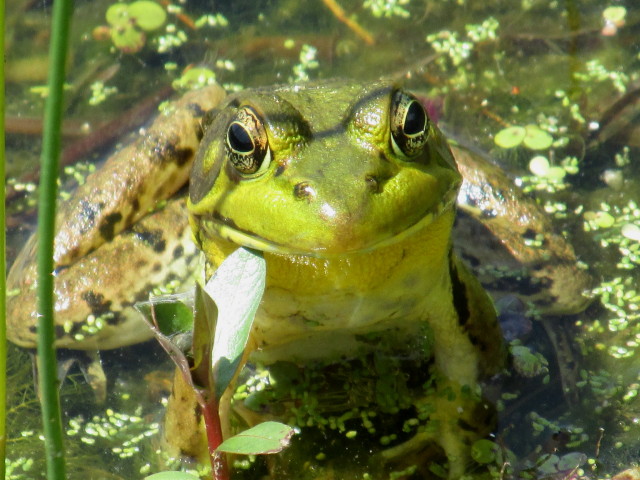
Green Frog photo by CAMP volunteer Lorraine Catt

Each spring, our Calling Amphibian Monitoring Project (CAMP) volunteers drive along a fifteen mile route after dusk, stopping at ten established stops along the route. They are hoping to hear the calls of some of New Jersey’s 17 species of frogs and toads. If they are lucky they’ll get to hear a chorus of several different species, sometimes so loud it’s almost deafening. Other times, they strain to hear a lone call from far away and many times they only hear the passing cars. It takes a dedicated volunteer to spend the time surveying and hearing only a few or no calls. But even the negative data is important, amphibians face many threats in New Jersey and establishing a long term database is key to learning about the population.


This season, twenty-one routes were surveyed and 16 of the 17 New Jersey frog and toad species were heard. The Eastern Spadefoot Frog was not heard this season. This year, the American Green Treefrog was recorded on one route in Salem County. This species of frog was first discovered in New Jersey in June 2011 in Salem County. The Northern Spring Peeper was heard on 19 out of the 21 routes, with Green Frogs heard on 15 routes and Northern Gray Treefrogs heard on 14 routes.

Gray Tree frog@ CAMP volunteer Marilyn Patterson
Gray Treefrog photo by CAMP volunteer Marilyn Patterson

There are 63 CAMP routes through out New Jersey. Currently 34 routes are available for the 2016 CAMP season. If you are interested in volunteering for the CAMP project, please contact Larissa Smith via email.


Learn more:


Larissa Smith is the Wildlife Biologist/Volunteer Manager for Conserve Wildlife Foundation of New Jersey.