Bahamas Revisited

Piping Plover Research and Conservation Five Years Later

by Todd Pover, Beach Nesting Bird Project Manager

CensusPine2


The wintering segment of the 2016 International Piping Plover Census has just wrapped up in the Bahamas. This marks six winters of my own involvement with piping plover conservation work in the Bahamas – starting with the last international census in 2011 – so I thought it would be a good time to reflect on the changes I have observed in the years between the censuses.


First and foremost, we now know much more about how many piping plovers winter in the Bahamas and where they are located, including some areas where there are particular high concentrations of piping plovers and other shorebirds. This knowledge is due to the significant increase in survey effort put forth by partners in the Bahamas during the census, but also surveys conducted by Bahamas National Trust and National Audubon Society, as well as our own work at Conserve Wildlife Foundation of New Jersey (CWF), in the years since 2011 to supplement the earlier surveys and better understand how piping plovers use the sites.

The author, CWF's Todd Pover, scoping out  piping plovers during the census.
The author, CWF’s Todd Pover, scoping out piping plovers during the census.


This is demonstrated by the results of the 2016 census. As just one example of how this extra research paid off, in 2011 when we visited Casuarina Point on Abaco for the census, we knew from local birders and e-Bird that piping plovers were frequently seen there, but not that it was only for a narrow window during low tide to forage, nor that depending on wind conditions or disturbance, they could be at another more remote flat across Cherokee Sound. So in 2016, we had surveyors in place at the correct tide AND in both locations at the same time, thus allowing us to record 26 piping plovers, instead of 0 in 2011. Using similar information gathered across the island we found 178 piping plovers in 2016, compared to 76 in 2011 (and 82 on Eleuthera in 2016 vs. 30 in 2011).

The CWF 2016 International Piping Plover Census team for Abaco and Eleuthera: Pam Prichard, Todd Pover, Stephanie Egger, Michelle Stantial, Emily Heiser, Brendan Toote (left to right).


Even with some oversights like those, the 1066 piping plovers tallied in the 2011 census revealed that the Bahamas was one of the most significant wintering locations for piping plovers, second only to Texas. And with band resight data, we now know that the Bahamas is THE most important winter location for the Atlantic coast population (as compared to the Great Lakes and Great Plains populations). Although the final count for the 2016 census is not complete yet, it has already topped the 2016 figure and will account for a good part of the remaining unknown wintering birds and locations. New surveys in the Turks and Caicos, more intensive surveys in Cuba, as well as the Southeast/Gulf Coast U.S. (which is critical for all three populations of piping plover) should make this the most comprehensive and informative survey to date.


While improved census results are important, one may reasonably still ask how the census is going to translate into better conservation. The Bahamas is a good example of what can be done with the data  last year the Bahamas government set aside the Joulter Cays as one of a series of new national parks, to a large degree based on its importance for shorebirds, especially piping plovers, as a result of information initially gathered from the census and follow-up surveys. This marked the first time shorebirds played a significant role in such a designation, so this is a watershed event for shorebird conservation in the Bahamas (and the Caribbean).


I have noticed other “sea changes” in attitude on a smaller scale. When I first visited the Bahamas (Abaco) during the 2011 census, aside for some birders, piping plovers were little known by the public there. Now when I come, I am recognized as the plover guy and piping plover bumper stickers can be spotted around the island on golf carts and trucks. There is even a new post card, entitled “Birds of the Bahamas” that has a piping plover side by side with a flamingo, the national bird. And there is refreshingly little of the rancor we sometimes have in the states over their protection – the habitats piping plovers use in the Bahamas, especially tidal flats, are also important for valuable resources, such as conch and bonefish, and other marine species, so protecting them is less of a conflict.

birds of the bahamas postcard


The important role the Bahamas plays in the piping plover life cycle is now much better known by the public and other stakeholders. Many of the participating partners have not only provided technical shorebird expertise during the surveys, but worked hard to provide education and outreach towards a long-term conservation goal. One area my colleague Stephanie Egger and I are most proud of in this realm is our Shorebird Sister School Network, where we pair up schools and students in the Bahamas and in New Jersey, using piping plover migration as the link. Now in its third year, this project is working to create a new generation of young conservationists (and piping plover lovers)!


This is not to say our work is done. There is still more to learn, a banding study is being conducted to help us better understand survival compared to other wintering (and breeding) regions, more detailed aspects of site fidelity, and how birds move around sites within islands. Still, piping plovers are no longer a novelty in the Bahamas as was largely the case when I first came in 2011. The challenge over the next five years will be how to harness the increased awareness and knowledge to aid recovery of this endangered species.


A special thanks to Friends of the Environment, who have been our piping plover partner on Abaco from the beginning, please check out all the great work they do! Also to the Disney Conservation Fund and The National Audubon Society for funding, as well as Bahamas National Trust for other support and the conservation work they do in the Bahamas in general. Thanks to the U.S. Geological Survey, sponsors of the International Piping Plover Census, for supporting CWF’s inclusion in the surveys. Thanks to Rolling Harbour Abaco for setting up the Abaco Piping Plover Watch this winter to help us keep track of piping plovers and raise local awareness. Thanks to those who participated in the CWF led 2016 census on Abaco and Eleuthera: Brendan Toote, of the College of the Bahamas, Michelle Stantial, of SUNY – ESF, Pam Prichard, and CWF’s own Stephanie Egger and Emily Heiser. And finally, thanks to our local citizen scientists on Abaco who participated in or provided valuable knowledge for the 2016 census, especially Ali Ball, our “super” volunteer!


Learn More:


Todd Pover is the Beach Nesting Bird Project Manager for Conserve Wildlife Foundation of New Jersey.

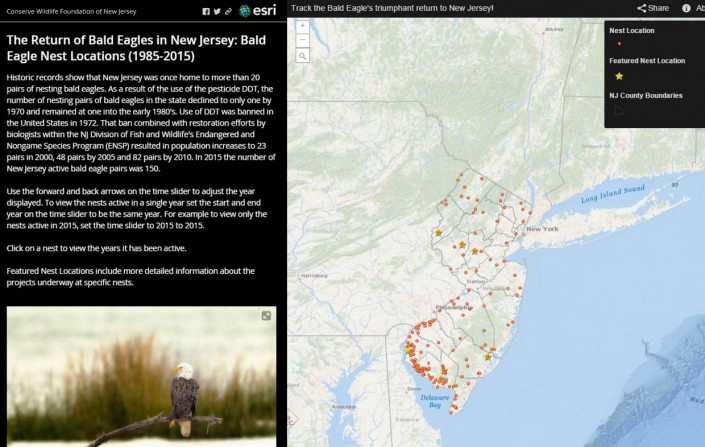
Track the Bald Eagle’s Triumphant Return to New Jersey

Updated Story Map Showcases Bald Eagle Nest Locations from 1985-2015

by Brian Henderson, GIS Specialist

Photo by Northside Jim

Our story map The Return of Bald Eagles in New Jersey has been updated based on the 2015 Bald Eagle Project Report. The story map shows the locations of every eagle nest known to be active (meaning they laid eggs) in New Jersey since 1985  — the year when there was only a single nest in the entire state. The map presents an animated depiction of where eagles have nested each year, so you can track the bald eagle’s triumphant return to the Garden State! Viewing the animation shows you how eagle nests spread from a single point in Cumberland County across all of New Jersey through the years.


The story map also highlights a number of Feature Nests which include more detailed information about the projects underway at specific nests, such as the Duke Farm nest which has been featured on our EagleCam since 2008.


The number of nesting pairs of bald eagles has steadily increased each year. This trend continued in 2015 with a record 150 active pairs, which was a slight increase over 146 such pairs recorded in 2014. In 2015, there were 122 nests that successfully  fledged at least one young compared to 115 successful nests in 2014 and the 199 total young fledged in 2015 was only slightly less than the record 201 young fledged in 2014.


Learn More:


Brian Henderson is the GIS Specialist for Conserve Wildlife Foundation of New Jersey.

Shutterbugs: “For the Love of Wildlife” Photo Contest Now Open!

Conserve Wildlife Foundation’s “For the Love of Wildlife” Photo Contest will run from February 12, 2016 to March 25, 2016

by Lindsay McNamara, Communications Manager 

Photo contest promo2

New Jersey might be the most densely populated state, but it is also home to a diverse array of wildlife. From bobcats in the north to Eastern tiger salamanders in the south, many different species of wildlife live in the variety of habitats found in New Jersey. Our photography contest is meant to showcase the love for and need to protect the endangered and threatened wildlife that call New Jersey home.


The “For the Love of Wildlife” Photo Contest is free to enter! Two grand prize winners — one youth and one adult winner — will receive $250. The People’s Choice Winner will win a canoe trip for two on the Batsto River in Wharton State Forest courtesy of Pinelands Adventures.


Submit your photos by 8 PM on Friday, March 25, 2016 in the following categories:

  • New Jersey’s Rarest Residents: Endangered and Threatened Wildlife Species Only
  • The Garden State: New Jersey Landscapes
  • Experiencing Nature: People Enjoying the Outdoors
  • Wild New Jersey: All Animals in the Garden State


For official contest rules and entry form, visit Conserve Wildlife Foundation’s website.


Lindsay McNamara is the Communications Manager for Conserve Wildlife Foundation of New Jersey.


CWF Headed to Honduras to Study Golden-winged Warbler

CWF biologist Kelly Triece to visit Honduras to observe Golden-winged Warblers in their Wintering Habitat

by Kelly Triece, Private Lands Biologist

Golden-winged Warbler. Photo by D. Kenny Golden.

CWF is headed down to Central America to see one of New Jersey’s native songbirds! This time of year the Golden-winged Warbler (GWWA) is in Central and South America. The GWWA is Neotropical Migrant songbird that breeds in New Jersey, but migrates south for the winter. This songbird is a species of special conservation concern in the U.S. and endangered in New Jersey, experiencing population declines due to loss of young forest habitat.


Conserve Wildlife Foundation biologist Kelly Triece will be traveling to Honduras next week to observe the GWWA in its wintering habitat. While she is there, she will be learning more about the wintering habitat requirements of the Golden-winged Warbler as well as the current threats and challenges facing the species in this part of the world.

Young forest habitat managed for Golden-winged Warbler. Photo by Kelly Triece.

The management of early successional habitat, or young forest habitat, is important in New Jersey because it provides breeding habitat and post-fledging habitat for the Golden-winged Warbler. In the past 30 years, over 11,000 acres of upland shrub and emergent wetland habitat have been lost to succession in New Jersey.


Today, 80% of New Jersey forests are between 60-99 years old, while only 5% of the forests are between 0-19 years old. In a naturally occurring system, where fire, wind, flooding and other disturbances are not controlled by humans, this age class would be more evenly distributed. Through management and proper forestry techniques, more diversity can be created to balance the age of the forest.


The Golden-winged Warbler is not the only scrub-shrub dependent bird species considered to be at-risk. About 85% of shrub obligate birds and 35% of forest birds are on the decline in North America. Some of the declining species are Prairie Warbler, Field Sparrow, Northern Bobwhite and American Woodcock. Additionally, woodland breeding birds are also at risk because many rely on young forest habitat for post-fledging. Therefore, the management of young forest habitat is not only specific to the Golden-winged Warbler, it is also important for many other avian species. Furthermore, other wildlife such as insects, reptiles and mammals will benefit from increased flowering plants and foraging habitat.


CWF and our partners Natural Resources Conservation Service, New Jersey Division of Fish and Wildlife and New Jersey Audubon Society have worked with private landowners to create or restore over 225 acres of Golden-winged Warbler habitat since 2012 in New Jersey. Our managed forests have a statistically significant higher diversity of birds than unmanaged sites!


Stay tuned for Photos from the Field next week as Kelly travels to Central America!


Learn More:


Kelly Triece is the Private Lands Biologist for Conserve Wildlife Foundation of New Jersey.

Volunteers Wanted! Amphibian Crossing Project

Interested in Helping Amphibians Cross the Road this Spring?

by Kelly Triece, Private Lands Biologist

Spotted Salamander Crosses a busy road to reach a nearby breeding pool. Photo by Kelly Triece

Amphibians, our harbingers of spring, are soon to be calling in the swamps, pools and woodlands of New Jersey. Thousands of salamanders, frogs, and toads make short, stealthy migrations through the forest to breed and lay their eggs in breeding pools every spring.


However, vehicle mortality during amphibian migration season is a big issue for small animals like amphibians. A single vehicle can harm dozens of the slow-moving animals as they try to cross the road during migration. High traffic volumes can wipe out entire populations over time. For Conserve Wildlife Foundation biologists, this means we will be out on the roadways helping secure safe passage for these amphibians.


Since 2002, we have worked to protect early-spring breeding amphibians like the wood frog, spotted salamander, Jefferson salamander, and spring peeper during their annual migrations. Last year at our biggest Amphibian Crossing site, we assisted 2,684 Spring Peepers, 1,100 Spotted Salamanders, 270 American Toads, 139 Wood Frogs, 95 Jefferson Salamanders and 18 Red-spotted newts cross the road!


The Amphibian Crossing Project relies on volunteers like you. Amphibian migration is completely weather-dependent, but usually occurs between March and April, three-five nights a year. We work in evening shifts and scan the road for crossing amphibians, record species, and number of animals crossing.


If you are interested in volunteering with our Amphibian Crossing Project at locations in North Jersey, please contact Kelly Triece. Volunteers must be 18 years or older.

A volunteer assists in CWF Amphibian Crossing Project. Photo by Kelly Triece.


The Amphibian Crossing Project aims to secure funding for amphibian crossing tunnels at two priority sites. This is part of a larger effort led by the Division of Fish and Wildlife called Connecting Habitat Across New Jersey (CHANJ). CHANJ aims to identify key areas and actions needed for preserving and restoring habitat connectivity for terrestrial wildlife in New Jersey.  CHANJ has the potential to increase the sustainability of New Jersey’s terrestrial wildlife populations and de-list endangered species. #CHANJiscoming


Stay tuned as the amphibian attempts to cross the road once again!


Learn More:


Kelly Triece is the Private Lands Biologist for Conserve Wildlife Foundation of New Jersey.

Puzzle Pieces: Connecting Habitat for New Jersey’s Wildlife

Connecting Habitat Across New Jersey (CHANJ) and Strategic Habitat Conservation

by Kelly Triece, Private Lands Biologist

A spotted salamander, photographed during a quiet moment along the road shoulder. © Brett Klaproth

In New Jersey and throughout the world, almost every ecosystem is under some degree of disturbance caused by human impact. In particular, urbanization and deforestation often have negative consequences on ecosystems because they typically lead to overall habitat loss. A reduction in available habitat creates habitat fragmentation, where an ecosystem becomes segmented and broken apart. Habitat fragmentation can have multiple negative effects on wildlife, including dispersal, genetic isolation, and community structure impacts. Here in New Jersey, wildlife species are up against steady urbanization and a dense network of roads compromising the connectivity of habitat and wildlife populations. Today, the state of New Jersey remains the most densely populated state in the country occupying about 39,000 miles of public roads.

Connectivity is vital for wildlife. Different color habitat patches represent different resources essential for survival. Lines represent possible corridors connecting patches.

In order to maintain diversity and sustain healthy wildlife populations, we must connect various fragmented habitats and wildlife communities. Animals need to be able to move through the landscape to find food, shelter, mates, and other resources. Without that ability to move, healthy populations cannot persist over the long term. In order to curb the effects of roads and habitat fragmentation, wildlife road crossing structures can be installed to reduce wildlife road mortality. In addition, wildlife habitat corridors can be prioritized for land management, restoration and acquisition.

Wildlife Crossing Tunnels like this along with fencing reduce wildlife road mortality ©Kelly Triece
Wildlife Crossing Tunnels like this along with fencing reduce wildlife road mortality © Kelly Triece

What is New Jersey doing to create habitat connectivity for our state’s diverse wildlife?

Connecting Habitat Across New Jersey (CHANJ) was formed in 2012 by the Division of Fish and Wildlife, with the vision of making our landscape and roadways more permeable to wildlife movement. CHANJ represents a blueprint for strategic habitat conservation that will identify key areas and the actions needed for preserving and restoring habitat connectivity for terrestrial wildlife in New Jersey. CHANJ has the potential to increase the sustainability of New Jersey’s terrestrial wildlife populations and de-list endangered species. Connecting populations of wildlife will improve gene flow and allow wildlife to move freely throughout the landscape.


How can you help?

  • Be mindful of wildlife while driving: Peak wildlife crossing season occurs in the spring and summer as wildlife travel to find food and mates. If wildlife such as amphibians and turtles are on the road, safely pull over and carry them to the shoulder in their direction of travel. Always be mindful of safety and do not attempt to handle any wildlife if you are not comfortable.
  • Create wildlife friendly backyard habitats: learn more on Conserve Wildlife Foundation’s website.


Kelly Triece is the Private Lands Biologist for Conserve Wildlife Foundation of New Jersey.

Photos from the Field

Productive Trip to North Jersey Falcon nests

by Ben Wurst, Habitat Program Manager

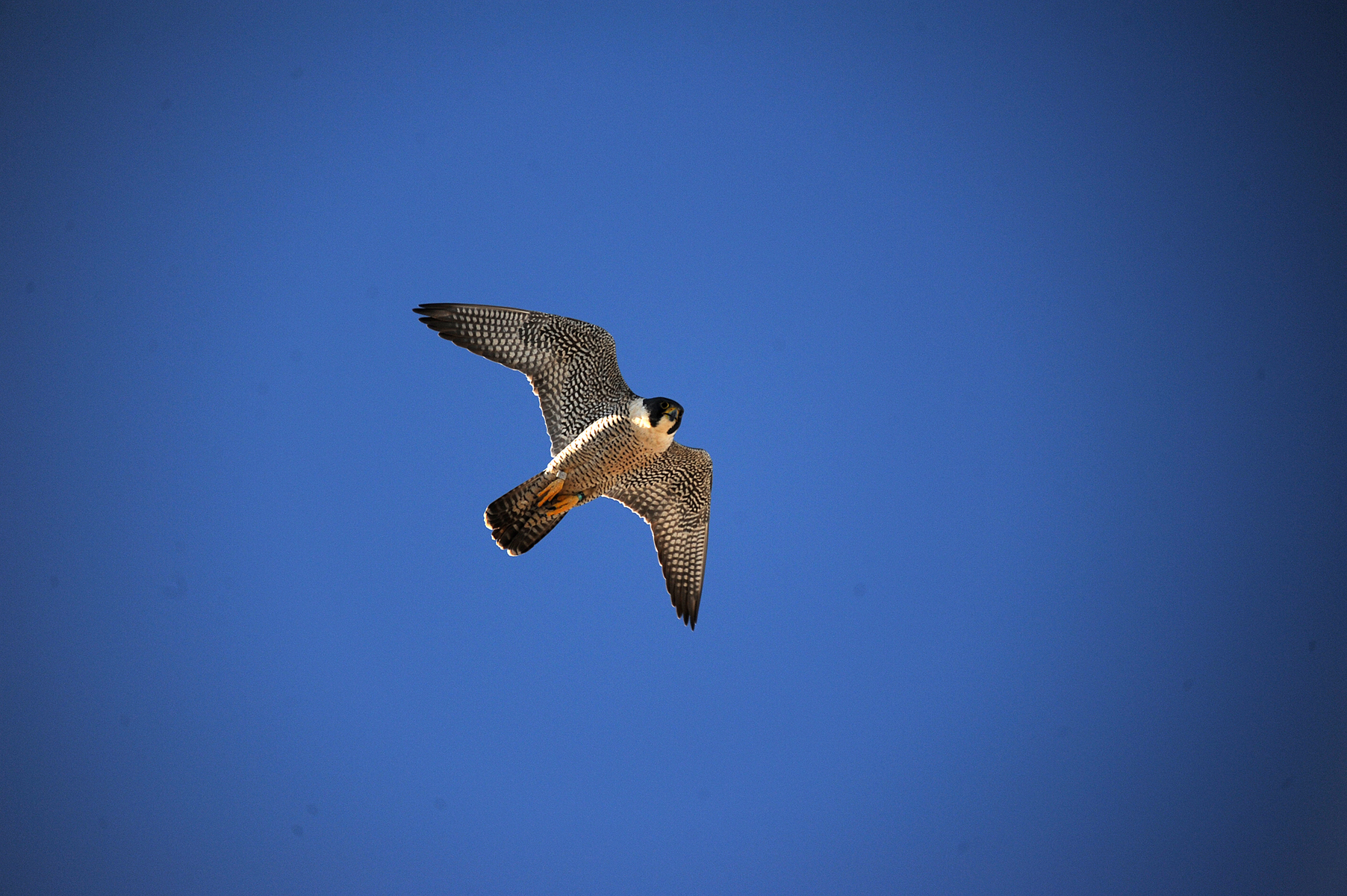
Kathy Clark, ENSP Wildlife Biologist and myself made use of our trip to North Jersey on Tuesday. Both being based out of S. Jersey, we try to maximize our productivity and time spent up north. We visited a total of three peregrine falcon nest sites to conduct winter maintenance at them. Winter maint. is in preparation for the start of their nesting season, which usually begins in mid-late March. Eggs are usually laid in late March-early April. On the list for usual maint. (which we do at over 12 nest sites throughout NJ) is to refresh gravel, treat for parasites, and check condition of predator guards (for those sites on former hacking towers). At the sites we visited yesterday, we had some additional work.

Our first stop was at the Union County Courthouse in Elizabeth. While fixing up the nestbox on the roof, we also helped with the installation of a new pinhole camera that was installed on the inside wall. The camera, paid for and installed by Union County, will stream online soon. CWF will help to promote the camera and our own Peregrine Falcon Cam curriculum. The female that nests here was not seen as we would have known since she is overtly aggressive to anyone who climbs onto the roof there. It could be the same female but it was odd that she was not seen at all. In addition, Kathy photographed the male who is banded (likely in NY – you can tell by the silver band he wears – we use black in NJ). The previous male was not banded. So, there could be a whole new pair here. Only time will tell if this site will be active this year. Having the camera there will help biologists learn about the turnover and if eggs are in turn laid by the female.

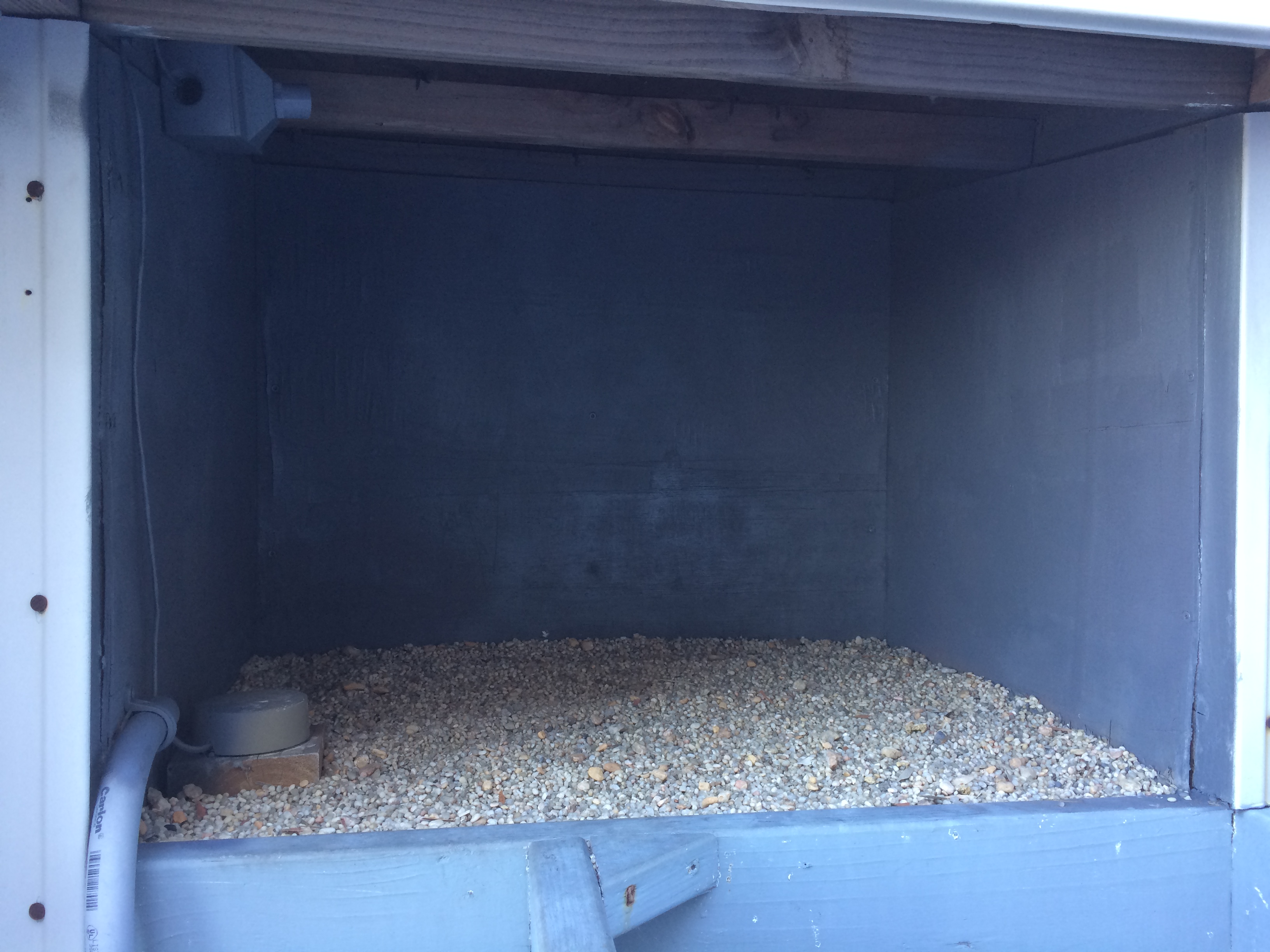
Second, we visited the Jersey City eyrie. There we removed the pinhole camera to get repaired/replaced. Then we painted the inside of the nestbox, which was showing its age and a good covering of guano. The female Juliette was there and not quite sure of our presence. Since she has not nested here yet, she does not attribute our presence with any kind of disturbance. This will change when she has young to protect.

Our last visit was to the PSE&G Sewaren Generating Station. Here we moved a new nestbox from one building to another. The story of this site is where young falcons were found on the ground after attempting to fledge a few years ago. Their nest site was found to be in an old and unused duct which was accessed by an open window on the north side of the building. Then last year the pair attempted to nest on a tiny ledge on the south side of the building, but the nest was flooded. Our site visit revealed that there was a suitable ledge above the tiny ledge and we moved the nestbox here. This will give them the best chance of successfully raising young. PSE&G staff were very willing to help and are proud that their generating is home to a pair of nesting falcons!

Cameras/photography can be used to document new birds at nest sites. This is a new male peregrine falcon (yet to be ID'd) at the Union County Courthouse. The previous male was not banded. Photo by Kathy Clark/ENSP
Cameras/photography can be used to document new birds at nest sites. This is a new male peregrine falcon (yet to be ID’d) at the Union County Courthouse. The previous male was not banded. Photo by Kathy Clark/ENSP
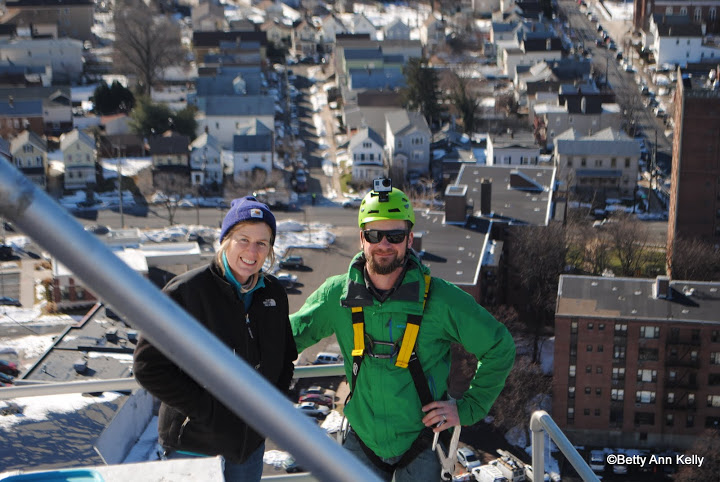
Kathy and I atop the Union County Courthouse. Photo by Betty Ann Kelly.
Prey remains atop the Union County Courthouse. Can you ID it? Photo by Ben Wurst
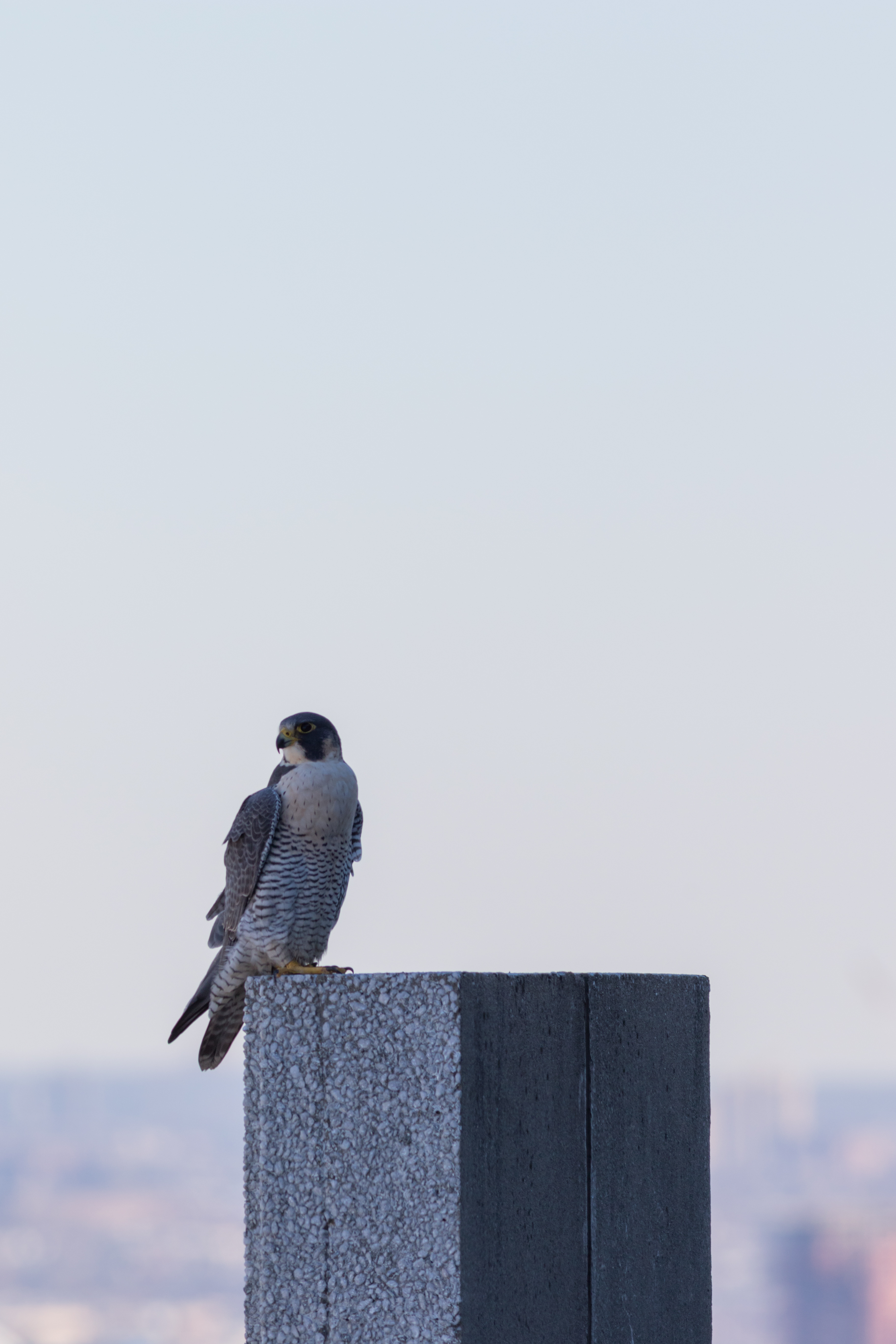
Juliette on a perch atop 101 Hudson St. Photo by Ben Wurst
The inside of the Jersey City nestbox got a new paint job.
Our last stop of the day was at the PSE&G Sewaren Generating Station where we moved a nestbox to a new location at the plant. It was placed directly above a narrow ledge that the birds nested on last year. Photo by Ben Wurst

Conserving Barn Owls in the Garden State

Insight into a Nocturnal and Enigmatic New Jersey Raptor

by Melanie Mason, Assistant Biologist

800px-Barn_Owl_-_Abingdon_2013_(8731175397)

Barn Owls (Tyto alba) are one of the most widespread avian species in the world. Despite this impressive distribution, their numbers have been decreasing in parts of their range, and New Jersey is no exception. The extent of their decline isn’t fully known since barn owls are nocturnal and enigmatic, so it’s difficult to estimate their numbers. Although barn owls can travel great distances to disperse after fledging and to find prey, they don’t truly migrate. Therefore, there isn’t a breadth of migration data to sift through in order to triage their downward trend either.


The first step in species conservation is to understand its biology. Because barn owls aren’t migratory, they don’t have the intense energy requirements needed to fuel long distance treks to warmer climates, but the trade-off is they are at the mercy of their local prey abundance and availability. If you look at a distribution map of North American barn owls, you’ll see that New Jersey is close to the northernmost extent of their range. In fact, the majority of their subspecies/races are found in lower latitudes. Unlike their tropical kin, however, northern owls have to frequently survive freezing conditions and in order to do so, need food and lots of it!


Catching enough prey through New Jersey winters can be a challenge in and of itself, but if owls lack sufficient fat stores because of an unfavorable prey year (think hurricanes, floods, droughts, etc), they can easily succumb to cold conditions and die from exposure. The reality is that many young owls do not survive their first winter — a very steep learning curve.


Their preferred prey is meadow vole which are close relatives of lemmings — made famous for their explosive populations during favorable years. In order to respond to sweeping changes in prey availability, the reproductive strategy of barn owls is atypical for most raptors. Where small clutches and high parental investment are the norm, instead, barn owls are capable of breeding year round in favorable conditions (generally fall/spring here in New Jersey) and can have large clutches in order to respond quickly to prey availability. Another uncommon and well-documented strategy is polygyny — where one male sires and provides for multiple nests.


These reproductive strategies are important since barn owls are not a long lived species and typically do not survive much longer than five years. Their saving grace is their ability to “bounce back” and quickly repopulate local areas. This is where we can help!


Barn owls get their name from their close association with humans. They hunt in marshes, fields and grasslands typically favored for agriculture. They frequently nest in structures like old barns, buildings and silos. Constructed structures such as barns and nest boxes are generally preferred over natural cavities (dead or hollow trees for example) because they are safer from predators, more protected from the elements and have a vast supply of mice and voles at their doorstep. As silos and old barns fall down or are torn down in favor of newer, longer lasting metal structures, these nest boxes are even more critical to provide nesting opportunities.


The goal of our barn owl project is to provide safe nesting structures for barn owls in suitable habitat throughout the state. We also hope to gain insight into owl occupancy and nesting success in previously un-monitored areas of New Jersey.


Four ways to help barn owls:

  • Report any sightings, any time of year. While we are most interested in bolstering the breeding population, identifying winter habitat is critical as well.
  • Barn owls are better for the environment than barn cats since they are native and don’t kill songbirds, so consider housing barn owl instead! They’ll alleviate your rodent problem without the cost of feeding and risk of unwanted litters.
  • Don’t use rodenticides! They can harm or kill barn owls (and many other species too), plus owls often do a better job than poisons and are safer for everyone.
  • Know a potential location or just want to learn more? Email me at melanie.mason@conservewildlifenj.org. I want to hear from you!


The generous support of Washington Crossing Audubon Society provided quite literally the nuts and bolts of the fledgling nest box project by facilitating purchase of supplies for nest box construction — a million times thank you!


Learn More:


Melanie Mason is the Assistant Biologist for Conserve Wildlife Foundation of New Jersey.

Removing Harmful Microplastics from New Jersey’s Waterways and Wildlife

Nation Follows New Jersey’s Lead in Banning Microbeads

by Jake Levine, Intern

microbeads01

Have you ever used a skin-care product with those “exfoliating” beads? Have you ever used toothpaste that guarantees a brighter smile with its “abrasive” powers? The small plastic microbeads found in those products — and many other cosmetics — are polluting waterways and affecting wildlife. These small plastic microbeads are all less than five millimeters in size. Although they are tiny, they can have some colossal impacts on the waterways and the wildlife that inhabit these ecosystems.


What makes these microbeads so detrimental to the waterways and wildlife is its chemical composition. Commonly called plastic, polymers have been one of the most revolutionary creations in industry. They are strong, lightweight, and last a lifetime… literally. A key characteristic of polymers is long decomposition rate. Instead of naturally breaking down, they photo-degenerate, which means they absorb sunlight to break apart. When found in waterways, the rate that they break down is much longer, since the surrounding water keeps the microbeads cool and can redirect the sunlight. In animals that depend on waterways for food, these microbeads put up a fight against their digestive systems. These polymers do not break down in their digestive systems, which can pose a serious health risk to wildlife.


In a standard food chain, the smaller organisms make up the foundation. This foundation provides the energy and nutrients needed to fuel the rest of the food chain. With the introduction of microbeads into waterways, the foundation of the food chain now also contains microbeads. Since microbeads are made of polymers, they offer no nutritional value to any of the organisms that consume them. In addition to not being able to decompose or break down in wildlife, these small pellets can quickly cumulate inside animals, leading to fatal health issues.


So what is being done about the microbead issue? In 2015, legislators passed a bill that will prohibit the selling and distributing of these products that contain microbeads, and you can thank New Jersey for leading the charge! The “Microbead Free Waters Act of 2015” will ban the manufacturing, introduction, or delivery for introduction into our commerce of products that contain intentionally-added microbeads. The ban on the manufacturing will begin on July 1, 2017, while the ban on commerce will begin July 1, 2018.


The ban is one step, but I am anticipating it to lead to something bigger towards the recovery of the waterways and the environment.


Learn More:


Jake Levin is an intern for Conserve Wildlife Foundation of New Jersey.

NJDEP Closes Remainder of Terrapin Hunting Season

Urgent Protection for an Under-served Species in New Jersey

by Ben Wurst, Habitat Program Manager

An adult female terrapin on the edge of Great Bay Blvd in Little Egg Harbor, NJ. Photo by Ben Wurst

Northern diamondback terrapins are considered a GAME SPECIES in New Jersey. It is (or was) legal to harvest any number of terrapins from New Jersey waters during their hunting season from November 1 to March 31. There were no permits, bag limits or reporting of catches, but they had to be caught by hand (using a rake or similar device). It must have been assumed that no one considered them a valuable species to catch since their value as a food source has diminished, but that is not the case and is why the New Jersey Department of Environmental Protection Commissioner Bob Martin signed an Administrative Order closing the remainder of the commercial harvest season this year. This is the second year that the season has been closed using an Administrative Order, and is a good reason for NJDEP to take terrapins off the game list and designate them as a non-game species.

“The diamondback terrapin has long been special to many people who live in or and visit our coastal communities,” said Commissioner Martin. “Many people have dedicated countless hours to protecting its habitats and raising awareness about this unique species. We need to ensure the terrapin remains part of our coastal ecosystem.”

Unfortunately, terrapins have been an under-served species for a long time in New Jersey. As a former major food source for Native Americans then European settlers, their population has only narrowly avoided being extirpated from our waters by their over exploitation in the late 19th century. Currently, their hunting season is full of unknowns and not one biologist in New Jersey can tell you the actual size of the population. Besides being hunted in winter, terrapins face a huge amount of threats (listed in order of severity): collecting for the pet and food trade, drowning in ghost crab pots, road mortality, habitat loss/shoreline hardening, collision with boat props and hulls, and predation. With all of these threats in their environment and not knowing the current status of their population, taking no action would be a huge mistake. Terrapins are not equipped to reproduce quickly and sustain their population when there are large (and unnatural) sources of mortality. They have very slow reproductive rates and very high mortality rates. Adult females do not reach sexual maturity until they are around 9-10 years old. In addition, only around 1-3% of terrapins are believed to live to adulthood. Recent studies have shown that adult females are becoming smaller and less numerous.


Terrapins do occasionally nest at night. Photo by Ben Wurst

We’ve seen far too many terrapins face terrible deaths from our way of life. This is why we are leading many grassroots conservation efforts to protect terrapins in New Jersey. Since 2009, Conserve Wildlife Foundation of New Jersey has worked tirelessly to help reduce the amount of diamondback terrapin road-kills, to more accurately map their range, and to educate the public about their threats in the environment in the Great Bay and Barnegat Bay watersheds as part of the Great Bay Terrapin Project. Over the past 5 years we have cut the mortality rate of adult females in half to only 4% of adults that attempt to cross Great Bay Blvd. in Little Egg Harbor Twp. In 2015, with help from numerous dedicated volunteers, we documented a total of 906 individuals. Read our full report from 2015!


In 2015, we received 1,291 observations (not include our own) from various partners including a few from the public. Terrapins are extremely under reported from the general public. Most of the sightings that we get are not dispersed enough for them to be used to accurately depict their presence in their historic habitat throughout New Jersey. When they’re active during summer months the public is urged to report sightings of terrapins.


Lastly, we are the project leader for the development of a regional, multi-state strategy for Northern diamondbacks aimed at achieving long-term sustainability for terrapins throughout the Northern and Mid Atlantic Region (35 partners/8 states).  We are also working with various partners and have gotten a grant from NOAA to find and remove ghost crab pots on Barnegat Bay, which is a huge threat to terrapins and other aquatic marine life.


Some more good news. This past month, the Endangered and Nongame Species Committee voted to accept the Delphi designation of “Special Concern” for the species. We sincerely hope that legislation to remove terrapins from the game list will not be delayed any longer.


Learn More:


Ben Wurst is the Habitat Program Manager for Conserve Wildlife Foundation of New Jersey.