Beachnester Buzz: Drum roll please, the 2016 breeding results for beachnesters are…

NEW, WEEKLY UPDATES FROM NEW JERSEY’S BEACH NESTING BIRD PROJECT TEAM

by Todd Pover, Beach Nesting Bird Project Manager

There are many ways to gauge success for our beachnesting bird project. We look at how well our management tools work, the effectiveness of our partnerships, and how well our educational efforts work, to name a few qualitative measures we use. At some point, however, it comes down to cold hard numbers, how well did the birds do in a particular season and over the long-term. We are at that point in the season, and for the most part, I am happy to report it has been an excellent breeding year. I will caution that these are still preliminary figures, some quality checking of the data needs to be done before they are final, but the trends are clear.

One of a "bumper crop" of piping plover fledglings produced in New Jersey in 2016. Photo courtesy of Kevin Knutsen.
One of a “bumper crop” of piping plover fledglings produced in New Jersey in 2016. Photo courtesy of Kevin Knutsen.

First up are piping plovers. We will come in at ~115 pairs statewide, up modestly from the 108 pairs in 2015, and the second consecutive year of an increase after hitting our historic low of just 92 pairs in 2014. So, we have climbed back closer to our long-term average, but there is still room to improve. The really good news is our productivity this year – close to a statewide record at 1.37 chicks fledged per pairs – puts us in the position to continue our population increase. If trends hold, because piping plovers demonstrate high site (or region) fidelity, when we produce a lot of fledglings, our breeding population rises in the next year or two. With three straight years of well above average fledgling rates for New Jersey now in the books, our prospects look good in the short term for our breeding population levels.

Least terns and black skimmers, which nest in colonies, sometimes numbering hundreds (or even thousands), are more challenging to count and assess, but we had at least modest success this year for both species. As is typical, our least tern colonies were variable, with some completely failing and others being highly productive. The Monmouth County region, one of our strongholds for least terns in New Jersey, didn’t have one colony that was a standout but most of them had at least some success. In South Jersey, our two largest colonies at Holgate (EB Forsythe NWR) and Seaview Harbor were very successful and helped make up for losses and failures at other colonies. The majority of our state’s black skimmers are concentrated in one large colony at Seaview Harbor, and although skimmers are our latest nesters (so the season isn’t quite over for them), they appear to have been very successful there, which means a good season overall for the state.

We also track American oystercatchers, although only for the portion that nest on the barrier beaches and spits. Because the biggest percentage of oystercatchers in the state nest on back bay and marsh islands, we cannot determine true statewide population or productivity levels, but the population on the beach habitat appears to be rising in recent years. Typically breeding success is lower for oystercatchers on the beach habitat due to high levels of human disturbance and predators, but productivity has been relative high the past two years. Of particular note this year was Stone Harbor Point, where a record number of 27 pairs nested and produced over 30 fledglings.

The reality is our beachnester staff works just as hard in years when the birds do poorly, as when they do well like this year, but it is SO much more rewarding when we have a good season. So as we wrap up the season, we are all feeling in a bit of a celebratory mode now!


LEARN MORE


Beachnester Buzz: A Day in the Life of a Beachnester

NEW, WEEKLY UPDATES FROM NEW JERSEY’S BEACH NESTING BIRD PROJECT TEAM

by Todd Pover, Beach Nesting Bird Project Manager


For this week’s installment, I thought it would be fun to have you tag along with me on a day in the field, so you can get a sampling of what goes into our beach nesting bird program. Let’s call it, “A Day in the Life of a Beachnester.”


skimmer
Black skimmer and chicks at our Belmar colony where we recently banded the young before they could fly. Photo courtesy of Jersey Shore Photography.

Today it is an early 4 am rise to beat the beach crowds and heat, as we are banding black skimmers at our Belmar colony. This is the first time our program has banded skimmers –  it is a collaborative effort with other organizations/agencies in both New York and New Jersey – we hope to find out more about their survival, longevity, and movement, both local and long distance. Everything goes well, we are able to corral and band about 35 chicks in less than an hour. This part of the day represents the science portion of the beach nesting bird project, science for the sake of study and a better understanding of our birds, but more importantly to gather information to help us manage and recover endangered species.


With no time to spare, it is now off to Leonardo along Sandy Hook Bay where CWF is hosting a summer wildlife experience for kids. No surprise, I am the guest today to teach the kids about beach nesting birds. I explain why piping plovers and American oystercatchers are at risk, and then give them a chance to use a high powered birding scope to try to read bands I have placed on decoy birds. We definitely have some budding biologists in the mix. Education is key to our project, unlike other endangered species that mostly live out of sight or reach, beachnesters spend the breeding season on the same beaches visited by millions of tourists and residents. If they are going to learn to “share the shore” with our endangered birds, outreach is essential.


beachnester buzz plant
Sea beach amaranth, a rare plant, that shares the beach with our nesting shorebirds and also is protected.

Next up is a stop at Seven Presidents Oceanfront Park, one of our important nesting areas in Monmouth County. For most of the season we are erecting and adjusting fence to protect nesting areas, but today we are working with the park to reduce the fence, as many of our birds have successfully nested and started to leave the area. First we count and locate any remaining least terns – these surveys are the base of our project – we need this data to track population trends and seasonal productivity as metrics of progress towards recovery. Before we remove any fence at this site, we also conduct surveys of sea beach amaranth, an endangered plant that shares the beach with our nesting birds. We locate a few plants and that dictates how we readjust the fence, the plants need protection from trampling by beachgoers or vehicles used by the park to maintain their beach.


Coordination with municipalities or other land owners that host beach nesting birds is a critical part of our project, as their activities can impact nesting success as much as beachgoer’s recreational use of the beach. So there is one more stop today to assess whether a maintenance request can be granted in a way that won’t put birds at risk. That done, it is time to start the two hour drive back to our office in Cape May County. I am ready for a nap, but no luck, as the truck becomes a mobile office to take care of other unattended business (while someone else drives of course). There are calls with several other towns, check-ins with our seasonal staff members that are spread out all along the coast, and finally dealing with a broken down vehicle (not ours fortunately) and a person who refused to take their dog off a nesting site.


Back at the office, it is one last check of email, entering a little bit of the data we collected today, and finally time to head home. Every day is a little different, but this day has been a good cross-section of the range of things we do on the project. It is tempting to think we just pop up fence and signs and hope the birds do well, but protection and recovery of our endangered beach nesting birds requires a comprehensive strategy addressing all the factors that impact nesting success.


LEARN MORE


NJTV News: CWF’s Pover Discusses Piping Plover Conservation

by Emily Hofmann, Assistant Communications Manager


todd on njtv news


Todd Pover, CWF’s Beach Nesting Bird Project Manager, recently sat down with NJTV’s Mary Alice Williams to discuss piping plover conservation on the anniversary of 30 years of federal listing. Listen in to what he had to say.


LEARN MORE


New Jersey’s Hidden Coast – The Final Episode

NEW JERSEY’S HIDDEN COAST – EPISODE 6

by Emily Hofmann, Assistant Communications Manager


“Our work on the bayshore is not just about wildlife, it’s about people, and how keeping nature strong keeps us all strong in the face of disasters like hurricanes.”


We want to ensure that New Jersey’s Hidden Coast remains a vital part of our livelihood for generations to come.


This is the final episode to our video series, “New Jersey’s Hidden Coast.” Catch a glimpse of the Bay, the horseshoe crab at the center of the bay’s system, and the incredible relationship between horseshoe crabs and migratory birds, like the red knot. We reveal the real value of horseshoe crabs, the challenges to the ecosystem, and the potential for thriving regional economy along the bayshore. We will show Hurricane Sandy as a catalyst for decisive action and the work being done to rebuild the area for both people and wildlife.


Catch up on the previous episodes, here on our blog or on YouTube. Explore the use of “living shorelines” instead of bulkheads and the importance of marshes to the marine ecosystem. Discover the on-the-ground, grassroots efforts of the community to build oyster reeds alongside veterans. And examine the future of the Bay and the work that needs to be done to preserve our conservation successes year after year.


Discover Delaware Bay:


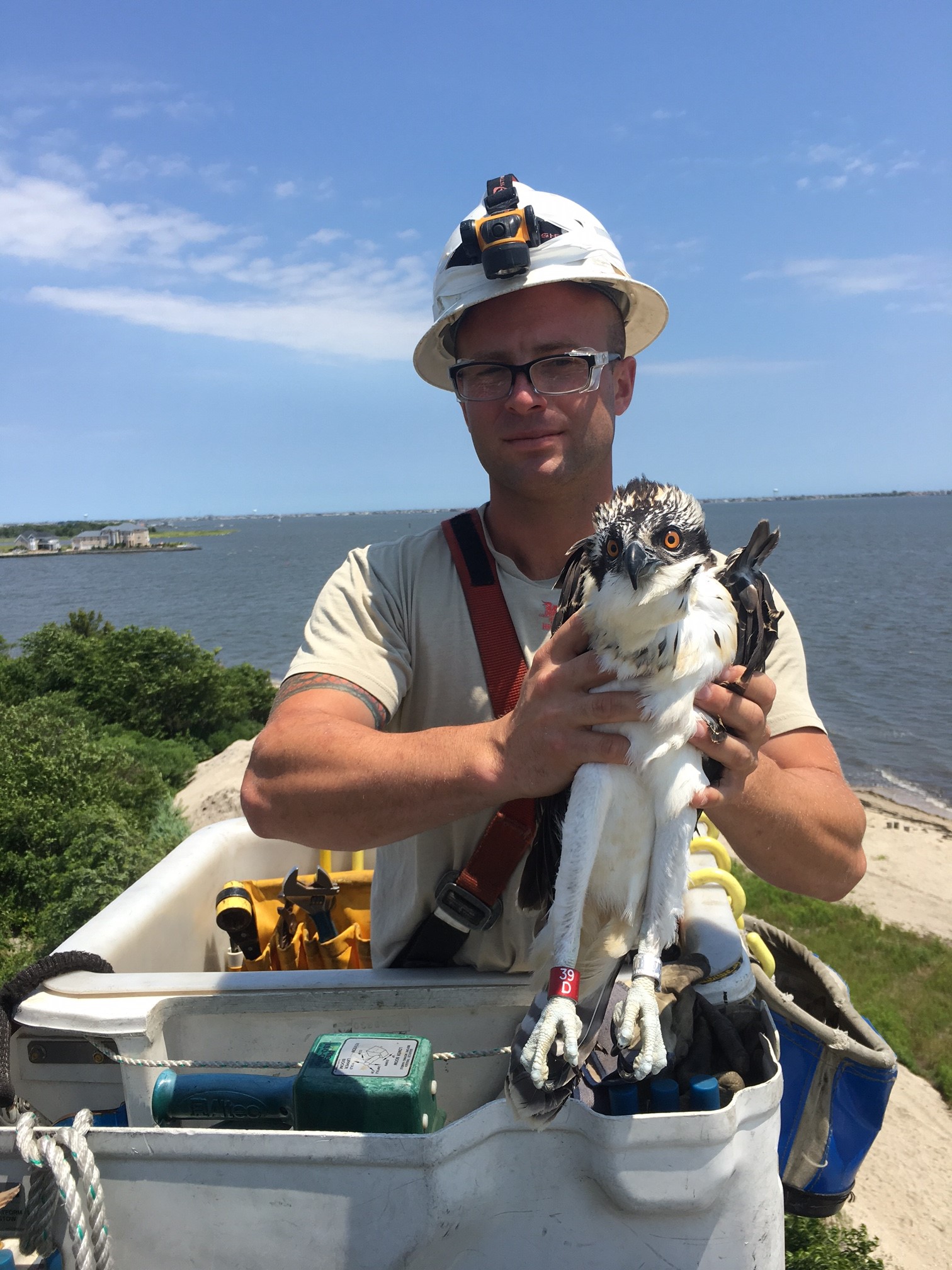
A tribute to osprey 39/D

Project RedBand alumni update 
by Ben Wurst, Habitat Program Manager
39/D being rescued on July 13, 2016. Photo by Bonni Myszka.
Ospreys are in the news again. This time it is not so pleasant news, or at least news that is hard to swallow for some, where an adult bald eagle predated a young osprey at Hog Island in Bremen, Maine. While it can be a traumatic thing to witness firsthand, it is pretty common where the range of ospreys and bald eagles overlap. We are only witnessing it because of technology. It can and has happened right here in New Jersey too. Last year, I found an adult female who had lost her wing. With no other way for that to happen (on the open saltmarsh, and her wing was gone), the only suspect is an attack by a bald eagle. As both the eagle and osprey population continue to grow, there will only be more interaction between the two species as they are competitors for food and bald eagles are opportunistic scavengers.
In other more local osprey news, on the afternoon of July 25th I got the most unfortunate news. Osprey 39/D was found dead near the nest where he fledged just two weeks ago. If you are not familiar with this bird, it is one who has graced the pages of the Asbury Park Press, The Sandpaper, and many other news networks online. His daring rescue was viewed over 2,800 times

Continue reading “A tribute to osprey 39/D”

Flemington “BatCam” Bats Banded LIVE on Facebook

BIG BROWN BATS ARE THE STAR OF THE SHOW FOR OVER 200,000 ONLINE FOLLOWERS

By Stephanie Feigin, Wildlife Ecologist

Earlier this week marked the second year that Conserve Wildlife Foundation of New Jersey wildlife ecologist Stephanie Feigin, along with project partner MacKenzie Hall from New Jersey’s Division of Fish and Wildlife and project interns from Rutgers University, banded the BatCam bats. This banding survey was part of a long standing maternity survey project conducted by CWF in partnership with NJDEP. These surveys allow us to gain important information about reproductive success, record weight, sex and age status of the bats, assess bats for signs of white-nose syndrome, and band bats for future observation.


IMG_2302 IMG_2295 IMG_2292

Photos by Stephanie Feigin


This year, the team decided to stream the banding of big brown bats LIVE on Facebook. Allowing viewers to gain a once in a lifetime opportunity to see wildlife in a way they have never seen before and giving us the ability to directly interact with thousands of followers as we conducted an important wildlife survey. The banding has reached over 200,000 online followers as of Thursday morning.


The team caught and banded 36 bats total, 14 adult females (10 were recaputres from last year, 4 were banded as juveniles last year) and 23 juveniles (12 males and 11 female). All of the bats were weighed, measured, and banded according to the same coding as last year (red for juveniles and silver for adults).


The main goal of our Bat Project is to protect the bats we have in New Jersey, protect their habitats, learn more about their life cycles, and educate the public on the benefits of bats and how amazing and beneficial they truly are. By streaming live, we were able to shed new light on bats and allow the public to gain a better understanding for these special mammals.


Learn More:


Diamondback Terrapins off Game List

UNDER-SERVED SPECIES RECEIVES RECOGNITION IN NEW JERSEY

by Corrine Henn, Assistant Communications Manager

Last week on July 15th, Governor Chris Christie signed a bill into law effectively making it illegal to hunt or harvest diamond terrapin, a species native to New Jersey’s coastal salt marshes. Now legally considered a non-game indigenous species, the terrapin will be subject to all laws and regulations as stated in the Endangered and Nongame Species Conservation Act.


DSC_6820_crop


For many, this news is long time coming. Since 2009, Conserve Wildlife Foundation of New Jersey has worked diligently alongside our partners to conserve, research and raise awareness for the plight of the diamond terrapin. The Great Bay Terrapin Project aims to reduce the number of deaths and simultaneously educated the public on the importance of conserving this vital species.


Out of all the threats the terrapin face, including habitat loss, ghost crab traps, and accidental deaths, harvesting of the terrapin has increased in a number of areas around the state as the demand for terrapin (as pets) and terrapin meat grows in overseas markets.


Up until this new legislation, the diamondback terrapin could be legally harvested in New Jersey during the permitted hunting season. Unfortunately, there has never been any formal regulation in place to keep track of just how many were being taken from the wild. All that was required was that the terrapin be caught by hand. However, an incident in 2014 that resulted in the harvesting of near 3,500 terrapins only reaffirmed that something more needed to be done.

DSC_6645


For the past two years, the New Jersey Department of Environmental Protection (NJDEP) commissioner Bob Martin signed an administrative order ending the harvesting season early. The culmination of these incidents, along with years of monitoring and studying the terrapin and the ongoing threats they face supported the concerns brought forward in the legislation to Governor Chris Christie.


We have never been able to fully grasp the status of the terrapin population here in New Jersey, but this legislation opens up new opportunities and renewed hope, to those of us not only at CWF but our partners around the state. We hope that this new law will deter those who wish to harvest the terrapin illegally, and that those who do and are caught will be prosecuted.


In the meantime, there are still many ways you can help in protecting this beautiful and unique species.

DSC_6722


Learn More:

Beachnester Buzz: Post-nesting Season Migration Begins

NEW, WEEKLY UPDATES FROM NEW JERSEY’S BEACH NESTING BIRD PROJECT TEAM

by Todd Pover, Beach Nesting Bird Project Manager

Up until now the focus of our weekly reports has been on breeding activities – for good reason as that is the main purpose of our beachnesting bird management and recovery program here in New Jersey. However, the past two weeks have been a good reminder that piping plover migration is already well under way.

The idea of “fall” migration is a bit of a misnomer for piping plovers and other shorebirds since they begin moving south for the “winter” as soon as nesting is complete. For piping plovers that can be in early July. In fact, last week we had our first report of piping plovers already back on their wintering grounds in the Bahamas. And yesterday we received word of 164 piping plovers in Ocracoke, North Carolina, many of them individuals that had bred in states further north. We know that from the bands and flags placed on the birds as part of various research projects.

Piping Plover E4, spotted by CWF staff in the Bahamas and Canada, and last week it made a stop in New Jersey during migration. Photo courtesy of Stephanie Egger.

Meanwhile, back in New Jersey we resighted our first Canadian piping plover on July 12. Then last week we had another very exciting visitor from Canada – a flagged bird with the alpha/numeric code of E4. CWF’s very own Todd Pover had spotted this bird on its wintering ground in January 2014 in Spanish Wells, Eleuthera, the Bahamas. In the spring of 2014 Todd traveled up to this bird’s breeding location at White Point Resort in Nova Scotia, Canada, where he was able to spy the bird with its mate as they started to set up their nest. Having it now show up during migration in New Jersey completed the circle.

Although Todd didn’t see it himself in New Jersey this time, there is some pretty amazing “dots being connected” with this individual bird. One of the important issues brought up by the resightings of E4 is just how connected the sites are all along the flyway. It is important that we focus on breeding success here in New Jersey, but we also play an important role in protecting shorebirds during different phases of their lives as well. Long term survival and recovery of piping plovers depends on full life cycle conservation, not just during the breeding season. And with many shorebirds moving thousands of miles annually, that is an effort that needs to reach across partners and even countries.


LEARN MORE


New Jersey’s Hidden Coast – Strengthening Bayshore Beaches

NEW JERSEY’S HIDDEN COAST – EPISODE 5

By Emily Hofmann, Assistant Communications Manager


Like all ecosystems, Delaware Bay is amazingly complex, and there’s no one way to fix it. Between climate change, sea level rise, and the growing risk of major storms, there’s a lot to consider.


We’ve learned that restoring healthy marsh habitat is a key component in rebuilding Delaware Bay beaches; however, we’re also trying to further strengthen bayshore beaches by building reefs – living underwater infrastructure. By creating some reef structures we can keep the sand where we’re putting it.


Learn more about strengthening New Jersey’s Hidden Coast – the Delaware Bayshore in our fifth episode to our series.


A new episode of our video series “New Jersey’s Hidden Coast” will air every two weeks throughout the summer! Catch a glimpse of the bay, the horseshoe crab at the center of the bay’s system, and the incredible relationship between horseshoe crabs and migratory birds, like the red knot. We will reveal the real value of horseshoe crabs, the challenges to the ecosystem, and the potential for a thriving regional economy along the Bayshore. We will show Hurricane Sandy as a catalyst for decisive action and the work being done to rebuild the area for both people and wildlife.


Over the next several weeks, we will explore the use of “living shorelines” instead of bulkheads and the central importance of marshes to the marine ecosystem. We will discover the on-the-ground, grassroots efforts of the community to build oyster reefs alongside veterans. And we will examine the future of the Bay and the work that needs to be done to preserve our conservation successes thus far.


Discover Delaware Bay:


Beachnester Buzz: Meet Bob, Avalon’s “Famed” Piping Plover

NEW, WEEKLY UPDATES FROM NEW JERSEY’S BEACH NESTING BIRD PROJECT TEAM

by Todd Pover, Beach Nesting Bird Project Manager

Meet Bob, Avalon's "famed" long-time breeding piping plover, easily identifiable by his color bands. Photo courtesy of Tom Reed.
Meet Bob, Avalon’s “famed” long-time breeding piping plover, easily identifiable by his color bands. Photo courtesy of Tom Reed.

Meet Bob. He is a piping plover who received this nickname while being banded by CWF Wildlife Biologist Emily Heiser in 2012 as part of a SUNY-ESF research project in New Jersey. This past weekend was a big day for Bob. Three of his chicks reached the fledgling state – this milestone of flight is the metric for a successful breeding season.

Things have not always gone so well for Bob. In 2012 his mate was killed by a predator and he couldn’t incubate their eggs alone, so the nest was abandoned and he didn’t find a new mate. In 2013 Bob and his new mate (Kelly) were down to their last remaining chick when a ghost crab snatched and dragged it down its burrow. We dug the chick out, but it died soon after in rehab. In 2014 Bob and Kelly’s chicks died quickly at the hands of an unknown predator. In 2015 a nest camera painfully showed Bob’s chicks being eaten by a fox just after they hatched and were still lying in the nest bowl.

Flash forward to this year and Bob was part of the last piping plover pair left nesting in Avalon, once a thriving breeding site with as many as eight pairs. His long-time mate Kelly left him for another male at Stone Harbor Point, but he found a new mate and finally they have met success. Given all that has happened to Bob, you can see why we are happy for him (and Emily) today!

Sadly, this five year “drama” is not an especially unusual story for piping plovers. Their existence, especially here in New Jersey, is seemingly “against all odds”. In addition to the predators, they face a multitude of threats, direct and indirect, such as human disturbance as a result of heavy recreational use of beaches, habitat loss and degradation, and flooding, to name a few. Each year CWF and a host of partners throughout coastal New Jersey mount an extensive effort to protect piping plovers and other endangered beach nesting birds such as least terns and black skimmers. Without this active protection and management these birds would probably disappear from most of our state’s beaches.


LEARN MORE