Beachnester Buzz: Piping Plovers Return to Island Beach State Park

NEW, WEEKLY UPDATES FROM NEW JERSEY’S BEACH NESTING BIRD PROJECT TEAM

by Todd Pover, Beach Nesting Bird Project Manager

One of four recently hatched "itty-bitty" piping plover chicks at Island Beach State Park. Photo courtesy of Kevin Knutsen.
One of four recently hatched “itty-bitty” piping plover chicks at Island Beach State Park. Photo courtesy of Kevin Knutsen.

So far our weekly beach nesting bird updates have focused on statewide trends, but this week we are going to feature one special pair of piping plovers.

The story actually starts in the summer 1989…Ronald Reagan had just left the White House and the Berlin Wall would fall a few months later. It was also the last time a piping plover nested on the miles of oceanfront beaches at Island Beach State Park. That all changed in May of this year, when a pair of plovers was observed exhibiting breeding behavior at the southern portion of the park close to the inlet jetty. Eventually they laid four eggs, a cage was erected around the nest to protect it from predators, and right on schedule over the July 4th weekend, four itty-bitty chicks emerged. A week later, three chicks have survived the daily battles with predators (i.e. fox, crows, gulls) and a heat wave. The story isn’t over yet, we won’t know for another 3 weeks or so if they survive to the stage where they can fly, which is our metric for success.

Regardless of the outcome, this pair being at Island Beach State Park symbolizes an interesting point in New Jersey’s conservation efforts to recover this federally threatened and state endangered species. 2016 marks the 30th anniversary of federal listing for the Atlantic coast population of piping plovers, and with it extensive management to aid recovery. Those management efforts have led to varying results in New Jersey; our population has swung from a low of 92 pairs to a high of 144 pairs, but mostly settling in around 120 pairs. We are currently in a slight upswing, but the bottom line is New Jersey is a tough place for piping plovers to successfully breed – it represents a convergence of all the significant threats the birds face.

Why did piping plovers suddenly show up at Island Beach State Park again this year? Well, we may never know for sure, but we do think Hurricane Sandy probably had a part in it. While it was wrecking destruction up and down the Jersey Coast, Hurricane Sandy was also creating the kind of sparse, open habitat where piping plovers prefer to nest. Some of that was created at Island Beach, and soon after Sandy, we noted some “prospecting” plovers at the park. Nothing came of that, but meanwhile piping plover action was heating up just a little bit south on LBI at the Holgate Unit of the Edwin B. Forsythe NWR and just across the inlet at Barnegat Light. The storm created especially good conditions for piping plovers in those locations, including a giant “overwash” at Holgate, which in turn attracted more and more plovers, which produced a “bumper crop” of young fledglings. Barnegat Light only had one remaining plover, but it produced well above average numbers of fledglings for several years in a row.

One of the newest "residents" of Island Beach State Park, an adult breeding piping plover. Photo courtesy of Kevin Knutsen.
One of the newest “residents” of Island Beach State Park, an adult breeding piping plover. Photo courtesy of Kevin Knutsen.

Quick biology lesson…piping plovers exhibit very strong site fidelity, so the adults tend to come back to the same site year after year, often the same patch of beach. That includes their young, but they have to forge their own territory as existing pairs fiercely defend their established territory. This year we have seen a bump from one to four pairs in the Barnegat Inlet area and one of the new breeding birds was born last year at Holgate (we know that from bands now being placed on the birds by researchers). With Holgate reaching capacity, the returning young are looking nearby for other places to nest. The Island Beach plovers are not banded, but the banding in this area is new in our state, so they might also be young from previous successful nests at Barnegat Light.

At the moment New Jersey has high concentrations of piping plovers at Sandy Hook and the Forsythe NWR, over three-quarters of the state population occurs at these federal properties. They are performing well at these sites for now, but habitat conditions change quickly along the coast and real recovery has to happen over a wider geographic area. For any significant population rebound to occur, new sites need to be colonized, so the piping plovers at Island Beach State Park this year may be a small sign of that starting to happen.


LEARN MORE


Healthy Marshes, Healthy Beaches

NEW JERSEY’S HIDDEN COAST – EPISODE 4

By Emily Hofmann, Assistant Communications Manager

Periodic storms are an unavoidable fact of life when you live along the coast. In rebuilding after Hurricane Sandy, we realized we needed a new way of thinking about beach restoration on New Jersey’s Hidden Coast – the Delaware Bayshore. Storms like Sandy and Katrina have shown us that the most effective way to control storm surge is to follow Mother Nature’s lead. The restoration of tidal wetlands, or marshes, will help absorb the brunt of coastal storms, acting as a buffer between the beaches and the mainland.


Learn more about marsh restoration – one of the key components to rebuilding coastal beaches – in the fourth episode of our video series.


A new episode of our video series “New Jersey’s Hidden Coast” will air every two weeks throughout the summer! Catch a glimpse of the bay, the horseshoe crab at the center of the bay’s system, and the incredible relationship between horseshoe crabs and migratory birds, like the red knot. We will reveal the real value of horseshoe crabs, the challenges to the ecosystem, and the potential for a thriving regional economy along the Bayshore. We will show Hurricane Sandy as a catalyst for decisive action and the work being done to rebuild the area for both people and wildlife.


Over the next several weeks, we will explore the use of “living shorelines” instead of bulkheads and the central importance of marshes to the marine ecosystem. We will discover the on-the-ground, grassroots efforts of the community to build oyster reefs alongside veterans. And we will examine the future of the Bay and the work that needs to be done to preserve our conservation successes thus far.


Discover Delaware Bay:


CWF in the News: Exotic Pets

CWF’S DAVID WHEELER DISCUSSES WILDLIFE ON FOX NEWS WITH ERNIE ANASTOS

CWF Executive Director David Wheeler joined Fox News legend Ernie Anastos for a studio interview on Wednesday night about the threats of exotic pets and the safe opportunities to engage with wildlife in the metropolitan area. You can view the piece here, with the studio interview beginning at the 2:25 mark of the clip.

CWF Executive Director David Wheeler joined Fox News legend Ernie Anastos for a studio interview about the threats of exotic pets.

Wildlife and Conservation in Honduras

A Traveling Biologist’s Favorite Honduran Wildlife Species

by Kelly Triece, Wildlife Biologist

As a final chapter to the Honduras blog series, I will be sharing with you some of my favorite wildlife experiences from the trip as a traveling biologist. The country of Honduras has a very diverse landscape including tropical forests, dry deserts, the Caribbean Sea and the Atlantic Ocean. Luckily, during our trip we were able to travel to all of these locations and that meant we were in a new location almost every night! Our accommodations varied from rustic to very rustic. Hot water was often in short supply, but hot meals and hot coffee were always on the menu and wildlife was plentiful. Honduras is a country of much scenic beauty and many local lodges and accommodations are beginning to attract tourists and travelers from across the world.


Emerald Hummingbird (Amazilia luciae) by Greg Homel

One lodge that we visited has over 100 hummingbird feeders! Hummingbirds travel from around the tropical forest to taste the sweet water and are welcomed by many eager photographers and nature lovers. Honduras has one endemic hummingbird, the Honduran emerald (Amazilia luciae), known only to a few special locations in the country. The Honduran emerald lives in dry scrub habitats of open, arid deciduous thorn forests. The species is declining due to loss of habitat from cattle grazing and development. However, local conservationists including the Honduran Corporation for Forestry Development (COHDEFOR) – a forestry agency, private landowners and non-profits are attempting to work with ranchers to preserve patches of thorn forest amongst pasture land. Through the integration and communication of conservationists and land users (ranchers), conservation has the potential to bring positive results for all end-users. If the Honduran emerald can survive on a mixture of scrub and pasture, then we may have a true success story.


While traveling through these various landscapes and working with the local Hondurans who are looking to bring community and wildlife together we were able to see some other great wildlife include leaf-nosed bats and boa constrictors! This boa constrictor (Boa constrictor) was found in a tree near a Neotropic cormorant (Phalacrocorax brasilianus) rookery. This boa likely feeds on the cormorants living nearby. Boas can reach up to 13 feet long and feed mostly on mammals and birds. Truly a sight to see!

Boa constrictor (Boa constrictor) photo by wizscience

We also discovered Leaf-nosed bats, tucked in palm leaves in the pine forest. Leaf-nosed bats are found throughout central and south America. Leaf-nosed bats are among the most diverse family of bats in the world and vary in diet, ranging from insects to fruits. The bats pictured here are tent-making bats (Uroderma bilobatum) that make shelters out of palm leaves. These bats are frugivores, but may also eat insects, pollen and nectar. The bats make the tent shelters by biting the mid-section of the leaf to create a V-shape. After the lead dries up, a new shelter must be made. The palm leaves provide shelter from heavy rains, sun and wind. This adaptation allows bat to travel to new locations in search of ripe fruit and to escape predators.

Tent-making bats (Uroderma bilobatum) photo by Kelly Triece

Throughout the trip our group had the opportunity to meet with many local leaders in conservation as well as golden-winged warbler researchers. It is clear that a multi-faceted approach to conservation is necessary in order allow for education, passion and protection to the many landscapes and wildlife of Honduras. It is through a partnership with educators, researchers, professionals, farmers, children and all locals alike that we can work to help promote the beauty of Honduras while preserving its beautiful landscapes and wildlife. These far-reach effects can be seen not just in Honduras, but in North America as well, as many of these species call both North and Central America home.


Learn More:


Kelly Triece is a Wildlife Biologist for Conserve Wildlife Foundation of New Jersey.

American Toad: Myths and Misconceptions

Learn the Facts about a Common New Jersey Amphibian

by Liam Hobbie, Field Intern

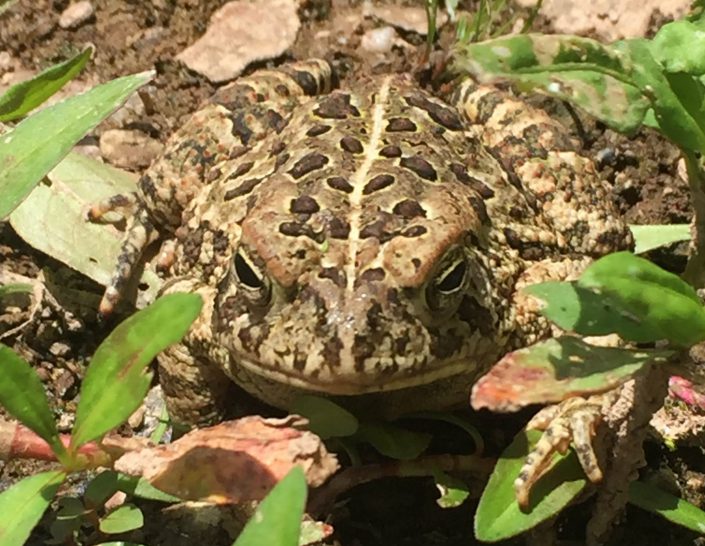
Adult American toad photo by Kelly Triece

Did you know that wetlands are very important habitats that provide benefits for both humans and wildlife alike? Generally defined as “land consisting of marshes or swamps”, wetlands provide natural flood control by soaking up runoff from heavy rains and filter out chemicals, pollutants, and sediments that would otherwise contaminate our drinking water. They also provide a home for much of the fish and wildlife species that inhabit the state of New Jersey.


Due to the extensive development and urbanization of the state to accommodate our ever-growing population, much of New Jersey’s natural wetlands have ceased to exist. In the 1980’s a study conducted by the United States Fish and Wildlife Service (USFWS) found that, since the mid-1900’s, the state lost at least 20 percent of its natural wetland resources. Since then, concerted efforts have been made to protect, restore, and create wetland habitats across the state. One such effort has been made by the Natural Resource Conservation Service (NRCS) with the Wetland Reserve Easement (WRE) project, a component of The Agricultural Conservation Program in partnership with Conserve Wildlife Foundation. WRE is a voluntary program that provides an opportunity for landowners to receive financial assistance in exchange for permanently protecting retired agricultural land.

Lamington River, Bedminster, Somerset County. Location of American toads.

While walking one such easement property in Bedminster, Somerset County we observed a population of American Toad (Anaxyrus americanus) polliwogs in a shallow water inlet along the Lamington River. There had to be hundreds of these young toads both in the water and on the shore. The American toad is just one example of a wildlife species that benefits from readily available wetland habitat and that is also vulnerable to habitat loss due to wetland destruction. Although they are very common in New Jersey, and many people can recognize a toad when they see one, there are still a handful of myths and misconceptions about toads that I would like to address.

American toad- just metamorphizing into an adult! Photo by Kelly Triece

Myth 1 – Toads will give you warts if you touch them: False. While toads do have warts across their bodies, they cannot transmit these warts to humans as warts in people are actually caused by a virus. This doesn’t mean you should go around handling every toad you come across, but if you do pick one up you will not contract warts from it.


Myth 2 – Toads must be completely safe to handle if they do not transmit warts: False. Toads secrete toxins through their skin so it is completely necessary to wash one’s hands after handling a toad. They also are known to pee in self-defense, especially when picked up by a human. This may not bother some people but you should still make sure to wash your hands after holding one.


Myth 3 – Wild-caught toads make good pets: False. While toads are very easy to care for, and it is not hard to replicate their natural environment in a fish tank, it is still very important to leave wild toads wherever you find them. Toads will spend their whole lives in one area, leaving it once or twice a year just to go breed, and it can be very disruptive to a toad’s well-being to find itself in a new home. If you do happen to keep a toad for more than a few minutes, it is of utmost importance that it gets returned to exactly where you found it. Releasing it into any suitable habitat would seem adequate enough, but it would be like if one day you just found yourself wandering around Nebraska with no way of knowing where to go or how to get home!


Myth 4 – Toads are terrestrial species and do not need to be near water to thrive: False. Toads will spend most of their lives hanging out in fields or meadows or even forests, but they do need access to pools of water in order to breed. Every summer, toads will migrate to pools to find mates and to lay eggs. While they do not swim, like their close relative the frog, they still benefit from having shallow water habitat in close proximity to where they spend most of their time.


Myth 5 – Toads are poisonous: TRUE. Contact with a toad’s skin will not give you warts and it will not poison you just through skin-to-skin contact. However, they have glands just behind their eyes that when pressed will secrete a milky-white substance that can severely harm someone if ingested. This may not be a danger to most people, as most humans have no interest in putting toads in their mouths, but it is a concern for dogs. Dogs very typically love to grab strange objects with their mouths, which applies enough pressure to a toad’s glands to excrete their poison. This can be very detrimental to a canine’s health and can even kill them. If you find yourself wandering around toad habitats with your beloved pup ensure that they do not try to eat any toads that they come across. If your dog does mistakenly poison itself you should take it to a vet immediately.


NRCS easement boundary sign.

Through programs like WRE, more and more wetland habitats are being made available across the state for wildlife species like toads. It is important to be aware of what impact you can have on them, as well as what could happen to you or your pet through contact with toads.


Learn More:


Liam Hobbie is a 2016 field intern for Conserve Wildlife Foundation of New Jersey.

Beachnester Buzz: Least Tern Love

NEW, WEEKLY UPDATES FROM NEW JERSEY’S BEACH NESTING BIRD PROJECT TEAM

by Todd Pover, Beach Nesting Bird Project Manager

Least tern photo by Northside Jim.

Piping plovers tend to garner most of our attention on the beach nesting bird project because they are so critically endangered. American oystercatchers and black skimmers are visually striking and very charismatic, so they are popular with the public, as well. That sometimes leaves the least tern as the “forgotten stepchild” of our beachnesters.


Their protective behavior of dive-bombing and even pooping on beachgoers who get too close to their nests or young doesn’t help their reputation. Yet, they are a fascinating species to watch and their chicks rank high on the cute scale.


Because they are a colonial species, and the colonies often take up large areas of the beach, they are a special challenge to manage and protect. But they do need protection – they are listed as endangered in New Jersey. Over the past decade, their population has remained low but stable. On one hand that is good, it means they aren’t declining further, but it also means they aren’t recovering either.


This week, we completed the latest of our bi-monthly surveys with a total of about 1200 individuals counted. This is below our peak a little earlier in the month, but in line with our typical statewide population. To date, we have recorded 24 active colonies along the coast from Sandy Hook to Cape May this year. That is within our average annual range of 20-25, although several of those colonies have already failed due to intense predator pressure.


It is too early to say whether this will be a good or bad year for least terns. We are in the peak period for chicks, so the next two weeks or so will determine if we successfully produce enough young to the fledgling stage. In the meantime, now is the time to get out to see these cuties, but remember to view them from a safe distance and share the shore with all our beach nesting birds.


Learn More:


Todd Pover is the Beach Nesting Bird Project Manager for Conserve Wildlife Foundation of New Jersey.

Emergence of Clinging Jellyfish in New Jersey’s Coastal Waters

Invasive Species reported in the Shrewsbury and Manasquan Rivers along with Barnegat Bay

by Corrine Henn, Program Coordinator

Clinging Jellyfish photo by Dann Blackwood, U.S. Geologoical Survey, Woods Hole

The presence of the clinging jellyfish off the New Jersey coast has been stirring up quite the commotion lately. Dr. Bologna, a biologist and ecologist at Montclair State University, confirmed the identity of the Gonionemus vertens. Distinguished from other species by the distinctive red, orange or violet X-like marking on their pad, Gonionemus vertens is often no larger than the size of a dime.


An invasive species from the Pacific Ocean, there have been reported sightings of the introduced jellyfish in Southern California, Massachusetts, Europe and the Mediterranean Sea for the greater part of the last 100 years.


This relatively small species was given the nickname due its ability to, quite literally, cling onto eelgrass and other shallow-water flora when at rest using the pads on their tentacles. Typically harmless, this unique trait keeps the jellyfish away from the sandy beaches of the New Jersey shore, preferring calmer, quieter back bays and rivers.


Sightings to date have been reported in the Shrewsbury and Manasquan Rivers along with Barnegat Bay, but the reach of their presence has yet to be determined. Biologists are working diligently to confirm the status of the jellyfish by trawling a number of New Jersey waters over the next 30 days. They also hope to gather vital information regarding their life cycle, including where the polyps are settling.


Although the arrival of the Gonionemus vertens should not be ignored, it’s important to keep in mind beachgoers are unlikely to encounter the species. However, if you or someone you know has been stung, there are a number of steps that can be taken for preventative care:

  • Wearing gloves, white vinegar may be used to remove any remaining tentacles.
  • Rinse the area with salt water.
  • Apply a hot compress to the area.
  • Contact your doctor, or seek immediate medical assistance if necessary.


Learn More:


Corrine Henn is a Program Coordinator for Conserve Wildlife Foundation of New Jersey.


“For the Love of Wildlife” Photo Contest: First Place Winners

CONGRATULATIONS, FRANCESCA BUCHALSKI AND BILL DALTON!

by Lindsay McNamara, Communications Manager

Earlier in 2016, Conserve Wildlife Foundation launched the “For the Love of Wildlife” Photo Contest. Our photography contest was meant to showcase the love for and need to protect the endangered and threatened wildlife that call New Jersey home. We encouraged youth and adult photographers across the Garden State to submit photographs in the following categories:

  • New Jersey’s Rarest Residents: Endangered, Threatened, and Special Concern Wildlife Species Only
  • The Garden State: New Jersey Landscapes
  • Experiencing Nature: People Enjoying the Outdoors
  • Wild New Jersey: All Animals in the Garden State

We were blown away by the amount of submissions we received! Over 1,470 entries were counted! New Jersey wildlife photographers, CWF board members and staff poured over the entries to choose our winners. Today, we are thrilled to announce both first place winners.


First Place: Francesca Buchalski
Allentown, New Jersey
Praying Mantis

Praying Mantis on Lens
Praying Mantis on Lens, youth first place winner Francesca Buchalski

Francesca was so happy to have won our contest! She shared more about the image and her passion for photography with CWF: “I took that photo at the Cape May Meadow during last year’s fall hawk migration festival. My mom and I are avid birders, and we love going to the migrations in Cape May! We were bringing up the rear on a guided walk, and just as we started walking down the path through the reeds, I heard ‘Wows!’ and ‘Cools!’ up ahead. As we caught up, we saw that everyone was looking at a praying mantis perched on a man’s telephoto lens! I had my camera with me to photograph birds, but that was an opportunity that couldn’t be missed! I thought it was pretty interesting and ironic that the man couldn’t photograph the praying mantis, even though it was on his camera (he couldn’t stop laughing), and it posed there for a long time. It was a great way to start the walk!


“I’ve only been photographing wildlife for about 3 years, just for fun. I started off by taking pictures of the birds that came to our feeders, and now I bring my camera on all of my birding adventures. As for my favorite New Jersey species…that’s a tough one! I think I would have to go with the osprey; they’re so charismatic in their coloring, hunting habits, and cool ‘opposable’ talon. I also really enjoy how easy it is to observe them by boat; whenever I think about the wetlands or the back bays of New Jersey, I automatically think ‘osprey.’ They also have such a great comeback story, its almost impossible not to love them!


“A close second would be the horseshoe crab; I find it simply incredible that they have remained unchanged for millions of years, and that so many migrating shorebirds depend on them. And who can forget their incredible immune system and blue blood! I also love how you can learn about and help horseshoe crabs by participating in hands on counting, tagging, and flipping walks (my mom and I have done some of those, and they’re such great experiences!)


“New Jersey has such an amazing array of wildlife, and sadly, so many people miss it amid all of the big cities; big thanks to everyone at Conserve Wildlife [Foundation] for helping to promote New Jersey’s wildlife and keep them around for years to come!”


First Place: Bill Dalton
Interlaken, New Jersey
Black Skimmer

Sky Skimmer Bill Dalton
Sky Skimmer, adult first place winner Bill Dalton

Bill was so pleased to have won our contest. He said he is “truly honored to have [his] ‘Sky Skimmer’ photo selected as the grand prize winner from such a prestigious organization.”


Bill explained to CWF, “I once read that a photographer’s definition of luck is: Preparedness over opportunity = LUCK! That was certainly the case when I photographed the skimmers at Forsythe on a early spring morning. On a previous visit, I saw a mature peregrine falcon perched at sunrise not far from the observation tower. I returned a day or two later with the proper equipment for low light, high speed photography, with hopes to get early light shots of the peregrine. The falcon was there but I noticed 6 to 10 black skimmers feeding about 50 yards from my location. The light from the predawn sky and clouds reflected perfectly on the windless water’s surface. I took about 50 shots but one shot caught the skimmer in exactly the right position. The line between sky and water vanished! The camera should get all the credit, I just pushed a button! I’ve been a nature photographer (hobby) for decades. My first camera back in the 70’s was a Minolta SRT 101. Boy has photography come a long way since the days of only film!


“I love to kid people by telling them I’m an endangered species. By that, I mean, I was born and raised in Monmouth County. One of the most important goals in [CWF]’s mission statement is, ‘educating everyone who lives in New Jersey about our shared wild heritage and our shared responsibility to protect it.’ We’ve come a long way in accomplishing those goals but so much more has to be done.


“I must admit being a born and raised Jersey Shore boy that my favorite species is the osprey. I vividly remember back in the 1950’s asking my dad while driving down a shore road in Monmouth County, why the power company men were knocking down bird’s nests that were atop of the poles! Those nests were ospreys and the nests on the poles were considered a nuisance! Years later I am proud to have been partly responsible for one of the first osprey nesting programs in Monmouth County. I convinced the company I worked for to enter into an agreement with the NJDEP to relocate a nest from the Keansburg pier to our location in Union Beach. At that time ospreys were on the threatened and endangered species list.


“The transfer of the nest was successful and at that time (1987) it was the most northern osprey nest in Monmouth County. Now I see nests in dozens of locations throughout the county! The osprey is truly an example (along with many other species) on how educating the public about our wildlife heritage worked!


“My work has been wildly published over the years including leading magazines, books and educational publications. National Geographic has published my work several times, most recently in their book, ‘Sublime Nature: Photographs That Awe and Inspire.’ Once again, thanks to the judges and staff of the Foundation for this wonderful award.”


Lindsay McNamara is the Communications Manager for Conserve Wildlife Foundation of New Jersey.

New Jersey’s Hidden Coast — After the Storm

New Jersey’s Hidden Coast — Episode 3

by Lindsay McNamara, Communications Manager

At 8:00 PM on October 29th, 2012, Hurricane Sandy made landfall in Brigantine, New Jersey, only about 30 miles from New Jersey’s Hidden Coast – the Delaware Bayshore. The storm was devastating for the people of the area, many of whom lost their homes and livelihoods. It was equally hard on the area’s wildlife, bringing many species, including the famous horseshoe crab and red knot, perilously close to extinction.


What happened? Watch the story unfold in the third episode of our video series.


A new episode of our video series “New Jersey’s Hidden Coast” will air every two weeks throughout the summer! Catch a glimpse of the bay, the horseshoe crab at the center of the bay’s system, and the incredible relationship between horseshoe crabs and migratory birds, like the red knot. We will reveal the real value of horseshoe crabs, the challenges to the ecosystem, and the potential for a thriving regional economy along the Bayshore. We will show Hurricane Sandy as a catalyst for decisive action and the work being done to rebuild the area for both people and wildlife.


Over the next several weeks, we will explore the use of “living shorelines” instead of bulkheads and the central importance of marshes to the marine ecosystem. We will discover the on-the-ground, grassroots efforts of the community to build oyster reefs alongside veterans. And we will examine the future of the Bay and the work that needs to be done to preserve our conservation successes thus far.


Discover Delaware Bay:


Lindsay McNamara is the Communications Manager for Conserve Wildlife Foundation of New Jersey.


Emergency Osprey Nest Surveys in Cape May, Wildwood and Stone Harbor

What you won’t hear on the news!!

by Ben Wurst, Habitat Program Manager

Matt Tribulski places a young osprey back in its nest.

It’s osprey season. Osprey Survey Season, that is. However, we never like to start the season off with these types of emergency surveys, but with the increase of strong storms and extreme straight line wind events, they are becoming an annual event. Ospreys nest on platforms in open areas near water, so their young can easily become victims during these types of storms. After receiving a text message from my colleague Kathy Clark yesterday evening about the intensity of the storms, she said we should try to do a survey of the affected areas. I had other plans but I knew that those could wait. Continue reading “Emergency Osprey Nest Surveys in Cape May, Wildwood and Stone Harbor”