CWF contributes to conservation of Belizean ospreys
by Ben Wurst, Habitat Program Manager
A male Ridgway’s osprey perched near its nest on a snag off Blue Ground Caye. Photo by Ben Wurst
When I first learned of the work being done by Dr. Paul Spitzer and Alan Poole to study the breeding population of Ridgway’s ospreys (Pandion haliaetus ridgwayi) in Belize, I was instantly captivated. I first met Paul at the Raptor Research Foundation Conference in Cape May last October where he explained the study and the need for partners to assist with this years survey. Some of the aspects that immediately drew my attention was the fact that the estimated size of the population there was around 50 pairs, that those pairs nest exclusively on the coastal cayes (mangrove islands), and that their estimated productivity rate was around .3-.4 young/active nest. The coast of Belize is approximately 170 miles long and protected by barrier reefs and these mangrove islands. Continue reading “Studying Ridgway’s Osprey of Belize: Part I”
Back from Belize and summarizing results from our study of the Ridgway’s osprey
by Ben Wurst, Habitat Program Manager
Ridgway’s ospreys (Pandion haliaetus ridgwayi) are lighter than their north american counterparts. With a pale eye stripe and lighter plumage on their wings and back, they appear “white-washed” in appearance. Photo by Ben Wurst.
Stay tuned for a series of blog posts (with plenty of photos) from our work with ospreys in Belize.
Results from the 2016 nesting season show very positive results. Statewide census planned for this year.
by Ben Wurst, Habitat Program Manager
Ben Wurst prepares to band two young ospreys. Photo by Northside Jim
New Jersey’s ospreys continue to defy my expectations. Since being tasked with coordinating the NJ Fish & Wildlife’s Osprey Project, I have witnessed the population grow from around 400 nesting pairs to an estimated 600. That’s a 30% increase in the overall state population. In addition, the productivity rate (a measure of the health for the population) has remained at level consistent with an increasing population. The results from last year were positive throughout almost all major nesting colonies that were surveyed. I’ve never been more amazed by the shear resiliency and adaptability of a species.
Volunteers brave rain and high water to benefit ospreys!
by Ben Wurst, Habitat Program Manager
Volunteers work on a flooded saltmarsh to remove an osprey nesting platform in Atlantic City.
I’ve been surveying osprey colony on Absecon Bay since 2008, after I moved to the local area. It’s been an area with a small but slowly growing colony. In 2008 there were a total of 11 active nests. This year there were 23 active nests. Productivity has been good with an average of 1.72 young/active (known-outcome) nest over the past nine years (more than double what’s needed to sustain the population). Many of the nests in this area were installed in 2005 for mitigation for nests that were removed when the ACUA installed large wind turbines off Route 30. But, some platforms that were placed near the turbines, have been slowly abandoned by ospreys. This year only one nest was occupied there and it did not produce any young. Continue reading “Giving Absecon’s ospreys a boost”
Volunteers needed to help maintain and repair osprey nests
by Ben Wurst, Habitat Program Manager
Map of nests that are in need of repairs in Absecon, NJ.
We have an obligation to care for and protect our wildlife, and for me, that’s what drew me into my current position. Osprey nesting platforms have been a focus of my work over the past 10+ years. They are designed specifically for ospreys and if built properly, can withstand the impacts of severe weather, including coastal flooding, high winds, and storm surge. For ospreys these platforms protect their nests from predators and flood tides, but over time the extreme salt marsh environment takes its toll on them. With the added weight of the large, perennial stick nests it can shorten the life span of a properly built platform drastically. Over the years I’ve seen older nests topple, from the weight of the nesting material and aging hardware, during the middle of the nesting season during severe storms. This is hard to prevent at every nest, during every storm, which we know are becoming more and more frequent, but we are adapting and in turn, helping our ospreys become more resilient (and productive) in the end.
New stainless screws are installed in an existing osprey nest to help prevent future catastrophe.
In the past we (myself and other volunteers who survey ospreys and help maintain platforms) used to visit a nest only once a year, during nesting surveys in late June and early July. At that time we would note the condition of the platform and if repairs were needed, schedule those for the seven month long non-breeding season. Those who have volunteered to help and worked with me, know the task at hand. Most tasks include using hand tools to construct nest platforms and perches and to install them. I always say the hardest part is getting the platform to the saltmarsh where they will be installed.
To help engage and inspire others to help care for our growing osprey population, we are looking for volunteers who live within the watersheds were we are planning to conduct repairs of osprey platforms. Tasks vary by watershed but most are to add new (stainless) screws to existing platforms, install predator guards/perches, clean off excess nesting material, and do any other repairs to platforms (including moving and replacing some). We are hopeful to meet some local baymen and fishermen who are looking to help keep the nesting population stable as it has been over the past 10 years.
The work will occur in mid-late October and will be carried out through these watersheds:
Barnegat Bay (Point Pleasant south to LEHT)
Great Bay – All nests here need new hardware and one nest needs to be replaced.
Absecon Bay – In this area we have four platforms to replace. Three will be moved and one new one installed. Four other nests need critical repairs.
Sea Isle – several nests here need predator guards and a couple need minor repairs.
Wildwood/Cape May – After the strong storms in late June hit this area, many nests need new platform (tops) and others need to be cleaned off.
If you are interested in being notified when these platform construction and repairs occur, please email me. Let me know what you are interested in helping with and if you have a boat (and a ladder!) that can be used.
For those of us who call New Jersey home, we’ve all likely witnessed the impact human activities have on our environment and the species who thrive here. Although habitat loss, illegal poaching and invasive species can be equally devastating to an ecosystem, the presence of plastic pollution around our state is a threat that almost every individual can be found personally culpable.
A jellyfish & a plastic cup cover – which is which? It’s easy to see how a sea turtle could get confused and accidentally swallow plastic. Photo by Mike Davenport.
Although many forms of pollution impact our native species, the summer months at the Jersey Shore often result in a surge of plastic debris that are left behind or improperly disposed of. Plastic pollution impacts millions of wildlife species globally, and the diverse number of species in New Jersey are no exception.
The plastic pollution that accumulates in our waterways and elsewhere around New Jersey poses a serious threat to native species. Single-use plastic products like plastic bags, bottles, bottle caps, wrappers, straws, and even balloons are not only unsustainable, but particularly dangerous for the animals that may become entangled in them or accidentally ingest them.
A few years ago, CWF’s Habitat Program Manager Ben Wurst and his dedicated group of volunteers who monitor the osprey nests along the coast began to hold onto the trash and debris collected in and around the nests. While it may not be the most visually appealing educational resource, it made the growing problem of plastic pollution personal for Ben, in a way that words aren’t always able to convey.
Plastic bags, one of the most common single-use plastic products, were overwhelmingly prevalent in many of the nests. And osprey aren’t the only wildlife species facing this threat. Seals, terrapins, shorebirds, fish, whales, sharks and dolphins can also be impacted by plastic debris.
The presence of plastic in our daily lives is interminable and difficult to eliminate completely, but there are a number of things we can do to minimize the impact our habits may have on our wildlife!
Clean up after yourself:
Whether you’re spending the day at the beach, having a picnic by a lake, or tubing down a river, make sure you take any trash with you before leaving and recycle what you can.
Be mindful of your surroundings:
If you’re out and about and notice that someone left some trash behind, take a moment to throw it away.
Reduce your consumption:
A number of small changes from millions of people can make a big difference. For starters, invest in reusable shopping bags and water bottles. And cut down on the number of miscellaneous throw away plastics you use, including straws and plastic wrappers.
Donate:
Consider donating to CWF to support our conservation projects and ensure our biologists and our volunteers are able to continue surveying and aiding species in need.
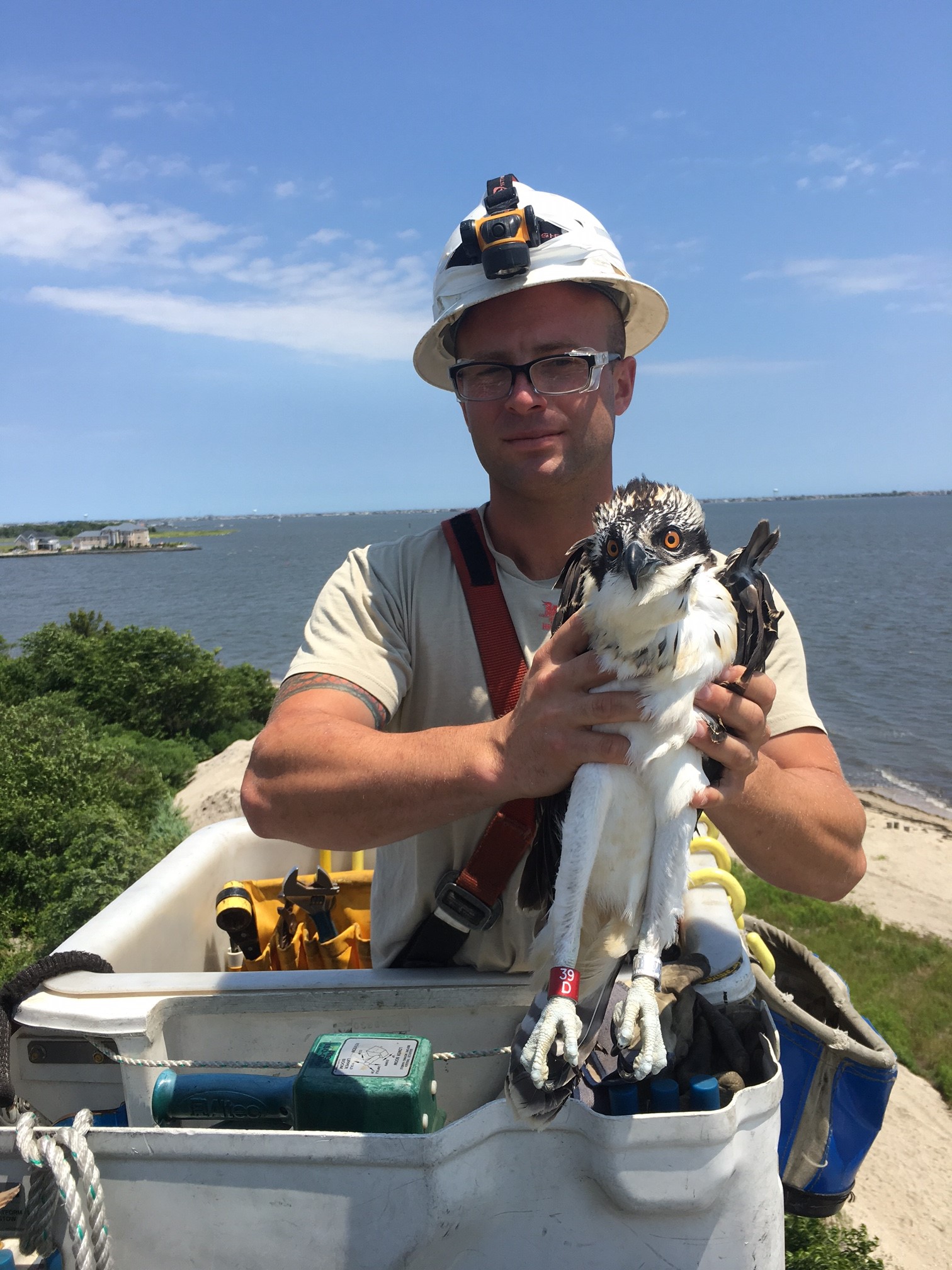
39/D being rescued on July 13, 2016. Photo by Bonni Myszka.
Ospreys are in the news again. This time it is not so pleasant news, or at least news that is hard to swallow for some, where an adult bald eagle predated a young osprey at Hog Island in Bremen, Maine. While it can be a traumatic thing to witness firsthand, it is pretty common where the range of ospreys and bald eagles overlap. We are only witnessing it because of technology. It can and has happened right here in New Jersey too. Last year, I found an adult female who had lost her wing. With no other way for that to happen (on the open saltmarsh, and her wing was gone), the only suspect is an attack by a bald eagle. As both the eagle and osprey population continue to grow, there will only be more interaction between the two species as they are competitors for food and bald eagles are opportunistic scavengers.
Approaching a natural nest inside Barnegat Inlet. Photo by Northside Jim.
Each year, while conducting osprey surveys by boat, our volunteer banders and biologists try to reach the majority of known osprey nests in the most densely populated colonies in New Jersey. The data that is collected (active nest, # of young) help to determine the overall health of the population. Since 2013, we have surveyed more than we have ever have, after releasing all of the known locations of osprey nests in New Jersey. All osprey nests can be viewed on our partners website, www.osprey-watch.org, which is run by the Center for Conservation Biology. It has helped us reach 80% of the known population. Publishing and mapping all the known nests was an attempt to engage citizen scientists (by them going out to observe ospreys) and save critical funding (for more endangered species of wildlife) while collecting data to monitor and manage our ospreys. So far it has proved to be an amazing tool for the future management of ospreys, who nest in very close proximity to humans. Continue reading “Calling all Osprey Watchers!”
Yesterday evening, while conducting an osprey nest survey at Sedge Island Wildlife Management Area, I received a message from a local wildlife photographer about an osprey nestling that was entangled. I talked to the photographer, Rich Nicol and got detailed information about the situation, the nest, and started to formulate a plan to address the situation. After learning that the nest was on a 35-40’ high pole, I knew that I wouldn’t be able to get up there without some help. Yes – a large ladder would suffice, but it would be tricky to handle the situation (with the bird being entangled). You see, after seeing photos of the young osprey, I knew it was RTF (Ready To Fly). Ospreys fledge or take their first flight at around 7-8 weeks of age. The entangled osprey was around 7 weeks old. I knew we had to act quickly to catch the bird and untangle it before it tried to fledge. This morning I saw the photos that Rich took and it clearly showed that the young osprey had monofilament or a net around its neck… Continue reading “The Inspiring Story of Osprey 39/D”
Osprey 44/C re-sighted at Island Beach State Park!
by Ben Wurst, Habitat Program Manager
Project RedBand Osprey 44/C was re-sighted by Shayna Marchese on Island Beach State Park on July 3, 2016.
Really exciting news. For the first time this year, a (live and well) red banded osprey was re-sighted! 44/C was banded as a nestling on July 12, 2014 and photographed by Shayna Marchese on July 3, 2016 at Island Beach State Park. Young ospreys spend two years on their wintering grounds before returning to their natal areas. This is the first year that 44/C has returned to New Jersey. 44/C appears to be a male, and males have a higher level of site fidelity than females do, so they are more likely to return to the same area that they originated from. We aren’t surprised that one of our first red banded birds to be re-sighted in New Jersey was at Island Beach State Park, just outside Sedge Island Wildlife Management Area. For anyone who is not familiar with Sedge, it is the state’s most densely populated osprey colony in New Jersey. Around 30 pairs of ospreys nest at Sedge which is less than 3 square miles. Continue reading “Project RedBand Alumni Update!”