SALAMANDERS ARRIVE AT ENHANCED VERNAL POOL COMPLEX IN CAPE MAY

by Karena DiLeo, Wildlife Biologist
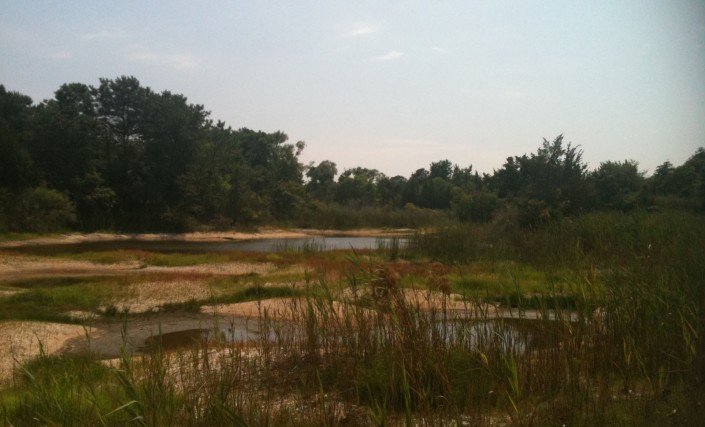
Newly excavated vernal pools © Dave Golden

This fall ENSP, in partnership with CWF, completed a project to enhance a complex of vernal pools in Cape May County, creating habitat for state-endangered eastern tiger salamanders and other vernal pool breeding amphibians.  Since excavation of these twelve interconnecting pools was completed in October, and eastern tiger salamanders return to vernal pools to breed in early winter, we were unsure the salamanders would find our new pools in time to breed this year.  But on December 14th, as we were adding leaves and debris to provide attachment points for the salamanders to lay their eggs, we noticed eastern tiger salamander egg masses in our pools!  The salamanders not only found our pools but found the only three sticks in the pool to attach their eggs!

To supplement this population and increase genetic diversity, egg masses collected from other sites have been introduced into these pools.  Egg mass were also collected as part of a headstarting program at the Cape May County Zoo.  Amphibians are very vulnerable to predation during their egg and early larval stage so by headstarting these salamanders and raising them in a safe environment, like special tanks at the Zoo, we are able to release larger individuals into the pools and increase survivorship.

This enhancement is part of a larger project to create an eastern tiger salamander stronghold in New Jersey by linking sites where this state-listed species are found and creating new metapopulations that allow for migration between sites.  Increasing connectivity of vernal pool habitat also allows us to plan for climate change and possible sea level rise by assisting these species’ migration towards more upland habitats.

Photo from the field

Planting trees for wildlife and people!

by Ben Wurst, Habitat Program Manager

Volunteers helped plant over 200 tree seedlings last week at a former golf course in Cape May, NJ. © Ben Wurst

For the past 3 years Conserve Wildlife Foundation of NJ has been working to restore habitat at an old golf course in lower Cape May County. We have concentrated on reforesting many of the old fairways at the site, now known as Cape Island Wildlife Management Area. This past week we planted around 300 native tree seedlings from Pinelands Nursery there. All of the species planted will benefit wildlife by providing food and cover. It will increase biodiversity and reduce fragmentation of forested habitat. We planted white and scarlet oak, pitch pine, gray birch, bayberry, serviceberry, persimmon, beach plum, and tulip poplar. Seedlings are protected by tree tubes (help reduce light browse by deer and rabbits) and weed mats (reduce competition from cool season grasses) to help increase survival rates.

Trees also benefit you and I. They capture carbon dioxide and release oxygen. Planting trees is one of the most effective and least expensive ways to reduce carbon in the atmosphere. They can reduce heating and cooling costs if planted around your home. They can also help increase your home’s property value. Fall is the best time to plant trees. When planting a tree make sure to dig the hole twice as deep and twice as wide as the root ball. Plant to a depth where the collar of the truck is not below ground level. Amend the soil if necessary and only put up to 2″ of mulch against the trunk. Here are my picks for best native trees to plant for wildlife (and you) in your yard:

Shade trees: Sweet gum (awesome fall foliage!), tulip poplar (great pyramidal shape when mature, great shade tree), oak spp. (produce acorns and good shade trees, scarlet oaks have stunning fall foliage). Plant these on the south side of your house to reduce cooling costs in summer.

Conifers: red cedar (good wind break, dense cover for wildlife, provide berries for songbirds), american holly (beautiful red berries in winter, good cover for wildlife from heavy snow). Plant these along the NW side of your house to act as a windbreak from cold winter winds.

Watch a video clip about our work at Ponderlodge that was featured on NJTV on September 22.

Photo from the Field

Final Phase of site work at Ballanger Creek Complete!

by Ben Wurst, Habitat Program Manager

An excavator removes milled asphalt that was dumped into freshwater wetlands. © Ben Wurst

In late 2009 we received notification that we were going to receive funding through the American Recovery and Reinvestment Act of 2009 to carry out a habitat enhancement project inside Bass River State Forest. The purpose of the project was to enhance habitat on site for migratory birds and other wildlife, especially rare species. The main part of the project was to remove fill and control invasives, like phragmites, that was illegally dumped on the edge of freshwater wetlands. The first phase of the project was to create scrub-shrub habitat. In early 2010 we planted over 1,000 native shrubs that provide both food and cover. Even though it was a hot, dry summer last year many of the shrubs are already flowering and bearing fruit. In summer we broadcast 75 lbs. of wildflower seed in the old fallow fields. Finally, over the past 2 weeks a crew from Anthony Excavating Inc. used excavators to remove tons (literally) of milled asphalt, concrete, and other debris (everything but the kitchen sink) along the edge of the wetlands. They used a small excavator that was able to reach a long distance without disturbing much of the surrounding area.

A series of interpretive signs are being designed and will be installed on site this fall. I also plan to work with volunteers from Bass River State Forest to enhance a 1.5 mile loop hiking trail around an old fire road on the edge of the wetlands.


Removing milled asphalt that was dumped into freshwater wetlands. © Ben Wurst

A Welcome Mat for Bats

Enhancing Bat Roosting Habitat in NJ’s Forests

Posted by MacKenzie Hall, Private Lands Biologist

Kyle Whittle, a Boy Scout from West Milford, will earn his Eagle rank soon for a project that adds summer roosting habitat for forest bats.  Dwindling habitat is a threat to NJ bats – even those that aren’t affected by White-nose Syndrome – and most of our 9 species need dead/dying trees with flaking bark to roost and raise their young.  Artificial roosts can also be successful and long-lasting.  Kyle chose to put his Eagle-eye on bats after hearing about our Indiana Bat Forestry Project through a family friend with several wooded acres to offer.

Last week I worked with Kyle and a group of his friends to mount bat roosts at the West Milford property, which sits on the edge of the Bearfort Mountains.  We hiked up a steep hill of rhododendrons and hemlocks to the deeper part of the forest…a really enjoyable walk without the ladders, hammers, bundles of cedar shakes, asphalt paper, screw guns, and 15-lb bat houses!

The afternoon made good use of the teenagers’ energy, carpentry skills, and tree-climbing impulses.  They put up four traditional bat houses, built earlier by Kyle, and a few tree “wraps” meant to resemble the loose bark of dead trees.  We chose trees that get a lot of sun during the day; the owners will also do some girdling to open the canopy and create natural roosts.

Bats are starting to show up in their summer grounds again.  Thanks, Kyle & crew, for rolling out the welcome mat!


A Future Forest for Hillsborough

Restoring valuable wildlife habitat in northern new jersey

By MacKenzie Hall, Private Lands Biologist

A row of trees wait to be planted. © MacKenzie Hall

Last week, a park in Hillsborough Township got a makeover.  Following “a shave and a haircut,” more than seven acres of fallow farmland were planted with 1,500 native trees and shrubs.

This afforestation is the latest partnership between Hillsborough and the Conserve Wildlife Foundation to improve wildlife habitat on township-owned lands.  The park (on Wertsville Road between Montgomery & Long Hill Rds) sits on the northern edge of the Sourland Mountains, which hold significant values to forest wildlife, migratory songbirds, human residents and recreationists.  Our project will extend this forest cover and all of its benefits.

Elliot Hodge helps out on planting day. © MacKenzie Hall

We selected 25 different native tree & shrub species with a variety of things in mind…for example:

  • Red, white, black, and chestnut oaks will produce acorns, a great food source for many animals;
  • White pines grow densely to shelter wildlife in winter;
  • Hackberry and sassafras are larval food sources for certain types of butterflies;
  • Tulip poplars grow quickly and are loved by bees;
  • Shagbark hickories are important bat roosts in summer;
  • Elderberry, bayberry, and dogwoods produce fruit to fuel migrating songbirds as well as animals who winter here.
Volunteer John Muth settles a young white pine into its new home. © MacKenzie Hall

While the trees are in the ground, this project is still “in progress.”  The next step is to install temporary fencing to protect the saplings from deer browse.  We’ll also have to fight the invasive plants – like autumn olive and multiflora rose – that grew so heartily at the site before. And lastly, we still have 150 trees and shrubs to plant at the neighboring Otto’s Farm Park.  Please contact me (908-782-4614 x 104) if you want to help!

A huge “THANKS!” goes out to Conservation Resources, Inc. for funding a large part of this restoration, to the US Fish and Wildlife Service’s NJ Partners for Fish and Wildlife program for donating 1,000 of the trees and shrubs, to the D&R Greenway Land Trust nursery and Pinelands Nursery for their beautiful plant products, to Hillsborough Township for investing in their local wildlife, and to the 20 volunteers who helped with the tree planting.

Photo from the Field

American Recovery and Reinvestment Act provides food for migratory birds

by Ben Wurst, Habitat Program Manager

This past spring, in April, over 1000 native shrubs were planted at a habitat enhancement site called Ballanger Creek, pronounced “Baaa-lan-ger.” The site is located within Bass River State Forest in Bass River Township and is being funded by a grant from the American Recovery and Reinvestment Act of 2009. The purpose of the project is to create and enhance wildlife habitat while stimulating the creation of jobs in the local economy. Volunteers helped plant these shrubs in an area along the edge of an old fallow field (click on the “Learn More” link for before/after photos). The purpose is to provide a buffer between Route 9 and a housing development and provide food and cover to migratory birds and other wildlife. This summer was very tough for the new plantings. Many shrubs could not handle the drought-like conditions, while others did quite well.  Of those that survived some went dormant early to survive the drought. Others in areas that had shade during the hottest times of day were able to produce fruit or berries like arrowood viburnum (pictured below).

Over twelve species of birds feed on the plump blue-black berries produced by the native shrub, Arrowood viburnum (Viburnum dentatum). The fruits ripen in early August and persist through October. Large thickets of arrowood can also provide important nest sites for many species of birds.

We are currently working on the third phase of the project which is to remove old fill from the edge of freshwater wetlands. Work on this phase is expected to begin in 2011. Later this month we will be planting some left over shrubs from the spring planting at the site. If you’re interested in volunteering please contact me for more information.

The work upon which this publication is based was funded in whole or in part through a grant awarded by the Northeastern Area State and Private Forestry, U.S. Forest Service.

“This institution is an equal opportunity provider.”

We are currently working on the third phase of the project which is to remove old fill from the edge of freshwater wetlands. Work on this phase is expected to begin in 2011.

Photo from the field

Natural Succession at its finest

By Ben Wurst, Habitat Program Manager

A former golf course called “Ponderlodge,” now referred to as Villas WMA and officially part of Cape Island Wildlife Management Area in Lower Township, NJ is slowly reverting back to forested habitat. Forests and trees are good for migratory and resident wildlife, the environment, and people! Trees provide food and cover to migratory birds. Many early successional woody species like, Winged sumac, Black cherry, Sassafras, and Mulberry are already established on old fairways on site. Other trees like White oak, Willow oak, and Pitch pine are sprouting from seed, especially in areas where the overstory of trees acts like a nursery for these to grow quickly. As you may know trees naturally sequester or capture CO2. Over time, large amounts of carbon are stored as biomass in the parts of a tree (leaves, branches, roots, and trunk). A one acre reforestation site can sequester an estimated 3 metric tons of CO2 in one year. In 20 years that’s 65 metric tons of CO2 that is removed from the atmosphere. Once many of the fairways that we are working dilagently to reforest with the NJ Division of Fish and Wildlife are reforested, over 170 acres forested habitat will exist on site.

A former fairway at Ponderlodge. Four years after this property was acquired by Green Acres its fairways are being to succumb to forest succession. © Ben Wurst

This summer has been tough on many of our plantings. The severe drought in Cape May County has killed a large amount of seedlings that were planted in early 2009. However, when planting we choose to overstock or plant at a higher density to allow for some mortality to occur. Only the strong survive and will be more adaptable to future droughts!

Next year we plan to plant more seedlings on additional fairways to convert “fairways to forests.” We will be needing volunteers to assist with the plantings. If you’d like to volunteer to help plant trees send me an email and I’ll let you know when we’ll be planting (sometime in March).

Ten Things:

You can do to help wildlife In your backyard

By Ben Wurst, Habitat Program Manager

Eastern red cedar berries provide food for a wide variety of songbirds. © Ben Wurst

1. Plant trees! The more the better, plant evergreens on the north-east side of your house and deciduous on the south side. Evergreens provide cover to birds and other wildlife in winter months and also shelter to your house from those cold NW winds. Make sure to choose native species like Eastern red cedar or Pitch pine for NW locations and Tulip poplar or Sweet gum for south locations.

2. Minimize use of pesticides and herbicides. Use only plant based pesticides, like ones made with Pyrethrum, which is made from the dried flower heads of Chrysanthemums. Try using vinegar as a natural alternative to broad spectrum herbicides. Do not use any pesticides or herbicides before any precipitation.

3. Use local and FREE mulch and compost. Many municipalities and county utility authorities provide free mulch to their residents. This is a great way to reuse a large portion of the waste stream in your county. Better yet, start a compost pile in your own backyard!

4. Use native species! They are acclimated to our climate and most are non-invasive. Many plants and trees sold at nurseries are meant to be aesthetically pleasing and most don’t provide suitable habitat for wildlife, besides providing cover.

5. Create a brush pile using branches and logs to provide cover for small mammals, reptiles, and songbirds.

6. Plant fruit bearing shrubs and trees. These can provide food for songbirds and other wildlife throughout the year. From eastern red-cedar and American holly to winged sumac and northern bayberry.

A Swallowtail butterfly nectars on a zinnia flower. © Ben Wurst

7. Reduce the size of your lawn by planting a wildflower garden. They require less water than cool season grasses and provide nectar to butterflies, bees and hummingbirds and also provide seeds to many songbirds. You will save money and time by reducing the amount of grass on your property.

8. Install bird and bat houses. Bird houses can provide a place for cavity nesting birds to nest, like chickadees, wrens, and bluebirds. Monitor the birdhouse throughout the spring and summer to be sure no exotic species are utilizing it, like European starlings. Maternity bat houses can provide female bats with a place to raise their young. Bats feed on thousands of insects each night. They help control insect populations and in some areas help pollinate fruit and vegetable crops.

9. Wildlife need water to survive. Put out a bird bath or even better, install a pond. A simple bird bath can be a medium-sized saucer or shallow bowl. Change the water frequently to prevent mosquitoes from breeding. Ponds are even better for wildlife, especially amphibians, like frogs, toads, and salamanders. A simple pond can be made out of an old bath tub. Place rocks along the edge, plant some flowers along the edges, and put some branches and rocks in the water to enhance the habitat in the pond.

10. Certify your yard with the National Wildlife Federation and get a yard sign to let others know you provide habitat for wildlife in your backyard!

This Ain’t the Midwest…

Switchgrass seeds
Native grass and wildflower seeds are loaded into a no-till planter. Photo: M. Hall

By MacKenzie Hall, Private Lands Biologist

New Jersey isn’t a corn belt state and probably isn’t what you picture when you think “prairie.”  Fair enough.  But New Jersey is an incredible medley of ecosystems, and for the past five years we’ve been working to make sure that native grasslands remain in the mix. 

Switchgrass, big bluestem, and other native warm-season grasses provide excellent habitat for ground-nesting birds like the threatened bobolink and grasshopper sparrow (which is why we like them).  But they have many other uses, too, such as livestock forage, mulch, and even bio-energy (which is why farmers like them). 

Planting native grasses
Pat Hilton plants a prairie mix for wildlife and agriculture. Photo: M. Hall

More and more NJ farms are incorporating warm-season grasses and bird-friendly practices.  Pat Hilton just converted eighteen acres of her Readington Township farm to native grasses and is delaying the hay harvest on another thirty acres.  This will allow ground-nesting birds to fledge their young before the grass is cut. 

Pat’s rolling farm – call it “midwest-reminiscent” – is highly suitable for grassland wildlife and has already attracted eastern meadowlarks, kestrels, grasshopper sparrows, and northern harriers.

After another busy restoration season, we’re delighted to watch as the summer sun brings these grassland ecosystems to life.

Are you a farmer or farm owner?  Check out the NJ Landowner Incentive Program for a grassland grant.  Applications are due July 15, 2010!

This Project is For the birds!

Planting Native Shrubs

By Ben Wurst, Habitat Program Manager

Viburnums and other shrubs inside the deer fence. © Ben Wurst

During Earth Week, I planted dozens of shrubs. Viburnum, bayberry, spirea, clethra, sumac, etc… They were planted inside Bass River State Forest in Bass River Township, Burlington County, NJ at a habitat enhancement site called Ballanger (pronounced Baaa-lan-ger) Creek. The project is being funded by a grant from the U.S. Forest Service through the American Recovery and Reinvestment Act of 2009. The project is being managed by CWF and Duffield Associates, a environmental consulting firm that we hired to help us carry out the project.

The shrub planting was the first phase of this enhancement project. Approximately 1,500 shrubs were planted inside a deer exclusion fencing to help protect the shrubs from being browsed. Volunteers from the public, Bass River State Forest, and CWF came out and helped us plant all the shrubs. We had a great turn out for the event and I am thankful for all the help from all the volunteers!

A volunteer plants a native shrub at Ballanger Creek. © Ben Wurst

The second phase is the seeding of native wildflowers in an old field. The wildflowers will provide food to bees and butterflies in the form of nectar.

The final phase will be the enhancement of the freshwater wetland edge, where a lot of old fill and debris was dumped before the state acquired the property. The fill will be removed along with some exotic invasive species (Common reed) that have colonized the site. The project will be finalized after we install a series of educational interpretive signs that showcase our work and the site.