Horseshoe Crab Tagging and Monitoring in Raritan/Sandy Hook Bay

Bayshore Regional Watershed Council Looking for Volunteers to Help Out Four Nights in May and June

By: Lindsay McNamara, Communications Coordinator

Photo by: Joe Reynolds

The Bayshore Regional Watershed Council (BRWC) is looking for volunteers to help monitor and tag horseshoe crabs in Sandy Hook and Raritan Bay this May and June. Since 2009, BRWC has been collecting hard data through their volunteer-driven monitoring and tagging program. This data is used to help analyze the population of horseshoe crabs in the region and better inform conservation efforts to protect them.


Lately on the Bayshore, the Council has seen a ratio of about 35 males per 1 female, which is a cause for concern. Why are there so few females? How will the population continue to survive in the region with such a low number of mature, female horseshoe crabs?


BRWC investigated the issue and found that New York State is harvesting about 100,000 horseshoe crabs a year from the Harbor. Female horseshoe crabs are frequently harvested because their eggs are used as bait for fishermen. Horseshoe crab numbers have dropped dramatically in New York area waters, BRWC thinks in part because of the harvest. According to the Council’s website, over the last 150 years, horseshoe crab populations have declined 90%. What can concerned citizens do to help protect the current population of horseshoe crabs in Sandy Hook/Raritan Bay from further decline?


Volunteering with Bayshore Regional Watershed Council is a great place to start. Volunteers monitor and tag horseshoe crabs on four nights (alligned with the new and full moon and the tides) through May and June on Sandy Hook/Raritan Bay. The volunteers record clusters, single females, single males, swimming pairs, and other data points on tally sheets at five different locations on the Bayshore. The recordings function as a sampling of the population; volunteers monitor an area of 1,000 feet by 6 feet on the beach. BRWC volunteers can see anywhere from 10-125 horseshoe crabs a night, depending on the site.


Adult horseshoe crabs are also tagged. The tag displays a New Jersey Division of Fish and Wildlife phone number that can be called if the horseshoe crab is seen again. These tags and calls by the general public help biologists to better understand horseshoe crab behavior and where they go when they are not spawning. BRWC suspects that older horseshoe crabs return to the ocean out past the continental shelf, while younger horseshoe crabs stay in the bay. Volunteering will help the Council collect more data to analyze these observations and trends.


Take action to help protect these over 250 million year old creatures:

Bayshore Regional Watershed Council is recruiting volunteers at:

  • Cliffwood Beach in Aberdeen Township
  • Conaskonck Point in Union Beach
  • Leonardo Public Beach in Middletown Township
  • The mouth of Many Mind Creek in Atlantic Highlands
  • Plum Island at Sandy Hook National Recreation Area

Dates and times for the 2015 monitoring program are:

  • Monday, May 4, 2015 at 8:30pm
  • Monday, May 18, 2015 at 8:30pm
  • Tuesday, June 2, 2015 at 8:30pm
  • Tuesday, June 16, 2015 at 8:30pm

For more information, visit Bayshore Regional Watershed Council’s website.


Lindsay McNamara is the Communications Coordinator for Conserve Wildlife Foundation of New Jersey.

Calling All New Jersey High School Students – Win a Scholarship!

Enter Conserve Wildlife Foundation’s New Species on the Edge 2.0 Contest by May 22, 2015

By: Lindsay McNamara, Communications Coordinator


Attention New Jersey High School Students!


Love experimenting with new multimedia and technology programs? Want to express your concern for New Jersey’s endangered species and help show the public why wildlife protection is important in the Garden State? Make sure to enter our Species on the Edge 2.0 Multimedia Contest!


Open to all New Jersey high school students, this contest invites students to submit a video, app, podcast, digital graphic design, webpage, or other multimedia component showing why wildlife protection is important in New Jersey. Watch the new Species on the Edge 2.0 video, created by 2015 Video Intern Tyler Grimm, to learn more about this great opportunity.


Thanks to PSEG, our generous sponsor, first place, second place and third place entries will be awarded scholarships! For more information, visit Conserve Wildlife Foundation’s website and watch our new Species on the Edge 2.0 video. All entries due by Friday, May 22, 2015.


Lindsay McNamara is the Communications Coordinator for Conserve Wildlife Foundation of New Jersey.


Conserve Wildlife Foundation of New Jersey “2014 Annual Report” Released

CWF Releases its First Annual Report Ever Using a Story Map Format: “2014 Annual Report

By David Wheeler, Executive Director

Technology has proven to be vital to Conserve Wildlife Foundation’s work protecting rare wildlife species over the years. Our biologists depend greatly on modern technologies to band, track, and share online the journeys of wildlife. Our webcams broadcast the most intimate behaviors of nesting birds and bats across the web. And we seek out ever-evolving communications technologies to spread the word about the inspiring stories of wildlife, from social media and infographs to e-books and Story Maps. These technologies offer newfound abilities to share complex data on multiple levels, while still incorporating the awe-inspiring photography and videos that bring wildlife’s stories to life.

Conserve Wildlife Foundation of New Jersey is excited to offer our 2014 Annual Report in a unique format that utilizes one of those technologies – Story Maps. In the past year, we have explored the wonders of American oystercatchers with our first Story Map – and now the annual report allows all of our projects to be highlighted in this interactive format.

A screen capture of one of the pages of the CWF 2014 Annual Report Story Map.

Visit the multiple pages within this Story Map to learn about Conserve Wildlife Foundation’s many projects and partnerships in 2014, and the imperiled wildlife species in need of our help. Find examples of the innovative and dedicated leadership of our biologists and volunteers. And take an online journey across the state to learn how our projects made a difference in all corners of New Jersey in 2014 – a great year for wildlife in the Garden State!


Springtime Resources for New Jersey Educators

Environmental Education Workshops, Field Experiences and STEM Contests

By: Lindsay McNamara, Communications Coordinator


Green Eggs and Sand Curriculum Workshop

Picture1

A Green Eggs and Sand Curriculum Workshop will be held May 29-31 at the Wetlands Institute in Stone Harbor, Cape May County, New Jersey.

The workshop will delve into the ecological connections between horseshoe crabs and shorebirds, human connections to horseshoe crabs, and the challenges encountered in managing this resource via presentations, field trips and hands-on activities.


Sedge Island Summer Experiences

Kayaking at Sedge Island (c) Stephanie Feigin

The Sedge Island Natural Resource Education Center offers week long experiences in the heart of Barnegat Bay.

Three programs will be offered in 2015:

  • Sedge Island Fishing Experience: June 25 to 28, 2015 open to students entering grades 8 and 9 in the fall of 2015. Application deadline is March 31.
  • Sedge Island Field Experience: July 28 to 31, 2015 open to students entering grades 7, 8, and 9 in the fall of 2015. Application deadline is March 20.
  • Sedge Island Field and Research Experience: July 8 to 14, 2015 for students entering grades 10 and 11 in the fall of 2015. Application deadline is April 17.

For more information, visit Conserve Wildlife Foundation’s website.


Species on the Edge 2.0 Multimedia Contest

An American kestrel. Photo courtesy of Jim Gilbert.

The Species on the Edge 2.0 Multimedia Contest combines high school students’ expertise with technology and their love for nature. Students show why New Jersey’s wildlife is important by creating a video, app, podcast, webpage, or other multimedia project.

But best of all, its FREE and offers all New Jersey high school students the opportunity to win scholarship money!

Special thanks to Species on the Edge 2.0 Multimedia Contest sponsor PSE&G.

All entries are due before April 30, 2015.

For more information and to learn how to enter the contest visit our website.

Questions?
Contact Stephanie Feigin at stephanie.feigin@conservewildlifenj.org.


Lindsay McNamara is the Communications Coordinator for Conserve Wildlife Foundation of New Jersey.

NJ’s Frogs And Toads Are “Calling” For Your Help!

Volunteers Wanted for CAMP project

By: Larissa Smith, Wildlife Biologist/Volunteer Manager with Conserve Wildlife Foundation

Northern Gray Treefrog @ M. Patterson

It’s the heart of the winter season and cold outside, so the furthest thing from your mind is hearing the calls of New Jersey’s frogs and toads. But now is the time when we start getting ready for the Calling Amphibian Project (CAMP) and thinking ahead to the spring of 2015.


The object of CAMP is to assess the distribution, abundance, and health of New Jersey’s amphibians. This is part of a larger initiative called the North American Amphibian Monitoring Program (NAAMP) and the data collected in New Jersey will be submitted into the National database. Volunteers participating in this project will be asked to conduct roadside surveys (after dusk) for calling amphibians along designated routes throughout the state. Each 15-mile route with ten stops will be surveyed three times during the Spring and a structured protocol will be followed to determine which nights to survey, how long to survey, which species are calling, and how to estimate the total number of individuals calling at each site.


In 2014, 24 volunteers participated in CAMP and surveyed a total of 23 routes out of 63. We have many dedicated long-term CAMP volunteers. Unfortunately due to different circumstances some can no longer participate so we currently have 37 routes available for the 2015 survey season. If you are interested in learning more about this project, contact Larissa Smith.


This year we will be holding a meeting for CAMP  volunteers in January. The meeting will be a good opportunity to meet other volunteers and the biologists who work on the this project and other amphibian projects. Biologists from CWF, the state ENSP and DLUR will be there to discuss  the two “new” NJ frog species and how CAMP data is being used by the state.

Why are Science, Technology, Engineering and Mathematics (S.T.E.M.) Important to Wildlife Conservation?

By: Stephanie Feigin, Conserve Wildlife Foundation of New Jersey Wildlife Ecologist

Photo: atlantaschoolguide.com

S.T.E.M. (Science, Technology, Engineering and Mathematics) education is an important learning tool for today’s students. It encourages critical thinking, problem management skills, and uses real world applications to promote innovation. S.T.E.M. has become a new way to prepare students for the future and help them succeed in this new information-based and highly technological society.


As technology continues to become more accessible to the masses and continues to play a major role in the lives of the general public, wildlife conservationists have begun to utilize these innovative advancements to reach new audiences on growing social networking platforms, and educating the public through new technologies on the importance of protecting wildlife.


Conserve Wildlife Foundation of New Jersey (CWF) uses new media and technology, such as live webcams and interactive story maps, to educate the public and advance our work to protect New Jersey’s rare wildlife. In an effort to highlight the importance of S.T.E.M. education in the classroom, Conserve Wildlife Foundation has launched a new Species on the Edge 2.0 Multimedia Contest.


Species on the Edge 2.0 is the first contest that CWF has specifically designed to focus on S.T.E.M. education. We hope that this focus will engage and teach high school students about science and New Jersey’s rare wildlife, while also capitalizing on students’ fast-growing expertise with technology. This contest invites all New Jersey high school students to submit an original video, application, podcast, digital graphic design, webpage, or other multimedia project showing why wildlife protection is important in New Jersey. The contest is free to enter, with prizes up to $1,000 in scholarship money thanks to our sponsor PSE&G.


All Species on the Edge 2.0 Multimedia Contest entries are due before April 30, 2015. For more information and to download your contest kit visit: www.ConserveWildlifeNJ.org/Education/Edge2.0.


artinline_373

The Species on the Edge 2.0 Multimedia Contest expands on the success of Conserve Wildlife Foundation’s existing Species on the Edge Art & Essay Contest for fifth graders. The contest is open to all New Jersey fifth graders in public, private, or home schools. It is a great way to engage and excite students into learning about New Jersey’s over 80 endangered and threatened wildlife species. Educators praise the contest for encompassing inter-disciplinary teaching using science, language arts, computer technology, art, and geography. Judging takes place in March. Winners are notified by the end of April.


Entries for the Species on the Edge Art & Essay Contest are due before January 31, 2015. For more information and to download your contest kit visit: http://www.ConserveWildlifeNJ.org/education/edge/.


Wildlife Beach Restoration Groups Applaud Endangered Species Act Designation for Red Knot

Shorebird now federally protected as threatened species under Endangered Species Act

By: Lindsay McNamara, Communications Coordinator

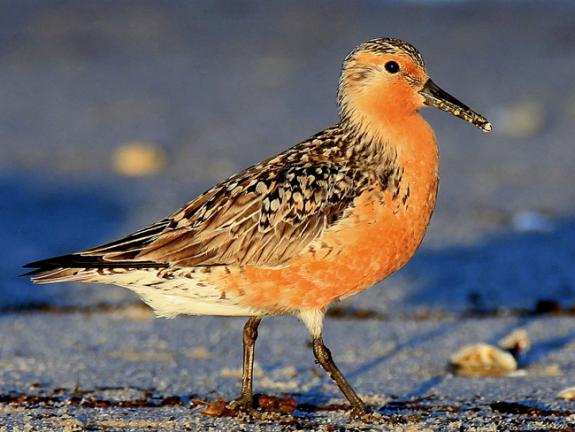
A red knot in breeding plumage along the Delaware Bay. © Bill Dalton

Wildlife conservation organizations leading the efforts to restore New Jersey’s Delaware Bay beaches for at-risk shorebirds today applauded the U.S. Fish and Wildlife Service decision to designate the Red Knot, a migratory shorebird, as “threatened” under the Endangered Species Act. A “threatened” designation means a species is at risk of becoming endangered throughout all or a significant portion of its range.


“This federal designation will make a big difference in strengthening the protections of this incredible shorebird,” said David Wheeler, Executive Director for Conserve Wildlife Foundation of New Jersey.


“Here in New Jersey, we are restoring the vital beach habitat that had been decimated by Hurricane Sandy, and this designation ensures the safeguards we are providing can be complemented along the East Coast,” Wheeler added.


Since the 1980’s, the Knot’s population has fallen by about 75 percent in some key areas. Wildlife biologists believe the major threat to the Red Knot is the dramatic decline of horseshoe crab eggs, an essential food source at the most critical stop over during their 8,000 mile trip from southern wintering grounds to Arctic breeding territory. High-energy horseshoe crab eggs provide nourishment for Red Knots to refuel and continue their journey.


“This is an important and needed step in the conservation and recovery of the Red Knot. It is an essential step in preventing the extinction of this amazing long distance traveler,” stated Tim Dillingham, Executive Director for American Littoral Society.


The largest concentration of Red Knots is found in May in the Delaware Bayshore of New Jersey and Delaware, where the shorebirds stop to gorge themselves on the eggs of spawning horseshoe crabs. In just a few days, the birds nearly double their weight to prepare for the final leg of their long journey.


“The major decline of horseshoe crabs in Delaware Bay is one of the largest threats to the survival of the shorebird,” explained Dr. Larry Niles, a biologist who leads the beach restoration efforts for Conserve Wildlife Foundation of New Jersey and American Littoral Society, and has studied Red Knots for three decades. “Agency groups have been working hard for the last two years, and will continue for the next two years going forward to rebuild the habitat damaged by Hurricane Sandy that the horseshoe crabs rely on. This work is integral to the recovery of the Red Knot and the shorebird’s best hope for survival.”


In the wake of Hurricane Sandy, American Littoral Society and Conserve Wildlife Foundation of New Jersey worked with the U.S. Fish and Wildlife Service, the New Jersey Division of Fish and Wildlife and the New Jersey Recovery Fund to remove 8,000 tons of debris and added 45,000 tons of sand to the beaches just before the annual spring arrival of the Red Knot in 2013.


Learn More:

Lindsay McNamara is the Communications Coordinator for Conserve Wildlife Foundation of New Jersey.

Why are You Thankful for New Jersey’s Wildlife?

By: Lindsay McNamara, Communications Coordinator

BannerTGiving

This holiday season, Conserve Wildlife Foundation of New Jersey asked our friends, supporters and volunteers, What is special about NJ’s wildlife to you? Why are you thankful for New Jersey’s wildlife? Friends of wildlife shared their thoughts by tweeting us, leaving us a comment on our Facebook page or sending us an email at info@conservewildlifenj.org. We encouraged everyone to use:  #thanksnjwildlife 
Here is a collection of some of the responses we received:

Bill Nigh on Twitter shared that “wildlife gives me perspective.”

Judy Floam wrote over e-mail, “I only spend one week a year in New Jersey (at the beach) but I love to watch the gulls and sandpipers, and go on seine netting expeditions at Island Beach State Park.”

“Why are we thankful for New Jersey’s wildlife? Each and every creature is special to us although the coyote and the bats have a special place in our hearts. We’re grateful to the bats for keeping insect pests at bay and enjoy watching them leave their roost at dusk. Amazing. The coyotes are very musical and we appreciate their part in balancing nature. We’re grateful that the staff and volunteers at Conserve Wildlife work diligently to protect natural habitats. Thank you!”
— Joe & Linda Jedju shared through e-mail.

“Is this really New Jersey? It’s a question I have asked myself numerous times while living in NJ but never so much as over the last three years. It was three years ago that we purchased a small house on a lake in Sussex County. The waters of the lake are pristine and they teem with beavers, herons, numerous waterfowl, and too many different fish to mention. We watch amazing sunsets over the Appalachian Trail. We sit awe struck as foxes and bears routinely traverse our yard. Hummingbirds and beautiful finches occupy our yard and the wildflowers that grow there. We have watched as Bald Eagles circle high above and slowly spiral down to snatch a fish from the surface of the lake. We have sat in the cool evenings and watched the Milky Way appear as a swath of white across a darkening night sky. We watch as some of our endangered friends the bats dance crazy patterns in the night air, feasting on insects. Is this really NJ? Is it the stereotype of landfills, factories, pollution, and exits on the Parkway? Most definitely not! The rich diversity of animal and plant life leave us awe struck on a daily basis. I could also go on and on about our beautiful shoreline, Island Beach State Park, the Pine Barrens, and numerous other ecosystems that make our state so incredible. NJ’s amazing Wildlife is not limited to amusement parks and bars!
David Claeys shared his story over e-mail.

Love what you’re reading? Feeling inspired? Consider getting involved with Conserve Wildlife Foundation:

Lindsay McNamara is the Communications Coordinator for Conserve Wildlife Foundation of New Jersey.

Celebrate GIS Day with Conserve Wildlife Foundation of New Jersey

By: Lindsay McNamara, Communications Coordinator

Data nerds rejoice! Today, Wednesday, November 19 is GIS Day. Geographic information systems (GIS) technology helps our wildlife biologists protect rare species throughout New Jersey. GIS technology is used to create our species range maps and other important tools that show where wildlife occur and what habitat they need to exist.

Conserve Wildlife Foundation is a key player in updating the NJ Endangered and Nongame Species Program’s (ENSP) database of rare wildlife species. The database called “Biotics” is a GIS and Oracle-based system developed by NatureServe, the leading source of information on the precise locations and conditions of rare and threatened species and ecological communities in the Western Hemisphere.

Although CWF and ENSP biologists submit a majority of the data on Biotics, we rely on the help of citizen scientists to fully understand the wildlife picture in New Jersey. Do you want to help biologists monitor certain areas of the state and locate the presence of species of concern? Visit our website to learn how you can get involved.

In addition to the Biotics database, GIS was used to create range maps for all 190 species featured on our online field guide! Check it out.

Have you seen our American Oystercatcher Story Map? GIS was used to create that tool as well! A Story Map is a web-based interactive GIS map embedded with all kinds of content, like text, photographs, and video.

storymap
“American Oystercatchers Through the Seasons”
 tells the story about a species of migratory bird, the American Oystercatcher, which spends the summer breeding season along the New Jersey coast, and is present year-round along the southern New Jersey coast. Learn more about our Story Map.

This GIS Day, take a look at all of the maps around you and consider supporting additional Conserve Wildlife Foundation Story Maps!


Lindsay McNamara is the Communications Coordinator for Conserve Wildlife Foundation of New Jersey.

Protecting Bats – What is Being Done and How You Can Help!

Hard to believe, but October is already here! And that can only mean one thing — bats! Everyday throughout the month of October, follow CWF on social media and our blog to fly high with these incredible creatures of the night! Each day we will have fun facts, quizzes, and beautiful photos highlighting these amazing animals and the work CWF does to protect them.

Our previous coverage included an overview of bats in New Jersey from our biologist, a look into the threats facing bats today, and a reality check on the myths and legends surrounding bats! Today we share some examples of ways you can get involved in our efforts to save bats in New Jersey.  Stay tuned next week to join CWF bat biologist Stephanie Feigin in the field!

Make sure to follow us everyday on Facebook and Twitter and read our blog every Friday for our #31daysofbats!


By Julianne Maksym

Big brown bats in bat house (c) Stephanie Feigin

With terrifying threats like White Nose Syndrome, bats face a tremendous fight for survival. Populations are declining worldwide at an alarming rate – some species are becoming so rare they are hardly ever seen at all.

Bats need all the help they can get and Conserve Wildlife Foundation (CWF) offers some simple ways to get involved and make a difference:

Building a bat house: This can create a safe and secure home for a colony of bats of up to 80 individuals. These houses provide the opportunity for bats to settle into a new roost before being evicted from a homeowner’s dwelling. The most ideal location to position a bat house is on the side of a building (where bats already roost) or on a pole in open space. The house should be set at a minimum of 12 feet off the ground facing south to southeast with early and direct sunlight. CWF is able to offer free bat houses in cases where bats are being evicted from a building. If interested in setting up a bat house please contact us, as we would like to monitor the process.

Summer Bat Count: During the hot summer months, we ask volunteers to participate in our annual Summer Bat Count. There are a total of four bat counts per summer – two between May 15 and June 21 (before pups can fly) and two more between July 6 and July 31 (when pups are flying and exiting the roost with their mothers). Making sure you do all four bat counts will allow us to best compare data from year to year and between sites. Previous yearly reports and current data sheets can be found at CWF’s ‘Summer Bat Count’ page.

AnaBat acoustic detector. The attached PDA (like a little computer screen) lets us view incoming bat calls instantly. © MacKenzie Hall

Acoustic surveys: To aid in bat research across New Jersey, CWF purchased two AnaBat SD2 acoustic detectors for the purpose of studying echolocation and general bat behavior. Four bat detectors are now in circulation for use; volunteers now do most of our mobile acoustic surveys. Volunteers are assigned a 10-30 mile driving route in their local area to travel twice each summer after dark. Detectors can be mounted on vehicles and activated while driving at night, making them a pretty quick and easy way to get a lot of information – all without having to catch, hold, or even see a single animal. For more details please contact us, as there is currently a waiting list for the acoustic detectors.

Plant a night garden: Love bats and have a green thumb? Plant a night garden! In these sanctuaries, night-scented flowers are grown to attract bugs such as moths, which in effect provides an ample food source for bats. Plants such as white jasmine and evening primrose and herbs such as mint and lemon balm are great to start with. Plant oak or field maple trees to add some shelter and warmth to your garden. To get started on your green project, check out Back to Nature, an artisanal home and garden store located in Basking Ridge, NJ. *Note: 10% discount for CWF members.

Do not disturb bats during hibernation: A huge way in which to help maintain stable bat populations is to stay away from caves, roosts, or trees during hibernation season. It is important to not disturb a hibernating bat as any disruption to its sleep can result in early awakenings. It is estimated that a bat can burn up to a two weeks worth of fat reserves in each awakening which in turn can severely weaken and/or kill the bat. Whether you are outside hiking or just taking a stroll and encounter a roost, leave quickly and quietly!

IMG_1497Adopt a Species Program: Interested in adopting a bat? Check out CWF’s Adopt a Species Program for the Indiana Bat. Your symbolic adoption supports our efforts to protect New Jersey’s rarest animals, restore important habitat, and foster pride in New Jersey’s rich wildlife heritage. Adopting a Species also makes a great gift for a friend or loved one. Give the gift that gives twice!

Bats face an ever-present uphill battle due to both natural and unnatural causes. Populations are in desperate need of help! Whether it is building a bat house or a night garden or anything in between, every action you take in supporting these animals means we are one step closer in providing a stable world for them. Join CWF in volunteering your time, educating the public and most importantly, protecting our amazing bats!

Julianne Maksym is a graduate wildlife intern for Conserve Wildlife Foundation of New Jersey