Bill Proposed to Encourage Homeowners to Create and Maintain Wildlife-Friendly Yards

Native Species Habitat Bill Passes in the Assembly

By: McKenzie Cloutier, Special Events and Fundraising Intern

Warbler
Golden-winged warbler. Photograph by Evan Madlinger

Of great interest to New Jersey homeowners, the Garden State’s General Assembly recently passed a native species habitat bill. This bill, pending further action in the Senate, encourages homeowners to create and maintain more wildlife-friendly yards. In hopes of creating more livable habitats for New Jersey’s wildlife, this bill includes a certificate program that promotes the growth of native plant species in landowners’ yards.


Under the provisions of this bill, landowners would be encouraged to grow and preserve native plant species that provide natural habitats for New Jersey’s other important species. In addition, this bill would also defend certified landowners against any municipal ordinances. For example, the bill would defend a landowner from an ordinance that calls for the removal of certain native plants or “weeds.”
The native species habitat bill not only benefits New Jersey’s wildlife, but homeowners as well, by reducing maintenance and chemical treatment costs. Under this program, yards will require less mowing and maintenance, and pesticide use is discouraged. With such changes, landowners could experience significant reductions in their usual yard maintenance costs, while helping to conserve local wildlife.


The native species habitat bill encourages New Jersey residents to become active participants in the preservation of wildlife. At the Conserve Wildlife Foundation, we encourage landowners to create wildlife-friendly backyards, and we are involved in helping private landowners to do so. Our wildlife biologist Kelly Triece works in partnership with United States Department of Agriculture’s Natural Resource Conservation Service (USDA-NRCS) to assist private landowners in managing existing cropland, forestland, and pastureland to best meet wildlife habitat needs or in establishing new wildlife habitat areas. Depending on the goal of the landowner, these programs can either help create or preserve pollinator, woodland, wetland and grassland habitats for many different wildlife species.

 
In particular, CWF biologists work with forest landowners to enhance young forest habitats on private lands. Young forest habitats are imperative for many birds, especially the Golden-winged warbler, a species of particular concern in New Jersey. The open canopy of a young forest also provides food such as berries, insects and small mammals to newly fledged birds, wild turkey, ruffed grouse, reptiles, black bears, bobcats, and butterflies.


Since 2008, CWF, NRCS and other partners have collaborated with landowners to create or restore over 225 acres of Golden-winged warbler habitat in New Jersey!

 
Want to get involved and help conserve wildlife on your property? Here are ten tips on how to create a wildlife-friendly habitat in your own backyard:

  • Allow native plants to grow.
  • Create a brush pile for ground nesting birds or small mammals such as chipmunks or mice.
  • Install a pond to benefit birds, frogs, salamanders, and aquatic vegetation.
  • Create a meadow for wildlife by choosing not to mow a section of your yard.
  • Plants trees and shrubs to provide food and cover for wildlife.
  • Buy a bird bath.
  • Remove invasive or non-native plants.
  • Refrain from using pesticides. Try composting!
  • Hang bird feeders.
  • Obtain a bird house.


Visit our website for more tips on how to create a wildlife-friendly backyard.


McKenzie Cloutier is the Special Events and Fundraising Intern for Conserve Wildlife Foundation of New Jersey.

Video Showcases EagleCam Lesson Plan Contest Winner Diane Cook

New Video Highlights Diane Cook’s Eagle Banding Experience and Classroom

By: Kathleen Wadiak, Wildlife Conservation Intern


This year, Conserve Wildlife Foundation of New Jersey and Duke Farms worked together to organize a contest in which educators could submit lesson plans based on the Duke Farms EagleCam, a webcam providing a live stream of a bald eagle nest. The winner, computer literacy teacher Diane Cook, had the opportunity to assist biologists in banding the eagle chicks from a nest in Hunterdon County. The new video showcasing Diane gives an up close and personal view into her story and her experience!


Diane has been incorporating the EagleCam into her lessons since the cam first went online in 2008, helping to inspire a respect for the animals and environment in her students from kindergarten to fourth grade. Diane also teaches her students about internet safety, web forums, and writing.


The Duke Farms EagleCam allows educators to connect their lessons to important environmental issues in a way that is interesting to their students. Teachers like Diane Cook are making a difference by encouraging children to care about their impact on local ecosystems and wildlife.


Learn more:


Kathleen Wadiak is a Wildlife Conservation Intern with the Conserve Wildlife Foundation of New Jersey.

Nominate an Exceptional Woman for 2015 Women & Wildlife Awards

Women & Wildlife Awards 2015 Nominations Open Until August 10, 2015

By: Liz Silvernail, Development Director

In founding Conserve Wildlife Foundation of New Jersey, past Women & Wildlife honoree Linda Tesauro helped to ensure the protection of eagles and other rare wildlife.

For the 10th year, Conserve Wildlife Foundation of New Jersey will present Women & Wildlife Awards to special individuals for their achievements, the advances they have made for women in their professions, their efforts to increase awareness of rare species and the habitats they depend on, and their contributions to New Jersey’s wildlife.

 
By acknowledging these special individuals, CWF hopes to encourage more young women to strive to make a positive impact on species and habitat protection, especially through the biological sciences. Conserve Wildlife Foundation encourages you to take this opportunity to nominate a woman who has distinguished herself in the service of New Jersey’s wildlife.


Nominations will be accepted in three categories:

  • Leadership
  • Inspiration
  • Education


The nomination period has been extended! The nomination form will now be accepted through Monday, August 10, 2015. Nominations submitted last year will automatically be reconsidered this year.


Save the Date: Tenth Annual Women & Wildlife Awards
Wednesday, October 28, 2015
Duke Farms, Hillsborough, New Jersey


Join us for this year’s very special event with keynote speaker Governor Christine Todd Whitman. We will be honoring outstanding women for their contributions to wildlife conservation at a wonderful cocktail party and silent auction on Wednesday, October 28, 2015, from 6:00 p.m. to 9:00 p.m.

 
Please Save the Date and join us to celebrate New Jersey’s wildlife and the women who protect our unique biodiversity.

 
Tickets will be on sale in August 2015. Proceeds benefit Conserve Wildlife Foundation of New Jersey’s work to protect our rare and imperiled wildlife.


Learn more:


Liz Silvernail is the Development Director for Conserve Wildlife Foundation of New Jersey.

Be Terrapin Aware!

Public urged to use caution while driving in shore areas this summer

By: Ben Wurst, Habitat Program Manager and Stephanie Egger, Wildlife Biologist

A adult female northern diamondback terrapin searches for a suitable nest site along Great Bay Blvd. Photo by Ben Wurst
An adult female northern diamondback terrapin searches for a suitable nest site along Great Bay Blvd. Photo by Ben Wurst

Each year in late May and early June the annual nesting season for northern diamondback terrapins begins. This unique species of turtle is the only one to inhabit our coastal estuaries year round. They live exclusively in brackish water.

During this time of year, adult females emerge from the protection of their aquatic habitat to find suitable areas to lay eggs. They seek nesting areas with a sandy gravel type substrate that’s above the high tide line.

Throughout their range along the coast, terrapins face a variety of threats to their survival. Terrapin nesting habitat has been lost due to commercial and residential development, shoreline hardening and flooding which poses a greater threat to these limited nesting areas. Loss of terrapin nesting habitat along marsh systems put terrapins at greater risk of mortality as a result of increased time searching for adequate nesting areas (Winters 2013). Terrapins will utilize roadsides for nesting which increases the threat of being hit by motor vehicles. Roads are essential to our daily life but they often are barriers to wildlife, especially small critters like terrapins. Studies have shown that adult females have become less abundant and smaller from road mortality. (Avissar, 2006).

You can help terrapins several ways during the nesting season. Driving more cautiously from now until mid-July is a simple way to be more aware of terrapins crossing the roads. Nesting peaks during the full and new moon cycles and they’re more active during the high tide (less distance to travel on land to nest sites). We ask drivers in coastal areas to “Be Terrapin Aware” while driving in these areas. If you find a terrapin crossing the road use these steps to help it cross safely:

  • Stay safe. Never put yourself at risk! Make sure that you do not endanger yourself, or others, by walking into traffic.
  • When safe to do so, pull your car over and onto the shoulder, if possible. Turn on your hazard signals.
  • When safe to enter the roadway, approach the turtle and pick it up by grabbing its shell with both hands between its front and hind legs. HOLD ON – Terrapins have strong legs!
  • It is important that you move the turtle in the direction that it is heading. They are not always headed directly towards water. They will turn around if you put them in the wrong direction, so work with their instincts.
  • Place the terrapin off the road onto the soft shoulder (dirt or grass).
  • If you have a GPS or a smartphone then record your location and submit your sighting on our website.
  • Please do not move a terrapin long distances to “somewhere safe!” They have very small home ranges and moving them will only hurt them.

Rescuing a live terrapin (or any other turtle) from the road is a rewarding experience. It’s a great way to engage future generations in caring for our terrapins.

You can also help terrapins during the nesting season by supporting our new “Turtle Gardens” project. CWF, in partnership with the Marine Academy of Technology of Environmental Sciencewill develop and implement an educational initiative to promote terrapin nesting habitat enhancement. These “Turtle Gardens” will raise awareness of the benefit of living shorelines to terrapins and other coastal wildlife, as it relates to sea level rise and coastal flooding within the Barnegat Bay Watershed. Turtle Gardens for terrapins are patches of sandy nesting habitat above the high water line that are less susceptible to flooding. They also reduce the risk of road mortality. We will be having informational training sessions for those that would like to volunteer for monitoring Turtle Gardens or have property that would support a Turtle Garden. Information on these sessions will be announced in mid-June.

In addition, we will also be looking for terrapin sighting information with Project Terrapin in Berkeley and Lacey Townships in Ocean County as part of an initiative to fill in data gaps for this species on the mainland. If you see terrapins in these locations please report your sightings online.

Learn more:


Ben Wurst is the Habitat Program Manager for Conserve Wildlife Foundation of New Jersey and Stephanie Egger is a Wildlife Biologist with Conserve Wildlife Foundation of New Jersey.

2015 Delaware Bay Shorebird Banding Season Comes to a Close

Delaware Bay Shorebird Project Team Finishes 2015 Banding Season

By: Dr. Larry Niles, LJ Niles Associates LLC

All our efforts to help shorebirds on Delaware Bay this year couldn’t have been better rewarded – nearly every red knot left the bay in good condition and in one of the earliest departures in the 19 years of the Project. We counted just over 24,000 knots in our aerial count of the entire Bayshore on May 26th. Just two days later, most had left and we could find only a few hundred, feeding on eggs like human shoppers feed on bargains at a half-price sale. By May 31st, virtually all were gone, along with the ruddy turnstones, sanderlings and semipalmated sandpipers. The beaches had an odd, deserted feel after the frenzy of the preceding days.

Photo by Jan van der Kam from Life on Delaware Bay

A good thing for birds and all those who love birds. The end of the shorebird stopover season also means the end of our shorebird team – at least for another year. All through the week, we lost team members—the North Americans left by car, those from other continents by air. Those who stayed shifted from research to manual labor: cleaning and storing equipment, closing up the rental houses, and reconnecting lost items to their owners.

Photo by Kevin Karlson

Will our project continue? Now in our 19th year of work on the bay, one must recognize the realities of time’s passage. Clive Minton just cleared 80, and the rest of the original team will soon follow. This author, who started at relatively young 44, is now pushing his mid-sixties. Death visited our team this year with the passing of Allan Baker. Surely the rest of us will start “falling off the perch” as Clive is fond of saying.

Allan Baker, the Senior Curator of Ornithology and Head of the Department of Natural History at Toronto’s Royal Ontario Museum suddenly and unexpectedly died in 2014.  His career included many significant achievements including early work that helped build a scientific case that overharvested horseshoe crabs caused the decline of red knot numbers. Photo from Wader Study.
Allan Baker, the Senior Curator of Ornithology and Head of the Department of Natural History at Toronto’s Royal Ontario Museum suddenly and unexpectedly died in 2014. His career included many significant achievements including early work that helped build a scientific case that overharvested horseshoe crabs caused the decline of red knot numbers. Photo from Wader Study.

And yet, all committed to return for a 20th year. I worry over the fundamentals: our funding remains uncertain, the listing of knots as Threatened in the U.S. creates new regulatory hurdles, and N.J. politics seem to get more fractious every minute. Will there be a 20th year of this project?


The answer starts and ends with the willingness of our team to do it again. It starts there because good ideas and projects always seem to find support; I know we will find a way. It ends there because this team provides the best chance of a strong scientific underpinning for protection. Our team includes some of the most important shorebird scientists in the world. At our dinner soirees (generously provided by Jane Galetto’s Citizens United team), Ph.D.’s are as common as empty beer bottles. It’s no surprise that conversation drills deep into conservation biology, behavioral ecology, migration physiology, stopover ecology, virology and many other subjects of interest to all our team, both scientists, old and young, and lovers of good science.


In many ways, the lives of our team members revolve around birds. The Delaware Bay Shorebird Project provides us a meaningful excuse to pull together once more. Our team members love birds, and do everything they can to help them. It’s been that way for 19 years, and it is this commitment that has led to this year’s results.

p180 red knots
This graph plots the percentage of red knots caught between May 26th and May 28th that have achieved at least 180 grams against the year of the catch. The 2015 result is still an estimate.

For the first time in 19 years, red knots left in a condition similar to the lucky ones migrating through before the fishing industry decimated horseshoe crabs in 1997. After that year, the populations of knots, turnstones, semipalmated sandpipers, and sanderlings fell off a cliff. For the last four years, however, the terribly reduced populations of shorebirds have been in rough balance with equally reduced number of horseshoe crabs breeding on the Bay. Consequently, the percentage of knots reaching the threshold weight of 180 g has climbed. (Knots need at least this weight to reach the Arctic and breed successfully.) From a low of just 5% making weight in 2003, they’ve clawed their way upward 30% in 2010, 50% in 2013 and now this year’s 90%.

Fat knot on the scale by Philippe Sitters

One must be cautious about the interpretation of this number but the catch of red knots on which it was based were truly fat birds! One weighed 226 grams, nearly 100 grams higher than its fat free weight. Whatever the figure it was a good season for both birds and the people who love them.

Learn more:

Dr. Larry Niles has led efforts to protect red knots and horseshoe crabs for over 30 years.

Fifth Graders from Across New Jersey Honored for Art & Essays on Rare Wildlife

2015 Species on the Edge Art & Essay Contest Winners announced at Awards Ceremony

By: Lindsay McNamara, Communications Manager

2015 Species on the Edge Winners
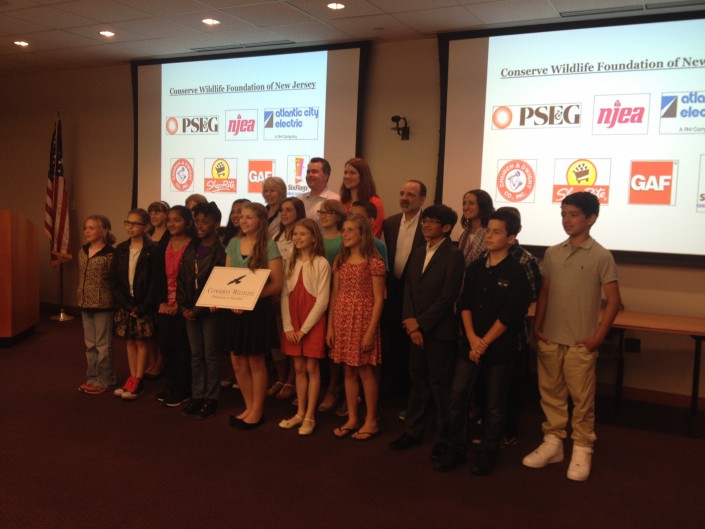
2015 Species on the Edge Winners with representatives from CWF and PSEG


Today, Conserve Wildlife Foundation of New Jersey celebrated and recognized the winners of the 2015 Species on the Edge Art & Essay Contest, a statewide educational contest open to all fifth-graders, which encourages students to become wildlife biologists through their research and artwork on the endangered and threatened wildlife species in New Jersey.


“The vibrant artwork and passionate essays that we received from fifth-graders across the state reveal just how much these talented children poured their hearts into the Species on the Edge contest,” said David Wheeler, Conserve Wildlife Foundation Executive Director. “We are so thrilled to help connect the next generation of New Jersey conservation leaders with the natural world around them. Through their art and essays, all of us can see the wonders of nature – and the many challenges that we must overcome to help rare wildlife survive in our densely populated state.”


Students were asked to draw a picture of one of New Jersey’s 83 endangered and threatened wildlife species and compose an essay about how the animal became endangered and what can be done to help protect it. The Species on the Edge Art & Essay Contest encourages students to learn about local environmental issues, express their concerns for the world around them, think creatively about ways to improve it, and to consider how their actions impact the natural world.


Abby Miller, a student at T.P. Hughes Elementary School in Union County believes that it is important to protect wildlife in New Jersey because “everything deserves to be saved when they’re endangered.”


Bald Eagle from Mercer County Wildlife Center

This year’s ingenious group of winners was honored at an awards ceremony which was hosted at the New Jersey Education Association, in Trenton, New Jersey. The contest was sponsored by PSEG, NJEA, GAF, Atlantic City Electric, Church & Dwight, ShopRite and Six Flags Great Adventure. Mercer County Wildlife Center brought a live Bald Eagle to the event.


The statewide contest drew over 2,000 entries from across the state. Since 2003, over 10,000 children from across New Jersey have entered the Species on the Edge Art & Essay Contest.


For more information, visit Conserve Wildlife Foundation’s website.


Lindsay McNamara is the Communications Manager for Conserve Wildlife Foundation of New Jersey.

Red Knots “Vote with their Wings”

An Update from the 2015 Delaware Bay Shorebird Project Team

By: Dr. Larry Niles, LJ Niles Associates LLC

Clive Minton is fond of saying, “the knots vote with their wings” as a way of saying knots concentrate in the best places for knots. Of course it’s true, animals move to the habitats they find most suitable, nature leaves little room for anything but. Sometimes however, animals use a habitat only because they have little choice — in other words, they are making the best of a bad situation. The job of a good wildlife biologist is to understand the difference. Unfortunately, it’s often not obvious.

Red Knot Photo by: Jan van der Kam


In all the places studied by this author — Tierra del Fuego, the Arctic, and many places in between — knots distinguish themselves as highly selective habitat specialists. There are many practical reasons for this: usually knots occur in flocks and thus require more space than many other species. More importantly, as they put on weight for their incredibly long-distance flights, they often push the limit of safe wing-loading (body weight to wing area). This makes them vulnerable to predators, both real and imagined. They need more flying space, more space for advance warning of a predator’s presence. They demand special roost habitats as well, especially night roosts that are free from disturbance and have good sight distances. Altogether they need more.

Red knots roost on a sandy spit on Egg Island, one of the largest contigous area of marsh in the mid Atlantic.   Half of the bay's shorebird population roost on Egg Island and than feed on the various beaches around Fortescue.
Red knots roost on a sandy spit on Egg Island, one of the largest contigous area of marsh in the mid Atlantic. Half of the bay’s shorebird population roost on Egg Island and then feed on the various beaches around Fortescue.


In Delaware Bay, they need all this, but above all they need good horseshoe crab egg densities. In the mid 2000’s when shorebird numbers were high, the demand for those eggs exceeded the production from the rapidly diminishing crab population. Knots wandered the bay like homeless refugees. Competition for eggs drew tens of thousands of birds to places unused by knots in healthier times.

Mispillion Harbor
Mispillion Harbor


Mispillion Harbor, Delaware, for example, in some years supported much of the knot population in the Bay because it acts like a funnel-trap for crabs. Crabs wandered into the harbor through long stone jetties finding themselves in crab breeding heaven, sandy shoals in a closed space, free from wind-generated waves that normally leave them upside down. The egg-laying frenzy caused eggs to reach epic densities, thus preparing many shorebirds for their onward journey to the Arctic. Tens of thousands of shorebird packed into Mispillion Harbor in densities so high that one could smell ammonia off-gassing from the amount of bird waste.


But for knots, Mispillion left a lot to be desired. The same jetties that protect the inner harbor from wind-driven waves also provide low-flying raptors the cover to pounce on flocks before they can easily react. Fat birds make easy prey for peregrine falcons, who themselves struggle to keep up with the insatiable hunger of rapidly growing chicks.

Photo by:  Jan van der Kam
Photo by: Jan van der Kam


But even as shorebird numbers fell in response to the reduced crab numbers, egg densities improved in other places. Knots reassessed their choices and voted with their wings.


This is why this year’s high count of red knots on the New Jersey side of the Bay are so important.  Two days ago, Mark Peck, Joe Smith and I flew the entire Bay to count knots, ruddy turnstones and sanderlings. We counted over 24,000 knots, with 21,000 of these using the beaches managed by the many groups that take part in shorebird management on the New Jersey shore of Delaware Bay.


I am not saying this is a competition between two states — I’m saying the numbers serve as assurance that all our hard work is paying off. It’s a confirmation that the beach restoration projects, the Shorebird Stewards project, the reTURN the Favor crab rescue project, and more are bearing fruit. These coordinated strategies are led by Conserve Wildlife Foundation of New Jersey, American Littoral Society, Manomet Center for Conservation Sciences,  New Jersey Audubon Society, the Wetlands Institute, Citizens United to Protect the Maurice River, The Nature Conservancy, as well as Downe Township, Maurice River Township, Middle Township and the Division of Fish and Wildlife, New Jersey Department of Environmental Protection. This work is funded by the US Department of Interior, Fish and Wildlife Service, the National Fish and Wildlife Foundation and the Willliam Penn Foundation. Good work all!

Jim May protect Cook Beach as part of  Conserve Wildlife Foundation of NJ's Shorebird Stewardship Project.  Each year the Division of Fish and Wildlife designates beaches important to shorebirds and protects them from disturbance.  The shorebird stewards alert Conservation Officers if people refuse to comply.  But most of thier job is helping people understand the shorebird migration and the needs of shorebirds and crabs
Jim May protects Cook Beach as part of Conserve Wildlife Foundation of New Jersey’s Shorebird Stewards project. Each year, the Division of Fish and Wildlife designates beaches that are most important to shorebirds and protects them from disturbance. The shorebird stewards alert Conservation Officers if people refuse to comply, but most of their job is helping people understand the shorebird migration and the needs of shorebirds and crabs.

We now near the end of the stopover season at Delaware Bay. Three days of southerly winds are proving irresistible for many birds. Nearly two-thirds have left and the rest will be gone in a few days. Thanks to the people who love birds and the residents of the Bay, they leave well-prepared for the next stage of their challenging and inspiring lives.

knots in the air

Learn more:

Dr. Larry Niles has led efforts to protect red knots and horseshoe crabs for over 30 years.


Help Clean-up the Barnegat Bay Watershed!

Barnegat Bay Blitz set for Wednesday, June 3, 2015

By: Lindsay McNamara, Communications Manager

Barnegat Bay

Concerned about the health of the Barnegat Bay ecosystem? Consider participating in a day of action for the Bay! The New Jersey Department of Environmental Protection (DEP) will be hosting its next Barnegat Bay Blitz clean-up day on Wednesday, June 3.


You can join thousands of volunteers as they fan out across the watershed, which includes all of Ocean County amd parts of Monmouth County, to clean up the Barnegat Bay Watershed and spread awareness about the people pollution impacting the Bay. Clean-up events are happening in all 37 municipalities!


To register for a clean-up, visit DEP’s website.


Barnegat Bay Blitz highlights include:

  • DEP Commissioner Bob Martin will be kicking off this year’s Barnegat Bay Blitz at the iconic Barnegat Lighthouse State Park. Hundreds of volunteers will gather at this one location to learn about the Bay and start a day full of awesome stewardship activities. Take part in the fun at 10 AM on June 3rd at the Lighthouse! To volunteer, visit DEP’s website.
  • In the middle of Barnegat Bay, there are many small islands called Sedges. These islands are home to a number of species of plants and animals, but unfortunately are impacted by litter that the tide washes in. Volunteers by boat, kayak and standup paddle board will make their way out to many of these islands, including Island Beach State Park, Seaside Heights and Brick to sweep them clean of debris. Get involved!
  • It’s not just the bayfront communities that impact Barnegat Bay. Communities miles and miles inland also play a role. After all, we are all downstream! That is why at the Barnegat Bay Blitz, volunteers will work to clean up all over the watershed, from inland areas of Plumsted to the barrier islands. In Plumsted, a farming community, volunteers include more than just people! Llamas will also join the crew to help haul out trash and debris that volunteers collect from the Colliers Mills Wildlife Management area. To make friends with llamas, register for the Plumsted clean-up on DEP’s website.

We hope to see you on Wednesday, June 3, for DEP’s next Barnegat Bay Blitz!


Questions? Feel free to contact:

Delaware Bay Shell-a-Bration Captured on Video

South Reeds Beach Oyster Reef Event Filmed by Local Delaware Bay Producer

By: Lindsay McNamara, Communications Manager

A record number of Red Knots were counted on New Jersey’s Delaware Bay this year, in part because of innovative restoration projects like our South Reeds Beach oyster reef.


Over 130 volunteers and veterans worked alongside Conserve Wildlife Foundation and American Littoral Society to establish a near-shore whelk shell bar at South Reeds Beach in Cape May Court House on the Delaware Bayshore in early April.


Shorebirds, like the federally listed Red Knot, depend on an uninterrupted supply of horseshoe crab eggs when they stopover in Delaware Bay during their migration. In recent years, countless horseshoe crab eggs have been lost because of the devastating storms that swept away the beaches they depend on.


The oyster reef was built to prevent sand loss from wind-driven waves. The approximately 200-foot project will test whether the reef bars help reduce beach erosion and create calmer water for spawning horseshoe crabs.


Learn more about the project and our “Shell-a-Bration” event in the video above produced by Kathleen Poliski of K. Productions, LLC!


The South Reeds Beach Oyster Reef is one of the many projects that American Littoral Society and Conserve Wildlife Foundation are working on to restore the ecology and economy of the Delaware Bayshore, thanks to generous funding by the National Fish and Wildlife Foundation. To learn more, visit RestoreNJBayshore.org.


Lindsay McNamara is the Communications Manager for Conserve Wildlife Foundation of New Jersey.

Celebrate International Migratory Bird Day 2015!

Restoring Critical Delaware Bay Habitat for Migratory Shorebirds

By: Kelsey Lawler, Spring 2015 Intern

Photo Credit: Photo Credit: Jan van der Kam
Photo Credit: Jan Van der Kam

Saturday, May 9 is International Migratory Bird Day (IMBD) 2015! It is time to celebrate and bring awareness to the spectacular event that is bird migration. Since 1993, IMBD has been serving as a celebration as well as a call to action for migratory bird conservation.


Conserve Wildlife Foundation of New Jersey has been doing their part for bird conservation. We have developed a range of programs to increase the numbers of endangered migratory birds, like the Red Knot, since their decline in the late 1990’s.


Red Knots use New Jersey’s Delaware Bayshore as a stopover for feeding after their long journey from the Arctic and South America. Delaware Bay plays a major part in the Red Knot life cycle, so we’ve focused our efforts on restoring this critical habitat. The Red Knot migration is timed to take advantage of the spawning of the horseshoe crabs that use the same beaches as breeding grounds. Their eggs provide a rich food source for the Red Knots at a time when they are in desperate need of nutrients.


We have been working to benefit both horseshoe crabs and the migratory shorebirds that feed on their eggs, like the Red Knot, through our beach restoration projects, oyster reef construction and monitoring projects. Since Superstorm Sandy, we have successfully restored over a mile of impacted horseshoe crab habitat. We’re working to further protect these beaches from erosion and to create calmer waters for horseshoe crabs through our oyster reef construction experiments. To learn more about our restoration work in Delaware Bay, visit RestoreNJBayshore.org.


Of course, we haven’t been able to do this work alone. Volunteers are one of the reasons why these projects are possible!


Celebrate International Migratory Bird Day by getting involved in migratory bird conservation:

Kelsey Lawler was the 2015 Spring Intern for Conserve Wildlife Foundation of New Jersey.