Every Thursday this summer, I am leading birding trips throughout Island Beach State Park. One week we walk, the next week we paddle. This Thursday, August 5th, I will lead a walk amongst the sand dunes and along the bay. The following Thursday, August 12th, we will paddle throughout the Sedge Islands.
Over the past couple of weeks we have seen a number of uncommon birds as well as some more common species. The interesting birds of the July 15th trip included numerous ospreys collecting nesting material and hunting and capturing fish to take back to their nest and feed their young; a great view of a flock of glossy ibis flying in the distance; and great views of Forster’s terns and double crested cormorants. The highlights of the trip on July 29th included a marbled godwit on a sandbar directly in front of the kayak launch; 12 whimbrels flying overhead; and a single brant near the mouth of Spizzle Creek. The number of shorebirds are steadily increasing in the bay as we move towards fall migration.
I hope you can join me on a walk or a paddle this August. The remaining walks for the season are August 5th, August 19th, and September 2nd. For more information about the bird walks, please call (609) 984-0621. The remaining kayak trips are August 12th and August 26th. Kayak trips are $25.00 and include a kayak, paddle, and life jacket.
For more information or to register for a kayak tour, please call 732-250-6314
1. Plant trees! The more the better, plant evergreens on the north-east side of your house and deciduous on the south side. Evergreens provide cover to birds and other wildlife in winter months and also shelter to your house from those cold NW winds. Make sure to choose native species like Eastern red cedar or Pitch pine for NW locations and Tulip poplar or Sweet gum for south locations.
2. Minimize use of pesticides and herbicides. Use only plant based pesticides, like ones made with Pyrethrum, which is made from the dried flower heads of Chrysanthemums. Try using vinegar as a natural alternative to broad spectrum herbicides. Do not use any pesticides or herbicides before any precipitation.
3. Use local and FREE mulch and compost. Many municipalities and county utility authorities provide free mulch to their residents. This is a great way to reuse a large portion of the waste stream in your county. Better yet, start a compost pile in your own backyard!
4. Use native species! They are acclimated to our climate and most are non-invasive. Many plants and trees sold at nurseries are meant to be aesthetically pleasing and most don’t provide suitable habitat for wildlife, besides providing cover.
5. Create a brush pile using branches and logs to provide cover for small mammals, reptiles, and songbirds.
6. Plant fruit bearing shrubs and trees. These can provide food for songbirds and other wildlife throughout the year. From eastern red-cedar and American holly to winged sumac and northern bayberry.
7. Reduce the size of your lawn by planting a wildflower garden. They require less water than cool season grasses and provide nectar to butterflies, bees and hummingbirds and also provide seeds to many songbirds. You will save money and time by reducing the amount of grass on your property.
8. Install bird and bat houses. Bird houses can provide a place for cavity nesting birds to nest, like chickadees, wrens, and bluebirds. Monitor the birdhouse throughout the spring and summer to be sure no exotic species are utilizing it, like European starlings. Maternity bat houses can provide female bats with a place to raise their young. Bats feed on thousands of insects each night. They help control insect populations and in some areas help pollinate fruit and vegetable crops.
9. Wildlife need water to survive. Put out a bird bath or even better, install a pond. A simple bird bath can be a medium-sized saucer or shallow bowl. Change the water frequently to prevent mosquitoes from breeding. Ponds are even better for wildlife, especially amphibians, like frogs, toads, and salamanders. A simple pond can be made out of an old bath tub. Place rocks along the edge, plant some flowers along the edges, and put some branches and rocks in the water to enhance the habitat in the pond.
Educating people about Barnegat Bay and its bird populations
By Skyler Streich, Barnegat Bay Birder-in-Residence
My name is Skyler Streich. I am an avid birder with excellent identification skills of eastern bird species of the United States. I have been birdwatching intensely for 5 years and since then have accumulated quite a knowledge and understanding of birds, their habitats and behavior. My background is a BS in Geology with a concentration in Paleontology. I got into birds when I was studying abroad in Costa Rica and one day on my campus in San Jose I saw a hummingbird fly to a flower to drink the nectar. Since then I became hooked and fascinated with birds. I have had positions with the Delaware Division of Fish and Wildlife as a Piping Plover Monitor, The Nature Conservancy as a Seasonal Field Biologist working with the endangered Black-capped Vireo, and a Natural Educator for both Island Beach State Park and Cattus Island Park, NJ. I have also conducted numerous bird surveys for The Audubon Society of Rhode Island, International Shorebird Surveys and CBC counts. Nationally I have birded all through the eastern states as well as through southern Florida, Texas, southeast Arizona, western Washington, here and there throughout the interior states and Hawaii. Internationally I have birded in Costa Rica, Panama, Australia, Trinidad and Tobago, Nova Scotia and PEI, British Columbia, England, France, Spain and Portugal and Tanzania. For my position with Conserve Wildlife Foundation of NJ as a Barnegat Bay Birder-in-Residence I will be conducting morning bird walks and kayak birding tours at Island Beach State Park, NJ. I will also be a roving interpreter at IBSP and helping out with research with the marsh and beach-nesting birds in NJ.
Hello all! I’m new to this blog so I’m going to introduce myself. My name is Agata Kaczkowski and I’m a student in New Jersey City University. Currently I’m lucky enough to be completing my internship for Conserve Wildlife Foundation of New Jersey. In May, 2012 I’m expecting to graduate with a B.S. in Biology (which explains my love for nature).
As the temperature outside reached 95°F. Ben Wurst and I arrived on Sedge Island on 06/28/2010. A camp composed of middle school students greeted us as we approached the island. I was pleasantly surprised to find out how knowledgeable these kids were on the subject of ospreys! After a brief introduction, Ben and I started our journey to visit over 20 nests with hopes of finding healthy osprey chicks. Even though the weather was extremely hot the cool breeze from the ocean and the ability to soak my feet from time to time in the water made all the difference. The students followed us to the first couple of nests, where they got to hold an osprey chick as it was banded, and they took some photographs with the chicks. As we approached the second nest, the female osprey was flying really low and seemed very aggressively protective of her young. The female is usually larger and more protective of the chicks than the male. She was soaring really low as Ben was banding the chicks at the nest site, the kids observed the whole incident from their kayaks. Ben and I had over 20 nests to visit, so as the kids went back to the island we continued our journey. At the fourth nest we encountered an unpleasant situation- deceased three-week-old chick. Of the two that hatched, one had died, most likely of natural causes. We cleaned the nest and moved along.
The boat was a great way of getting from one nest to the other, although at times we had to push it because the water was too shallow for the boat. My job was to record the nest type, the number of chicks hatched, number of chicks banded and the band number (that was only if Ben thought it safe enough to band them). Most of the chicks were banded, although a couple were too young to band. We ended up banding about 26 osprey chicks around the island.
Cleaning up the fishing nets and balloon ribbons from nests was a must because the young may get tangled in the debris and not survive. I personally found bottles and shopping bags all over, which was frustrating because this is how the habitat gets destroyed. I will keep you all updated on my next field experiences…
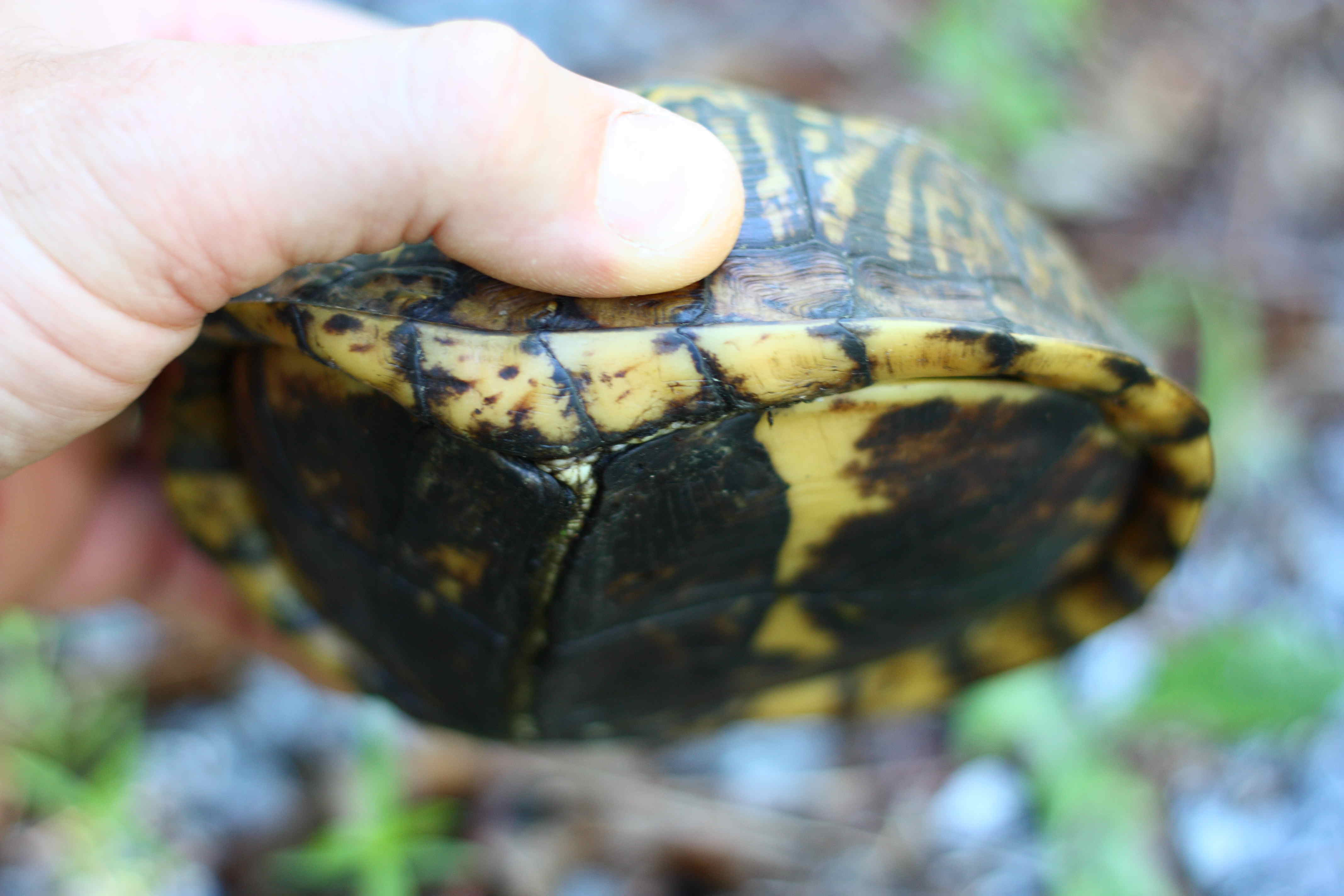
Highly domed carapace (upper shell) and a hinged plastron (lower shell). Most terrestrial turtle found in New Jersey.
Identification
Box turtles range in length from only 4″ up to 8.5″. The shell of the box turtle is unique. It’s carapace is high and shaped like a dome. It’s keel, or the ridge along the backbone is weak or very flat. The plastron is hinged and can close very tightly, in front and in rear. This is meant to protect the turtle from predators, especially the neighborhood dog.
Sexes are slightly similar in appearance. Both have yellow, orange, olive, or tan on their carapace and plastron that is contrasted by a light or dark black background. Individuals can appear very different in coloration. The male (pictured above) is very vibrantly colored. Younger turtles are more vibrantly colored than older ones. Males have a longer and wider tail than females. Their carapace is often more flattened than females. Males have a more vibrantly colored (orange or red) eyes. The plastron of males is slightly concave. Females have lighter colored (light brown to light orange) eyes and their plastron is flat. Their carapace is often more domed in shape.
Distribution and habitat
The Eastern or Common box turtle occurs in the eastern United States from central Maine south to southern Georgia and Alabama, west to central Michigan and southern Wisconsin and then south into parts of Illinois, all of Kentucky, Tennessee, and then parts of Mississippi. It can be found in all of the 21 counties in New Jersey.
Range of the Eastern box turtle. Image courtesy Davidson College Herpetology Lab.
Box turtles inhabit open woodlands and meadows. They are often seen in neighborhood backyards in rural and suburban areas. They are usually not far from streams or ponds, however, during rainy weather they may roam farther from water. They are the most terrestrial turtle found in New Jersey. They like water, but are not adapted for swimming in water.
Studies have shown that box turtles have very small home ranges. Researchers found that their territories are around 250 square yards or less. If box turtles are removed from their territories and placed in an unfamiliar area, then they may die while trying to find their way back home. It is very important to not take a box turtle from its habitat and relocate it. If you find an injured one and do transport it to a state certified rehabilitator; record the animals location and make sure to inform the rehabilitator so it can be re-released where it was found.
Diet
Box turtles are omnivores. Changes in food preference occur during different seasons and life stages. Young turtles eat more insects, while adults eat more plant matter. Young turtles eat earthworms, snails, insect larvae, and some vegetative matter. Adults eat large quantities of fungi and particularly like berries and fruits from trees and shrubs.
Life Cycle
Box turtles, like other reptiles are cold-blooded and in the northern parts of their range hibernate from late October or November until April. During hibernation they burrow into loose soil, vegetative debris, and/or loose sand, and sometimes in the mud of stream bottoms. They dig burrows with their front legs, instead of their back legs (which are used to dig holes for laying eggs). Some hibernate at depths up to two feet deep. They can arise during warm spells.
Individuals become reproductive at 4 to 5 years in age. They can live to be older than 20 years in age. Mating begins shortly after individuals emerge from hibernation. During courtship, males chase or follow females to mate. Males often bite the edges of the females carapace, head, and neck. The male mounts the female (males have the concave plastron that helps during copulation) and hooks his back legs under the back edge of the females shell. During copulation the males body becomes upright and reproduction occurs. There has been evidence that females can remain fertile for two or three years after mating.
Eggs are laid in June and July. Nesting usually occurs in the late afternoon. Females deposit eggs in a hole that she digs in loose or sandy soil and sometimes in lawns. The cavity is around 3 inches deep, or about as long as the back legs of the adult female turtle. They lay between 2 to 7 eggs. Most hatching occurs in September or average incubation is around 87 to 89 days. Young either remain in the nest after hatching, emerge and go directly into hibernation, or emerge and explore for a few days to weeks, then hibernate. They do not require food during their first summer or fall before going into hibernation.
Current Status, Threats, and Conservation
Box turtles are fairly common throughout their range; however, they’re population is declining in New Jersey. Habitat destruction and fragmentation isolate individuals from finding mates and food. This causes local populations to decline in numbers or become extirpated from an area. Their slow reproductive rate does not allow for a fast recovery if a local population losses several individuals in a given amount of time.
Be aware for box turtles while driving!
Another threat to box turtles is the illegal collection for use as pets. They are highly sought for their use in the illegal pet trade (one of the world’s most profitable markets). Many people collect box turtles to breed in captivity for use as pets. Another conservation concern is the impact of high mortality rates from impacts with motor vehicles. Many roads transect suitable habitat for box turtles and many turtles that enter roadways die each year.
These threats have exacerbated their decline and the fact that the NJ Division of Fish and Wildlife, Endangered and Nongame Species Program have listed them as a Species of Special Concern. This listing will mostly importantly help garner protection through enhanced habitat protection of suitable or critical habitat for box turtles.
How to help
The Endangered and Nongame Species Program would like for individuals to report their sightings of box turtles. Record the date, time, location, and condition of the animal and submit the information by submitting a Sighting Report Form. The information will be entered into the state’s natural heritage program, commonly referred to as Biotics. Biologists map the sighting and the resulting maps “allow state, county, municipal, and private agencies to identify important wildlife habitats and protect them in a variety of ways. This information is used to regulate land-use within the state and assists in preserving endangered and threatened species habitat remaining in New Jersey.”
Schwartz, Vicki and Dave Golden. 2002. Field Guide to Reptiles and Amphibians of New Jersey. NJ Division of Fish and Wildlife. Available in our online store!
Visitors to Reeds Beach discuss the shorebird season with Shorebird Steward Jim May.
One part of my job that is quite enjoyable is getting to spend time on the Delaware Bay beaches in the spring and working with the Shorebird Stewards. As the CWF volunteer manager I organize the Shorebird Steward program which is part of the International Shorebird Project. During the two week period that stewards are on the beaches I try to get out and check on the beaches and meet with the stewards as much as possible. This season there were 26 stewards and 23 of those had worked as stewards during a previous season.
The main part of the steward’s job is to educate people about the shorebirds and horseshoe crabs, but they do a lot more than that in a day. Stewards also keep people from going into the closed areas of the beaches so that the shorebirds can feed undisturbed. They give directions and send people to the beaches where the most birds have been sighted that day.
Shorebird Steward Rochelle Gimmillaro points out shorebirds to visitors to Cook’s beach.
If they have time they also count the number of shorebirds on the beaches and if possible record any banded birds that they see. Stewards deal with all types of people and situations. Some beaches are much busier than others, such as Reed’s beach where there is a viewing platform. On many days there is a constant stream of people coming to the view the shorebirds and horseshoe crabs.
This season there were very few problems on the beaches and it is directly due to the shorebird stewards hard work and dedication to the project.
I look forward to getting back on the beaches next shorebird season and working with such a great group of volunteers.
A student at Unity Charter School shows off his bald eagle sculpture (c) Maria Grace
Recently, I went to Unity Charter School in Morristown to give a presentation to the 3rd and 4th graders about NJ’s endangered wildlife.The students in Julia Kelly’s class raised over $100 for Conserve Wildlife Foundation as part of a unit on endangered species.
These students impressed me with their breadth of knowledge and genuine passion to try and protect NJ’s rare wildlife. Ms. Kelly did a fantastic job using New Jersey wildlife as a focus to teach about the global issue of endangered species.Each student selected an endangered species that lives in NJ (there are 73 currently listed as either endangered or threatened). They did some research about its habits and habitats and wrote a report.
But as a finale to their projects, each student created a sculpture of their animal in its preferred habitat.I was overwhelmed by these sculptures and completely amazed by the students’ attention to detail and their comprehensive knowledge of their chosen animal. They really wowed me with their art creations and I wanted to share it with the masses in the hopes that these students will move more of us to support the work of Conserve Wildlife Foundation.
This April, for the second year in a row, I had the happy task of visiting the sixth graders at Valleyview Middle School in Denville, Morris County. Valleyview students have taken a great interest in bats lately…partly because their school sits a mere 3 miles from Hibernia Mine, New Jersey’s most important known winter den for resident species like the little brown, northern long-eared, and endangered Indiana bats.
Bats have always been a common neighbor in their town. And since White-nose Syndrome appeared two winters ago, Denville residents have literally had a front row seat to the toll it has taken. Many have seen bats flying on cold winter days, searching for food that would not be found, and many have seen the bodies of starved bats on the ground.
Valleyview Middle School has a fantastic science faculty, with teachers like Dan Gross and Chris Bias who aim to give the kids tangible experiences with topics that relate to their own community. They chose to turn the White-nose Syndrome crisis into a learning opportunity:
The school invited us to come in and teach the students about their local bats and talk about the work we’re doing to help study and protect them. I got to interact with the entire sixth grade, first finding out how much they already knew about bats and then teaching them a whole lot more!
I came back a second day to put the kids to work – we built six bat houses which will be installed in parks and other properties across the region. Everybody (including me) had a lot of fun with the screw guns, hammers, and caulk…and my “no eyes poked out” success streak continues!
The school also made an “Adopt A Species” donation to the Conserve Wildlife Foundation to support our work.


 My name is Skyler Streich. I am an avid birder with excellent identification skills of eastern bird species of the United States. I have been birdwatching intensely for 5 years and since then have accumulated quite a knowledge and understanding of birds, their habitats and behavior. My background is a BS in Geology with a concentration in Paleontology. I got into birds when I was studying abroad in Costa Rica and one day on my campus in San Jose I saw a hummingbird fly to a flower to drink the nectar. Since then I became hooked and fascinated with birds. I have had positions with the Delaware Division of Fish and Wildlife as a Piping Plover Monitor, The Nature Conservancy as a Seasonal Field Biologist working with the endangered Black-capped Vireo, and a Natural Educator for both Island Beach State Park and Cattus Island Park, NJ. I have also conducted numerous bird surveys for The Audubon Society of Rhode Island, International Shorebird Surveys and CBC counts. Nationally I have birded all through the eastern states as well as through southern Florida, Texas, southeast Arizona, western Washington, here and there throughout the interior states and Hawaii. Internationally I have birded in Costa Rica, Panama, Australia, Trinidad and Tobago, Nova Scotia and PEI, British Columbia, England, France, Spain and Portugal and Tanzania. For my position with Conserve Wildlife Foundation of NJ as a Barnegat Bay Birder-in-Residence I will be conducting morning bird walks and kayak birding tours at Island Beach State Park, NJ. I will also be a roving interpreter at IBSP and helping out with research with the marsh and beach-nesting birds in NJ.