SPECIES ON THE EDGE ART & ESSAY CONTEST AWARDS CEREMONY
by Karena DiLeo, Assistant Biologist
The Species on the Edge Art & Essay Contest Awards Ceremony was May 6th at the New Jersey Education Association in Trenton. We had a great turn out and would like to thank everyone who attended and submitted entries into the contest. We received over 2,000 entries this year! Winning artwork is currently on display at NJ Audubon’s Plainsboro Preserve and will travel to Liberty State Park on June 6th.
Angela Guo from Mercer County received her First Place certificate from CWF Executive Director Margaret O'Gorman and Board Member and sponsor Bob Coleman.
Matt Klewin and Liz Silvernail at the CWF table.Rebecca and Tari Clark with their new eagle birdhouse.
On Sunday May 1st Liz Silvernail, CWF Director of Development, and I spent the day at the Atlantic County Utilities Authority Earth Day celebration. The weather was gorgeous and we were busy all day talking to people about CWF and the different projects that we are working on. Kids especially stopped by to see the mounted Barred Owl, Peregrine Falcon and turtle shells. Also helping at the table were volunteers Matt Klewin, Margaret Klewin-Atack and their daughter Rhianna. Their team the, Wrending Talons, which has been together for 18 years, will be participating in the World Series of Birding on May 14th and CWF is the recipient of their pledges.
We also had a free raffle for an eagle bird house made by eagle project volunteer Kevin Buynie. The winners were Tari Clark
and her daughter Rebecca. They were thrilled to be the winners and were excited to see if any birds would nest in the house this year.
This week I had the opportunity to speak to a group of 5th grade students at the Ocean City Intermediate School. The group of 44 students are in Mrs. Rosander’s science class. Over the holidays the students earned money for a charity and this year they chose to adopt a piping plover for their classroom through the CWF Adopt a species program.
As part of the adoption they received a classroom visit by a CWF staff person, which was me. I spoke about NJ’s rare wildlife and of course their adopted species the Piping Plover. The students were already very knowledgeable about NJ Endangered and Threatened species. One of their class assignments was to write an essay or draw a picture of one of NJ’s E & T species. For extra credit they could do both and those were entered in the Species on the Edge Art & Essay contest. The students had a lot of great questions for me and I think there are some future environmentalists in the group!
On Saturday February 5th thirty eagle project volunteers met to discuss the 2011 eagle season. The meeting took place during the Cumberland County Eagle Festival which is held the first Saturday in February. It was a rainy day but that didn’t keep the volunteers away.
During the festival there were talks, walks, vendors and educational displays. Eagle Project volunteer Kevin Buynie made and donated two eagle shaped bird houses to CWF. We raffled one off at the festival and it was a big hit!
People stopped by the CWF table and reported eagle sightings and a few possible new eagle nests. It is always nice to see how interested people are in eagles, raptors and wildlife in general.
Thank you to everyone who came out to visit us and support our work to monitor and conserve eagles in New Jersey!
Our website features profiles on every one of New Jersey’s 73 Endangered or Threatened species in our Online Field Guide. Now, we’re beginning to profile New Jersey’s Species of Special Concern. The term “Species of Special Concern” applies to species that warrant special attention because of some evidence of decline, inherent vulnerability to environmental deterioration, or habitat modification that would result in their becoming a Threatened species. This category may also be applied to species that meet those criteria and for which there is little understanding of their current population status in the state. There are currently 108 species within New Jersey with the Special Concern status. So far, we have profiles for 18 of those species.
Wildlife Preservation Club members build bat houses for NJ bats
by Maria Grace, Education & Outreach Manager
On Tuesday, December 14th, I had the pleasure of working with over 60 middle school students from 2 Union Township (Union County) schools, Burnet Middle School and Kawameeh Middle School. Larry Petras, Advisor of the club, received a grant to educate the club members about bats and build and install bat houses around the township. Mr. Petras reached out to Conserve Wildlife Foundation to help fulfill his and his students wishes of improving bat habitat throughout their community. So with wood, caulk, screws, and power drills in tow, I arrived at Burnet Middle School to assist the students in building bat houses that will be placed around the township to bolster the bat population.
First, I gave a presentation about bats – their natural history, habitat requirements, and importance to the environment. Afterwards, the over 60 students were broken into groups and given the task of building 3 chambered maternity bat houses, capable of holding of approximately 80 bats.
I have run many bat house building workshops over the last couple of years and I always describe the scene as “controlled chaos.” Enthusiastic kids with power tools, staple guns, and caulking guns, can make any educator a bit tense. And to top it all off, this group was the largest group that I had ever done a bat house buildilng workshop for – over 60 middle schoolers! (we usually top out at about 25 students for building 5 bat houses.) But Mr.Petras assured me that the students would be well-behaved and respectful of the work that would be completed.
The kids moved through the task with shining colors – I was so completely impressed with how the students worked together and allowed each other to help build the houses. They made sure everyone had a turn working with the tools. Those that knew how to use a caulking gun or a power drill, taught those who did not. The satisfaction of building something from a pile of wood was evident in the buzz that hummed throughout the room.
The end result was 5 bat houses capable of holding 400 or more bats. With plans to build more bat houses, Mr. Petras and his students are well on their way to doing their part to conserve wildlife in their community.
To Mr. Petras and his students, thank you for wanting to help protect New Jersey’s imperiled wildlife. It is inspiring to see such enthusiasm and dedication in a group of young people. I hope you enjoyed the project as much as I did.
Bats get a bad rap – they are blind bloodsuckers that get caught in our hair. But these are all myths and this post is going to bust them!
There are no bloodsucking bats in the U.S. Yes, there are vampire bats in the world (3 species live in the tropics from Mexico to Brazil, Chile, and Argentina) and while they do rely on blood for their sustenance, they don’t view people as a food source. They usually pierce the skin of livestock such as cows, goats or chickens, and gently lap the blood from the wound (similar to how a dog licks water from a bowl).
Bats are not blind. Most species of bats have very good eyesight but they usually depend on their sense of echolocation to navigate through the world. They emit high frequency sounds into their environment and these sounds bounce off objects and back to the bat. The bat is then able to interpret the sounds and create a picture of what their environment looks like.
Bats rarely get caught in human hair. Bats, using their sense of echolocation, can detect objects as fine as a single human hair in total darkness. They are not aggressive animals but they can fly too close to people while feeding on insects or when flying low over water to take a drink.
Beneficial bats eat bugs. Bats are incredible animals and do a lot for us. All nine species of bats found in New Jersey eat insects, consuming one-third of their weight in bugs each night. Bats play essential roles in keeping populations of night-flying insects in balance. Just one bat can catch hundreds of insects in an hour, and large colonies catch tons of insects nightly, including beetles and moths that cost American farmers and foresters billions of dollars annually, not to mention mosquitoes in our backyards.
Bats play a key role in pollination. In other areas of the world, bats are the primary pollinators for many desert plants like the saguaro and organ pipe cactus as well as many species of agave. Bats also help in the pollination of fruits and veggies like bananas, avocados, coconuts, vanilla, dates, and mangoes.
Bats also help in seed dispersal. In fact, seeds dropped by bats can account for up to 95 percent of forest regrowth on cleared land. Bats spread the seeds of almonds, cashews, and chocolate. Did you read that? CHOCOLATE! Bats help us to have more cacao trees, which produces the yummy main ingredient of our favorite Halloween treats!
So instead of screaming and freaking out if and when you see a bat, why don’t you stop and appreciate it and maybe say a little “thank you” for all the wonderful benefits they provide to us. Halloween wouldn’t be the same without bats and the delicious m&m’s, snickers, and Almond joys are made possible because of the wonderful, now better understood, bats of the world.
Enter the 2011 Species on the Edge Art & Essay Contest!
by Maria Grace, Education & Outreach Manager
Open to all 5th graders throughout New Jersey, the very popular Species on the Edge Art & Essay Contest encourages students to think about rare wildlife in New Jersey, not just on television.
To enter the contest, students research a species of wildlife that is rare or endangered in New Jersey. They write an essay detailing the needs of the species and the challenges to its future existence. They then create artwork – a painting or collage – depicting their chosen animal in its natural habitat.
Over the past 8 years, almost 20,000 students have entered the contest and have expanded their knowledge about New Jersey’s imperiled wildlife. Hundreds of teachers throughout the state have participated in the contest and have praised its interdisciplinary approach and its ability to create a deep appreciation for nature:
“My students love the Species on the Edge Contest because they enjoy learning about the many endangered animals in New Jersey, which fits into our curriculum. The contest helps raise their awareness about how humans interact with the natural world. My students take ownership of one species, and through artwork and research, they express their concerns about the environment and how to protect it.”
–Mary Keyser, Maple Road School, West Milford, NJ
A winner is chosen from each county in NJ, 21 winners in all. The winning artwork and essays become part of a statewide traveling exhibit, helping to raise awareness for New Jersey’s endangered wildlife. Finally, the winning entries are published in a beautiful, colorful calendar to help inspire people to conserve wildlife throughout the year!
2011 Species on the Edge Calendar
The contest is free and it’s easy to participate! Download your contest kit today from our website. The kit contains everything you need to participate – lesson plans, entry forms, and a list of approved resources for research.
The 2011 Species on the Edge Calendar is now available in our store for only $8. It makes a great gift for friends, family, and co-workers. Get your copy today!
As the Barnegat Bay Birder-in-Residence for CWF of NJ I led a total of 4 Bird Walks and 4 Birding by Kayak Tours in Island Beach State Park. It was very successful with a total of 60 people attending the Birding by Kayak trips and a total of 34 participants for my bi-weekly bird walks. There were many repeat customers, mostly from participants that enjoyed the Birding by Kayak trips so much so they wanted to attend my bird walks too. The participants ranged from beginners to excellent and avid birdwatchers. So it was a nice mix of skill levels of bird identification abilities on the trips. The Birding by Kayak tours were sponsored by the Friends of Island Beach State Park, so they advertised those tours via the IBSP Visitor Guide. As for my bird walks I advertised them by printing out flyers and distributing them to local businesses like Big Ed’s produce, Lavallette Post Office, Wild Birds Unlimited and Cattus Island County Park. Also Pete Bacinski of Sandy Hook posted my walks in the Rare Bird Alerts which is posted on the JerseyBirds forum. And of course, they were posted on CWF’s Calendar of Events.
The tours were extremely successful in seeing all of the common birds of the Barnegat Bay area as well as numerous uncommon to rare sightings. Each kayak tour gave participants the chance to see and compare all the herons and egrets that inhabit the saltmarshes of Barnegat Bay. Each tour there were juvenile Little Blue Herons, which are all white, and the later tours had Black-crowned Night Herons. More than once we got to see beautiful and not too common shorebirds like Whimbrels and Marbled Godwits along with the much more common sandpipers and plovers. Other great shorebirds seen on the BBK trips were Pectoral Sandpipers and a Solitary Sandpiper. We even had a Caspian Tern amongst the Royal Terns. It seems that Ospreys were even more abundant this year than last year, with plenty of hatch year juveniles around in late July and August. Also, American Oystercatchers seemed unusually abundant this year.
The bird walks also produced some exciting and uncommon birds. Least Terns seemed to be in pretty high numbers in August. Also we had multiple Black Tern sightings in and around the inlet area. One of the best finds was a group of 8 Common Eiders that decided not to migrate to their arctic breeding grounds and just stay in Island Beach for the summer. We also had 1 single Piping Plover feeding amongst the Sanderlings and Semipalmated Plovers on the shoreline. That was only the second Piping Plover I have ever seen at IBSP in my life. So all in all, it was a very successful season with very successful tours and each participant walked away with a greater appreciation of the magnificent birdlife that relies on the Barnegat Bay area for their survival.
Kids spend a week exploring the natural wonders of Barnegat Bay.
By Maria Grace, Education & Outreach Manager
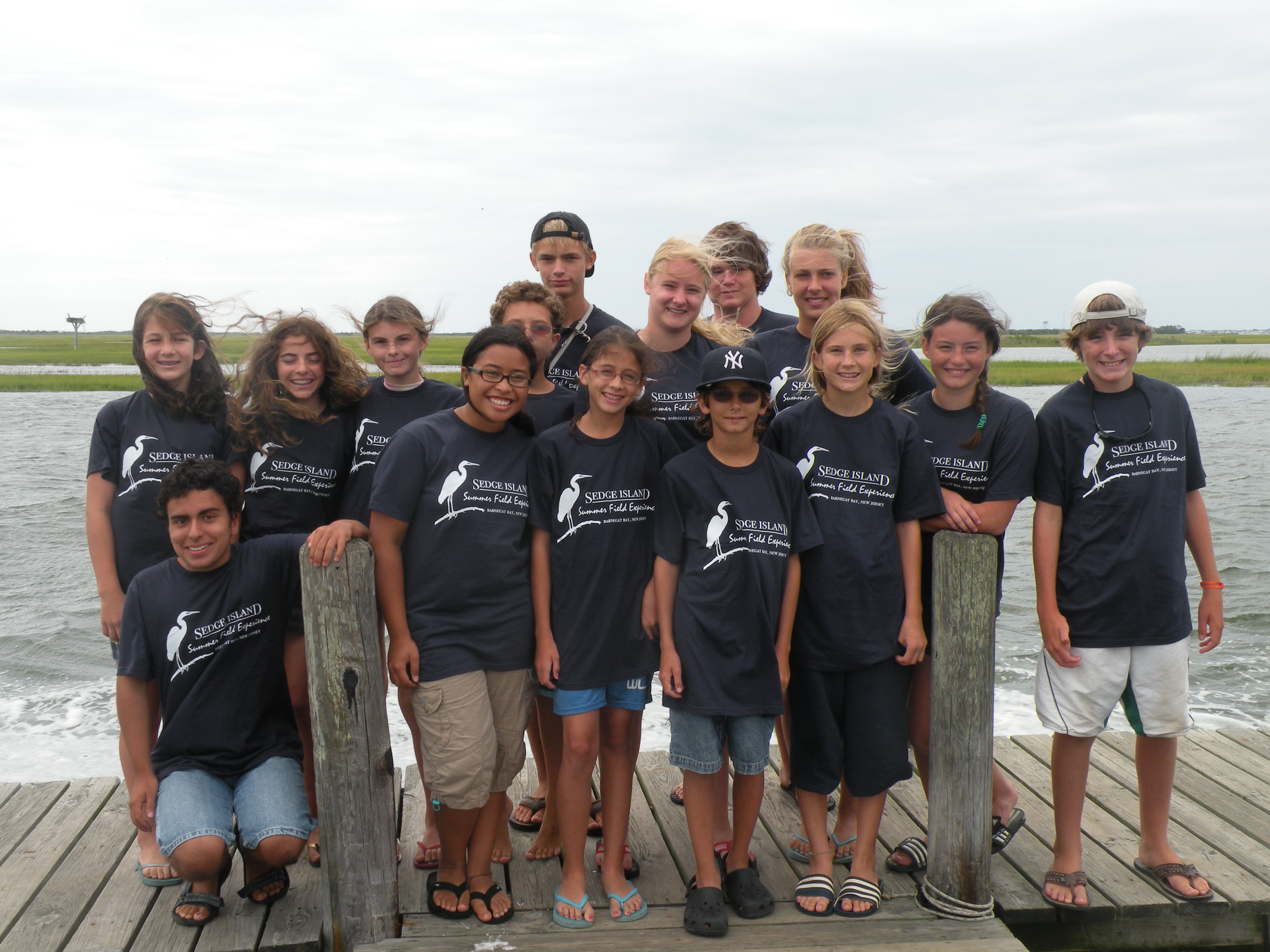
Earlier this month, 14 kids from across the state, got to spend the week in Barnegat Bay. They were the first participants in the Sedge Island Summer Field Experience, a week long immersion that took place at the Sedge Island Natural Resource Education Center, a facility run by the NJ Division of Fish & Wildlife within the Sedge Island Marine Conservation Zone.
Participants from the first Sedge Island Summer Field Experience.
This outstanding group of kids spent time clamming, kayaking, bird watching, fishing, fish tagging and even saw diamondback terrapins hatching. Each day a different activity was organized by our friends and partners in the conservation community and each night, the group reflected on their activities by writing in journals provided especially for this experience. These kids were privileged to learn from the experts – biologists and environmental specialists who work on various topics like shellfish restoration, bird and terrapin conservation, to oceanography.
On the last day of the experience, the kids welcomed their families to the island and the kids taught their parents about Barnegat Bay and its natural wonders. All involved considered this pilot program to be a great success that will be duplicated in future years. If you are interested in applying to attend future Sedge Island Summer Field Experiences, please email maria.grace@conservewildlifenj.org.


 Open to all 5th graders throughout New Jersey, the very popular Species on the Edge Art & Essay