2018 NJ Bald Eagle Project Report

by: Larissa Smith, CWF Wildlife Biologist
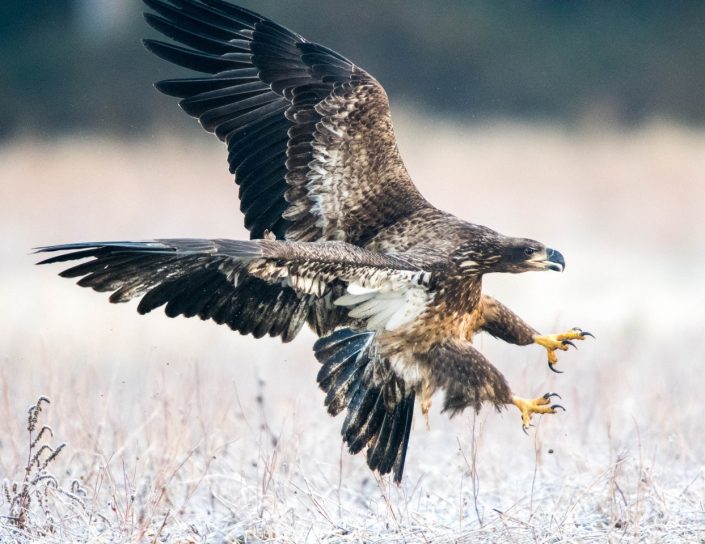
photo by Bob Kane, Cranbury, Middlesex County

The Conserve Wildlife Foundation of NJ in partnership with the NJ Division of Fish and Wildlife, Endangered and Nongame Species Program, has released the 2018 NJ Bald Eagle Project Report.

“Two hundred-four nest sites were monitored during the nesting season, of which 185 were documented to be active (with eggs) and 19 were territorial or housekeeping pairs.  Thirty new eagle pairs were found this season, 20 in the south, nine in central and one in the north.  One hundred-twenty-one nests (66%) of the 182 known-outcome nests produced 172 young, for a productivity rate of 0.94 young per active/known-outcome nest. The failure rate was well above average with 61 nests (33%) failing to produce.  The Delaware Bay region remained the state’s eagle stronghold, with roughly half of nests located in Cumberland and Salem counties and the bayside of Cape May County.”

The number of active nests has increased while the number of young eagles fledged has decreased since a high of  216 young fledged in 2016.  During the 2018 eagle nesting season there was an abundance of cold, wet, windy and snowy weather which was the cause for a portion of the nest failures. As the eagle population increases, there are  more eagles competing for territories. This can also be a contributing factor in nest failures.  NJ is still in the range of 0.9 to 1.1 young per nest which is needed for population maintenance with a productivity rate of 0.94 young per known-outcome/active nest in 2018. The 2018 NJ Eagle Project Report has all the details on the project including telemetry, re-sightings and recoveries.

The success of the eagle project is due to the tremendous dedication of the NJ Eagle Project Volunteers. They monitor the nests in all types of conditions and education people about the eagles with enthusiasm.

THANK YOU


Bald Eagles and Lead: A Deadly Mix

by Larissa Smith, CWF Biologist
Lead poisoning continues to be a serious issue affecting Bald Eagles today.  CWF and ENSP biologists produced a brochure to educate hunters about this issue and ask for their help. Below is an excerpt from the brochure. Please view the entire brochure and pass along to anyone you know who is a hunter.
One person can make a difference!

Thank you.

Eagle with lead poisoning at Tri-State Bird Rescue@Erica Miller

“Bald Eagles have made an amazing recovery in NJ since the 1980s. Today the eagle population still faces challenges and one of those is lead poisoning. Lead in the environment is dangerous to eagles as well as humans, and is often deadly. Unintentional poisoning of eagles can occur when they scavenge gut piles from deer or other game species shot with lead ammunition. It takes just a tiny fragment of lead to sicken and kill an eagle. Each year avian rehabilitators receive eagles that are diagnosed with lead poisoning and most will die. There is no good treatment for lead poisoning.”

Video from the Field: Osprey Platform Install

Ensuring Osprey Platforms Remain Resilient

by Ben Wurst, Habitat Program Manager

On a brisk November morning, a couple dedicated NJ Osprey Project volunteers joined myself and CWF Biologist Larissa Smith to install an osprey platform on the coastal saltmarsh of New Jersey. The new platform was installed to replace a very old and unstable platform that fell this summer. The new structure is more than twice the size of the old one and will give the nesting pair, who return in the spring, a much more resilient nest site. As you can see from the video above, it takes a bit of strength to raise up a 16′ tall wood nest platform. We decided to slow it down when WCC Volunteer, Wayne R. gives it a final push. Continue reading “Video from the Field: Osprey Platform Install”

Early Birds….

by Larissa Smith: CWF Biologist

Some of New Jersey’s  eagle pairs are getting an early start on the 2019 nesting season. Eagles in NJ will begin incubation anywhere from January through March.  NJ Eagle Project volunteers usually report eagles back and working on the their nests in the late fall/early winter.  But some pairs have already been spotted sprucing up their nests in preparation for the upcoming nesting season.

Kettle Creek 9/27/18@Alex Tongas
Overpeck 10/24/18@D.M. De Santis

Injured Eagle Flying Once Again

…thanks to help from some friends.

By: Larissa Smith, CWF Biologist

On August 20th, 2018 a resident of Monmouth Beach reported a young eagle that had been perching in the neighborhood and was possibly injured.  NJ Eagle Project Volunteer Randy Lubischer,  was able to respond and check out the situation.  The bird was a hatch year eagle, which means it fledged during this nesting season.  The eagle was feeding on a swan carcass and though Randy could get fairly close,  the bird was able to fly a short distance and appeared to have an injury to its left leg. The eagle had been seen feeding on the swan carcass for the past few days, so it was assumed that its injury was keeping it from hunting and the bird would only get weaker over time.

Injured eagle before capture@ R. Lubischer

Continue reading “Injured Eagle Flying Once Again”

Documenting the presence of plastics in osprey nests

The threats are real and these photos should alarm you!

by Ben Wurst, Habitat Program Manager

U.S. Coast Guard assists NJ Fish & Wildlife with recovering an entangled osprey on a channel marker in Cape May Harbor, Summer 2018. photo by Kathy Clark/ENSP

As I work to finalize data from this summer’s osprey surveys, I wanted to look back and highlight an important observation: more plastic is being found and recovered from active osprey nests. I guess it’s no surprise when you hear that “18 billion pounds of plastic waste flows into the oceans every year from coastal regions.Continue reading “Documenting the presence of plastics in osprey nests”

Just Beneath the Surface: Junior’s 5 Seconds of Fame

Long Beach Island video series highlights coastal birds of prey and “Junior,” from the Jersey City Falcon Cam!

by Ben Wurst, Habitat Program Manager

When we were contacted to be a part of this LBI centered documentary series, we knew that we couldn’t pass up the opportunity to share some of our work with coastal raptors, like the osprey and peregrine falcon, and their importance in the local environment and economy. In this video you’ll see us banding “Junior,” who hatched at the Jersey City Falcon Cam this spring, but was removed from his nest after being examined and found to be malnourished. We was fostered into the falcon nest at Sedge Island. You’ll also see video of ospreys on their nest at sites surrounding Long Beach Island, and interviews with my friend, and CWF supporter, Northside Jim, and Kathy Clark, ENSP Supervisory Zoologist.  Continue reading “Just Beneath the Surface: Junior’s 5 Seconds of Fame”

Falcon on LBI bridge perishes, but peregrines’ progress continues

by The Sandpaper
File Photo by: Ryan Morrill

“Northside Jim” Verhagen regularly monitors the peregrine falcon family that resides in and around a new nesting platform in the marsh to the south of the eastbound stretch of the Dorland J. Henderson Bridge. Early last week, after the sole fledgling, named Blue Bonnet, was found dead on the roadway there, he believes her parents, Bridgeboy and Jo Durt, demonstrated mourning. “They do a certain call,” said Verhagen. “Jo Durt landed on the pier with her mate, which is very unusual.”

Despite the young peregrine’s death, as Ben Wurst, habitat program manager for Conserve Wildlife Foundation of New Jersey, pointed out, “This is still kind of a success story.”

Click here to continue reading.

2018 Osprey Outlook

Insight Into Important (Bio)Indicators: Ospreys

by Ben Wurst, Habitat Program Manager

CWF Osprey Banding Apprentice Northside Jim holds a young osprey, 13/K, after banding.

Mid-summer marks the nestling period of nesting ospreys, a coastal raptor, whose diet consists mainly of fish. As a state that’s heavily influenced by its location along the Atlantic Ocean, they play a critical role in our coastal ecosystem. Ospreys are important bioindicators of the health of our coastal waters, through the lens of their prey, where pollutants are biomagnified through the food chain. As we consume many of the same fish, they show the effects of these pollutants long before humans, so the health of their population has implications for our coastal waters and us! Continue reading “2018 Osprey Outlook”

Photos From The Field

NJ Eagle Chicks Spread their wings and fly.

by Larissa Smith; CWF biologist

So far this season 123 eagle chicks have fledged (taken their first flight). Even after fledging the chicks will stay around the nest area for the next few weeks learning to hunt, fly and survive on their own.

Below are some photos of recent fledges taken by NJ Eagle Project Volunteers

Navesink fledge 6/27/18@Randy Lubischer

Continue reading “Photos From The Field”