For those of us who call New Jersey home, we’ve all likely witnessed the impact human activities have on our environment and the species who thrive here. Although habitat loss, illegal poaching and invasive species can be equally devastating to an ecosystem, the presence of plastic pollution around our state is a threat that almost every individual can be found personally culpable.
A jellyfish & a plastic cup cover – which is which? It’s easy to see how a sea turtle could get confused and accidentally swallow plastic. Photo by Mike Davenport.
Although many forms of pollution impact our native species, the summer months at the Jersey Shore often result in a surge of plastic debris that are left behind or improperly disposed of. Plastic pollution impacts millions of wildlife species globally, and the diverse number of species in New Jersey are no exception.
The plastic pollution that accumulates in our waterways and elsewhere around New Jersey poses a serious threat to native species. Single-use plastic products like plastic bags, bottles, bottle caps, wrappers, straws, and even balloons are not only unsustainable, but particularly dangerous for the animals that may become entangled in them or accidentally ingest them.
A few years ago, CWF’s Habitat Program Manager Ben Wurst and his dedicated group of volunteers who monitor the osprey nests along the coast began to hold onto the trash and debris collected in and around the nests. While it may not be the most visually appealing educational resource, it made the growing problem of plastic pollution personal for Ben, in a way that words aren’t always able to convey.
Plastic bags, one of the most common single-use plastic products, were overwhelmingly prevalent in many of the nests. And osprey aren’t the only wildlife species facing this threat. Seals, terrapins, shorebirds, fish, whales, sharks and dolphins can also be impacted by plastic debris.
The presence of plastic in our daily lives is interminable and difficult to eliminate completely, but there are a number of things we can do to minimize the impact our habits may have on our wildlife!
Clean up after yourself:
Whether you’re spending the day at the beach, having a picnic by a lake, or tubing down a river, make sure you take any trash with you before leaving and recycle what you can.
Be mindful of your surroundings:
If you’re out and about and notice that someone left some trash behind, take a moment to throw it away.
Reduce your consumption:
A number of small changes from millions of people can make a big difference. For starters, invest in reusable shopping bags and water bottles. And cut down on the number of miscellaneous throw away plastics you use, including straws and plastic wrappers.
Donate:
Consider donating to CWF to support our conservation projects and ensure our biologists and our volunteers are able to continue surveying and aiding species in need.
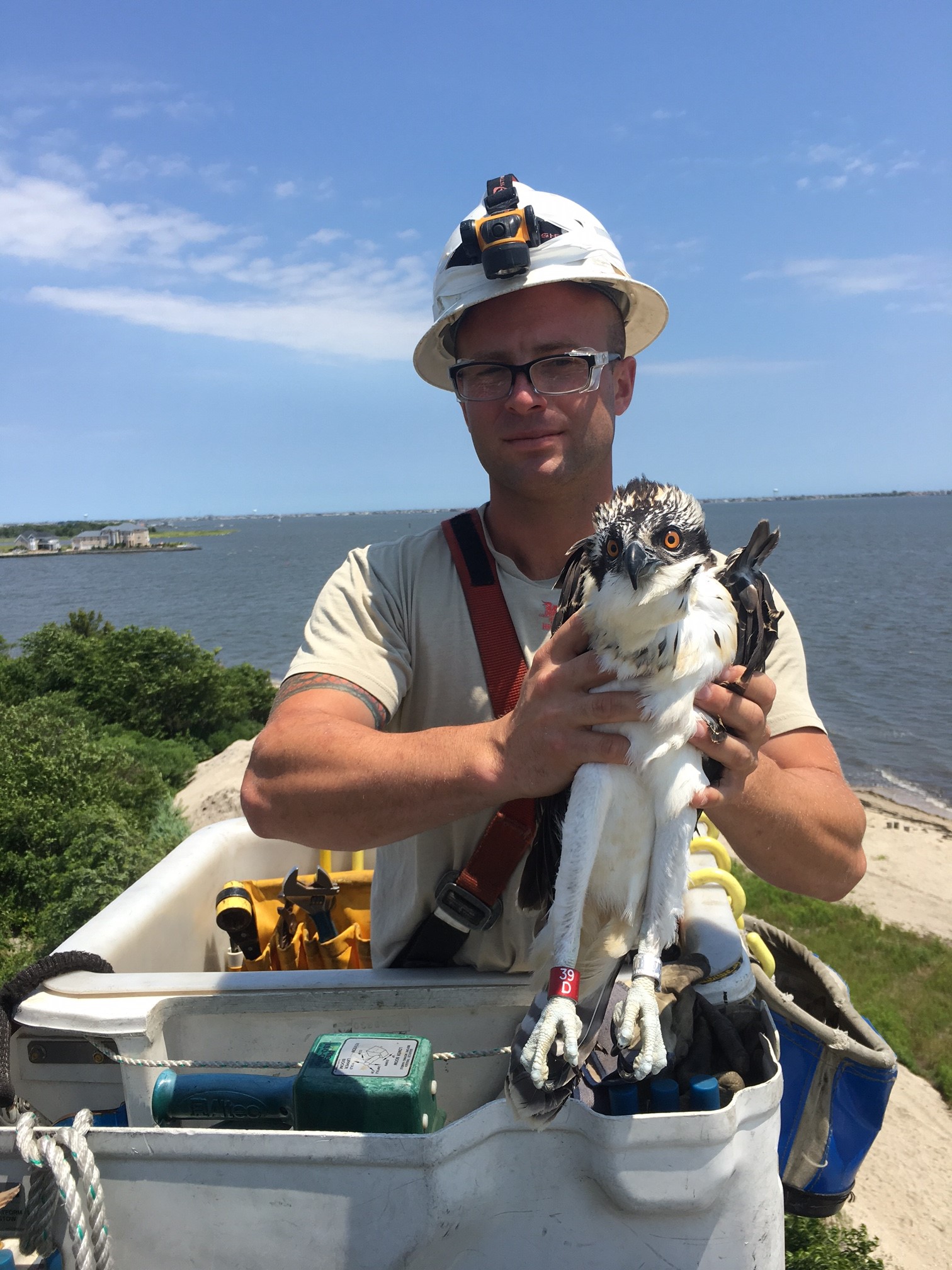
39/D being rescued on July 13, 2016. Photo by Bonni Myszka.
Ospreys are in the news again. This time it is not so pleasant news, or at least news that is hard to swallow for some, where an adult bald eagle predated a young osprey at Hog Island in Bremen, Maine. While it can be a traumatic thing to witness firsthand, it is pretty common where the range of ospreys and bald eagles overlap. We are only witnessing it because of technology. It can and has happened right here in New Jersey too. Last year, I found an adult female who had lost her wing. With no other way for that to happen (on the open saltmarsh, and her wing was gone), the only suspect is an attack by a bald eagle. As both the eagle and osprey population continue to grow, there will only be more interaction between the two species as they are competitors for food and bald eagles are opportunistic scavengers.
Approaching a natural nest inside Barnegat Inlet. Photo by Northside Jim.
Each year, while conducting osprey surveys by boat, our volunteer banders and biologists try to reach the majority of known osprey nests in the most densely populated colonies in New Jersey. The data that is collected (active nest, # of young) help to determine the overall health of the population. Since 2013, we have surveyed more than we have ever have, after releasing all of the known locations of osprey nests in New Jersey. All osprey nests can be viewed on our partners website, www.osprey-watch.org, which is run by the Center for Conservation Biology. It has helped us reach 80% of the known population. Publishing and mapping all the known nests was an attempt to engage citizen scientists (by them going out to observe ospreys) and save critical funding (for more endangered species of wildlife) while collecting data to monitor and manage our ospreys. So far it has proved to be an amazing tool for the future management of ospreys, who nest in very close proximity to humans. Continue reading “Calling all Osprey Watchers!”
Yesterday evening, while conducting an osprey nest survey at Sedge Island Wildlife Management Area, I received a message from a local wildlife photographer about an osprey nestling that was entangled. I talked to the photographer, Rich Nicol and got detailed information about the situation, the nest, and started to formulate a plan to address the situation. After learning that the nest was on a 35-40’ high pole, I knew that I wouldn’t be able to get up there without some help. Yes – a large ladder would suffice, but it would be tricky to handle the situation (with the bird being entangled). You see, after seeing photos of the young osprey, I knew it was RTF (Ready To Fly). Ospreys fledge or take their first flight at around 7-8 weeks of age. The entangled osprey was around 7 weeks old. I knew we had to act quickly to catch the bird and untangle it before it tried to fledge. This morning I saw the photos that Rich took and it clearly showed that the young osprey had monofilament or a net around its neck… Continue reading “The Inspiring Story of Osprey 39/D”
Osprey 44/C re-sighted at Island Beach State Park!
by Ben Wurst, Habitat Program Manager
Project RedBand Osprey 44/C was re-sighted by Shayna Marchese on Island Beach State Park on July 3, 2016.
Really exciting news. For the first time this year, a (live and well) red banded osprey was re-sighted! 44/C was banded as a nestling on July 12, 2014 and photographed by Shayna Marchese on July 3, 2016 at Island Beach State Park. Young ospreys spend two years on their wintering grounds before returning to their natal areas. This is the first year that 44/C has returned to New Jersey. 44/C appears to be a male, and males have a higher level of site fidelity than females do, so they are more likely to return to the same area that they originated from. We aren’t surprised that one of our first red banded birds to be re-sighted in New Jersey was at Island Beach State Park, just outside Sedge Island Wildlife Management Area. For anyone who is not familiar with Sedge, it is the state’s most densely populated osprey colony in New Jersey. Around 30 pairs of ospreys nest at Sedge which is less than 3 square miles. Continue reading “Project RedBand Alumni Update!”
Matt Tribulski places a young osprey back in its nest.
It’s osprey season. Osprey Survey Season, that is. However, we never like to start the season off with these types of emergency surveys, but with the increase of strong storms and extreme straight line wind events, they are becoming an annual event. Ospreys nest on platforms in open areas near water, so their young can easily become victims during these types of storms. After receiving a text message from my colleague Kathy Clark yesterday evening about the intensity of the storms, she said we should try to do a survey of the affected areas. I had other plans but I knew that those could wait. Continue reading “Emergency Osprey Nest Surveys in Cape May, Wildwood and Stone Harbor”
Boaters urged to not approach active osprey nest inside Barnegat Inlet
by Ben Wurst, Habitat Program Manager
Osprey Nest #3591
Yesterday, while working on Barnegat Bay, we visited this natural nest that is behind the dyke inside Barnegat Lighthouse State Park. This is the third time we’ve passed by to monitor their success. So far, so good and it looks like they now have young in the nest. As you can see the nest is built in a precarious location on a sandbar. When the sandbar is exposed people can walk right up to the nest. Last year the pair did not raise young but people did still walk up to the nest. With young, the adults will be more defensive of their nest to protect their young.
New document provides guidance to homeowners and landowners with osprey nest issues and focuses on the use of UAVs around active nests
by Ben Wurst, Habitat Program Manager
An osprey prepares to land on its nest on a chimney along the Jersey Shore. Work to identify, protect and remedy problem nests is crucial to their long term survival. Photo by Kevin Knutsen.
In New Jersey, we’ve seen the osprey population grow to an estimated 600 nesting pairs in 2015. As the population continues to grow, work to identify, protect, and remedy problem nests is crucial for their long term survival. Each year many new young adults return to their natal areas to find suitable areas to construct nests. Ospreys have a high level of site fidelity and usually return to the same areas where they originated (females do tend to wander more). A suitable nest site for an osprey is a high structure near water, usually away from human disturbance. However, ospreys can become more tolerant of disturbance if it can be expected and is not too close to their nest, especially for those birds that nest on tall structures.
Ospreys build large nests which can weight up to 200 lbs. They use sticks, grass, muck, seaweed, eelgrass, reeds, and often trash to build up their nests.
Around 75% of the state population nests on man-made platforms that are designed specifically for them. The other 25% is a mixture of nests built on other man-made structures and a few natural nests. Yes, ospreys do still nest in trees! But, trees that are suitable for them are few and far between. A suitable tree for an osprey is a standing dead tree (snag) or a tree with a top that has broken off. As the population continues to grow and there are fewer nest sites available on platforms and few suitable trees, more nests are being built on man-made structures where problems can arise. Ospreys are being pushed to nest in areas that are not always ideal, like on utility poles, stadium lights, emergency sirens, communication towers, boat lifts, docks, and even houses. Nests on utility poles can cause power outages and sometimes the nest might catch on fire or an adult can be electrocuted. Nests on houses, docks and boat lifts often limit use of such structures unless dealt with properly, but active nests cannot be removed without consulting with experts.
Osprey builds nest on chimney. Photo by Kevin Knutsen.
Lastly, it also provides some clear guidance on the use of UAVs near active osprey nests. UAV pilots must follow all FAA guidelines and not fly within 1,000 feet of any active osprey nest. To an osprey, a UAV looks like a potential predator. Ospreys will defend their nests and attack any potential predator at nest sites. Simply flying near a nest can add stress to birds and cause adults to fly off nests where their young are vulnerable to predation. Any pilot who flies within this area and pursues or harms an osprey or its young is in direct violation of the Migratory Bird Treaty Act. We ask that all UAV pilots use caution to protect the safety of our ospreys and other birds.
2015 New Jersey Osprey Report documents close to 600 pairs up from low of 50 pairs
by Lindsay McNamara, Communications Manager
Bill Clarke, project supporter holds a young and feisty osprey that Ben Wurst prepares to band with a red auxiliary band on Barnegat Bay. July, 2015. Photo by Northside Jim.
Today, we released the 2015 New Jersey Osprey Report with our partner New Jersey Division of Fish and Wildlife’s Endangered and Nongame Species Program (ENSP). The report highlights the continued recovery of this threatened bird of prey.
“Ospreys are an important indicator of the health of our coastal ecosystems, so it is important to track the health of their population. Their continuing recovery is a very promising sign for our estuaries and the fish and other wildlife that depend on clean water to survive” stated Conserve Wildlife Foundation executive director David Wheeler. “Today, no visit to a coastal waterfront would be the same without the magnificent sighting of an osprey soaring above or crashing down to the water’s surface for a fish.”
Though only about 50 osprey pairs remained in New Jersey in the early 1970s, the report documents close to 600 pairs using a total of 534 active nests in 2015, more than any other year in the project’s history.
CWF and ENSP survey an estimated 80% of the population and create an accurate representation of overall health. Biologists have come to rely on the assistance of specially trained volunteers (osprey banders) and many “Osprey Watchers” who report nests on Osprey-Watch.org.
“The vital work of our volunteers helps us keep our finger on the pulse of the population,” said Kathy Clark, supervising biologist with the DEP’s Endangered and Nongame Species Program. “Having dedicated volunteers is a great long-term monitoring tool and really strengthens the team’s ability to cover the state osprey population effectively.”
“Over the past few years we’ve really seen a shift in how we can track the overall health of the osprey population. In previous years, the use of aerial helicopter surveys to document the size and health of the statewide population allowed biologists to reach large areas, but was also very expensive,” stated Conserve Wildlife Foundation habitat program manager Ben Wurst. “Today, we utilize volunteers to help collect much of this valuable data. These ‘Osprey Watchers’ can view all nests, report nest activity, and other data online that we can, in turn, use to track the statewide population. The use of Osprey-watch.org also helps to raise awareness and educate citizens about ospreys and current environmental issues that aquatic ecosystems face today, including global climate change, depletion of fish stocks, and environmental contaminants.”
As in previous years, biologists and dedicated volunteers conducted ground surveys in mid-summer. These surveys were conducted in the most densely populated colonies of nesting ospreys in New Jersey. From the Meadowlands, south to Cape May, and west along Delaware Bay, a sample of each major colony is checked and nest outcome data are used to determine how well our ospreys are faring. During these surveys, the health of nestlings is assessed and they are banded with USGS bird bands for future tracking. Since this is usually the only visit to nests each year, the condition of the nesting platform is also noted and repairs or replacement are scheduled for the non-breeding season.
In 2015, CWF continued to band young ospreys produced in Barnegat Bay with a red, alpha-numeric coded auxiliary band. Project RedBandis focused on ospreys that nest in the Barnegat Bay watershed from Point Pleasant to Little Egg Harbor. The main goal of the project is to engage the public in osprey management and conservation along the Jersey Shore. At the same time, while collecting data from re-sightings, biologists will learn about their dispersal, foraging habits, site fidelity, migration routes, and life span. This year 33 bands were deployed, putting the total in the field at 95. 2016 marks the first year that red banded ospreys (from 2014) will start to return here from their wintering grounds in South America.
2015 Report Highlights:
In 2015, 423 known-outcome nests fledged an average of 1.74 young per active nest. That rate has averaged 1.75 in recent years, remaining well above the minimum necessary for a stable population (1.0 young/active nest).
The 2015 productivity rate was near the long term average and suggests the population will continue to grow.
Thirty-one new nests were found this year, and we combined that number with last year’s census to estimate the overall population close to 600 pairs.
The next statewide census will occur in 2017.
Of the 423 known-outcome nests, 347 were found along the Atlantic Coast and 76 were found on Delaware Bay.
A total of 737 young were produced from these known-outcome nests.
A total of 432 young were banded by volunteers and biologists with USGS leg bands for future tracking.
Population growth remains around 10% since approximately 2009.
You can help protect New Jersey’s ospreys and all other rare wildlife by supporting ENSP’s New Jersey Endangered Wildlife Fund when you file your state income tax this year and every year. Simply look for Line 59 on your NJ 1040 income tax return, and check-off for wildlife. Every dollar you donate goes directly to ENSP, enabling biologists to continue their work to restore, conserve and enhance New Jersey’s populations of rare species. What’s more, your contribution is matched with an equal amount of federal funding, further strengthening efforts to protect hundreds of imperiled species.
Lindsay McNamara is the Communications Manager for Conserve Wildlife Foundation of New Jersey.
Volunteers and Students from Cape May County Technical School
One lucky pair of ospreys received a brand new nesting platform due to the effort of volunteers and students from the Cape May County Technical School! Dedicated osprey project volunteer Matt Tribulski reached out to CMC Tech Natural Science teacher Hanna Toft, regarding replacement of an aging platform in the Avalon back bay. Hanna is an osprey project volunteer and bander and incorporates the osprey project into her curriculum. The nest that was replaced was an old four poster that was unstable and not predator proof. The nest was located at the edge of the water causing the birds to get off the nest every time a boat or jet ski went by (which in the summer is quite frequently).
Hanna had a platform available that her students had built last year. We couldn’t have picked a better day for the install, the weather was gorgeous and warm for November. We met Hanna and eight of her students out on the water. The new platform was placed further back from the water and has a predator guard. The students removed the old platform, leaving some posts for the ospreys to perch.
We hope that the birds like their new home when they return in the spring.
Thank you to Matt, Hanna and her students for all of their help!