The extreme cold weather in January brought some really neat winter scenery to the coastal saltmarsh. One of the most productive ecosystems in the world is almost totally desolate in the middle of winter. There are still a few signs of life though, which have been captured by our Osprey Cam, including top tiers predators, peregrine falcons, and herbivores, snow geese. There’s no doubt that each plays a role in the ecosystem. The snow geese eat any kind of vegetation that they can find and they consume any part of the plant, seeds, stems, leaves, tubers, and roots. The osprey cam showed them sticking there heads underground to forage on the rhizoidial roots of saltmarsh cordgrass (Spartina alterniflora). Here’s an interesting fact from Cornell University’s All About Birds website: “Food passes through the Snow Goose’s digestive tract in only an hour or two, generating 6 to 15 droppings per hour. The defecation rate is highest when a goose is grubbing for rhizomes, because such food is very high in fiber and the goose inevitably swallows mud.” Their droppings will no doubt help to fertilize the marsh in the spring!
Ice floe.A few adult peregrine falcons have been perching on the platform.Snow and geese.More snow geese…YUM! Roots and tubers!Got a napkin?Looks like the arctic…6″ of fresh snow.
Piping plover roosting beach on the island of Eleuthera, Bahamas.
Up until now, nearly all of our piping plover conservation work in the Bahamas has been focused on the island of Abaco. One of the objectives of our Disney Worldwide Conservation Fund grant is to identify other islands and partners where and with whom the model we are developing on Abaco might be implemented as well. With this in mind, we spent the past several days on the island of Eleuthera.
Although we believe the basic elements of our Abaco work are transferable to other islands, a “one size fits all” approach may not entirely work. The various major islands are unified under the Bahamas flag, but each also has its own flavor, history, and way of life. The best analogy would be that they operate much like the individual states in the U.S.
On Abaco, we have been partnering with Friends of the Environment, a non-profit organization with a strong education and outreach component to all of their work – not so different from what we do here at the Conserve Wildlife Foundation. On Eleuthera we are hoping to partner with the Cape Eleuthera Institute (CEI) and The Island School. Although education is at the core of their work as well, it is also different in that they carry out and support primary research and host visiting scientists and students at their campus. Continue reading “Bahamas Piping Plover Project”
Bonus shots from wildlife photographer, Herb Houghton
by Ben Wurst, Habitat Program Manager
Peregrines are by far one of the most majestic birds of prey to observe in their natural habitat. Since 2003 they’ve been streaking through the skies of the New Jersey Palisades along the Hudson River. Thanks to Herb Houghton, we’re able to witness their majesty and their tenacitythrough his photography.
Herb first began photographing wildlife in his own backyard after some debilitating back surgeries put him out of work and made him pay more attention to the wildlife that was in his own backyard. He started out using simple point and shoot cameras using the “digiscoping” technique but finally he decides to get serious and he upgraded to some professional camera gear, including several super telephoto lenses. Herb’s work has been published in many publications, including The Peregrine Observer by New Jersey Audubon Society. He has photographed a wide variety of wildlife throughout New Jersey and especially near his home in Sussex County. Herb also volunteers at WallKill River NWR.
Herb first started photographing peregrines at the Palisades after looking up at the sky and noticing them flying overhead. He explored and found a rock outcrop and set out to find the falcons that he saw overhead. Since 2008 he’s documented each year’s triumphs and failures at the Palisades, and has witnessed the ferocity of these awesome predators. His photos have also helped zoologist Kathy Clark with ENSP to ID the nesting pairs and document nest success.
“What I love the most about these birds is that they are fearless predators which take their habitat very seriously. I’ve heard them scream like crazy, then each of the pair launches off of the cliffs and flies over the river all the way to the other side and then start dive bombing a red-tailed hawk or an eagle in Yonkers.” Herb said.
Herb has learned a lot about peregrines over the years. All from going out into the field to observe them in their natural habitat. Truly, it’s the best way to learn natural bird behavior. As Herb points out, it’s not just about taking photos. “To witness interesting behavior or a new behavior is exhilarating for me, even if it’s too far for a picture.” This past year Herb thinks he even witnessed a rare occurrence, where young of the year were feeding on some of the periodic cicadas that emerged in 2013.
Herb’s most memorable experience while watching the peregrines at the Palisades was when a peregrine bombed him while he was eating a snack while near the cliffs. He watched the bird fly way up until it was a speck in the sky and heard a “whoosh” as it dove within 10 feet of him. It “turned its head to look at me and started screaming her head off. The hairs on the back of my neck stood out as I proceeded to pack up and leave the lookout heading for the woods very quickly.” Thanks so much to Herb for allowing CWF to use his wonderful photos on our website and for sharing his stories of photographing the peregrines at the Palisades.
Peregrines are now common residents of NJ’s coast. Photo by Northside Jim.
It’s hard to believe now, but peregrine falcons were once extirpated from their nesting grounds in the Eastern United States. They were federally listed as endangered in 1969 (prior to the passage of the Endangered Species Act of 1973) under the Endangered Species Conservation Act of 1969.
Shortly thereafter a reintroduction project began. New Jersey was one of the first places were wild nesting occurred.
Today more than 25 pairs of peregrines nest in New Jersey and their reproduction here remains strong. However, biologists remain concerned of their long term recovery since they have some of the highest loads of DDE and mercury (Clark et al. 2009). Continue reading “Month of the Falcon – Part II”
Even military aircraft, like the “F-22 Raptor,” were engineered to be more like a peregrine falcon!
Peregrine falcons are top tier, aerial predators that are capable of reaching speeds faster than any other animal in the world. In a stoop (a rapid dive) to catch prey, they can reach speeds over 200 mph (top recorded speed of 242 mph)! Even military aircraft, like the F-22 Raptor and SR-71 Blackbird, have been designed to mimic the special traits that falcons have to fly faster and be more maneuverable at top speeds.
Both falcons and F-22s are light weight, have extreme maneuverability, fly at high speeds, and have stealth-like flight to avoid detection from prey (or enemies).
Peregrines are also unique because they are only one of two species of birds (do you know the other one?) that are found worldwide and nest on every continent (besides Antarctica).
They mate for life and (Jersey birds) do not make long distance migrations.
Lastly, peregrine falcons are top tier predators and are an indicator species. The health of their population can tell us a lot about the health of our environment, which is one of the most important reasons for protecting them.
They have made a remarkable recovery in New Jersey. Forty years ago these aerial predators were missing from our skies… they were extirpated from all native nesting territories that were east of the Mississippi River by 1964.
After the NJ Endangered Species Conservation Act was passed in 1973, a plan to re-establish them was made. Young birds were “hacked” at artificial nest sites throughout the state from 1975 to 1980.
The innovative program was a success! Wild nesting of peregrines first occurred in 1980 at Edwin B. Forsythe National Wildlife Refuge. Since that time the population has steadily increased and in 2003, peregrines nested on the natural cliffs of the New Jersey Palisades.
New Jersey is the most densely populated state, but peregrines don’t mind. Cities and urban areas actually provide suitable habitat for peregrines. Since they’re top tier predators and nest near areas with large numbers of prey, like pigeons, they provide a service by controlling their population.
Urban areas have two components necessary for peregrines: abundance of prey and ledges to nest on. One city is Jersey City. Since 2000 peregrines have nested on the roof of 101 Hudson St. The Jersey City nesting pair has been very productive over the years.
Their annual life cycle has been streamed online for the public to view and learn about their natural history. With your support we can keep the Falcon Cam streaming in homes, offices and classrooms to educate viewers about endangered species conservation in New Jersey. Donate to the project and be entered into a drawing to attend the banding of young falcons in 2014!
Since 2000, a pair of state endangered peregrine falcons have nested on a building in Jersey City, New Jersey. Peregrine falcons are drawn to urban areas since there are high levels of prey (pigeons) and suitable areas to nest (building ledges and outcrops). To follow along with their daily life cycle a webcam was first installed in 2001. Since then it has broadcast their success and struggles over the years to reproduce and help bolster the population in the state.
Peregrines have made a remarkable recovery in New Jersey since their reintroduction in the 1970s, and the Falcon Cam has allowed us to help raise awareness for their conservation. This past year we learned that the NJ Division of Fish and Wildlife, who hosted the camera since it’s installation, no longer has funding to maintain the webcam. Over the next month we’ll be fundraising to help keep the webcam online! At the same time we’ll also be featuring a weekly series “The Month of the Falcon” with insight from biologists and awesome photos of peregrines from New Jersey.
By Emily Heiser, Piping Plover Research Technician
Emily Heiser (l) and Lauren Gingerella (r) with piping plovers in hand for banding.
Call me crazy, but the combination of piping plovers and New Jersey are just too much for me to resist! Over the last six years, I have spent the majority of my time working for Conserve Wildlife Foundation of New Jersey and New Jersey Division of Fish and Wildlife protecting piping plovers on their nesting grounds. Most recently I worked on a research project with the State University of New York-ESF that dealt with piping plover flight behavior in Stone Harbor, Avalon and Strathmere, New Jersey. The project’s graduate student, Michelle Avis conducted the other half of the study on Cape Cod, Massachusetts. The project was specifically designed to look at piping plover flight patterns across their breeding grounds. The results of the study could have implications for the management of coastal wind turbine development. Continue reading “Overview of piping plover flight behavior research”
The images above were taken during a recent survey of the Raritan River in Somerset County. The image on the left is a Banded Killifish with the larval stage of freshwater mussels attached (the small black dots on the side of the fish are the larval mussels, known as glochidia). Glochidia are parasites of fish, and some other aquatic animals, which will drop-off at the end of their larval stage, and then complete their life cycle in the bottom of the river, stream, or lake as the adult mussels most people are familiar with. The host fish not only provides a meal for the glochidia, but also enables mussels to travel further than they can as an adult.
The image on the right is a crayfish which took shelter within the old shell of a freshwater mussel, in this case an Eastern Elliptio. Other freshwater invertebrates may reside within old mussel shells, such as snails and aquatic insects.
To learn more about freshwater mussels in New Jersey, visit our Freshwater Mussel site.
We continue following the movements of the female that had the transmitter placed on May 29th, 2012. She spent the winter down at the Delmarva Penninsula in coastal Virginia and then headed up north and spent a large portion of the summer in Maine. She is starting to head south and on September 2nd was in Connecticut.
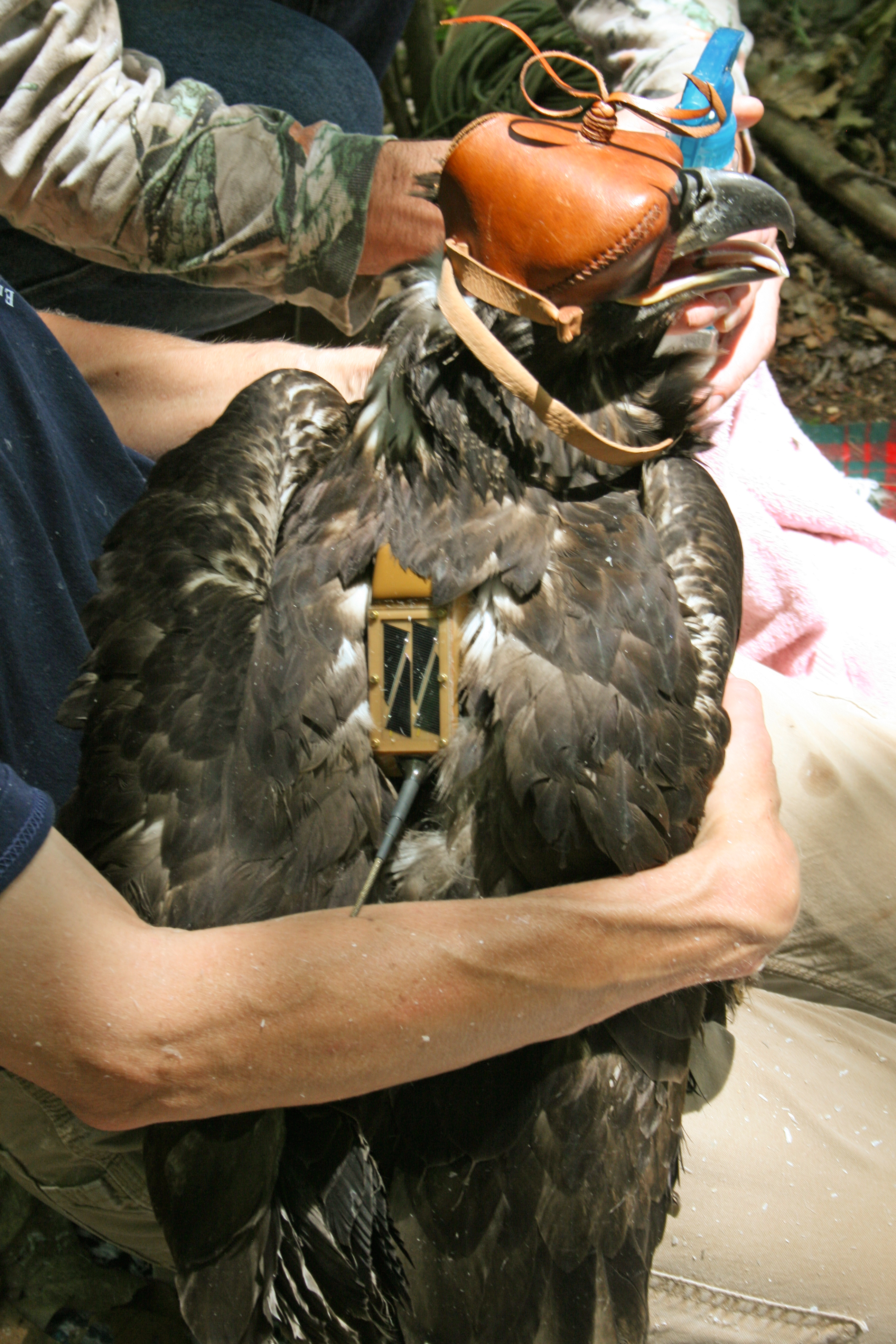
On May 31, 2013 the largest of three chicks at the Merrill Creek Reservoir nest, a female, was fitted with a transmitter.
Merrill Creek chick with transmitter May 29th, 2013
This transmitter is different than the ones previously used in that it uses GSM technology. Instead of using satellites to pick up the bird’s location, the transmitter will transmit data via cell phone towers. The data is then transmitted over the internet and delivered as an email to a mobile device or computer. This new technology transmits more data, costs less and allows users to have instant access to the data through smart phones or computers. Since fledging this bird has been on the move spending time in NY, PA and back to NJ and as of September 3rd was back near the nest site.