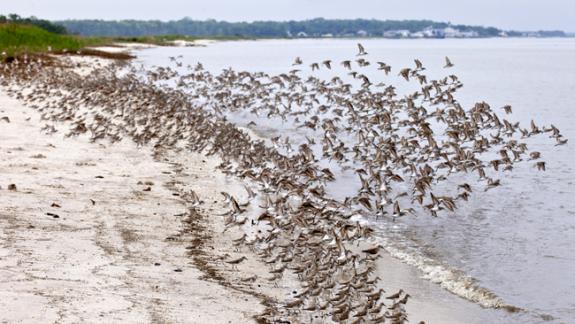
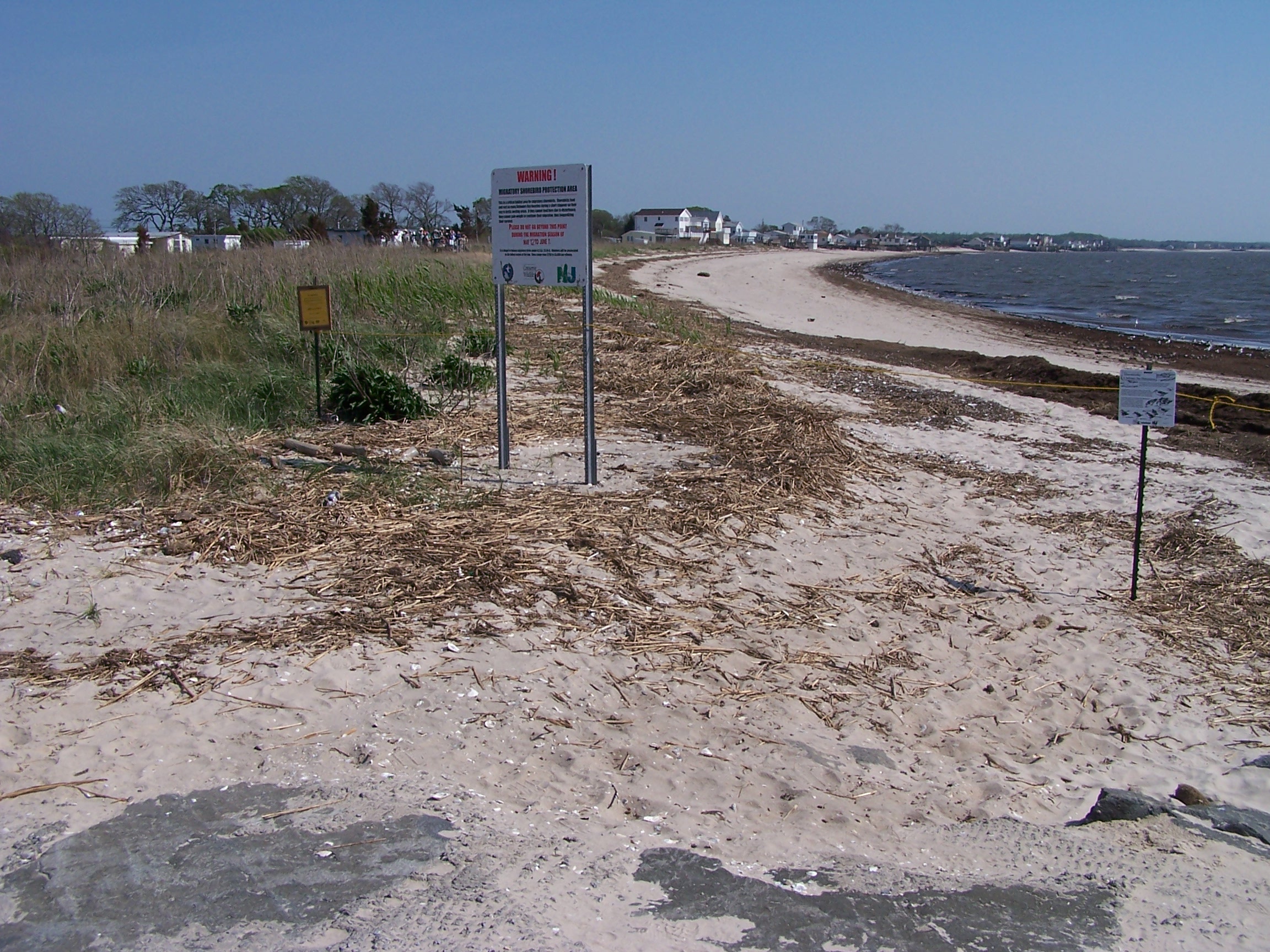
Each spring New Jersey hosts the largest concentration of shorebirds in North America! From about the first week in May to the second week in June, the biggest gathering of horseshoe crabs in the world comes to Delaware Bay to spawn.
At the same time, hundreds of thousands of shorebirds arrive on the Bayshore to refuel on horseshoe crab eggs at a critical stopover during their migration. Delaware Bay is an extremely important area for a number of at-risk wildlife, including Red Knots and Horseshoe Crabs.
The Rufa red knot (a shorebird) named “Moonbird,” or “B95,” photographed in a crowd of birds at Fortescue, NJ. Credit: Christophe Buidin.
“Moonbird is the most famous, charismatic member of a group of mid-sized shorebirds called Rufa red knots, whose numbers have plummeted so dramatically in the past several decades that they just became the first bird ever listed under the Endangered Species Act with climate change cited as a “primary threat.”
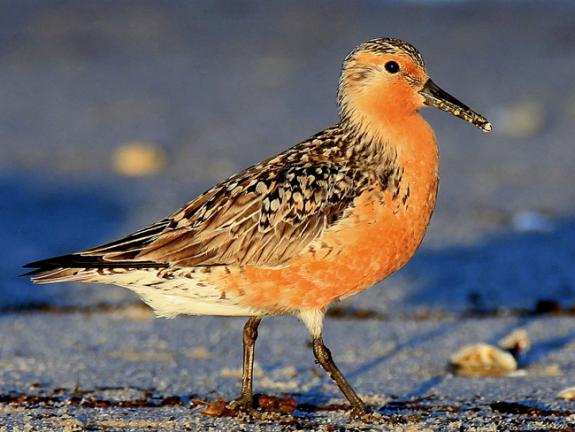
Rufa red knots are among the avian world’s most extreme long range flyers (especially in light of their relatively small size). They travel vast distances — some flying over 18,000 miles — in the course of an annual migration that begins in Tierra del Fuego, Argentina, and extends all the way up to the Canadian Arctic (and back again).
Which brings us to Moonbird’s distinction: Because he is so old — he is at least 21 — he is believed to have flown as many as 400,000 miles in his lifetime. The distance to the moon varies, depending on where it is in its orbit, but the average distance is about 237,000 miles. Thus, Moonbird has not only flown the distance it takes to reach the moon — he has also covered the bulk of the return voyage.
Assuming that Moonbird is still living — the last sighting was in May — there are reasons to wonder whether there will ever be another bird that is his equal. Why? Simply put, his subspecies has been devastated, and climate change will only make matters worse — making extreme survival of the sort that Moonbird has achieved that much more difficult.”
Washington Post Science and Environment Reporter Chris Mooney explores Moonbird’s journey, threats to the species, and the recent Endangered Species Act listing of the Rufa Red Knot:
Wildlife conservation organizations leading the efforts to restore New Jersey’s Delaware Bay beaches for at-risk shorebirds today applauded the U.S. Fish and Wildlife Service decision to designate the Red Knot, a migratory shorebird, as “threatened” under the Endangered Species Act. A “threatened” designation means a species is at risk of becoming endangered throughout all or a significant portion of its range.
“This federal designation will make a big difference in strengthening the protections of this incredible shorebird,” said David Wheeler, Executive Director for Conserve Wildlife Foundation of New Jersey.
“Here in New Jersey, we are restoring the vital beach habitat that had been decimated by Hurricane Sandy, and this designation ensures the safeguards we are providing can be complemented along the East Coast,” Wheeler added.
Since the 1980’s, the Knot’s population has fallen by about 75 percent in some key areas. Wildlife biologists believe the major threat to the Red Knot is the dramatic decline of horseshoe crab eggs, an essential food source at the most critical stop over during their 8,000 mile trip from southern wintering grounds to Arctic breeding territory. High-energy horseshoe crab eggs provide nourishment for Red Knots to refuel and continue their journey.
“This is an important and needed step in the conservation and recovery of the Red Knot. It is an essential step in preventing the extinction of this amazing long distance traveler,” stated Tim Dillingham, Executive Director forAmerican Littoral Society.
The largest concentration of Red Knots is found in May in the Delaware Bayshore of New Jersey and Delaware, where the shorebirds stop to gorge themselves on the eggs of spawning horseshoe crabs. In just a few days, the birds nearly double their weight to prepare for the final leg of their long journey.
“The major decline of horseshoe crabs in Delaware Bay is one of the largest threats to the survival of the shorebird,” explained Dr. Larry Niles, a biologist who leads the beach restoration efforts for Conserve Wildlife Foundation of New Jersey and American Littoral Society, and has studied Red Knots for three decades. “Agency groups have been working hard for the last two years, and will continue for the next two years going forward to rebuild the habitat damaged by Hurricane Sandy that the horseshoe crabs rely on. This work is integral to the recovery of the Red Knot and the shorebird’s best hope for survival.”
In the wake of Hurricane Sandy, American Littoral Society and Conserve Wildlife Foundation of New Jersey worked with the U.S. Fish and Wildlife Service, the New Jersey Division of Fish and Wildlife and the New Jersey Recovery Fund to remove 8,000 tons of debris and added 45,000 tons of sand to the beaches just before the annual spring arrival of the Red Knot in 2013.
This marks the second story in Shorebird Week! Our first blog post, on Tuesday, introduced the film “A Race Against Time” and directed you to a free viewing of the film on our website. Today’s blog post, will highlight an incredible news story about a resighting of the iconic Red knot B95 on the Delaware Bay! And tomorrow’s blog post, will highlight volunteer’s incredible efforts to save stranded horseshoe crabs!
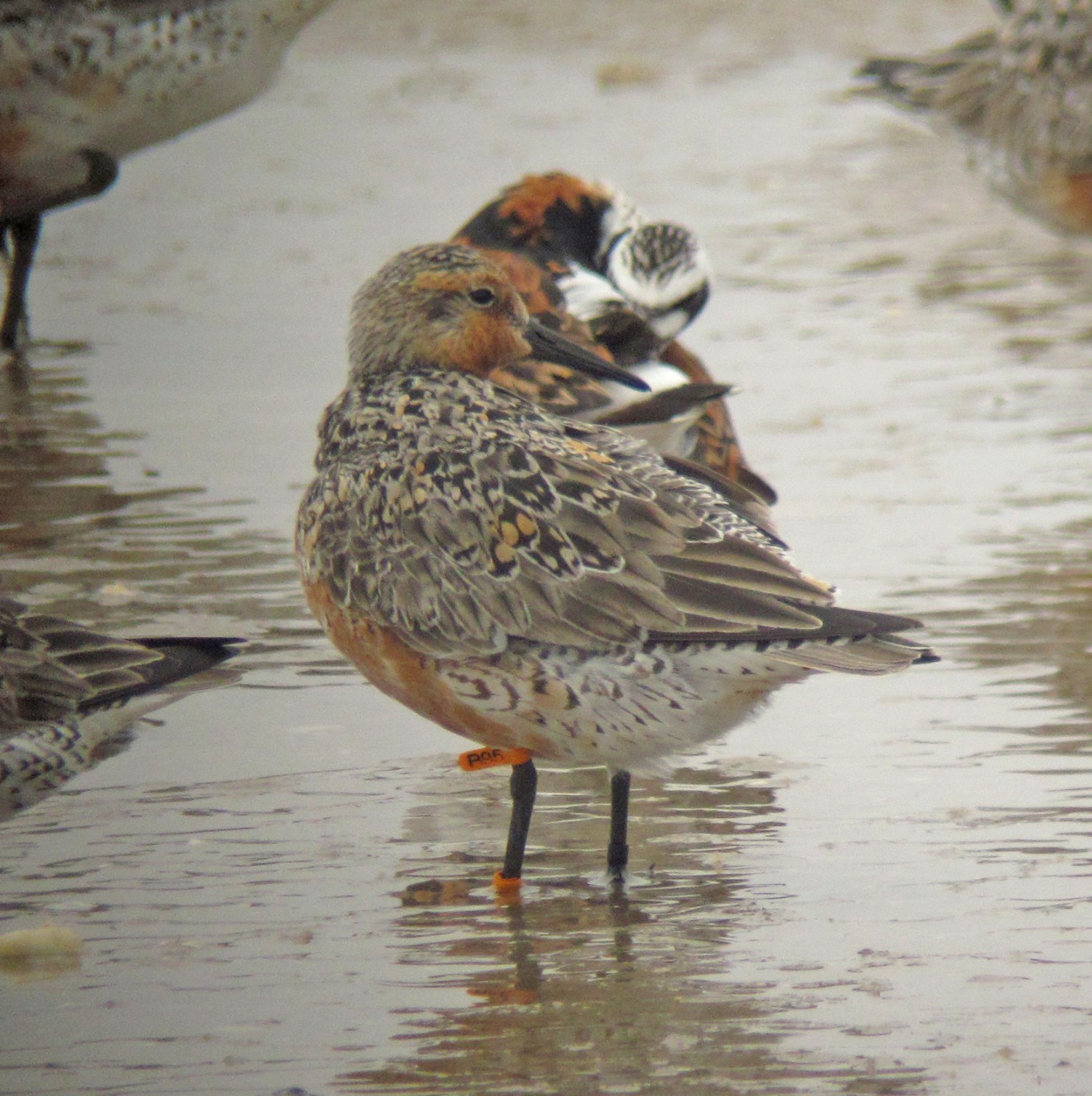
This story highlights the iconic Red knot, B95, being resighted on the Delaware Bay. B95, nicknamed Moonbird, is at least 20 years old, which makes him the oldest Red knot on record. He received his nickname because he has flown the equivalent of the distance between the earth and the moon and at least halfway back in his lifetime.
Iconic Red knot shorebird B95
One of Conserve Wildlife Foundation’s partners, Manomet Center for Conservation Science, highlights this bird in an fascinating news story about his resighting and the research efforts being done by the CWF biologist Dr. Larry Niles and Amanda Dey, senior biologist with the Endangered and Non-game Species Division of N.J. Fish and Wildlife and their team to restore the Delaware Bay.
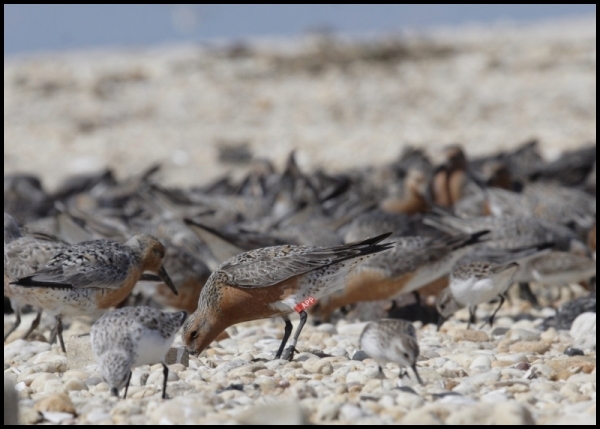
A banded red knot searches for food on a Delaware Bay beach.
This week for Animal Week, we will be spotlighting Shorebirds in the Media! Endangered red knots, ruddy turnstones, and other magnificent birds travel from South America to the Canadian Arctic during their migration, and make an important stopover along the Delaware Bay Shore from May to June.
The 2014 Shorebird film, “A Race Against Time” celebrates the Delaware Bay Beach Restoration
The film can now be enjoyed for free on our website:
Greener New Jersey Productions this spring produced a 30-minute film documenting the ambitious campaign by Conserve Wildlife Foundation, American Littoral Society and other partners to restore Delaware Bayshore beaches decimated by Hurricane Sandy. This project ensures that the at-risk horseshoe crabs and globally migrating shorebirds relying on this habitat can survive.
Conserve Wildlife Foundation of New Jersey and the Endangered and Nongame Species Program (ENSP) of the New Jersey Department of Environmental Protection’s Division of Fish & Wildlife, and New Jersey Audubon have partnered for many years to conduct research on Delaware Bay shorebirds in order to prevent their decline.
by Larissa Smith, Wildlife Biologist/Volunteer Coordinator
Shorebird Steward Liz Hermoso shows beach visitors a clump of horseshoe crab eggs on Cook’s beach.
Once again migratory shorebirds, including the NJ endangered red knot, have returned to the Delaware Bay to feed on horseshoe crab eggs. This annual phenomenon brings people from around the world to the Delaware Bay beaches.
Beaches are closed during the migration from May 7th through June 7th to protect the shorebirds from disturbance when feeding. Just as the birds return each year so do volunteer Shorebird Stewards who educate the public about the beach closures , shorebirds and horseshoe crabs on nine beaches in Cape May and Cumberland County. Now is a great to come out to the beaches to view shorebirds and crabs and say “hi” to the stewards.
This year the hot spots for shorebirds in Cape May County are Reed’s , Cook’s and Kimble’s Beaches and Fortescue in Cumberland County.
Several Delaware Bay beaches will be closed from Monday, May 7 to Thursday, June 7, 2012. Beaches are closed to protect a rapidly-declining population of migrating shorebirds including the red knot which is an endangered species in NJ. But this doesn’t mean that you can’t come out and view the shorebirds and horseshoe crabs. It’s the prefect time to see these birds undisturbed and feeding on horseshoe crab eggs.
Several beaches are set-up for shorebird viewing including Reeds Beach, Norburys Landing, Kimbles Beach and Cooks Beach in Cape May County. Find more viewing locations on our interactive Wildlife Viewing Map.
Shorebird Stewards will be present at closed beaches to educate the public about the interaction between the shorebirds and horseshoe crabs. Take some time this May and come visit the Delaware Bay and enjoy the view!
Detailed maps of the closed areas can be found at:
By Michael Davenport, Marine Species & GIS Programs Manager
New Jersey’s list of endangered and threatened species increases to 84 this week with the addition of the Atlantic sturgeon. It is the second fish, along with the shortnose sturgeon, on that list.
After a lengthy review process, the National Oceanic and Atmospheric Administration (NOAA) listed the Atlantic sturgeon as Endangered under the federal Endangered Species Act. Species which occur in New Jersey and are listed as Endangered on the federal level, automatically become listed as Endangered at the state level as well.
Sturgeon are often referred to as “living fossils” because they are among the oldest groups of bony fishes and have retained primitive characteristics. Like the shortnose sturgeon, Atlantic sturgeon are slow-growing, long-lived fish which mature late in life. Both species have been overfished both for the eggs and their flesh and their populations have yet to recover. Despite the current ban on their capture, they continue to face threats due to unintentional catch (bycatch), pollution, dredging of critical habitat, and boat strikes.
While both species of sturgeon inhabit the Delaware and Hudson rivers, the Atlantic sturgeon also occurs in marine waters with Delaware and Raritan bays and along New Jersey’s Atlantic coast. To learn more about this species, please visit our on-line field guide page.
A banded red knot searches for food on a Delaware Bay beach.
Bandedbirds.org is an effort to collect data on shorebirds throughout their range from the southern tip of Chile to the Canadian arctic. This effort has been underway for many years and has an international network of volunteers reporting re-sightings data on shorebirds.
The following was shared with the shorebird community by Jeannine Parvin, administrator for bandedbirds.org.
The bird being discussed was banded in NJ in May 2005. It seemed to return to NJ each year, having been resighted most years up to 2010. The bird seemed to be heading back up to NJ for the 2011 Spring shorebird season, when it was shot and killed in French Guiana. Illegal hunting is still a big issue for shorebirds. Paired with loss and degradation of habitat, and pollution, these birds face major threats. Read more about CWF’s work to monitor and protect shorebirds here.
A red knot identified as FL(PPM) was shot in French Guiana by a hunter.
The data was submitted by Alexandre Vinot from French Guiana. He regularly reports to bandedbirds.org and is a volunteer with GEPOG.
His comments state: “shot in Mana Ricefield – flag given to Antoine Hausselman, who gave me the data”.
Scientists today released a report announcing that a decrease of at least 5,000 red knots was observed at key wintering grounds in Tierra del Fuego, Chile from the previous year. Scientists reported population counts of wintering knots in other locations declined as well. The estimated current total population for the migratory shorebird is now unlikely to be more than 25,000.
The decline in red knot numbers elevates the importance of implementing stronger protections at Delaware Bay, a key U.S. stopover where migrating knots depend on an abundant supply of horseshoe crab eggs to fuel the final leg of their migration to breeding grounds in the Canadian Arctic.
The scientists’ report concludes that despite horseshoe crab harvest restrictions put in place by the Atlantic States Marine Fisheries Commission over the past decade “there is still no evidence of recovery of the horseshoe crab population, either in numbers of spawning females or in all sub-adult age groups including juveniles.” Restrictions to date have only been enough to stop the population from declining further, are insufficient to recover the population and will continue to be insufficient unless the harvest is greatly reduced.
WASHINGTON (May 23, 2011) – Conservation groups are calling on the U.S. Fish and Wildlife Service (FWS) to take immediate steps to list the red knot under the Endangered Species Act. A listing would initiate the development of a recovery plan and require federal agencies whose actions affect red knots to consult with the FWS. A listing would also require the Atlantic States Marine Fisheries Commission, housed under the National Marine Fisheries Service, to consult with the FWS on the regulations it establishes for the horseshoe crab fishery. The following are statements from groups pursuing an endangered species listing:
“It’s simple, to halt this decline and imminent extinction, we must list the red knot now and view all shorebird protection through the same lens,” said Margaret O’Gorman, executive director for Conserve Wildlife Foundation.
“This year’s huge decline in wintering red knots provides clear evidence that the status quo is not working. Unless action is taken now, red knots may be on an irreversible slide to extinction,” said Bob Irvin, senior vice president for conservation programs at Defenders of Wildlife. “The U.S. has a responsibility to the global community to protect this migratory shorebird, which stops along our coast to rest and feed while making one of the longest migrations in nature, from the tip of South America to the Arctic.”
“The bad news demands we redouble our efforts to rebuild the horseshoe crab population of Delaware Bay,” said Tim Dillingham, Executive Director of the American Littoral Society. “A listing of the red knot under the ESA will allow for management of the horseshoe crab population to be directed toward recovery of the shorebird populations, and not simply the local fishing interests. We urge the USFWS to make this a priority.”
“Until recently, the Delaware Bay resplendent with spawning horseshoe crabs and over a million shorebirds was the land of plenty – our Serengeti,” said Eric Stiles, vice president for Conservation and Stewardship for New Jersey Audubon Society. “The red knot is one of the shorebirds whose very existence is teetering on the brink of survival. Unlike special interest naysayers, we have full faith in the Endangered Species Act. Only through listing will the robin-sized, chestnut colored shorebird be enjoyed by future generations.”
“The decline of the shorebirds and the horseshoe crabs that sustain them is not speculation; it is a proven reality documented by science and history. The Atlantic States Marine Fisheries Counsel, among those charged with protecting the species, has ignored the science and the harm in order to assuage their political allies. In the absence of strong and earnest action from the ASMFC, we need strong action from our states. While New Jersey has taken that strong action to protect the crabs and the birds, Delaware’s actions leave a lot to be desired when the politics heats up” expresses Maya van Rossum, the Delaware Riverkeeper.
“The rufa red knot, which once darkened the skies during their migration, now stands on the very knife-edge of extinction. The states along the east coast, with the exception of New Jersey, dithered for decades and now the only way to save this subspecies is for the U.S. Fish and Wildlife Service to place it on the Endangered Species List. With this new report, it is clear that if the federal government doesn’t act soon, the next generation of Americans will never see this amazing long-distance migrant. People who want to see this bird in the wild best make plans in the near future because the way things are going, it will be gone sooner rather than later,” said Darin Schroeder, Vice President for Conservation Advocacy for ABC.
“A population decline this large and this rapid is almost unequalled in our lifetime,” said Greg Butcher, Director of Bird Conservation for National Audubon Society. “Surely such a bird requires the immediate protection of the Endangered Species Act and needs to be a top conservation priority for all of us.”