by: Larissa Smith, CWF biologist

by: Larissa Smith, CWF biologist
by: Larissa Smith, CWF biologist


Since 2003 Conserve Wildlife Foundation has been coordinating the Delaware Bay Shorebird Stewards. Shorebird Stewards are posted at the beaches with restricted access during the shorebird season. This is done so that the shorebirds can feed undisturbed on horseshoe crab eggs. The beach restrictions are from May 7th to June 7th. The Delaware Bay is an important stopover for these birds on their way north to their breeding grounds. Stewards educate the public about the need for the beach restrictions. Once most people learn about the connection between the horseshoe crabs and shorebirds, they are more than happy to accept the restrictions. This season there were thirty-one stewards on 10 beaches in Cape May and Cumberland Counties. They are dedicated and on the beaches despite the weather, bugs and sometimes lack of shorebirds. Stewards are on beaches through Monday, so stop by and say “hello”.
Thank you Shorebird Stewards

by Meaghan Lyon

Earlier this week CWF and USFWS biologists joined forces to start off the season with a grassland bird survey in Burlington County, New Jersey. The vast grassland habitat, doubling as an airfield, is home to the state endangered upland sandpiper, state threatened grasshopper sparrow, savannah sparrow, and bobolink, as well as the eastern meadowlark, a species of concern. These bird species, among many others, can all be found nesting at this site in the clumps of grass during the months of May, June, and July. Many of the management practices at the airfield, like consistent mowing, help maintain this grassland habitat and keep it an early successional state for grassland birds to nest in year after year.
For the survey, biologist met on site just before sunrise with binoculars hanging from their necks and clipboards with data sheets in hand. Male birds were already perching on tall blades of grass and singing to attract mates and defend territory as we dispersed to our survey points. At each point it was our job to distinguish what bird song and calls we were hearing and record any focal species activity onto our data sheets.
Between the three surveyors and 25 survey points, all of the target species were identified as well as hundreds of red-winged black birds, two great egrets, and a few mallard ducks. Of particular note, one upland sandpiper pair was sighted in its usual nesting area.
Three more surveys will follow between now and the end of the grassland bird nesting season. Follow along for updates throughout the season!
by Ben Wurst, Habitat Program Manager

Another season of growth and new life is here! As many species are beginning their annual life cycle to reproduce, some peregrine falcon pairs already have young. The eyases (young falcons) at the Union County Falcon Cam are a prime example. They are now a little over a week old and have been examined and treated for a pigeon borne disease, called trichomoniasis, which adult falcons can transfer to their young. If young falcons would get trich., then they could perish. Kathy Clark, NJDEP Fish & Wildlife Supervisory Zoologist, UC staff and colleague Cathy Malok, w/ The Raptor Trust visited the site to ensure the survival of this brood.
Continue reading “Three healthy peregrine falcon eyases in Elizabeth!”by Meghan Kolk, Wildlife Biologist

Conserve Wildlife Foundation has successfully completed the restoration of the Certified Wildlife Habitat behind the Trailside Nature and Science Center at Watchung Reservation. The project was initiated last fall with a major clean up of the overgrown and neglected garden. The cleanup included pulling weeds, digging up unwanted and overgrown plants, trimming shrubs and trees, clearing vines from trees, and raking and blowing leaves. As a result, sunlight was let into the garden so that new wildlife-friendly plants could be added. After the cleanup, new native shrubs were planted that attract bees, butterflies, hummingbirds, and other birds. A new deer fence was also installed to protect the plantings from deer browse.
Continue reading “Restored Garden is Ready for Wildlife at Watchung Reservation”by Todd Pover

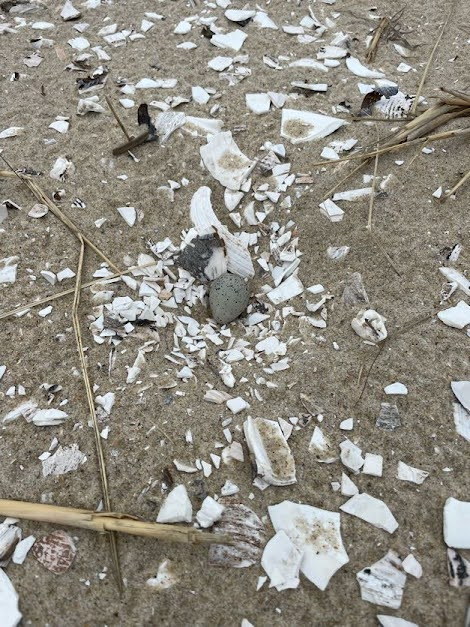
For the past eight years, CWF has been contracted by the U.S. Fish and Wildlife Service through a cooperative agreement to provide monitoring and management of beach nesting birds at the Edwin B. Forsythe National Wildlife Refuge. The Refuge nesting sites – both the Holgate and Little Beach Island Units – provide some of the only habitat in the state closed to the public and free of human disturbance and detrimental beach management practices. The habitat at the sites is especially suitable for the state endangered piping plover as a result of optimal nesting conditions created by Superstorm Sandy and largely sustained since then through winter storms. As of the 2021 season, the Refuge sites had the highest concentration of piping plovers in the state, with Holgate having by far the most pairs (46). Furthermore, on average in recent years, Holgate has produced a higher fledgling rate than many sites in the state.
Continue reading “Beach Nesting Bird Monitoring is Underway at the Edwin B. Forsythe National Wildlife Refuge”by Christine Healy, CWF Wildlife Biologist

As the coordinator for CWF’s Amphibian Crossing Project, I think it’s safe to say I spend more time than the average person hoping for rain to pop up in springtime forecasts. April 22, however, is always an exception. What could be better than warm and sunny conditions to inspire folks to get outside and celebrate Earth Day by giving back to the planet that gives us, well, everything? Mother Nature certainly came through with the weather last week, handing us one of the most glorious days of the season thus far, while the Elizabeth Mayor Chris Bollwage, Union County Board of County Commissioners, Groundwork Elizabeth, and their partners offered a destination for all the aspiring wildlife warriors: Phil Rizzuto Park.
by Meaghan Lyon, Wildlife Biologist
Our infamous Piping Plover pair, Joey and Hamlet, officially have a nest!
Joey (the male), and Hamlet (the female) were seen exhibiting breeding behavior for weeks since arriving back to their nesting grounds. The pair had been favoring a spot recently improved with habitat enhancements that included removing dense American beach grass and adding shell cover.
Continue reading “New Nest Alert!”by Meaghan Lyon, Wildlife Biologist

The well-known Piping Plover pair, Joey and Hamlet, has been monitored by Conserve Wildlife Foundation of New Jersey (CWF) at the Sea Girt National Guard Training Center (NGTC) for three nesting seasons (check out our last blog on Joey and Hamlet’s arrival here!
Continue reading “Joey & Hamlet’s History”by: Larissa Smith, Wildlife Biologist

We received a call about a homeowner who found two great horned owlets on the ground. They had fallen out of a nest located in a pine tree in her backyard. The female owl was still sitting in the nest with one chick. Great horned owls use the vacant nests of other bird species and this nest was too small for three growing chicks. At this age the young owls are defenseless from predators, plus a rain/wind storm was predicted for that evening. The plan was to keep the owlets overnight in safe location and renest them the next day.

We met Ray Byrant, with Tri-State Rescue & Research, raptor renesting team at the nest site. Due to crowding the owlets would end up on the ground again if placed back in the nest. A basket serving as a substitute nest was secured in a nearby tree that was sturdier than the nest tree. The two nests are close enough that the adults can go back and forth between nests caring for the young. The female owl watched us closely the entire time and the owlets were “clicking” with their bills, so she knew they were there.


The homeowner will keep an eye on the nests to make sure the owlets remain in them until they start to branch. She reports that the adult has been at the basket nest several time since the renest. Thank you to the homeowner for calling to report these owlets, Vicki Schmidt, Matt Tribulski, Ray Byrant and Tri-State Bird Rescue & Research. It takes a team.