#NotAnOsprey
by Ben Wurst, Habitat Program Manager

by Ben Wurst, Habitat Program Manager
Larissa Smith & Ben Wurst: Conserve Wildlife Foundation of NJ

The Conserve Wildlife Foundation of NJ in partnership with the NJ Endangered and Nongame Species Program has released the 2016 NJ Bald Eagle Project Report and the new and improved Eagle Tracking Maps. In 2016, 172 eagle nests were monitored during the nesting season. Of these nests 150 were active (with eggs) and 22 were territorial or housekeeping pairs. A record high of 216 young were fledged. The success of the NJ Eagle Project is due to the dedicated Eagle Project Volunteers who monitor and help to protect nests throughout NJ. Continue reading “2016: A Good Year For NJ Bald Eagles”
By Larissa Smith: Wildlife Biologist
The fall is a great time of year to spot a bald eagle anywhere in New Jersey. Eagles that nest and live further north are migrating south. Many will be staying to spend the winter months in NJ where there is usually warmer weather, open water and a supply of food. We’ve had a report of an eagle with an orange band sighted in Burlington County, NJ. The orange band means that the bird was banded in Massachusetts and the plumage shows the bird to be a first year bird banded this past season.
NJ nesting pairs are here year round and we’ve had reports of pairs already sprucing up their nests for the nesting season.

New Jersey eagles also travel out of state, a green banded eagle (NJ) was spotted down at High Rocks Lake in North Carolina October 16th by Carolyn Canzoniere. The code on the band wasn’t readable, but going by the plumage the bird was banded in 2013. This bird hasn’t yet reached sexual maturity, perhaps it’s checking out the area for future nesting in North Carolina.

Telemetry
CWF and NJ ENSP have been tracking two eagles outfitted with transmitters. The telemetry maps on the CWF website are currently being updated and redesigned to allow for easier viewing of “Nacote” and “Oran’s” movements. We hope to have the new maps up and running in the next few weeks.
Nacote D/95 continues to spend time around Cape May and Atlantic Counties.
He was photographed by Peggy Birdsall Cadigan on 10/23/2016 at Forsythe NWR, near his old nest site.

“Oran” E/17: From July 18th until September 21st Oran was out of cell range. His last known location was near the Quebec/Maine border and then on the September 21st came back into range along the Maine coast. He made his way back down to southern New Jersey and was at Dennisville Lake, Cape May County on October 3rd. Mid-October he made a trip to Delaware and came back to NJ a day later and has been foraging and roosting in Cumberland County.

In 20015 we were contacted by Cyndi Pratt Didan regarding a pair of nesting eagles she has been observing in CT about 150 miles from Duke Farms. She was able to get a reading of the green band on the male C/94. It turns out that C/94 is a Duke Farms eagle from the 2009 nesting season. In 2009 there were three chicks in the nest and all were male. C/94 was the youngest and considerable smaller in the beginning as he was a week younger than the oldest chick and got the nick name “Tiny”.

His mate is also a banded bird from Massachusetts banded on June 11th, 2008. The pair nested in 2014 fledged two chicks and fledged one chick in 2015.

Larissa Smith: CWF Wildlife Biologist
Since the spring of 2014 CWF and the NJ Endangered and Nongame Spieces Program have been tracking a transmittered eagle named “Nacote”, D/95. He fledged from the Galloway nest (Atlantic County) in the summer of 2014 and made a trip up to Canada, he returned to NJ in Mid-October of 2014 and has been in southern NJ ever since, spending most of his time in Cape May and Atlantic Counties. He spend some time in April near his nest of origin at Forsythe NWF where he was photographed.

In the past few weeks he has been in Upper Cape May County spending time at the county landfill and he even made an appearance at Tuckahoe Lake behind our office. NJ ENSP biologist, Kathy Clark was able to get a photo of him perched by the lake.
Another eagle we are tracking “Oran”, fledged from the Egg Island nest, Cumberland County along the Delaware Bay in the summer of 2015. In Mid-November he headed south and spent the winter down in the Chesapeake Bay area and returned to southern NJ in the spring 2016. “Oran” spent most of his time ranging around Cumberland County until making a bold move north in Mid-July. He flew to Maine in two days and then north into Canada, south of Quebec City. He has been out of range and the last signal received was July 18th when he was at the Maine/Canadian Border.
Juvenile Eagles take their first flights.
by: Larissa Smith, CWF Wildlife Biologist
So far this Eagle Nesting season 82 young eagles have been reported to have fledged (taken their first flight). Juvenile eagles will spend the next few weeks in the nest area strengthening their flying and hunting skills. The first year morality rate for first year eagles is high due to their inexperience. We wish all the NJ fledglings safe travels, and look forward to some returning to NJ to nest in the future.

by Lindsay McNamara, Communications Manager
Earlier in 2016, Conserve Wildlife Foundation launched the “For the Love of Wildlife” Photo Contest. Our photography contest was meant to showcase the love for and need to protect the endangered and threatened wildlife that call New Jersey home. We encouraged youth and adult photographers across the Garden State to submit photographs in the following categories:
We were blown away by the amount of submissions we received! Over 1,470 entries were counted! New Jersey wildlife photographers, CWF board members and staff poured over the entries to choose our winners. Today, we are thrilled to announce both second place winners.
Youth Photographer: Kayleigh Young
Cresskill, New Jersey
Golden-crowned kinglet

Kayleigh was happy to share more about her image with us! She said, “after placing third in CWF’s 2015 Species on the Edge 2.0 Multimedia Contest, I was invited to join a birding trip on which I took this picture. I’ve always loved photographing wildlife, because I absolutely love nature, hiking, and the outdoors. I don’t think I can choose a single favorite species because I truly do love all animals; if I had to, I would say a fox maybe.”
Howie Williams: Adult Photographer
Oceanville, New Jersey
Mobbed Eagle

Howie Williams has been photographing nature, especially raptors, for over 8 years. Peregrine falcons are his favorite bird (because of their raw speed), followed by ospreys, and eagles are a close third. Howie was hooked on photography after watching an osprey family at Edwin B. Forsythe National Wildlife Refuge (NWR) several years ago. He watched the chicks grow from when they were two weeks old to their first flight!
Howie frequents Forsythe NWR, which is where his winning photograph was taken. A juvenile eagle was sitting on an osprey nest platform. Howie heard a screech and a yell, looked up and saw another juvenile eagle fly in and land on the platform too. He took the above photograph at that moment! Howie couldn’t get both eagles in the frame. In the original shot, you can see just the talons from the other eagle, but he cropped them out for the image he submitted for our contest.
Howie is retired and spends five days a week photographing raptors. He often posts his photographs in the “visitor post” section of our Facebook page. Howie told CWF, “what’s the point of taking pictures without sharing them with people? Where’s the fun in that?”
Stay tuned as we announce the second place winners of the “For the Love of Wildlife” Photo Contest over the next few days!
Lindsay McNamara is the Communications Manager for Conserve Wildlife Foundation of New Jersey.
by Dr. Larry Niles, LJ Niles Associates LLC

In the early days of the Bald Eagle project, when we really didn’t know whether the species could be restored back to New Jersey, there were a few people that offered their help without reservation to help the birds. Elmer Clegg and his wife Bunny were two and among the most dedicated. Elmer died May 20th at 79 years old. He was a loyal eagle volunteer for more than two decades.
To understand Elmer and Bunny’s contribution its important to remember the circumstances in which the eagles found themselves. The historic population of eagles, about 22 in 1950 but probably much higher in history, had been whittled down to just one unproductive pair by 1981. Biologists at the newly formed Endangered Species Program, including me, worked hard to restore the Delaware Bayshore population with new projects, like hacking young birds into the wild. By the early 2000’s, we had new nests but in places that had not known eagles for decades. In many places they were unwelcome because they thwarted sprawl development or short sighted resource use. They had to be defended, but then we couldn’t afford staff.

Into that breach stood Elmer and Bunny and others like them, John and Sheryl Healy and Red and Mary Jane Horner. They were stalwart defenders of wildlife that brooked no insult to the birds by watching the nest throughout the nesting period until the young birds fledged. It was rewarding but difficult work trying to persuade farmers, businessmen, irate suburbanites and many others that the eagles deserved to be where they were. A few times our conservation officers had to step in, or DEP had to drop the regulatory hammer, but mostly it was the calm persuasion of people, like Elmer, who’s true love for these birds spoke convincingly to those against the bird.
Elmer helped me understand that the future of wildlife doesn’t lie in the agencies or their staff, but in the hearts of people who care for wildlife. People like Elmer deserve to return to this earth as the species they loved so much.
Dr. Larry Niles has led conservation efforts for over 30 years.
by Larissa Smith, wildlife biologist

On April 8th, Kelly Hunt was photographing four bald eagles at Forsythe National Wildlife Refuge (NWR), two adult birds and two immature birds. When she got home and looked at the photos she realized that one of the young birds was banded and had a transmitter. It was “Nacote” back in his home area. “Nacote” was banded and outfitted with a transmitter on May 6, 2014 at the Galloway nest. Since then we have been tracking his movements on the CWF website. These photos give a great look at what the plumage of a bald eagle going into its third year looks like. You’ll also notice that the eyes and bill haven’t yet turned yellow.


Learn More:
Larissa Smith is a wildlife biologist for Conserve Wildlife Foundation of New Jersey.
by Brian Henderson, GIS Specialist

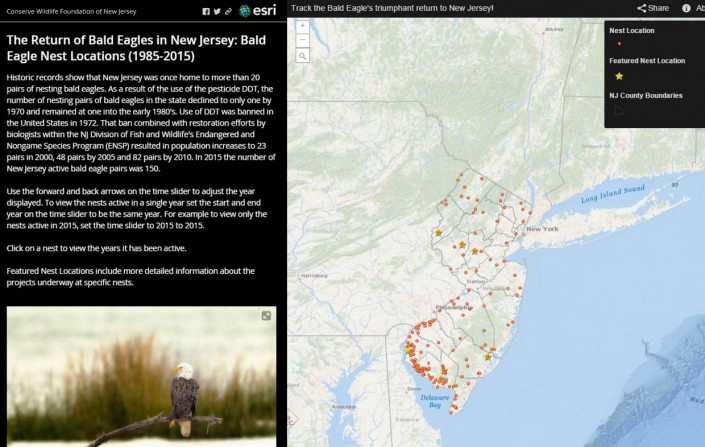
Our story map The Return of Bald Eagles in New Jersey has been updated based on the 2015 Bald Eagle Project Report. The story map shows the locations of every eagle nest known to be active (meaning they laid eggs) in New Jersey since 1985 — the year when there was only a single nest in the entire state. The map presents an animated depiction of where eagles have nested each year, so you can track the bald eagle’s triumphant return to the Garden State! Viewing the animation shows you how eagle nests spread from a single point in Cumberland County across all of New Jersey through the years.
The story map also highlights a number of Feature Nests which include more detailed information about the projects underway at specific nests, such as the Duke Farm nest which has been featured on our EagleCam since 2008.
The number of nesting pairs of bald eagles has steadily increased each year. This trend continued in 2015 with a record 150 active pairs, which was a slight increase over 146 such pairs recorded in 2014. In 2015, there were 122 nests that successfully fledged at least one young compared to 115 successful nests in 2014 and the 199 total young fledged in 2015 was only slightly less than the record 201 young fledged in 2014.
Learn More:
Brian Henderson is the GIS Specialist for Conserve Wildlife Foundation of New Jersey.