CWF Biologists and Volunteers Rescue Three Eagle Chicks

Biologists and Volunteers come to the Rescue of Three “Downed” Eagle Chicks

By: Larissa Smith, Wildlife Biologist/Volunteer Manager

On Saturday the 23rd, I received a call from Eagle Project volunteers Donna and Heiki Poolake. One of the nests that they monitor in Natural Lands Trust’s Glades Wildlife Refuge in Cumberland County had partially fallen and Heiki found all three chicks on the ground, thankfully alive. ENSP Principal Biologist Kathy Clark met them out at the nest site and determined that all three looked uninjured but were weak from lack of food and water. The two smallest were especially docile so the decision was made to take them to Tri-State Bird Rescue & Research in Delaware for a check up and to get needed fluids and food. The largest and strongest bird was given water and fish, and set on a leaning tree (off the ground) in the hope that it would hop up on branches where the adults, still watching from above, would continue to feed it.


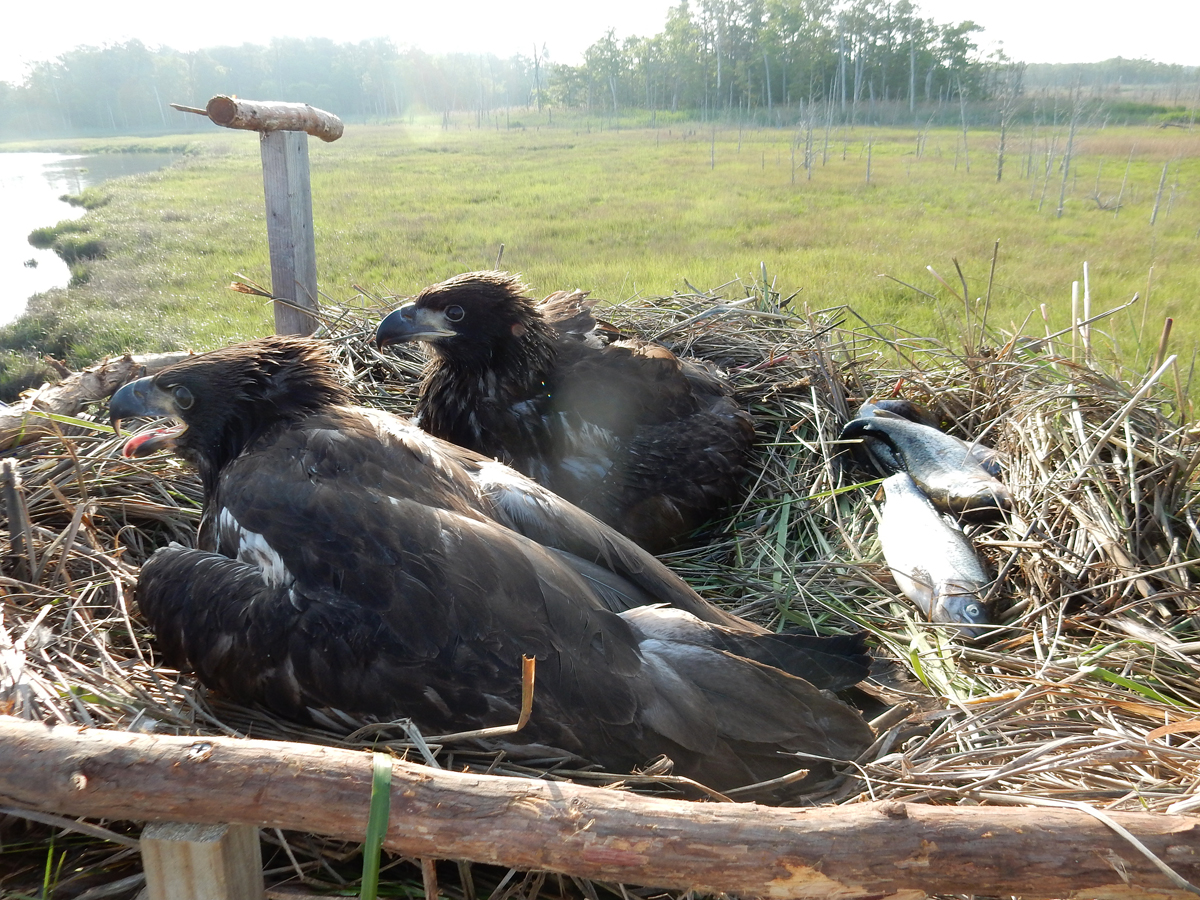
The next day we pulled together a crew to install a nest platform for the remaining eaglet. We carried the pre-built nest platform (designed for ospreys) into the marsh, installed it and built a nest of branches and grass, and added perches to make it more roomy for an eagle. We found the eaglet back on the ground, sitting on the remains of the fallen nest. We caught the bird again, banded and took measurements that confirmed this was a female about 9 weeks of age. She gladly ate pieces of fish offered to her as well as some more water. We placed her up in her new “nest,” along with several fish, and she looked quite happy to be off the ground and back up in a nest.

Chick in fallen nest on ground @ Heiki Poolake
Re-nested eagle chick in platform nest @ K. Clark
Re-nested eagle nestling in platform nest Photo by: K. Clark

In the meantime, the two eaglets at Tri-State were deemed healthy and ready to return to their parents. The challenge was how to return these two without disturbing their sibling now living in a nest platform built for smaller ospreys. The solution: a second nest platform. This second one was improved by CWF’s Ben Wurst by enlarging the size and adding branches as railings for perching. For a second time, a work crew assembled to use the early morning tide, and we boated the new platform out to within 200 yards of the first. The platform went up, a stick-and-grass nest quickly built, and the eaglets were brought out.


The eaglets, a 9 week old male and a 7.5 week old female, were kept covered until they got settled. When the chicks were uncovered, one of the adults started calling and flew in and perched on a snag within viewing distance. We quickly left and monitored them from a distance. One adult was perched near the platform with one eaglet, and before we left had flown in and perched near the new platform. Kathy went out the next day and reported that all three chicks were fine and using the perches and branches.
Re-nested chicks in second platform@ K. Clark
Re-nested eaglets in second platform Photo by: K. Clark
eagle chicks in new nest@K. Clark
Eagle nestlings in new nest Photo by: K. Clark

We’d like to thank the following people for their help: Dr. Erica Miller (NJDFW); Todd Vasquez (NJDFW Law Enforcement); Eagle Project volunteers Donna & Heiki Poolake and Matt Tribulski; Steve Eisenhauer (Natural Lands Trust) and local landowners, the Watermans.

Learn more:

Larissa Smith is the Wildlife Biologist/Volunteer Manager for Conserve Wildlife Foundation of New Jersey.

Red Knots “Vote with their Wings”

An Update from the 2015 Delaware Bay Shorebird Project Team

By: Dr. Larry Niles, LJ Niles Associates LLC

Clive Minton is fond of saying, “the knots vote with their wings” as a way of saying knots concentrate in the best places for knots. Of course it’s true, animals move to the habitats they find most suitable, nature leaves little room for anything but. Sometimes however, animals use a habitat only because they have little choice — in other words, they are making the best of a bad situation. The job of a good wildlife biologist is to understand the difference. Unfortunately, it’s often not obvious.

Red Knot Photo by: Jan van der Kam


In all the places studied by this author — Tierra del Fuego, the Arctic, and many places in between — knots distinguish themselves as highly selective habitat specialists. There are many practical reasons for this: usually knots occur in flocks and thus require more space than many other species. More importantly, as they put on weight for their incredibly long-distance flights, they often push the limit of safe wing-loading (body weight to wing area). This makes them vulnerable to predators, both real and imagined. They need more flying space, more space for advance warning of a predator’s presence. They demand special roost habitats as well, especially night roosts that are free from disturbance and have good sight distances. Altogether they need more.

Red knots roost on a sandy spit on Egg Island, one of the largest contigous area of marsh in the mid Atlantic.   Half of the bay's shorebird population roost on Egg Island and than feed on the various beaches around Fortescue.
Red knots roost on a sandy spit on Egg Island, one of the largest contigous area of marsh in the mid Atlantic. Half of the bay’s shorebird population roost on Egg Island and then feed on the various beaches around Fortescue.


In Delaware Bay, they need all this, but above all they need good horseshoe crab egg densities. In the mid 2000’s when shorebird numbers were high, the demand for those eggs exceeded the production from the rapidly diminishing crab population. Knots wandered the bay like homeless refugees. Competition for eggs drew tens of thousands of birds to places unused by knots in healthier times.

Mispillion Harbor
Mispillion Harbor


Mispillion Harbor, Delaware, for example, in some years supported much of the knot population in the Bay because it acts like a funnel-trap for crabs. Crabs wandered into the harbor through long stone jetties finding themselves in crab breeding heaven, sandy shoals in a closed space, free from wind-generated waves that normally leave them upside down. The egg-laying frenzy caused eggs to reach epic densities, thus preparing many shorebirds for their onward journey to the Arctic. Tens of thousands of shorebird packed into Mispillion Harbor in densities so high that one could smell ammonia off-gassing from the amount of bird waste.


But for knots, Mispillion left a lot to be desired. The same jetties that protect the inner harbor from wind-driven waves also provide low-flying raptors the cover to pounce on flocks before they can easily react. Fat birds make easy prey for peregrine falcons, who themselves struggle to keep up with the insatiable hunger of rapidly growing chicks.

Photo by:  Jan van der Kam
Photo by: Jan van der Kam


But even as shorebird numbers fell in response to the reduced crab numbers, egg densities improved in other places. Knots reassessed their choices and voted with their wings.


This is why this year’s high count of red knots on the New Jersey side of the Bay are so important.  Two days ago, Mark Peck, Joe Smith and I flew the entire Bay to count knots, ruddy turnstones and sanderlings. We counted over 24,000 knots, with 21,000 of these using the beaches managed by the many groups that take part in shorebird management on the New Jersey shore of Delaware Bay.


I am not saying this is a competition between two states — I’m saying the numbers serve as assurance that all our hard work is paying off. It’s a confirmation that the beach restoration projects, the Shorebird Stewards project, the reTURN the Favor crab rescue project, and more are bearing fruit. These coordinated strategies are led by Conserve Wildlife Foundation of New Jersey, American Littoral Society, Manomet Center for Conservation Sciences,  New Jersey Audubon Society, the Wetlands Institute, Citizens United to Protect the Maurice River, The Nature Conservancy, as well as Downe Township, Maurice River Township, Middle Township and the Division of Fish and Wildlife, New Jersey Department of Environmental Protection. This work is funded by the US Department of Interior, Fish and Wildlife Service, the National Fish and Wildlife Foundation and the Willliam Penn Foundation. Good work all!

Jim May protect Cook Beach as part of  Conserve Wildlife Foundation of NJ's Shorebird Stewardship Project.  Each year the Division of Fish and Wildlife designates beaches important to shorebirds and protects them from disturbance.  The shorebird stewards alert Conservation Officers if people refuse to comply.  But most of thier job is helping people understand the shorebird migration and the needs of shorebirds and crabs
Jim May protects Cook Beach as part of Conserve Wildlife Foundation of New Jersey’s Shorebird Stewards project. Each year, the Division of Fish and Wildlife designates beaches that are most important to shorebirds and protects them from disturbance. The shorebird stewards alert Conservation Officers if people refuse to comply, but most of their job is helping people understand the shorebird migration and the needs of shorebirds and crabs.

We now near the end of the stopover season at Delaware Bay. Three days of southerly winds are proving irresistible for many birds. Nearly two-thirds have left and the rest will be gone in a few days. Thanks to the people who love birds and the residents of the Bay, they leave well-prepared for the next stage of their challenging and inspiring lives.

knots in the air

Learn more:

Dr. Larry Niles has led efforts to protect red knots and horseshoe crabs for over 30 years.


Delaware Bay Shell-a-Bration Captured on Video

South Reeds Beach Oyster Reef Event Filmed by Local Delaware Bay Producer

By: Lindsay McNamara, Communications Manager

A record number of Red Knots were counted on New Jersey’s Delaware Bay this year, in part because of innovative restoration projects like our South Reeds Beach oyster reef.


Over 130 volunteers and veterans worked alongside Conserve Wildlife Foundation and American Littoral Society to establish a near-shore whelk shell bar at South Reeds Beach in Cape May Court House on the Delaware Bayshore in early April.


Shorebirds, like the federally listed Red Knot, depend on an uninterrupted supply of horseshoe crab eggs when they stopover in Delaware Bay during their migration. In recent years, countless horseshoe crab eggs have been lost because of the devastating storms that swept away the beaches they depend on.


The oyster reef was built to prevent sand loss from wind-driven waves. The approximately 200-foot project will test whether the reef bars help reduce beach erosion and create calmer water for spawning horseshoe crabs.


Learn more about the project and our “Shell-a-Bration” event in the video above produced by Kathleen Poliski of K. Productions, LLC!


The South Reeds Beach Oyster Reef is one of the many projects that American Littoral Society and Conserve Wildlife Foundation are working on to restore the ecology and economy of the Delaware Bayshore, thanks to generous funding by the National Fish and Wildlife Foundation. To learn more, visit RestoreNJBayshore.org.


Lindsay McNamara is the Communications Manager for Conserve Wildlife Foundation of New Jersey.

Pondering the Plovers

Researching the Causes of Chick Loss in Piping Plovers

By: Emily Heiser, Biological Assistant

Double the fun! We were able to capture both birds in one try at this nest!

I often find myself contemplating the lives of Piping Plovers. What happened to that nest? Why did they choose that exact spot to lay their eggs? Why did those chicks disappear? Where will they go for the winter? As wildlife biologists and conservationists who spend hours and hours each summer watching them, we tend to question every aspect of the Piping Plover’s life cycle. These questions also push us to work harder and do more for this species, which is so imperiled throughout its range.


This summer, thanks to the extraordinary support of the US Fish and Wildlife Service, the New Jersey Division of Fish and Wildlife, and along with the blessings of Conserve Wildlife Foundations’s own Beach Nesting Bird Project Manager Todd Pover, the State University of New York College of Environmental Science and Forestry (SUNY-ESF) received the green light to proceed with a chick mortality study of Piping Plovers along New Jersey’s coast.


Funded by the National Fish and Wildlife Foundation, SUNY-ESF’s Jonathan Cohen and Michelle Stantial have teamed up once again to make some plover magic happen here in New Jersey. Having had the great privilege of working for this dynamic duo in the past, I am over the moon to be able to assist them once again.


Nest camera being readied so it can keep a watchful eye on the nest for predators at all times.

The big question of this study is simple on the surface: what are the causes of chick mortality? The methods of finding those answers are much more complex. On April 15th, we kicked off another fantastic field season collecting data from Barnegat Light to Cape May. In order to determine the causes of chick loss we first need to locate nests, determine nest fate, track the adults, and then finally track the chicks. We hit the ground running and so far there are 26 active nests between all of our study sites! One of the most interesting parts of this study pertains to the cameras we are placing at a number of nests.


Our high tech plovers are now enjoying a 24/7 monitor that never bothers them, but is always watching. On more occasions than I can count, I have come across a nest that was lost in the past 10-24 hours.


We make our best guess as to what happened based on the evidence…Was it a flood? An avian predator? A mammalian predator? What happened?! It’s frustrating, but now we can know with certainty and we can learn much more about the threats Piping Plovers face on their breeding grounds.

A male piping plover in "holding pen" awaiting his debut sporting his new bands and transmitter to be used for tracking.
A male piping plover in “holding pen” awaiting his debut sporting his new bands and transmitter to be used for tracking.


Another important component of this project revolves around the banding and nano-tagging the adults. It is essential to the study that we are able to determine survival and movement of the adults. So far we have been able to band 24 adults, with 10 of those also receiving a transmitter. There are two telemetry towers between our study sites. These towers are able to pick up multiple radio-tagged birds and track of them day and night.


Interestingly, in a previous study developed by SUNY-ESF adult female Piping Plovers spent much of the evening away from the nest and leave the males to do all of the nocturnal incubating! The most advantageous part of these towers will, in theory, be able to tell us what happens to the chicks. Each chick will receive a tiny transmitter and as depressing as it may seem, those towers can tell us the speed and trajectory a chick was carried away from the site by a predator.


My vote was to give the chicks an iPhone and shoot me a text when they were in danger, but that doesn’t seem to be possible…yet.


I am not sure there will ever come a day when I am not pondering the lives of Piping Plovers, but I believe that science and research will continue to supply more answers. I believe that this particular study will contribute to a greater understanding of these birds, and on a personal level, I believe it will enable me to become a better steward and manager of all New Jersey’s beach nesting birds.


We look forward to bringing spectacular photos and updates whenever we can, so stayed tuned for more pondering of plovers!

Learn more:

Emily Heiser is the Biological Assistant for Conserve Wildlife Foundation of New Jersey.


19,077 Red Knots Counted – The Most Seen in New Jersey in a Decade

An Update on the 2015 Delaware Bay Shorebird Project

By: Dr. Larry Niles, LJ Niles Associates LLC

Despite the threatening forecast of a cold drizzle and strong winds, our team persevered to complete the first bay-wide count of this season. On the New Jersey side of Delaware Bay, we counted 19,077 red knots – the most seen in the state in a decade. With Delaware’s shorebird team recording 2,000 knots along their entire shoreline, the total knot count of 21,077 is not far from the 24,000 seasonal maximum of the last three years.


Red knot aerial counts


This is good news in either of two completely different ways. One explanation is that perhaps most of the knots have already come to the bay. If so, they are in good time to make weight and are getting close to an on-time departure for the Arctic. The alternative is that even more will arrive and we will exceed our counts of the recent past. Good weights promise good Arctic production; more knots offer new hope.


Knots in formation heading off to the Arctic (c) Jan van de  Kam
Knots in formation heading off to the Arctic (c) Jan van de Kam


The numbers of ruddy turnstones (12,295) and semipalmated sandpipers (56,788) are also close to the seasonal maxima counts of the recent past, so they too may soon brave the long flight to their Arctic homes. Our cannon-net catches of turnstones, sanderlings and knots point to weights building quickly.


Canon net catch
Canon net catch
Canon net catch
Canon net catch
Canon net catch
Canon net catch

The weather conditions play with our expectations. For the last few days, high westerly winds have generated beach-pounding waves all along the Cape shore. Its north/south orientation is perfectly perpendicular to the strong winds, and the wind-generated waves shut down horseshoe crab spawning. This forces the birds to seek shelter and better egg densities elsewhere.


Right from the start, the disappearance of the shorebirds we had been seeing intrigued us, for a good wildlife mystery gets consumed in this team like a good bottle of beer. Within hours, Mark Peck and Gwen Binsfeld found the knots south of where we would have expected. The knots, turnstones, sanderlings, and semipalmateds were comfortably riding out the wind storm on the vast, sandy intertidal flats in front of Sunray Beach and Villas. We haven’t seen birds gathering in numbers here since the early 2000’s.

Photo of shorebird team by Kevin Karlson (from bottom right: Mark Fields, Stephanie Feigin, Mark Peck, Clive Minton, Angela Watts, Jeannine Parvin, Christophe Buidin, Alinde Fojtik, Dick Veitch, Barrie Watts, Joanna Burger, Arie Manchen, Steve Gates, Phillipe Sitters, Ana Paula Sousa, Reydson Reis, Chege Wa Karuiki, Susan Taylor, Mandy Dey, Peter Fullagar, Deb Carter, Gwen Binsfeld, Nick Smith, Clara Kienzi, Joe Smith, Larry Niles, Humphrey Sitters, Stefanie Jenkinson, Ally Anderson, David Stallneckt, Gerry Binsfeld, Christian Friis, Chris Davey)

But back to the count. We found shorebirds all along the Bayshore with three areas of concentration. The first was the aforementioned Villas flats. The second was in the Pierces Point to Reeds Beach area, with most in the more southerly portion of the sector. “Not-knots” (mostly semipalmated sandpipers) were seen there in big numbers during the boat survey by Yann Rochpault, Christophe Buidin and Tom Baxter. They saw 12,000 shorebirds along this mostly unpopulated shoreline.


Semi palmated sandpipers along shoreline (c)Jan van de Kam


But the real shorebird wonderland of the bay continues to be Egg Island. Few people see this this vast intertidal marsh, and fewer still appreciate its wonder. Egg Island – actually a peninsula – juts miles out into the bay, nearly to the shipping channel. The marsh cradles one of the most diverse bird faunas of the mid-Atlantic. All along its mucky eastern flank, short-billed dowitchers, dunlin, semipalmated sandpipers, black-bellied plovers, and semipalmated plovers comb the eroded banks for crab eggs drifting in the water column from better crab breeding sites. The crabs themselves attempt to breed in the overhanging edges of the spartina marsh, a lost cause; however, because the muck lacks oxygen and the eggs cannot develop. This is bad for crabs but good for shorebirds because most of the eggs end up on the sod banks, easy prey for shorebirds.


birds on sod


But this week, the wonders of Egg Island overwhelmed us. Our team – Humphrey Sitters, Phillipa Sitters and this blog’s author – wove along the shallow shoreline in our intrepid 17-ft Carolina skiff, counting thousands of shorebirds – 8,226 knots, 4,125 ruddy turnstones, 3,000 sanderlings, and 21,000 semipalmated sandpipers. The flocks swirled around the   peninsula’s sandy western shore, alighting, then flying, and then alighting again. It was a shorebird dance that was a wonderful sight for increasingly tired-out shorebird scientists.


Learn more:

Dr. Larry Niles has led efforts to protect red knots and horseshoe crabs for over 30 years.

13,000 Red Knots on New Jersey’s Delaware Bay

An Update on the 2015 Delaware Bay Shorebird Project

By: Dr. Larry Niles, LJ Niles Associates LLC

We had about 13,000 knots on the New Jersey side of the Delaware Bay (an additional reported 2,000 on the Delaware side of the Bay). Yesterday, we suffered strong NW winds in excess of 20 kts and the birds virtually disappeared. Our daily survey turned up about 6,000 knots, the rest we suspect, finding refuge in Egg Island and Goshen Marshes or with a flyover to Delaware.


We will know where they went today. The team will comb the Bayshore for shorebirds with a coordinated ground, boat and aerial survey. The birds gain weight in good time and we expect the first Arctic lift-offs by the 26th. At the current rate, most of the Bay’s population will be off to the Arctic by the 30th.


Above is a clip from a new video about knots and our work by Mitch Smith, a longtime supporter of the team and head of the Mitch Smith Media.


Learn more:

Dr. Larry Niles has led efforts to protect red knots and horseshoe crabs for over 30 years.


Photo from the Field: First falcons of 2015

Monitoring for hatching at Peregrine falcon nests

by Ben Wurst, Habitat Program Manager

Four 14 day old peregrine falcon nestlings. Photo by Ben Wurst
Four 14 day old peregrine falcon nestlings. Each spring we visit all known falcon nests to check for hatching. At the time we age the young and then inspect them for any parasites and treat them. Then our final visit is to band the young for future tracking. Photo by Ben Wurst

2015 Horseshoe Crab Spawn and Shorebird Migration on Delaware Bay

An Update on This Season’s Horseshoe Crab Spawn and Shorebird Migration, Ten Days In

By: Dr. Larry Niles, LJ Niles Associates LLC

Thousands of shorebirds now fill Delaware Bay’s beaches and marshes in a determined effort to regain lost reserves with free-for-the-taking fatty eggs of the horseshoe crab. The crab spawn began ten days ago and has gained momentum over the last week as the volume of eggs grows like a well-funded savings account. The eggs surface as each new female crab digs up egg clusters laid by other crabs or as wind-driven waves pound the always-fluid sandy beaches. At least 8,000 red knots slowly get fat on the eggs scattered on New Jersey’s Delaware Bay beaches.

Eggs on Beach
Eggs on Beach

Both crabs and birds are the beneficiaries of the increasing number of beaches that are highly suitable for egg-laying. In October, 2012, Hurricane Sandy ravaged two-thirds of New Jersey’s best crab-spawning beaches, its strong westerly winds lifting sand and spreading it far from the sea’s edge. Left behind was a jagged sod bank, completely unsuitable for horseshoe crab breeding. The mucky sod starves eggs of oxygen or gasses them with hydrogen sulfide, the by-product of decaying mud.


The American Littoral Society, Conserve Wildlife Foundation of New Jersey, the U.S. Fish and Wildlife Service and the National Fish and Wildlife Foundation came to the rescue, restoring many of these beaches to a condition superior to that before Sandy. The restoration team even repaired damages that predated Sandy — beaches with tons of rubble that entrapped crabs in nasty concrete, killing them by the thousands. Now beaches like Thompson’s Beach and Fortescue Beach join the growing number of delicate sandy strands that provide excellent spawning habitat.

Thompsons Beach Before and After
Thompson’s Beach Before and After Restoration

This week, eggs can be found in many places on the New Jersey side of Delaware Bay, and the birds have the freedom to move to those that best suit them. Earlier this month, strong northwest winds drove red knots from the Reeds Beach area to other, more northerly, beaches that saw good crab spawning — beaches that also provide shelter from the winds. Now that the wind and sea have calmed, the birds have returned to the Reeds Beach area, less than 20 miles away, and have resumed gorging on the plentiful eggs that built up in their absence.

Early Morning Shorebirds on Delaware Bay

If one were to look for any cloud on the Delaware Bay shorebird horizon, it would lie in the lack of any evidence of horseshoe crab recovery. The current, reduced, population of crabs spawned eggs in great numbers early this May because of a spike in the water temperature, a consequence of unusually warm weather.  So far the promise of this early spawn is holding, and crabs continue to spawn in good numbers. But will it hold until the end of May?

Crabs in Slew
Crabs in Slew

If not, the readers of this blog will witness the outcome. The graph below, developed by long-time team-member Dick Veitch tells the story of a past egg failure. In the early 2000’s, although the population of shorebirds had not yet declined to its current number, the crab population had already fallen to its current number, crushed by the onslaught of a poorly regulated fishing industry.  In those years, all the horseshoe crabs that could spawn had finished by the third week of May and egg densities on the bay plummeted. The birds crammed into the few beaches with eggs like Mispillion Harbor, Delaware, so densely that the beach reeked of off-gassing urinary ammonia.


But the number of eggs there was not sufficient to feed the still-large shorebird populations and birds failed to reach a weight – about 180g for red knots — suitable for their journey to the Arctic and subsequent breeding. Where once 80% reached the “good” weight, only 5% did in 2003 (see the second graph).

Percentage of Red Knots Reaching 180 Grams

The percentage has improved thankfully, but only because the number of shorebirds have fallen over the last 10 years, bringing a balance of sorts. Hopefully, with the new beaches, the new protection afforded by the red knot listing and the growing number of volunteers taking part in conservation of the crab and birds, this kind of disaster is behind us.

We shall see.


Learn more:

Dr. Larry Niles has led efforts to protect red knots and horseshoe crabs for over 30 years.

2015 Delaware Bay Shorebird Project Continues!

Another Season of the Delaware Bay Shorebird Project Underway

By: Dr. Larry Niles, LJ Niles Associates LLC

The value of a shorebird stopover like Delaware Bay can be seen in the shaky cam movie by this author.  Red knots – some recently arrived after a grueling 6,000-mile flight over 6 days of continuous flying – arrive on the Bayshore desperate for food. Over the last 10,000 years, the species has evolved to fly directly to the Bay to feed on the eggs of the horseshoe crab.

The 450-million year-old crab – which is actually in the spider family – crawls ashore and lays pin-sized eggs about 6 inches deep in the sand. When there are many crabs, as here on Delaware Bay, one crab often unearths the eggs of another. Thus they leave millions of fatty eggs on the surface, offering an energy-rich, soft feast for the starving birds. In turn, we get to watch the birds racing for an egg ‘hot spot’!

The birds often arrive beyond depleted. A normal weight for a knot is 130 grams.  Many arrive on Delaware Bay below 100 grams, the equivalent of a human in the throes of profound starvation. But when the birds fly north from the coast of northern Brazil, there’s no turning back. Once they go, they must go all the way.

Map of geolocator track of a South American wintering  red knot
Map of geolocator track of a South American wintering red knot

This year, migrating shorebirds faced a freak tropical storm that could have forced them out to sea, far off-course.  In severe cases, some birds with no remaining fat reserves even metabolize their own muscles, like airplanes throwing out vital equipment to stay aloft. Storms can also prevent birds from lifting off on migratory flights. They are capable of detecting atmospheric pressure changes and can just stay put until a storm passes. We think this is what happened this week when a storm, followed by a strong cold front and consequent northwest winds, prevented a movement north.

The sum of these challenges was lower than normal shorebird numbers during the first week of the stopover. The Heislerville impoundments support a good number of short-billed dowitchers and dunlin, but these species usually arrive earlier than the others and probably came in ahead of the adverse winds. Yet there are very few ruddy turnstones, sanderlings and semipalmated sandpipers on the Bay.

Short bill dowitcher (c) Jan van der Kam  from Life on Delaware Bay
Short bill dowitcher (c) Jan van der Kam from Life on Delaware Bay

The one exception on the Bay is the red knot. At first, we thought that only about 1,000 red knots had arrived in and around Reed’s Beach. Then Jerry Binsfeld and Peter Fullagar, Canadian and Aussie members of our team, found an amazing 7,000 knots at Gandys Beach on the northern Bayshore in New Jersey. Very likely, these are short-distance migrants, coming in from wintering areas in Florida, Georgia and the Caribbean.

Red Knots on Fortescue

Our catch results support this working hypothesis. The knots we caught at Fortescue were at higher weights than normal for this early part of the season, which would be expected if fewer very thin long-distance migrants were part of the average.

The graph shows the weight relative to previous years.
The histogram shows the distribution of all the birds weights in the catch.
Learn more:
Dr. Larry Niles has led efforts to protect red knots and horseshoe crabs for over 30 years.

The Return of Bald Eagles in New Jersey

Conserve Wildlife Foundation Releases New Story Map: “The Return of Bald Eagles in New Jersey”

By: Brian Henderson, GIS Specialist

Bald Eagle Story Map

Today, Conserve Wildlife Foundation of New Jersey (CWF) announced the release of “The Return of Bald Eagles in New Jersey” a Story Map that provides a new way to visualize the increasing number of bald eagle pairs nesting in New Jersey over time.


For years, CWF has worked closely with the New Jersey Endangered & Nongame Species Program (ENSP) to track and restore the bald eagle population within the state. It has been a rewarding experience for all involved to witness the return of bald eagles to the garden state, and now the public can appreciate the scope of their return as well.


The recovery of bald eagles nationally and in New Jersey is fairly well known, but some may not realize that as recently as the mid-80’s there was only a single pair of nesting bald eagles in all of New Jersey. The ban of DDT, combined with restoration efforts by ENSP biologists, resulted in population increases to 23 pairs in 2000, 48 pairs by 2005 and 82 pairs in 2010.


In 2014, there were a record 146 active bald eagle pairs nesting in New Jersey. This year, 190 nesting territories are being monitored and currently 88 chicks have been reported at 52 nests; it is still early in the season so we don’t have a count for all nests yet.


“The Return of Bald Eagles in New Jersey” Story Map displays the locations of all the known active bald eagle nests in New Jersey from 1985-2014. Users can choose to view the nests active in a single year or over a longer period of time. By choosing a one year interval and beginning in 1985, it’s possible to watch as nests multiply from a single nest in Bear Swamp to densely populating the Delaware Bay coast and spreading across the southern portion of the state and eventually into almost every county of New Jersey. In 2014, the only counties in New Jersey without an active bald eagle nest were Essex and Hudson.


The Story Map also highlights “featured” nests, or nests of special significance, including the Duke Farms nest which has been featured on a webcam since 2005 and the Millville nest where a juvenile eagle was fitted with a GPS tracking device in 2014. These featured nests include more information, pictures and links to pages that explore related projects in greater depth.


As the bald eagle population has reached record numbers in New Jersey, the raptors have expanded into non-traditional parts of the state, providing more and more people with a chance to glimpse this iconic species. This map highlights the ongoing success of conservation efforts and illustrates that whether you realize it or not, you’re never very far from a bald eagle nest in New Jersey!


Learn more:

Brian Henderson is the GIS Specialist for Conserve Wildlife Foundation of New Jersey.