Wildlife Beach Restoration Groups Applaud Endangered Species Act Designation for Red Knot

Shorebird now federally protected as threatened species under Endangered Species Act

By: Lindsay McNamara, Communications Coordinator
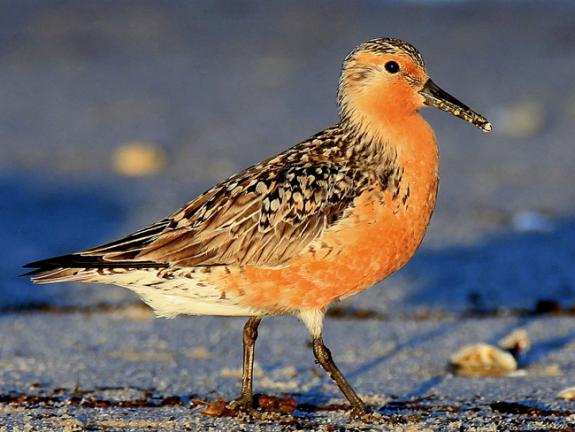
A red knot in breeding plumage along the Delaware Bay. © Bill Dalton

Wildlife conservation organizations leading the efforts to restore New Jersey’s Delaware Bay beaches for at-risk shorebirds today applauded the U.S. Fish and Wildlife Service decision to designate the Red Knot, a migratory shorebird, as “threatened” under the Endangered Species Act. A “threatened” designation means a species is at risk of becoming endangered throughout all or a significant portion of its range.


“This federal designation will make a big difference in strengthening the protections of this incredible shorebird,” said David Wheeler, Executive Director for Conserve Wildlife Foundation of New Jersey.


“Here in New Jersey, we are restoring the vital beach habitat that had been decimated by Hurricane Sandy, and this designation ensures the safeguards we are providing can be complemented along the East Coast,” Wheeler added.


Since the 1980’s, the Knot’s population has fallen by about 75 percent in some key areas. Wildlife biologists believe the major threat to the Red Knot is the dramatic decline of horseshoe crab eggs, an essential food source at the most critical stop over during their 8,000 mile trip from southern wintering grounds to Arctic breeding territory. High-energy horseshoe crab eggs provide nourishment for Red Knots to refuel and continue their journey.


“This is an important and needed step in the conservation and recovery of the Red Knot. It is an essential step in preventing the extinction of this amazing long distance traveler,” stated Tim Dillingham, Executive Director for American Littoral Society.


The largest concentration of Red Knots is found in May in the Delaware Bayshore of New Jersey and Delaware, where the shorebirds stop to gorge themselves on the eggs of spawning horseshoe crabs. In just a few days, the birds nearly double their weight to prepare for the final leg of their long journey.


“The major decline of horseshoe crabs in Delaware Bay is one of the largest threats to the survival of the shorebird,” explained Dr. Larry Niles, a biologist who leads the beach restoration efforts for Conserve Wildlife Foundation of New Jersey and American Littoral Society, and has studied Red Knots for three decades. “Agency groups have been working hard for the last two years, and will continue for the next two years going forward to rebuild the habitat damaged by Hurricane Sandy that the horseshoe crabs rely on. This work is integral to the recovery of the Red Knot and the shorebird’s best hope for survival.”


In the wake of Hurricane Sandy, American Littoral Society and Conserve Wildlife Foundation of New Jersey worked with the U.S. Fish and Wildlife Service, the New Jersey Division of Fish and Wildlife and the New Jersey Recovery Fund to remove 8,000 tons of debris and added 45,000 tons of sand to the beaches just before the annual spring arrival of the Red Knot in 2013.


Learn More:

Lindsay McNamara is the Communications Coordinator for Conserve Wildlife Foundation of New Jersey.

Piping Plovers and Researchers Return to The Bahamas

PROTECTING PIPING PLOVER HABITAT CRITICAL PART OF CONSERVE WILDLIFE FOUNDATION’S WORK

By: Todd Pover, Beach Nesting Bird Project Manager and Stephanie Egger, Wildlife Biologist

We talk quite a bit about “site fidelity” in connection with our beach nesting bird project. And for good reason, whether it be on the breeding or wintering grounds, these birds, like most wildlife, are strongly connected to specific places and types of habitats. Not just in the general sense; many piping plovers return to the same precise site year after year.

Aerial view of one of several hundred Bahamas islands and cays, with tidal flats, highly suitable piping plover habitat, visible stretching around the island.


We were reminded of this the last several days as we made our way around Abaco, The Bahamas, in search of wintering piping plovers. Having made a number of trips to Abaco since 2011, we have started to narrow down where it is likely we will be able to find them: the Green Turtle Cay Gillam Bay flat at low tide or the adjacent upper beach hummocks at high tide, Casuarina Point to forage at low tide, a number of the main island’s southern oceanfront beaches for roosting, to name a few. We are still finding new sites, not previously surveyed or documented, but we now have a much better idea of what to look for and on what tide or wind condition.


The catch is, this only works if the habitat remains intact and suitable. Back in New Jersey, we know this well, as many of the formerly suitable sites for beach nesting birds are lost forever to development or are highly disturbed by recreational activities so the likelihood of reproductive success is low even if they do choose to nest at those locations. Sadly, our breeding pairs of piping plover are relegated to a limited number of suitable sites, which is not a good recipe for recovery of this endangered shorebird.


With its hundreds of islands and cays, many undeveloped or lightly settled, we may be inclined to think this is less of an issue on the wintering grounds in the Bahamas. And relatively speaking, this might be true to some extent, but it would be unwise to believe this will always be the case. Economic forces are a driving factor there, as in anywhere in the world, so the lure of development and commercial use of resources is strong in the Bahamas as well.

Black Flag "K2", a Canadian breeder and one of six color marked piping plovers observed on wintering grounds on Abaco, The Bahamas, this past week by CWFNJ's Todd Pover and Stephanie Egger.
Black Flag “K2”, a Canadian breeder and one of six color marked piping plovers observed on wintering grounds on Abaco, The Bahamas, this past week by CWFNJ’s Todd Pover and Stephanie Egger.


Fortunately, there is also a strong incentive to protect shorebirds in the Bahamas. The tidal flats and shallow water habitats that shorebirds use are also important for bonefish, conch, and other fisheries that are important to the local economy and provide jobs. Furthermore, birding and wildlife-based activities are increasing an important part of the tourist sector. However, In order to sustain those activities and opportunities, ecosystems must remain intact and pristine.


A number of organizations, local and from abroad, are diligently working to designate more protected areas in the Bahamas. One of the top priorities now, an effort being led by the Bahamas National Trust and National Audubon Society, is to protect the vast flats area in the Joulter Cays, Andros, which are especially important for shorebirds such as the piping plover. On Abaco, where we have been focusing our piping plover work, Friends of the Environment  is strongly advocating for protection of East Abaco Creeks, Cross Harbour, and more recently The Marls.


During a survey this past week on Man-O-War, one of Abaco’s offshore cays, we were able to locate a banded piping plover that had originally been marked on its breeding grounds in Canada. In discussing the bird with a local resident who had first spotted it, she was surprised that the bird was remaining in the same spot ever since she saw it two months ago. This was site fidelity illustrated in its truest sense, and in the same vein, the researchers in Canada are already anticipating it will return to the same site to nest next spring. From what we know about piping plovers that is highly likely…as long as we remain committed to protecting the habitat they use.


Project RedBand: 04/C from LBI to Trinidad and Tobago!

Auxiliary bands help link Barnegat Bay ospreys to their wintering grounds

by Ben Wurst, Habitat Program Manager

04/C was banded at a nest on LBI and re-sighted on the island of Trinidad and Tobago by Nicholas Hassanali.

When I started work on Monday morning I got some amazing news (at least for an osprey lover). One of the young ospreys that I banded on Barnegat Bay was re-sighted on the Caribbean island of Trinidad and Tobago!! To top that cake, the osprey was photographed to confirm its sighting. YES!! Nicholas Hassanali took the above photo and enlarged the red band to read the alpha-numeric code which reads “04/C.” I looked up in my banding records and saw that 04/C was produced at a nest behind the Long Beach Island Foundation for Arts & Sciences in Loveladies, Long Beach Island.

04/C after being banded. He was around 4 weeks old on July 7, 2014.

I banded him (I can tell its a male by the size of the band on its leg and the lack of a brown necklace of feathers on its breast) on July 7th with a CWF donor Bill C. We ventured to four nests by kayak. This was the first survey where I started to deploy the red auxiliary bands on young ospreys. I remember that it was a pleasant day. Not too hot or windy. As we made our way from one sheltered nest on a lagoon to another out on the bay we felt the winds kick up from the south making paddling difficult (especially when you’re towing another kayak with a ladder on top!).

125-A-032: 04/C's nest.
125-A-032: 04/C’s nest.

We decided to return to Bill’s house and take my truck to survey the next two nests, since we could walk to them from a side street. We walked out to one nest and found that it failed, i.e. no young were produced. Then we proceeded onto the next, 04/C’s nest. I remember climbing up the ladder to band the young and did not get a chance to take any better photos because I had to be on my way soon. While up there I remember the male dropped a fish (bunker) and Bill got it and we put it back into the nest. One thing that I will not forget about this day is the smell of smoke and burning plastic. I found out later that day that a lawyer’s office in Ship Bottom was on fire when we were out surveying these nests. Luckily no one was hurt in the fire!

I personally cannot wait to get more reports of our red banded ospreys. The young that were banded this year will not return until 2016 and even then they might not return until the late spring/early summer and will not breed. At least I know that there are people out there watching and admiring our ospreys! As Nick said in a comment on his photo on Flickr, “ I have a great love for Ospreys.” 🙂

Help Northern Long-Eared Bats Become Listed as Endangered Species

By: Lindsay McNamara, Communications Coordinator

Photo Credit: MacKenzie Hall


The U.S. Fish and Wildlife Service has reopened the public comment period on a proposal to list the northern long-eared bat as endangered under the Endangered Species Act (ESA).  Comments will be accepted through Thursday, December 18, 2014.


The public is invited to submit comments one of two ways:

(1)  Electronically:  Go to the Federal eRulemaking Portal: www.regulations.gov.  In the Search box, enter Docket No. FWS–R5–ES–2011–0024. You may submit a comment by clicking on “Comment Now!”

(2)  By hard copy:  Submit by U.S. mail or hand-delivery to:  Public Comments Processing, Attn:  FWS–R5–ES–2011–0024; Division of Policy and Directives Management; U.S. Fish and Wildlife Service, MS: BPHC; 5275 Leesburg Pike, Falls Church, VA 22041-3803.

During the previous comment period, from June 30 to August 29, 2014, USFWS received over 65,800 comments on this issue!


Why is it so important?

The Northern Long Eared Bat, like many other bat species in the United States, is in danger of extinction due to White-Nose Syndrome, impacts to hibernacula, summer habitat loss and wind farm operation. Listing a species as endangered, under the protections of the Act, increases the priority of the species for funds, grants, and recovery opportunities.


How Else Can You Help Protect Northern Long-Eared Bats?
These tips were pulled from U.S. Fish & Wildlife Service’s Northern Long-Eared Bat Fact Sheet:

  • Do Not Disturb Hibernating Bats
  • Leave Dead and Dying Trees Standing: Where possible and not a safety hazard, leave dead or dying trees on your property. Northern long-eared bats and many other animals use these trees.
  • Install a Bat Box: Dead and dying trees are usually not left standing, so trees suitable for roosting may be in short supply and bat boxes can provide additional roost sites.


Learn more:

Lindsay McNamara is the Communications Coordinator for Conserve Wildlife Foundation of New Jersey.

Atlantic City Electric Holds Avian Protection Educational Event

Details Measures Taken to Help Protect Wildlife and Improve Reliability

By: Lindsay McNamara, Communications Coordinator

Photo Credit: Atlantic City Electric. Pictured left to right are Ben Wurst, wildlife biologist, Conserve Wildlife Foundation of New Jersey; Ed Kaminski, senior supervising engineer, ACE; Cristina Frank, lead environmental scientist, ACE; and Mike Garrity, senior supervising scientist, ACE.

Atlantic City Electric (ACE), in collaboration with the Conserve Wildlife Foundation of New Jersey, recently held an Avian Protection Educational Event to promote a better understanding of how Atlantic City Electric helps protect birds and other animals, while also helping improve electric service reliability for customers.

ACE environmental scientists Cristina Frank and Mike Garrity detailed the various types of migratory and breeding birds that may perch or nest on power lines, including ospreys, which frequently nest on utility poles. They discussed various types of devices placed on wires and other infrastructure designed to minimize the risk of birds and other wildlife from coming in contact with electric wires and equipment.

“Hundreds of thousands of birds migrate through Cape May County each year,” said Cristina Frank, lead environmental scientist, Atlantic City Electric and head of the company’s Avian Protection Program. “We conduct field studies to determine areas throughout Cape May County and our entire service territory to determine which areas are of the greatest risk to birds and other wildlife.”

ACE senior supervising engineer Ed Kaminski explained how avian protection is an integral part of the design phase before constructing any new infrastructure projects or upgrading existing infrastructure.

“We are in constant communication with our environmental team, and, when necessary, we’ll enhance our infrastructure to minimize the risk to birds while helping reduce the number of related power outages to create a more reliable electric system for customers,” Kaminski said.

Atlantic City Electric recently completed infrastructure enhancements in Cape May, Ocean City and Strathmere, N.J., that addressed risks to avian wildlife. As a result, the company has not seen any bird-related incidents since in these areas.

Also as part of the event, Ben Wurst, a wildlife biologist with the Conserve Wildlife Foundation of New Jersey, discussed the foundation’s role in helping manage and protect ospreys through man-made nesting platforms that provide a safer nesting alternative than utility poles. ACE partners with Conserve Wildlife to identify and address risks to birds throughout its service territory.

Birds routinely use power line poles and towers as perches to establish territorial boundaries, nest, hunt, rest, find shade and feed. Utility poles often provide perching or nesting opportunities in areas where few natural perches or nest sites can be found. If the configuration and location of utility structures are in areas where birds are attracted by favorable habitat or are in a migratory path, the chance of electrocution and/or collisions increase.

Learn more:

Lindsay McNamara is the Communications Coordinator for Conserve Wildlife Foundation of New Jersey.

Read All About It: Newsworthy BatCam Big Brown Bats

By: Lindsay McNamara, Communications CoordinatorStephanieBatCamABC7

BatCam, the live-action camera that captures a colony of big brown bats living in a family home in Flemington, received plenty of media attention this week. BatCam is hosted on Conserve Wildlife Foundation‘s website, thanks to the Williams family.

The bats’ unusual choice of a summer roost has given this family a unique peek at their lives, from knowing exactly when the bats return from hibernation each spring, to watching them give birth and care for their pups though the summer.

The bats also caught the attention of New Jersey media. Read about the colony of big brown bats:

Learn more about Conserve Wildlife Foundation’s work to help protect NJ’s bat population:

Lindsay McNamara is the Communications Coordinator for Conserve Wildlife Foundation of New Jersey.

Ebola of the Sea? Dolphins Still Dying Off Coast

By: Lindsay McNamara, Communications Coordinator

oct271
A live bottlenose dolphin on Tobay Beach in Nassau County, New York. (Photo Credit: APP/Riverhead Foundation for Research and Preservation)

Bottlenose Dolphins, their numbers impacted last year from a nasty virus that rivals the death rate of Ebola in West Africa, are still dying, researchers have found.

The outbreak of morbillivirus, a measles-like virus that causes pneumonia, skin lesions and brain infections, has killed roughly twice as many bottlenose dolphins as the last big outbreak in 1987-88. In New Jersey, 151 bottlenose dolphins died last year — nearly 10 times this year’s toll so far, according to the Marine Mammal Stranding Center in Brigantine.

Morbillivirus is highly contagious. It’s spread through respiration (via blowholes) and direct contact. Experts think the virus may also be spread through skin contact.

Asbury Park Press Reporter Todd B. Bates explores the unusual mortality event:

Learn more:

Lindsay McNamara is the Communications Coordinator for Conserve Wildlife Foundation of New Jersey.

Piping Plovers Plunge to Record Low in NJ

By: Lindsay McNamara, Communications Coordinator

Photo Credit: Asbury Park Press/Nancy A. Smith

Pairs of piping plovers — small, critically endangered shorebirds that dart along the sand in search for food — dropped to a record low in New Jersey this year. Just 92 pairs nested in the Garden State, down from 108 last year, BUT the beach-nesting birds spawned a high number of fledged chicks — 1.36 per pair, the third-highest figure since 1986 and above what’s needed to grow and maintain their population in the long-run.

Last week, Asbury Park Press Reporter Todd B. Bates discussed the issue with Conserve Wildlife Foundation’s Beach Nesting Bird Project Manager Todd Pover.

Lindsay McNamara is the Communications Coordinator for Conserve Wildlife Foundation of New Jersey.

Big brown bats in N.J. thrive as smaller cousins decline

Big Brown Bats (c) Phil Wooldridge

White-nose syndrome continues to kill off little brown bats in New Jersey, but there is hope on the horizon for another species of bat – the big brown bat. Reporter James O’Neill explores the changing fortunes of New Jersey’s bats.

Spotlight on Brooke Maslo, Women and Wildlife Education Award Winner

Rutgers Professor Dr. Brooke Maslo Honored for her Contribution to Wildlife Conservation

By: Lindsay McNamara, Communications Coordinator

As a Rutgers University professor, 2014 Women & Wildlife Inspiration Award Winner Dr. Brooke Malso has impacted the lives of many students by demonstrating the value of wildlife conservation. Through her scientific research, she has also uncovered valuable findings that have positively impacted conservation efforts in New Jersey.

Brooke Maslo Education Award Winner

In her course “Wildlife Ecology and Conservation,” Brooke creates a first-hand experience in conservation for each of her students by assigning them to work with a wildlife professional to create and execute a management plan for a species of their choice. An avid scientist, Brooke’s current research on beach-nesting bird habitat focuses on the challenges of both protecting breeding habitats to conserve threatened wildlife and protecting coastal infrastructure for severe storm resiliency. Brooke also investigates the role of bats in the control of invasive agricultural insects, encourage New Jersey agriculturalists to provide suitable habitats for the species, and educate New Jersey residents about bats.

Join us to honor Brooke and the three other 2014 Women & Wildlife Award Winners on Thursday, October 23rd beginning at 6pm. Purchase events tickets and find more information.


CWF asked Brooke a few questions about what working in wildlife rehabilitation means to her:

What is your favorite thing about your job?

“My favorite thing about being an academic researcher is that I am constantly learning. Conservation issues are complex and require solid understanding of the mechanisms that drive both the conservation threat, as well as the species’ response. In order to develop strategies to deal with new conservation issues, we must use what is known to explore how we can manage what is poorly understood. That requires a multidisciplinary approach, and it is often daunting to move out of one’s comfort zone to learn another branch of the field. However, arming yourself with the knowledge that can truly combat a conservation threat is incredibly rewarding.”

What do you find most challenging about your profession?

“Time management. Between teaching, advising students, conducting research, and engaging in public outreach, I often find myself staring at my to-do list, unsure of where to begin. When I am home, my mind is usually still on work, and I have to make a conscious effort to focus on relaxing and enjoying recreational time with my family. I succeed in that for the most part, but it is certainly a challenge.”

Do you have a New Jersey wildlife species that you like best? Why?

“That’s a tough question. I conducted my PhD work on piping plovers, which are probably about the cutest birds in the world. They will always hold a special place in my heart! But I am also quite happy working with little brown bats (and find them pretty cute, too!). I think my passion for little browns is driven by just how intelligent, adaptive, and social these animals are! The more I learn about them, the more intrigued I become.”

What is your favorite thing to do when you aren’t working?

“When I am not working, I enjoy spending time with my family outdoors… boating, swimming, going to sports games, etc. Doing any activity is great if you make it that way!”

Name one thing you can’t live without.

“Anyone who knows me knows that I cannot live without my NY Giants football Sundays. Obsessed might be an understatement.”

Please join us on Thursday, October 23, 2014, from 6:00 – 8:30 p.m. at the Trenton Country Club to honor the contributions that Brooke Maslo, Cathy Malok, Jeanne McArthur-Heuser, and Meghan Wren have made to wildlife in New Jersey.

We are excited to recognize the leadership and inspiration they provide for those working to protect wildlife in New Jersey. Women & Wildlife will also celebrate the timeless and inspiring journeys of wildlife migration in New Jersey and beyond.

Lindsay McNamara is the Communications Coordinator for Conserve Wildlife Foundation of New Jersey.