Nests on towers and buildings maintain stability in the state population
by Ben Wurst, Habitat Program Manager
Jersey City tiercel. photo by Ben Wurst
Results from the 2017 nesting season for peregrine falcons was released in a report from New Jersey Fish & Wildlife’s Endangered Species Program, and falcons had a decent year. New Jersey’s population remained stable with 32 active nests (with 34 known pairs) as compared to last years’ results of 30 active nests (35 known pairs). Nest success was slightly better than last year, with 22 pairs producing 52 young as compared to 20 pairs producing 47 young. The productivity rate, which is a measure of the health of the population, was very close to what was observed in 2016 at 1.59 young/active nest. Continue reading “New Jersey Falcons Remain Stable in 2017”
Ready to release Chump. RIP, Chump! photo by Northside Jim.
I thought long and hard about sharing this news, hence the delay in this post. In late October, we received news that a young osprey I banded this summer was re-sighted. It turns out that this bird was not your average young osprey, out of the 892 produced this year. This young bird hatched at a nest behind the Long Beach Island Foundation of the Arts & Sciences, around June 11th, a nest referred to as home to “LBI’s Most Famous Osprey Couple, Jack & Wendy.”He was banded, along with his nestlings, on July 5th. He was tagged with a red auxiliary “field readable” band: 78/D, as part of Project RedBand, which allows fellow biologists and citizen scientists the ability to identify the bird while still alive (most osprey band reports occur during mortality based events). At the time of banding, he was also given the name Chump, by Northside Jim.
In the end of October, NJ Eagle Project volunteer Randy Lubischer spotted a banded adult bald eagle near his home in Monmouth County. He was able take good photos that showed the bird was banded with a blue (NY) band on the left leg and was able to get a very clear image of the letter and number code on the band. We reached out to the NY Division of Fish, Wildlife and Marine Resources to find out more information on the eagle.
In the fall of 2011, an injured hatch year bird was found on the side of the road in Onondaga County, NY. The bird was rehabbed, banded (NY Blue band W34) and released on October 7, 2011 at the Montezuma NWR. On 11/18/2016, W34 was sighted in Darlington, Maryland and then in in NE Maryland again on 3/1/2017.
W34& mate 11/7/17@Randy Lubischer
W34 looks to be staying in NJ to nest as he has found a mate, a sub-adult female, who still has dark feathers on her head. They have started to build a nest and have been copulating.
We can’t necessarily assume that W34 was hatched in NY. Since he was found injured and not banded he could well be a NJ bird. We have followed NJ recent fledges outfitted with transmitters, take long flights north after leaving their nest areas. We also know that many NJ banded eagles do return to NJ to nest. So we’ll never know the true origin of W34 but we can piece together some of his story and hopefully have more news about him and his mate in the upcoming nesting season.
“Chimney swifts, which migrate through northern New Jersey by the thousands each September, have fallen on tough times as more and more large chimneys fall into disuse.
These small, insect-devouring birds have abandoned traditional migration roosts like the huge chimney at George Washington Middle School in Ridgewood in recent years. Another popular roost for these fast-flying, bug-eating birds — a chimney at the Berkeley Elementary School in Westwood — may get capped in 2018.”
Witches, ghosts, ghouls, bats – and even dogs in costume – helped celebrate the grand opening of the new Nature Center, a partnership between Conserve Wildlife Foundation of New Jersey (CWF) and the New Jersey Division of Parks and Forestry.
Over 200 people visited Leonardo State Marina on a gorgeous autumn afternoon to enjoy the Halloween costume contest, pet parade, pumpkin painting, and light refreshments.
Yet the tiniest creature of all may have been the most memorable –
CWF Wildlife Ecologist Stephanie Feigin teaches children about the big brown bat.
a live big brown bat. CWF wilflife ecologist Stephanie Feigin showed the rapt families the unique adaptations that allow bats to fly, roost, and use sonar, as well as the surprising skeletal similarity between a bat’s wing and a human hand.
Maggie Mitchell, Superintendent at Leonardo State Marina, had this to say, “The Marina’s new Nature Center and partnership with Conserve Wildlife Foundation of NJ will provide continued education to the Bayshore Area and expand on our presence in the community, many residents were grateful for this event and we look forward to hosting additional events in the future.”
Stephanie Feigin, CWF wildlife ecologist, Stephanie DAlessio, CWF Education Director, and Maggie Mitchell, Superintendent at Leonardo State Marina.
This partnership is designed to educate the public about important coastal habitat and diverse wildlife species that utilize the Raritan Bayshore area. The grand opening allowed visitors of the center to get up close and personal with both local species like diamondback terrapins, and invasive species like the red eared slider. In addition to those two turtle species, the Nature Center also hosts a corn snake, bearded dragon, touch tanks and other activities for children to enjoy.
“Children and adults alike are often amazed to find out some of the wildlife species that live right in their backyards and neighborhoods – and now our Nature Center allows visitors to experience those incredible animals up close,” said CWF Director of Education, Stephanie DAlessio. “We are so excited to create a new generation of environmental stewards to help protect our coastal habitat and the wildlife that shares it with us – all while having fun connecting local families to nature.”
Just south of New York City, New Jersey’s Raritan Bayshore hosts an impressive wildlife diversity for such a densely populated metropolitan area. Leonardo State Marina is located in the Leonardo section of Middletown in Monmouth County, west of Sandy Hook and just north of Route 36.
The Nature Center is open daily from 10 am to 3 pm, with extended hours until 6 pm on Fridays. CWF and Leonardo State Marina also offer school field trips, summer programs, and special events throughout the year.
You can learn more about the Nature Center at or to inquire about school or community programs, call 732-291-2986 or email Stephanie DAlessio at Stephanie.dalessio@conservewildlifenj.org.
David Wheeler is the Executive Director of Conserve Wildlife Foundation and the author of Wild New Jersey: Nature Adventures in the Garden State.
As a Principal Zoologist for the New Jersey Department of Environmental Protection’s Endangered and Nongame Species Program, 2017 Women & Wildlife Inspiration Award Honoree Kris Schantz works with one of New Jersey’s most underappreciated and persecuted species: the timber rattlesnake. She earned her Masters of Science degree from Rutgers University based on a study of the rattlesnake and its habitat in northern New Jersey, and her passion in both learning and developing greater understanding of this species has helped improve its protection.
Ms. Schantz partners with academic and consultant biologists, as well as a number of reptile enthusiasts to accomplish the New Jersey Department of Environmental Protection’s conservation mission. Her responsibilities have expanded to include other vulnerable snake species, such as the corn snake, northern pine snake, and scarlet snake. Continue reading “NJ DEP ENDANGERED AND NONGAME SPECIES ZOOLOGIST KRIS SCHANTZ HONORED FOR INSPIRATION”
As Vice President of Government Relations for New Jersey Audubon, 2017 Women & Wildlife Leadership Award Honoree Kelly Mooij works to promote and secure a legal and regulatory framework that supports habitat conservation, open space preservation, and species protection and recovery in New Jersey. She has dedicated her time and efforts in utilizing the tools of law, policy, and government affairs to protect our state’s wildlife.
Ms. Mooij earned her Juris Doctorate and Master of Studies in Environmental Law, focusing on marine biodiversity and land and water use issues, and has worked for New Jersey Audubon since 2008. Her efforts often center on bringing interested parties together to support efforts to protect the region’s wildlife. In 2012, Ms. Mooij helped lead the formation of the multi-state Coalition for the Delaware River Watershed. This coalition seeks to protect the watershed that provides drinking water for 16 million people, supports hundreds of miles of vital habitat for fish and wildlife, and is critical to the economic well-being of the mid-Atlantic region. Continue reading “NEW JERSEY AUDUBON’S KELLY MOOIJ HONORED FOR LEADERSHIP IN CONSERVATION”
As Director of Education & Outreach for Great Swamp Watershed Association, 2017 Women & Wildlife Education Award Honoree Hazel England has spent 24 years as an enthusiastic environmental educator and naturalist in New Jersey, bringing education programs to students and teachers of all ages about our local ecosystems and habitats. Her work focuses on providing powerful learning experiences for educators, encouraging youths to explore and understand New Jersey’s incredible biodiversity, and partnering with agencies to open up more environmental opportunities for students of all ages.
Since 2004, Ms. England has dedicated herself to developing, coordinating, and implementing a wide variety of educational and stewardship programs and activities at the Great Swamp Watershed Association as the Director of Outreach and Education. She currently focuses on creating programs about water quality and conservation, ranging from curriculum development, to watershed-wide issues, to local resident workshops. Continue reading “GREAT SWAMP WATERSHED ASSOCIATION DIRECTOR HAZEL ENGLAND HONORED FOR EDUCATION EFFORTS”
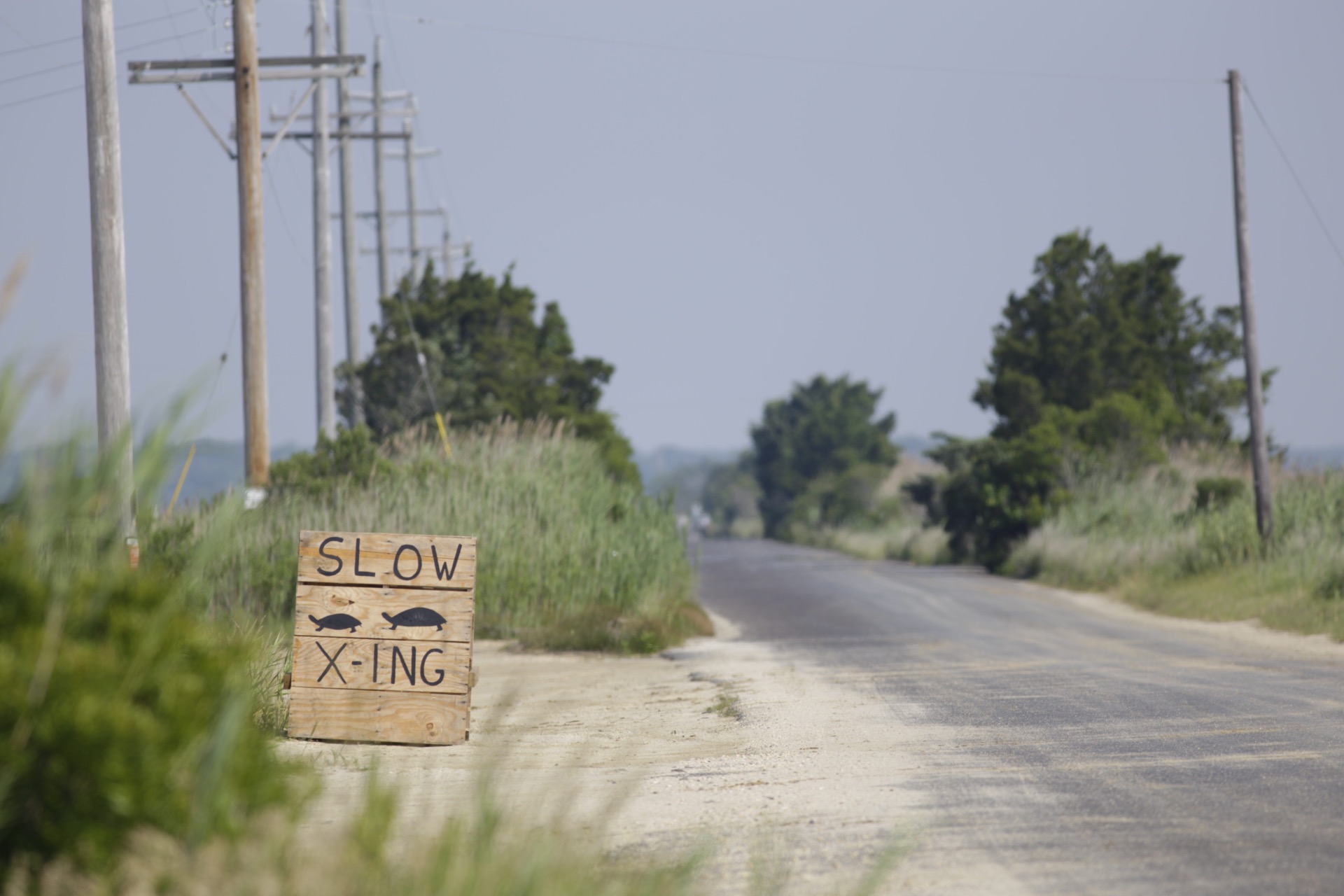
A clutch of eight tiny terrapin hatchlings found beneath one of our X-ING signs. photo by Ben Wurst
While removing our seasonal (better late than never!) terrapin X-ING signs on Great Bay Blvd. in Little Egg Harbor yesterday, we stumbled upon some tiny northern diamondback terrapin hatchlings. These little guys were hiding or trapped under a very large (and heavy) X-ING sign made from old pallets that someone knocked over (I say guys because they hatched later in the season and it was a very cool August, but some could be girls). At first I didn’t see anything, but upon closer inspection I saw several hatchlings in the vegetation. One, two, three, four, five, six. Then I dug a little with my hand and found two more. The sign had been atop a nest. Continue reading “Photo from the Field”