The last known Allegheny woodrat population lives at the base of the Palisades in northern New Jersey.
The Allegheny woodrat is a state endangered species. It was added to the endangered species list in 1991. There is one remaining population of these small mammals left in the state and they need our help this winter.
This season we are going to help the woodrat by providing it with food. We will distribute acorns, beech nuts, hickory nuts or any other nuts from native New Jersey trees in the area the woodrats live. By providing them with food we will help them survive the winter.
Collecting nuts while learning about the habits and habitat needs of the Allegheny woodrat is a great service learning project! Have your students collect native tree nuts throughout the community and help to protect one of NJ’s rarest wildlife residents.
We are collecting nuts now through October 31, 2011 to distribute to the woodrat’s location throughout the winter. If you would like to contribute to the woodrat’s winter food pantry, please drop off nuts from native New Jersey trees to ENSP’s office in Clinton, New Jersey. Please call Maria Grace at Conserve Wildlife Foundation at (609) 984-0621 for specific instructions. Nuts will be collected until October 31st.
Each spring Calling Amphibian Monitoring Project (CAMP) volunteers take time out of their busy lives to drive the dark roads of NJ and listen for the calls of NJ’s amphibians. Not only do these volunteers have to find the time to schedule the three surveys, each in a specific four week period, they need to meet the protocol for the surveys. This means meeting the minimum temperature requirement, which is not the easiest in March, as well as other weather protocol. Once they find a perfect night to survey the volunteers follow a 15-mile route with 10 stops. They stop and listen for 5 minutes at each stop and record the amphibians they hear. This can be a frustrating experience depending upon the route. Noise from cars can make surveying difficult and some of the routes in more developed areas record no amphibians calling on many of the stops. Meanwhile volunteers on the less developed routes can often hear a chorus of frogs and toads that can be almost deafening.
I’d like to thank all the dedicated CAMP volunteers for finding the time to survey this season.
Survey Results
Thirty-one volunteers surveyed 33 routes. Each route is to be surveyed three times during the spring in March, April & June. A total of 77 surveys were conducted. All 16 species of NJ frogs and toads were detected on the surveys. The species that was heard on the most routes was the Northern Spring Peeper which was heard on 31 routes out of 33 that were surveyed. The second most detected species was the Green Frog heard on 22 routes out of the 33 surveyed. The least detected species was the Spade Foot Toad which was only heard on one route.
Would you like to help next year?
Fourteen routes are available for the 2012 season.
For more information on volunteering email Larissa Smith.
Volunteers, CWF staff, and biologists with NJ Fish & Wildlife recently completed osprey nesting surveys throughout coastal areas of New Jersey. Each year these “osprey banders” complete “ground surveys” (referred to as ground surveys because they are surveying nests by land/sea, not by helicopter) that cover around 70% of the state population. I survey colonies on Barnegat Bay, Little Egg Harbor, and Absecon. The surveys are meant to keep track of the population and determine its health. During the surveys the banders access nesting areas mainly by boat since most ospreys nest in coastal areas or by water (their source of food). We use ladders to access nests where we count the number of young produced and then place an aluminum band on each of the young. For the past two years we have also been collecting feather samples for a study being conducted by the Academy of Natural Sciences in Philadelphia where they are analyzing the stable isotopes to determine what ospreys are eating and how their diet has changed over time. More specifically they’ll be looking for changes in the isotope profiles across the local range of ospreys – something that has never been done before.
In one area, Sedge Island WMA, that I’ve surveyed for the past few years I surveyed 27 nests. 22 of those nests were occupied and produced a total of 47 young. 34 of those young were banded for future tracking. From the survey I can calculate the productivity or reproductive rate which is a measure of how healthy the population of that colony is. The productivity rate for Sedge Island is 2.14 young/active(known-outcome)nest this year which is the highest ever recorded (see chart at right for more details). These awesome results are the result of calm and mild weather conditions this spring and summer, high availability of prey, and possibly the increased amount of experienced breeding birds. Another factor that has surely helped to give the population a boost is the increased availability of suitable nest sites along the coast. Since 2004, I’ve helped to install more than 100 nesting platforms. Many of these platforms replaced old dilapidated structures and now give ospreys a better chance at successfully raising young that will eventually return to New Jersey to reproduce.
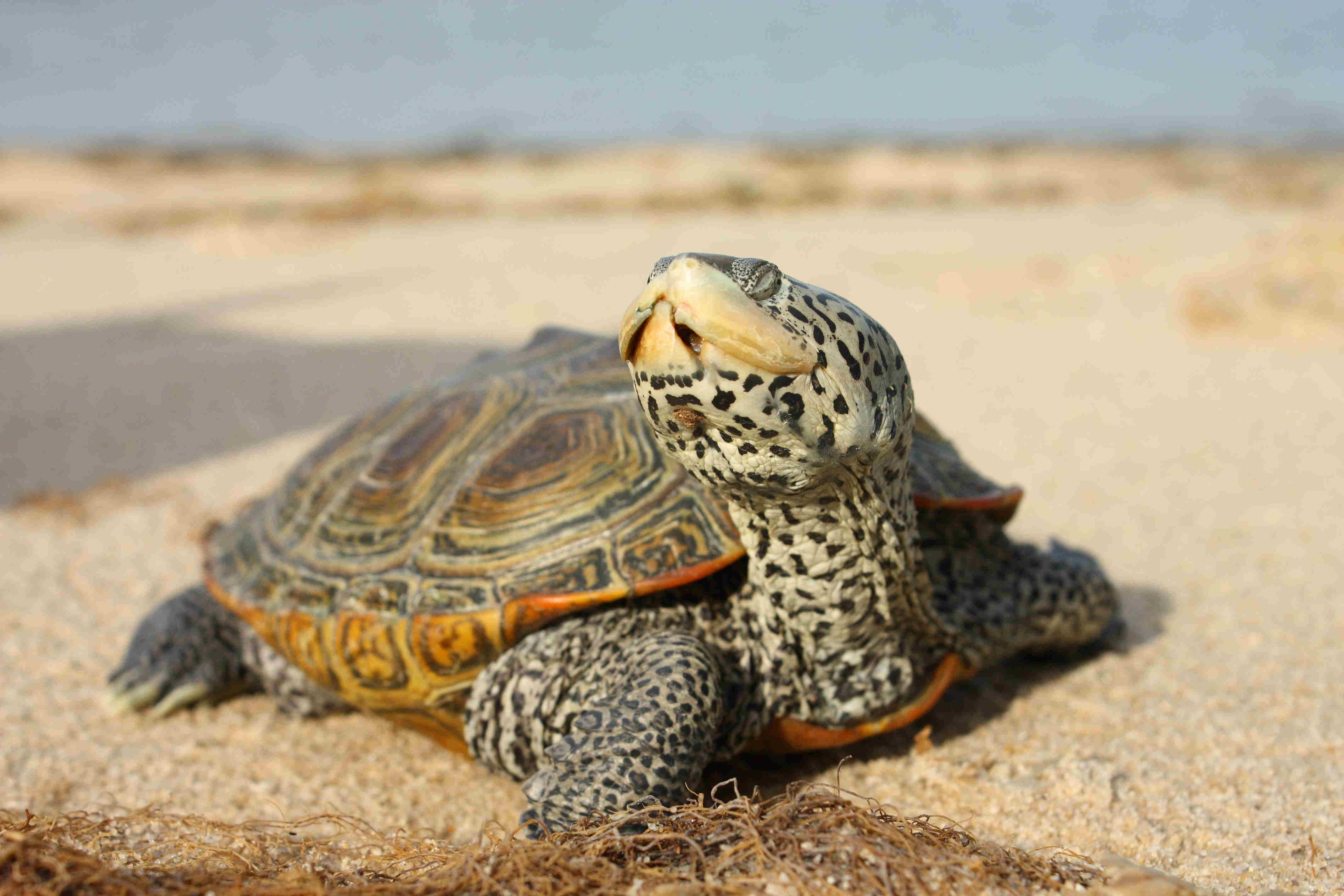
Northern Diamondback Terrapins are native to New Jersey and inhabit the many miles of coastal salt marshes along the Atlantic Coast and Delaware Bay. Terrapins were once very common and were used as a main food source of protein by Native Americans and then European settlers. In the early 1900’s it was hunted so extensively that it almost faced extinction. Luckily, during the 1920’s, use of terrapins for food dropped in popularity. This allowed the population to slightly recover and avoid extinction. However, several major threats still threaten their survival. Habitat loss, mortality from being drowned in crab traps, and road mortality all pose major threats to the health of the population. Each year thousands of terrapins are killed by motor vehicles throughout their range and here in New Jersey, Great Bay Boulevard is no exception.
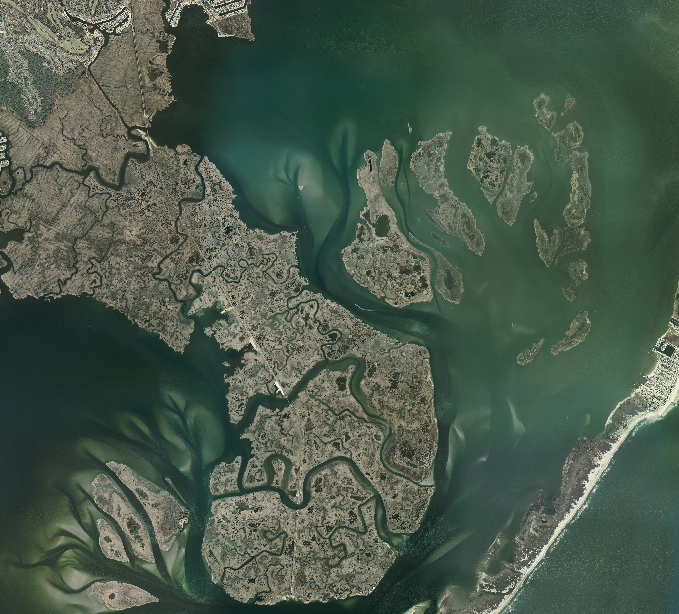
Great Bay Boulevard or Seven Bridges Road extends approximately 5 miles into estuarine emergent wetlands and northern diamondback terrapin nesting habitat. The boulevard is surrounded by over 5,500 acres of protected coastal habitat (Great Bay Boulevard Wildlife Management Area – Managed by NJ Division of Fish and Wildlife), a relatively unspoiled, estuarine ecosystem. This road, at times, has high a volume of traffic, especially on weekends when boaters and outdoorsmen travel on the road to get to and from one of the several active marinas along the road. Currently during May-August there is no protection to terrapins when they cross Great Bay Blvd. from vehicle traffic. Most terrapins who cross the road are adult females who are laden with eggs and are looking for a suitable nesting site. These females lay their eggs in a sand/gravel mixture where it is easy for them to dig and cover their eggs, like sandy beaches and in scrub-shrub habitat along road edges. Many female terrapins are inadvertently hit-by-car and injured or killed by speeding motorists or people unaware of the summer nesting habits of the terrapin. This high mortality rate has caused the local population to decline and it has also caused the average size of adults to drop significantly over the past 20 years.
How you can help:
Volunteers are needed to help install ~ 4,000 ft. of barrier fencing along Great Bay Blvd to help reduce the amount of road kills. Sambol construction will be helping us by trenching a ditch for us to place the fence in. Volunteers will help lay out fence, install metal posts, hang fence, and back fill trenches.
Please pack a lunch and bring plenty of water, sunblock, and bug spray.
We are starting work on Friday at 8am, but if we don’t finish, we’ll wrap up work on Saturday morning.
We will meet after the first bridge; click here for a Google Map link. You can park here and then we can car pool to the section of the road where the fence will be installed.
Last year Conserve Wildlife Foundation of NJ started a new project that was focused on reducing the amount of terrapins that were killed by motor vehicles. The project began because of one individual terrapin that I encountered on Great Bay Blvd in 2009. I observed the female terrapin as she walked along the edge of the Blvd. I saw this as being odd. Typically they cross the road and often at a speedy pace (probably because they know the apparent danger from crossing roads). I stopped and saw that she had an injury to her lower mandible, probably from a motor vehicle. I knew that she needed help.
Terrapins face a variety of threats in their environment. An untold number are trapped in crab traps that are not fitted with Bycatch Reduction Devices (BRDs), some are hit by speeding boats and jet skis, and many more are injured or killed while attempting to cross roads. Along Great Bay Blvd. in Little Egg Harbor several studies have documented the amount of live and dead individuals on the road.
As soil and coastal waters begin to warm, terrapins begin to become active again. In late April/early May hatchlings begin to emerge from nest cavities where they overwintered. Adults also begin to become active, but mostly remain in the waters where they live until June when females emerge to lay eggs in nests they dig on land.
The penninsula that surrounds Great Bay Blvd. is pristine habitat for terrapins in southern Barnegat Bay.
Last year we raised enough funding to develop and print an educational brochure, purchase and install “Terrapin X-ING” signs, and install 4,000 feet of barrier fencing. The fencing was placed along the first stretch of road where the highest mortality rates were recorded. The fence proved to be effective at reducing road kills and increasing awareness of terrapins. The fence was removed in late 2010. This year it will be installed again along the same portion of road with help from a local construction company, Sambol Construction. After this season, we hope to keep the fence up year-round and hope to fence the whole first section of the road (and possibly more).
This year to help reduce the amount of terrapins that are hit by motor vehicles, we are recruiting volunteers to act as “Terrapin Stewards.” Stewards will be asked to routinely drive, walk, or bike down Great Bay Blvd. during the summer months from June to mid-July (especially on weekends, holidays and when there is a full or new moon). Volunteers will educate the public about terrapins, their threats in the environment, and our project. Volunteers will also help terrapins safely cross roads and help record locations of live or dead animals. No more than 10 volunteers will be recruited this year.
Our Message to visitors:
The habitat that surrounds Great Bay Boulevard is very important to the reproduction of northern diamondback terrapins, a species in decline in New Jersey. Female terrapins often nest along the soft shoulders of roadways. Sometimes they enter the roadway to reach these suitable nesting areas where they lay their eggs. Research has shown that dozens of female terrapins are killed by motor vehicles each year along Great Bay Boulevard. Please help conserve terrapins by driving carefully while traveling along the road.
If you’d like to participate you are required to attend a training session on May 3rd @ 6pm at the Jacques Cousteau National Estuarine Research Reserve. Volunteers will fill out paperwork and learn more about terrapins and our project. You must register to attend this training/information session.
Jefferson Salamander, a species of special concern in New Jersey, crossing to its breeding pools. Photo by MacKenzie Hall.
Well, it’s that time of year again. As the temperature slowly climb and the ground thaws with spring rains, New Jersey amphibians emerge from their upland habitat and begin their long and increasingly treacherous journey to their spring breeding pools.
This March marked my first official amphibian migration night with Conserve Wildlife Foundation’s Amphibian Crossing Project. As always, any potential migration night begins with frantic checking for weather updates, a call to volunteers to suit up and meet us at rescue sites, early arrival to set up road signs and safety equipment, and hoping the rains continue…we wait. We wait as rush hour begins, the traffic steadily increasing as dusk falls, and then it happens: one by one, we spot wood frogs and spotted salamanders on the road edges- hesitating to leave the coverage of the forest almost like they know the roads bisecting their ancestral migration paths may prove an impassable barrier.
This past Thursday, our destination was a rescue site on East Shore Drive in Stillwater Township. With the help of dedicated volunteers, including boy scouts from local Patriots Path Council, we patrolled almost 250 meters of roadway and rescued 572 frogs, salamanders, and newts in just 2 ½ hours—that’s 229 amphibians per hour! Within this short span of time we also waved 70 cars through- most of which seemed oblivious to natural phenomenon taking place under their wheels.
Dedicated volunteers patrol roadway. From left to right: Diane Gonski, Doug Hankin, Wayne Bancroft, Eckhardt Debbert, and Paul Cook. Photo by Phil Wooldridge.
By 10pm, migration had slowed and more importantly traffic had too. So it was on to the next site. MacKenzie and I wanted to check out how a site on a busy road faired in Liberty Township. The results were disheartening—within a narrow corridor we saw at least 50 dead frogs and salamanders littering the road. During the hour we patrolled, 50 spotted salamanders were counted (and moved) trying to cross a road with still significant traffic at 11pm at night.
Wood frog dead on road. Photo by MacKenzie Hall.
If hundreds of amphibians died within hours in this narrow corridor- imagine how many thousands are killed throughout the state each rainy spring night. Each individual’s death marks a loss to the population but with females carrying between 200 and 2,000 eggs it marks a significant loss not only to their species future generations but also to the ecosystem as an important food source to other animals.
I knew the importance of amphibian migration and the potential extirpation populations were facing due to roads- I had seen other migration nights but I had never before seen the mass mortalities on a single road. So please on the next rainy spring night, leave your car in your driveway and instead grab a flashlight and see what you can find or contact CWF and become one of our dedicated Amphibian Crossing volunteers!
On Saturday February 5th thirty eagle project volunteers met to discuss the 2011 eagle season. The meeting took place during the Cumberland County Eagle Festival which is held the first Saturday in February. It was a rainy day but that didn’t keep the volunteers away.
During the festival there were talks, walks, vendors and educational displays. Eagle Project volunteer Kevin Buynie made and donated two eagle shaped bird houses to CWF. We raffled one off at the festival and it was a big hit!
People stopped by the CWF table and reported eagle sightings and a few possible new eagle nests. It is always nice to see how interested people are in eagles, raptors and wildlife in general.
Thank you to everyone who came out to visit us and support our work to monitor and conserve eagles in New Jersey!
Protecting Terrapins Through Education and Awareness
By Ben Wurst, Habitat Program Manager
Female Northern Diamondback terrapin by Jonathan Carlucci
Terrapins are ectothermic, or they are cold-blooded, and their activity is regulated by external temperatures in the environment. While they may be dormant at the moment, I’m far from that. I’ve never stopped working to protect terrapins from the end of last year’s nesting season. While it’s almost impossible to prevent every terrapin from being hit-by-car, it’s more important to highlight the need for protection and for people to become more aware of terrapins when driving.
Here are a few things I’m working on to help terrapins in the Great Bay area this year:
I’ve been working on getting some funding to help raise awareness, i.e. more X-ING signs, other signs (like “slow down, terrapin X-ING”) and other educational materials.
I developed an educational presentation about terrapins and our work to protect them. I just presented it for the first time a couple weeks ago at the Jacques Cousteau Coastal Educational Center in Tuckerton.
I have been in touch with the town engineer for Little Egg Harbor Twp. about lowering the speed limit on Great Bay Blvd. this year. The speed is currently 50mph!! For a road with soft shoulders (and in some areas, saltmarsh or shrubs that are growing onto the road), seven bridges, a lot of human use in summer, terrapins that nest on the edges and enter the roadway, and the fact that it divides a pristine Wildlife Management Area, it is just way too high.
I am attending both the environmental commission and town council meeting this month to address my concerns and to ask for their support for our project.
I recently met with officers from the Osborne Island Homeowners Association to assist them with protecting terrapins along Radio Rd.
I am developing a volunteer project where volunteers will help patrol area roadways to educate the public about terrapins, to help them cross roads safely, and to help document terrapins on roadways.
If you would like to help us protect terrapins in the Great Bay area, we could use your help!
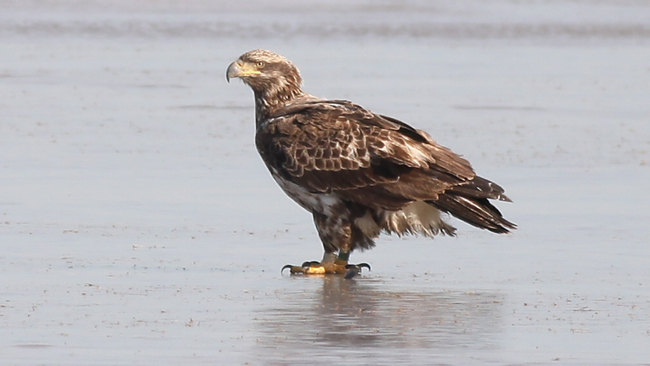
The New Jersey midwinter eagle survey takes place each January and is part of the National midwinter eagle survey to monitor population levels. Another benefit of the midwinter eagle survey is that new eagle nests and nesting pairs are often located. The target dates for the 2011 survey was January 8th and 9th. Approximately 75 volunteers participated throughout the state. This year the snowy winter weather on Saturday did effect the count due to the heavy snow fall at times and low visibility. Sunday was clear and sunny which allowed volunteers to get out and survey.
Preliminary results:
194 eagles – southern NJ
24 eagles – northern NJ reservoirs
17 eagles – Delaware Water Gap
A total of 235 eagles were observed this year.
This total is lower than 2010s count of 333 eagles which is in large part due to the weather. Full results will be released soon.
Thank you to all the volunteers who braved the snow, cold and windy weather!
If you enjoy hearing the sounds of frogs and toads and like a bit of adventure then the NJ Calling Amphibian Project (CAMP) might be the right project for you! Each of the 16 species of frogs and toads in NJ has a unique vocalization or “call” that can be heard during their mating season. The Conserve Wildlife Foundation of NJ is actively recruiting volunteers to participate in a statewide Calling Amphibian Monitoring Program (CAMP). Fourteen CAMP routes are currently available for the 2011 season.