As you may know, ospreys are returning to New Jersey from their wintering grounds in the tropics. Most North American ospreys winter in N. South America, with large concentrations in Columbia. Our “jersey birds” are unaware that our coast was devastated by a huge post-tropical storm in late October last year. Some might be coming home to nests that were damaged or lost to Superstorm Sandy. We’re working diligently to replace or repair any and all platforms that were damaged by the storm. Last week we replaced the first nesting platform in Ocean City. We were lucky to have met a local filmmaker who put together this short film.
Following Monday’s all-night amphibian foray – and the prolonged terror/adrenaline rush of playing real-life Frogger – I drove home through a rainy sunrise on Tuesday. According to a weather app on my phone, the rain would keep falling all day and end (wouldn’t you know) right around sunset. “You gotta be kidding me,” I think is what I slurred.
Warm nighttime rain is the simple cue for mass movement, like what we had before dawn that day. But nature is seldom that simple, so the task of monitoring an amphibian migration can get hairy. The warm, soaking daytime rain would get the attention of those slumbering frogs and salamanders. Even if it stopped before dark, the wet ground and road would entice some of them to move. Maybe a lot of them? And right at the time when nighttime traffic would be heaviest on the roads.
So we sided with caution and rallied the teams to hit the streets at dusk. I went back to Byram to lead a group of volunteers there while others covered different hot-spots.
The rain did end early – earlier than expected even – and by nightfall our team was spreading out over a damp road. It was a relief to see that a migration was happening anyway, albeit at a slower pace. And the cars were filing through our setup (cones and signs, buffered by police) in threes and fours…99 vehicles in the first hour! Basically, there was a car for every salamander that dared to cross the white line.
We did our best to stay ahead of the traffic. By 11:00 pm the temperature was dropping, the road was drying, traffic was slowing, and so were the amphibians. We paced the road below a starry sky with Orion front and center. We had tallied another 175 spotted salamanders, 41 Jefferson’s salamanders, and 52 spring peepers. Despite the heavy car flow early on, more than 85% of those animals made it to the safe side of the road – and eventually to their breeding pool below – with a little help from some friends.
The ingress migration to the pools is probably close to half-over across much of NJ, so we’ll be out few more times yet!
THANKS to all the dedicated people who have helped so far. It’s a diverse group of heroes, from long-time amphibian crossers like George Cevera and Carl Bernzweig, to new volunteers like Karen Ruzycki. We have help from local partners like Margaret McGarrity of Byram Township, and engineering students from NJIT who want to help design solutions to the roadkill problem. A couple reporters came out this week to cover the story and ended up shuttling amphibians, too. We thank the Sussex County Division of Engineering for issuing us the permit to assemble on their road. Thanks also to the Byram Police Department for their willingness to provide traffic control and their respect for our project, which I’m sure seems a little unusual. And that’s just at one location. Great job, everyone!
by MacKenzie Hall, Amphibian Crossing Project Coordinator
The past week has been like a wild trip through biomes and time zones. A half-foot of wet snow buried NJ on Friday, but it didn’t stand a chance against a sunny weekend above 50˚F and the valiant arrival of Daylight Savings Time. Bam! Spring. Suddenly birds were singing, crocuses were blooming, and salamanders were stretching their hamstrings for the journey ahead.
Throughout the day on Monday (March 11) a long wall of rain crept eastward across the US. It couldn’t possibly miss NJ, and the temperature would hold around 50˚F overnight – excellent predictors for a migration. The question was when the rain would hit and whether a rainfall starting very early in the morning would trigger many amphibians to move. There seem to be almost unlimited permutations for how the important factors of ground thaw, temperature, rainfall, date, and time of night can converge, and after almost 10 years with the Amphibian Crossing Project I still learn new and surprising things.
Snapshot of a Jefferson salamander being helped across the road.
A handful of us chose to wait out the rain at one of our big road-crossing sites in Byram (Sussex Co.). At least 3 hours before the rain even started, someone noticed a salamander crossing the dry road. We spread out to cover more ground and kept counting. By the time the first raindrops hit we had already tallied (and ferried) 190 salamanders and 20 frogs across the asphalt threshold dividing their forest habitat from the breeding pool below. We were all pretty surprised and excited by what we were seeing.
The rain came around 2:30 am, and in the 4 hours before dawn the road was swimming with frogs and salamanders. We did our best to keep up with the count, and the rescue, especially as vehicle traffic picked up toward dawn. Eight cars per hour around 3:00 am, then 10 cars per hour, then 26. By 6:15 it was hard for the last of us – Bob Hamilton and I – to keep our feet on the pavement as the vehicle count crested 100 per hour. We also started to lose the battle against roadkill – as many animals were getting hit as we could save. Luckily it was just a short period, and at dawn the migration would pause. Our totals for that night: 1,119 salamanders and frogs, 954 of which made it to their destination!
Our “scouts” all across northern & central NJ had similar reports. A big migration had happened before dawn, and there was some roadkill as evidence. But you can listen for a happier kind of evidence – the honking and peeping of those who made it to their pool. The harbingers of spring are arriving.
by MacKenzie Hall, Amphibian Crossing Project Coordinator
This small vernal pool in Hopewell is ready for things to start hoppin’.
For the 98 volunteers signed on to help with this year’s amphibian road-crossing efforts, yesterday brought on the first flurry of excitement. Forty degrees! The promise of nighttime rain! Saturday’s soaker had helped to get the ground thawing, though many of the amphibians’ breeding pools were still capped in ice. The conditions weren’t going to be perfect, but surely some eager salamanders would be enticed to come out from their winter burrows and set off on migration. And when their tiny feet hit the pavement of peril, we were gonna be there gosh dernit!
So our “scouts” got ready for night (and rain) to fall, to go check on a dozen or so road-crossing hot-spots in northern and central NJ. Then, as volunteer Phil Wooldridge of Warren County put it, we experienced a little deja-vu. The rain started later, the temperature was colder. North of Route 80, snow and sleet fell instead. We amphibian crossers have gotten used to the shakiness of weather forecasts, and to the somewhat complex combination of triggers that set an amphibian migration in motion. At any rate, we basically got skunked last night.
The only sign of life came from Hampton, in Sussex County, where Sharon and Wade Wander found a single Jefferson salamander crossing the road to his ice-covered breeding pool. Tough little salamanders, those Jeffs. Our first one of 2012 came out during a wet snowfall, too, around 2:00 am on February 24th.
The town of East Brunswick was also counting on last night’s forecast when they decided to close Beekman Road – a town road bisecting an amphibian migration path. The town’s Environmental Commission has coordinated the closure for the past 10 years to protect the spotted salamanders, wood frogs, and other migrants on 4 to 10 nights every spring (read about it here). Even there, only one male spotted salamander was seen making his way to the pool.
So, we’ll keep doing our best to predict the amphibian migration and to be in the right places when it happens. Clearly the big long nights are still in front of us.
To learn more about our Amphibian Crossing Project and experience the migration through video, please visit our “Amphibians Crossing!” webpage.
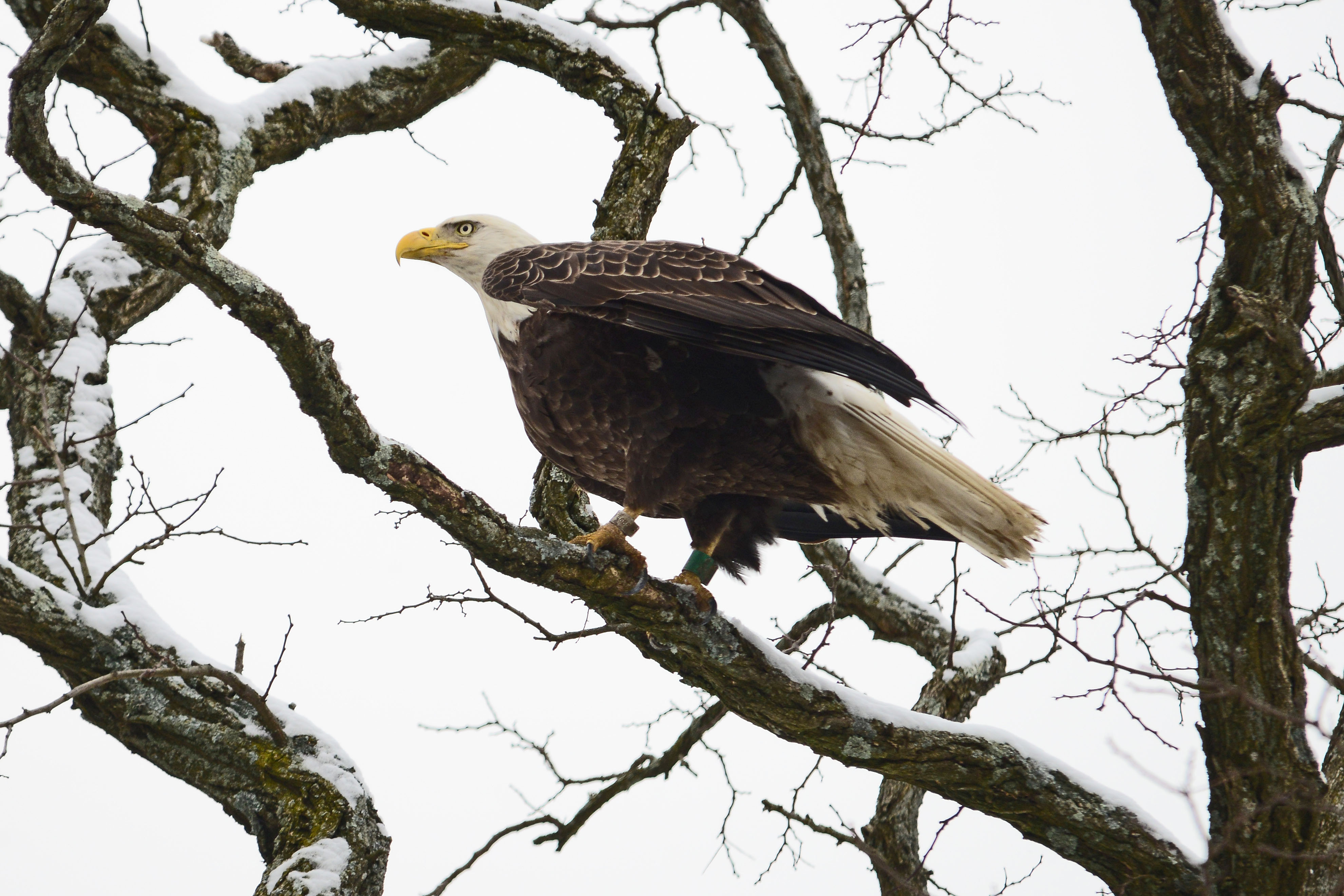
Every January NJ participates in the National Midwinter Eagle Count. Volunteers surveyed for eagles statewide during the weekend of January 12th & 13th. Due to dense fog the visibility was poor in many of the survey areas but despite this the total count was 297 bald eagles. This is 38 less than 2012’s high count of 335 bald eagles. Four golden eagles were also counted during the survey.
2013 Midwinter Eagle Survey Results
Southern NJ: 264 bald eagles
Northern NJ: 33 bald eagles
Total bald eagles: 297
Thank you to all volunteers who participated!
February is a great time to get out and view eagles in New Jersey. So far twenty-one pairs of eagles are incubating (on eggs) while others pairs are busy getting ready for the season. Not only can you spot resident birds this time of year but wintering eagles as well. The Cumberland County Winter Eagle Festival takes place this Saturday the 9th. This is a good opportunity to see eagles and other raptors and learn more about them. I’ll be there at the CWF table so stop by and say “Hi”.
On January 19th more than 30 volunteers showed up to help us build 20 osprey nesting platforms. The platforms will be used to replace or repair any that were damaged from Superstorm Sandy. We already have six that sustained damage from the storm and are making arrangements to replace them before the nesting season begins in early April.
On Saturday, January 19, Conserve Wildlife Foundation of NJ (CWF) will host an osprey platform construction day from 10:00 am to 3:00 pm at Tuckahoe Wildlife Management Area in Woodbine, New Jersey. Volunteers who signed up in advance are helping to build up to 20 new platforms to replace those lost or damaged in Superstorm Sandy.
Constructing these platforms now will allow CWF time to install them before the start of the osprey nesting season in April. Ospreys mate for life and typically return to the same nest year after year.
Since Sandy slammed into the coast of New Jersey in late October, biologists with CWF have been actively surveying and assessing damage to habitat that wildlife needs to survive. Many osprey nesting platforms were right in the middle of the high winds and strong storm surge associated with Sandy. The majority of the platforms weathered the storm; others need repairs or must be replaced. We have already installed 5 new nesting platforms. Two platforms were installed on December 1st on Herring Island (N. Barnegat Bay) in an area of homes that sustained significant damage. The other three platforms were installed in the Wildwood area.
The Conserve Wildlife Foundation is a small staff with a lot going on. If you glance through our conservation projects, you’ll see that volunteers have a role in almost everything we do. This hardy fleet of dedicated helpers allows us to cover more ground, stretch our dollars, reach wider audiences, and continue our upward and outward evolution as a group.
We’ve featured a handful of people on our Volunteer Profiles page so far, with Robert Hergenrother being the most recent. We enjoy learning more about their unique backgrounds and interests and hope you’ll check them out, too.
Every spring, vernal pool breeding amphibians migrate from upland wintering habitats to their spring breeding pools. Many of these ancestral migratory paths are bisected by roads, creating a barrier that not only disrupts natural migration and fragments habitat but often proves impenetrable, limiting gene flow and disconnecting populations. Our Amphibian Crossing Project works to protect these migration corridors through coordinated volunteer rescue efforts that move amphibians safely across the road during these annual mass migration events. Currently, our efforts are focused on select sites in northern New Jersey but we want to expand our database to document these migratory paths across the state.
Four-toed salamander (c) MacKenzie Hall
If you would like to report an amphibian crossing near you, please email us with:
-Location of the crossing marked clearly on a map
-List of species seen crossing or DOR (dead on road)
-Date(s) of occurrence and any other pertinent information you may have
*We ask that you only report known crossings and do not attempt to locate more by driving around on rainy spring nights. Increased vehicular traffic will increase mortality of amphibians during their annual spring migration!
When people first hear the word CAMP they might think of going out in the woods and setting up a tent, but CWF’s CAMP project is all about monitoring New Jersey’s amphibian population. CAMP stands for the Calling Amphibian Monitoring Project.
In 2012 33 volunteers participated and surveyed a total of 33 routes out of 63. Volunteers conduct roadside surveys (after dusk) for calling amphibians along designated routes throughout the state. Each 15-mile route is surveyed three times during the spring. Each route has 10 stops, where volunteers stop, listen and record all frog and toad calls for 5 minutes.
In 2012 15 out of the 16 New Jersey amphibian species were detected. The only species not detected was the Eastern Spadefoot. Northern Spring Peepers were the most common species detected on 31 of the routes while Green Frogs were detected on 22 routes. Both the American Bullfrog and Southern Leopard Frog were heard on 16 of the routes.
In NJ there are four frog and toad species of conservation concern; the Southern gray Treefrog is a state endangered species, the Pine Barrens Treefrog is a state threatened species, and the Carpenter Frog and Fowler’s Toad are both special concern species. The Southern Gray Treefrog was detected on 2 of the CAMP route, the Pine Barren Treefrog on 3 of the routes, the Fowler’s Toad on 13 of the routes and the Carpenter Frog on 7 of the routes.
CAMP data is entered into the North American Amphibian Monitoring Program (NAAMP) database housed by the USGS Patuxent Wildlife Research Center. All of the occurrence data for these species is extracted from the NAAMP database, quality checked for validity, and entered into the Biotics database by CWF & ENSP staff. These data will then be used in future versions of the Landscape Project maps. These maps are used by planners in various state, county, municipal and private agencies to avoid conflict with critical wildlife habitat.
Thank you to all CAMP volunteers!
WOULD YOU LIKE TO HELP IN 2013?
Twenty-five routes are available for the 2013 season
For more information on volunteering e-mail: Larissa.Smith@conservewildlifenj.org