Project RedBand: 04/C from LBI to Trinidad and Tobago!

Auxiliary bands help link Barnegat Bay ospreys to their wintering grounds

by Ben Wurst, Habitat Program Manager

04/C was banded at a nest on LBI and re-sighted on the island of Trinidad and Tobago by Nicholas Hassanali.

When I started work on Monday morning I got some amazing news (at least for an osprey lover). One of the young ospreys that I banded on Barnegat Bay was re-sighted on the Caribbean island of Trinidad and Tobago!! To top that cake, the osprey was photographed to confirm its sighting. YES!! Nicholas Hassanali took the above photo and enlarged the red band to read the alpha-numeric code which reads “04/C.” I looked up in my banding records and saw that 04/C was produced at a nest behind the Long Beach Island Foundation for Arts & Sciences in Loveladies, Long Beach Island.

04/C after being banded. He was around 4 weeks old on July 7, 2014.

I banded him (I can tell its a male by the size of the band on its leg and the lack of a brown necklace of feathers on its breast) on July 7th with a CWF donor Bill C. We ventured to four nests by kayak. This was the first survey where I started to deploy the red auxiliary bands on young ospreys. I remember that it was a pleasant day. Not too hot or windy. As we made our way from one sheltered nest on a lagoon to another out on the bay we felt the winds kick up from the south making paddling difficult (especially when you’re towing another kayak with a ladder on top!).

125-A-032: 04/C's nest.
125-A-032: 04/C’s nest.

We decided to return to Bill’s house and take my truck to survey the next two nests, since we could walk to them from a side street. We walked out to one nest and found that it failed, i.e. no young were produced. Then we proceeded onto the next, 04/C’s nest. I remember climbing up the ladder to band the young and did not get a chance to take any better photos because I had to be on my way soon. While up there I remember the male dropped a fish (bunker) and Bill got it and we put it back into the nest. One thing that I will not forget about this day is the smell of smoke and burning plastic. I found out later that day that a lawyer’s office in Ship Bottom was on fire when we were out surveying these nests. Luckily no one was hurt in the fire!

I personally cannot wait to get more reports of our red banded ospreys. The young that were banded this year will not return until 2016 and even then they might not return until the late spring/early summer and will not breed. At least I know that there are people out there watching and admiring our ospreys! As Nick said in a comment on his photo on Flickr, “ I have a great love for Ospreys.” 🙂

Giving Thanks!

Don DeRogatis volunteered to help us safely climb a 130' water tower at Bayside State Prison this summer. His reward was holding this nestling peregrine falcon, which will one day be flying at speeds upwards of 200mph! Thanks, Don!! © Ben Wurst
Don DeRogatis volunteered to help us safely climb a 130′ water tower at Bayside State Prison this summer. He was rewarded by holding this peregrine falcon nestling as we banded it for future tracking. Being able to say to you held the world’s fastest bird is definitely something to brag about! Thanks, Don!! © Ben Wurst

The success of Conserve Wildlife Foundation of NJ to manage and protect our rare wildlife depends greatly on our dedicated volunteers. Our volunteers construct and maintain osprey nesting platforms, perform road patrols to reduce terrapin road kills, count bats, install fencing to protect beach nesting birds, protect beaches for critically endangered shorebirds, and help amphibians cross roads safely on rainy nights. They also dedicate much time to watching bald eagle nests with the Bald Eagle Project. This past year they spent an amazing 3,500 hours monitoring eagle nests throughout the state of New Jersey!!  We wouldn’t be able to work with as many different species and accomplish all that we do without help from these dedicated volunteers. We’d also like to thank all of our members and donors for helping us complete our mission of “Keeping New Jersey’s Wildlife in our Future.”

From all of the staff at CWF, we hope you have a great Thanksgiving and a happy holiday season!

Planting for Butterflies

Baptisia Tinctotia plants
Containers of Baptisia Tinctoria ready for planting @ Larissa Smith

Conserve Wildlife Foundation along with Atlantic City Electric, the United States Fish and Wildlife Service, and a number of dedicated volunteers planted 150 plugs and 60 quart containers of Baptisia, a native perennial plant last week in Cape May County. Baptisia is the host plant of the state threatened butterfly the Frosted Elfin.

The perennial was planted in upland areas surrounding vernal pools, which had been previously constructed as Tiger Salamander habitat. In the spring, native shrubs had also been planted around the three vernal pools.

Want more updates on our work? Like Conserve Wildlife Foundation of NJ on Facebook and follow us on Twitter.

Project RedBand is a go!

Time to get outside and watch some ospreys!

by Ben Wurst, Habitat Program Manager

A pair of ospreys produced at a nest on Barnegat Bay were banded with a red auxiliary band. © Northside Jim

A lot has changed throughout the 40 project history of the New Jersey Osprey Project. From a low of only 53 osprey pairs (statewide) in 1973, today there are more than 540 pairs that return here each year to feed, nest, and raise young. In the beginning work to re-establish their population was a trementous undertaking. Ospreys, a  were loaded with environmental contaminents (DDT, which caused the thinning of egg shells), their habitat was bulldozed, and early on birds were shot for their feathers and eggs. Once the Endangered Species Conservation Act of 1973 ospreys were afforded protection they deserved, and work by biologists like Pete McLain were underway to restore the population in New Jersey.  Continue reading “Project RedBand is a go!”

Photo from the Field

Running the numbers

by Ben Wurst, Habitat Program Manager

Ben Wurst prepares to band two osprey nestlings for future tracking. Photo courtesy Eric Sambol

By now many young ospreys have taken to the wing. While they still rely on their nests to perch at night and their parents for food, these juveniles take to the skies to learn the skills needed to survive to adulthood. Our nesting surveys have been completed, birds banded, and our sunburn and green bites are healing! Over the next week I will start to enter and summarize data that I’ve collected and data from our volunteer “banders” who help cover the most densely populated colonies. From my surveys, which range from Mantoloking to Atlantic City, I’d say that productivity is down in some areas and up in others, as compared to last year. But, ospreys still had a decent year. I would NOT call it a BAD year!

By far my own survey effort was not as great as last year, when we conducted a census of all nesting ospreys in NJ, by publishing our nest locations on our partners website, called Osprey Watch. This year I battled broken boats, a severe cold (still didn’t slow me down), harsh south winds, and thunderstorms to get to as many nests as I could, especially on Barnegat Bay. Why Barnegat Bay? We all have heard that Barnegat Bay is dying. Overloaded with excess nutrients from stormwater runoff, which is killing off the eelgrass beds that provide shelter for many juvenile fish, aka future osprey prey. This project will help us learn about osprey foraging habitat on N. Barnegat Bay. Are more birds foraging in the ocean in those areas, as opposed to birds that nest closer to LBI and LEHT? Hopefully our ospreys will help shed some light on the health of the bay. Lastly, the project would not be possible without the generous support of Northside Jim, chief blogger/extraordinary photographer at “Readings from the Northside” and his many followers. With their support we were able to purchase (100) and deploy (60) a red auxiliary band on young birds. These bands are engraved with an alpha-numeric code which will make identifying birds much easier than only the aluminum USGS band. In the coming weeks Jim will be giving us some assistance with setting up a nice little website where people can learn all about the bands, the birds, and most importantly: report re-sightings of these awesome new bands!

CWF Selected for Rain Barrel Auction Through EarthShare NJ

rainbarrelphoto4


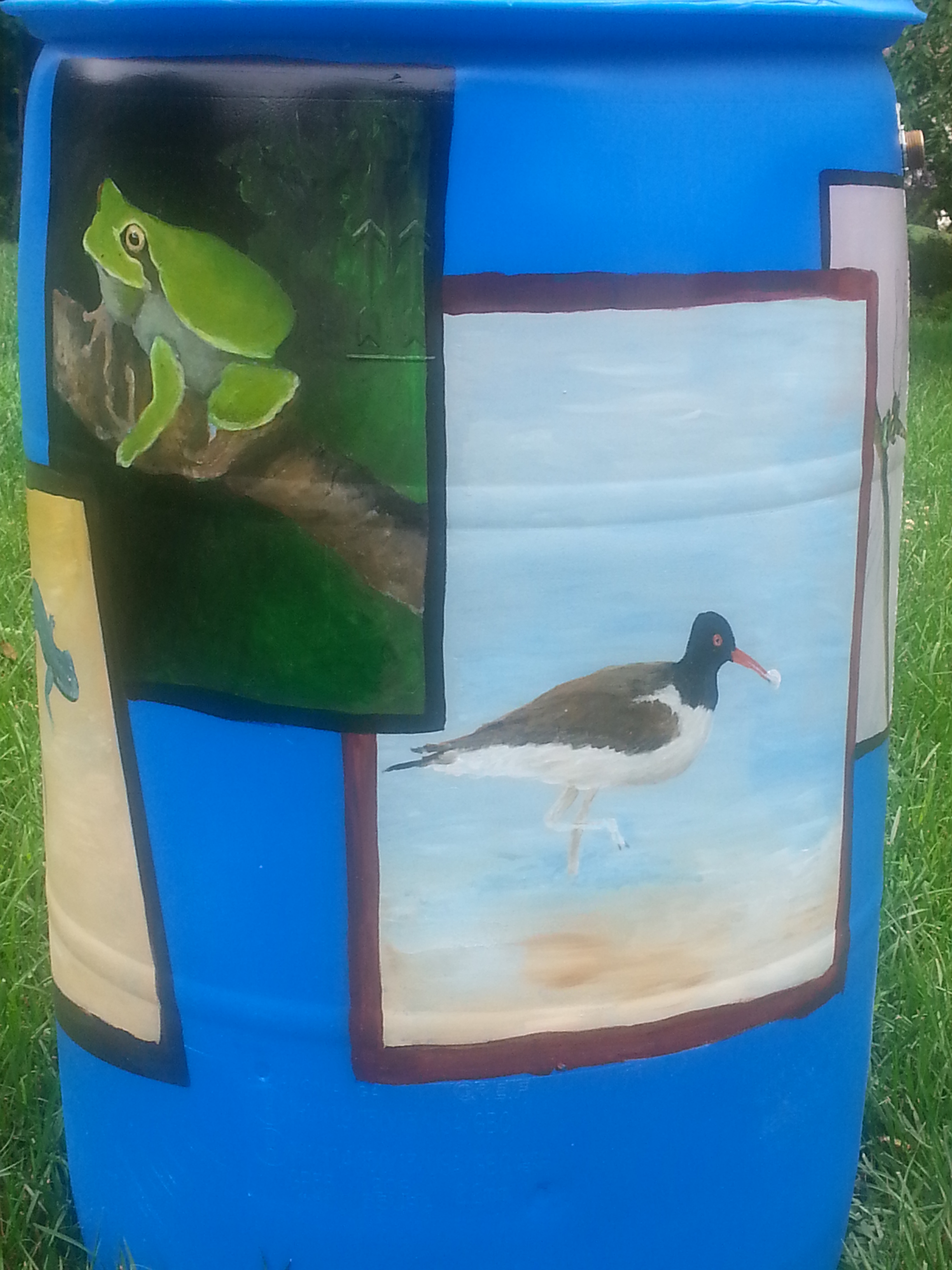
On May 30, 2014 EarthShare New Jersey launched the exciting new Rain Barrel Auctions program.  Thanks to a donation of barrels from Ocean Spray Cranberries, Inc. in Bordentown, N.J., each of the 24 members of EarthShare New Jersey will have one designed which captures the important work each of these charities do for our environment.  The auctions are designed to raise awareness and funds for the local members of EarthShare New Jersey. 

Rain Barrels offer a long-term, sustainable way to collect and store the rain water that drains from our roofs and gutters. The water can then be used around the home, in the garden, or even for hydration as long as it is adequately filtered and cleaned.  Each of the rain barrels being auctioned off are not only functional, but exquisite one of a kind works of art designed by artists from across the state. The program will run until the end of 2014.

The rain barrel designed for CWF was recently posted on eBay. CWF is very excited to have been selected for this effort, and we hope this rain barrel raises awareness and the sale is a success! The proceeds for this rain barrel will be split with CWF and EarthShare.

EarthShare is a national non-profit federation with 25 years of experience in connecting people and workplaces with effective ways to support critical environmental causes. Together we’ve raised more than $300 million for programs that care for our air, land, water, wildlife and public health — in your community, across the U.S. and around the world. EarthShare develops and manages employee engagement and giving campaigns to increase support for its member organizations and help our workplace partners achieve their philanthropic and CSR goals.

Conserve Wildlife Foundation is a non-profit and an EarthShare local member organization. Together CWF and EarthShare work to create a sustainable environment through education, conservation, preservation and community awareness. Through ongoing statewide and community activities we address so many important issues.


Check out our rain barrel, with beautiful artwork by Diane Novobilsky, here! 

rainbarrelphoto3 rainbarrelphoto2 rainbarrelphoto1

Delaware Bay’s Stranded Horseshoe Crabs Saved by Volunteer Effort

by Stephanie Feigin, CWF Program Coordinator

This marks the third story in Shorebird Week! Our first blog post, on Tuesday, introduced the film “A Race Against Time” and directed you to a free viewing of the film on our website. Our second blog post, highlighted an incredible news story about a resighting of the iconic Red knot B95 on the Delaware Bay! And today’s blog post, will highlight volunteers incredible effort to save stranded horseshoe crabs!

Volunteer Don Senior extracts an impinged horseshoe crab from the rubble on the south end of Fortescue beach along the Delaware Bay on Saturday  (c) Phillip Tomlinson South Jersey Times
Volunteer Don Senior extracts an impinged horseshoe crab from the rubble on the south end of Fortescue beach along the Delaware Bay on Saturday (c) Phillip Tomlinson South Jersey Times

This story illustrates the incredible efforts of volunteers for Conserve Wildlife Foundation and other conservation groups to save the stranded horseshoe crabs on Delaware Bay beaches. Horseshoe crabs can easily be flipped onto their backs by incoming tides, and they are not able to right themselves on their own. They also get trapped easily by tides and man-made obstacles, such as debris, which leaves them unable to return to the water leaving them to eventually die.


Return the Favor, a multi-group effort, has committed to rescuing as many horseshoe crabs as possible from South Jersey’s Delaware Bay beaches by regularly combing designated stretches of beach and helping to flip the crabs back on their bellies and redirect them back to the water. If possible these volunteers go out daily and rescue all of the flipped or impinged crabs. These efforts have been very successful so far, and they hope to continue these efforts and engage more about who want to volunteer.

  • To read this full news article click here
  • More information on how you can become a volunteer can be found on their website at www.ReturnTheFavorNJ.org.

And make sure to check out the film “A Race Against Time” which highlights CWF’s efforts to restore the Delaware Bay Shore beaches as well!

Ann Street School Children visit Island Beach State Park

by Brooke Sambol, Wildlife Intern 


“This is the best field trip ever!” shouted the fifth grader at the edge of the bay. Many of her Newark classmates agreed.

Brooke Sambol with Ann Street School Students

On a Thursday in June, fifth graders from Ann Street School of Newark came to Island Beach State Park for a day of nature education and fun! Sponsored by PSEG the program was part of Conserve Wildlife Foundation’s WILDCHILD urban initiative, which seeks to make the experience of and knowledge about nature accessible to children from urban environments.

The park is situated on roughly 3,000 acres of barrier island in Seaside Park, New Jersey.  Its access to the ocean and Barnegat Bay, as well as the surrounding maritime thicket, makes it a prime location for aquatic and coastal education.

AnnStreetSchool.IBSP.HorseshoeCrab1
Ann Street School Students looking at a horsehoe crab

The program allowed the children to venture the bay and search for sea creatures like blue claw crabs and silversides while seining, hear a talk on ospreys given by CWF’s Maria Grace, examine bones and shells of the animals that live in the region, and visit the park’s nature center.


Students from Ann Street School
Students from Ann Street School at Island Beach State Park


As a CWF intern working in Island Beach State Park, it’s truly a joy to experience the natural beauty of the Jersey Shore along with the kids, and to help contribute to an environmental understanding for children who might not ordinarily have the opportunity. The excitement and happiness was evident on their faces when they got to examine up close the critters of the bay. Their willingness to participate in activities and answer questions about horseshoe crabs and moon snails was a testament to just how fun caring for the environment can be.

The day proved to be a great success! The children from Ann Street School got to experience and enjoy the natural beauty of Island Beach State Park, and we all learned more about this unique ecosystem from each other and from the land, itself.


Photo from the Field

Slow down, don’t tailgate and help a terrapin cross safely!

by Ben Wurst, Habitat Program Manager

Female terrapins often cross roads to find suitable nest sites along the Jersey Shore. © Ben Wurst

This week the annual nesting season of northern diamondback terrapins began. Females leave protection of our coastal estuaries to seek out suitable nest sites, course gravel and sand, which is often along roadsides. These individuals often cross roads to get to these nest sites. Please be courteous of terrapins and slow down, leave a greater following distance, and help a terrapin cross when you see one on the road.


In the News: CWF’s Amphibian Crossing Project

A spotted salamander after being rescued after attempting to cross a road. (c) CWF

Conserve Wildlife Foundation of New Jersey was profiled in a recent article in the The Record about our efforts to protect migrating amphibians.  


One of the lesser known signs of spring arrived Monday night on Clinton Road in West Milford: A steady trickle of frogs and salamanders crept through an icy rain in search of love. If not for the teams of volunteers who waited to prod them across the winding road, many would meet a quiet end under the wheels of a passing car. Every year in early spring, champions of the tiny amphibians spend several hours at this spot and dozens like it throughout the Northeast so they can witness — and do their small part to continue — a natural phenomenon that goes largely unnoticed by the greater population.  Read more…