An Update on This Season’s Horseshoe Crab Spawn and Shorebird Migration, Ten Days In
By: Dr. Larry Niles, LJ Niles Associates LLC
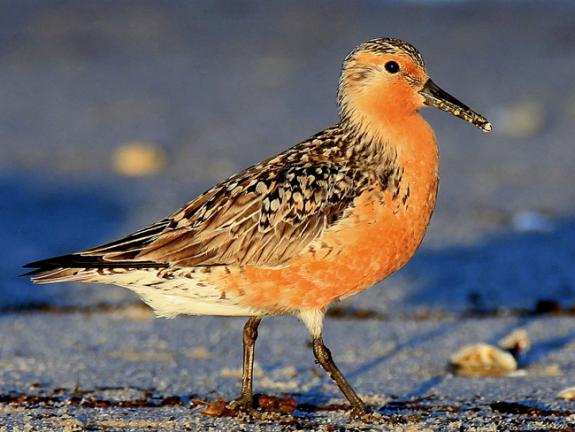
Thousands of shorebirds now fill Delaware Bay’s beaches and marshes in a determined effort to regain lost reserves with free-for-the-taking fatty eggs of the horseshoe crab. The crab spawn began ten days ago and has gained momentum over the last week as the volume of eggs grows like a well-funded savings account. The eggs surface as each new female crab digs up egg clusters laid by other crabs or as wind-driven waves pound the always-fluid sandy beaches. At least 8,000 red knots slowly get fat on the eggs scattered on New Jersey’s Delaware Bay beaches.
Eggs on Beach
Both crabs and birds are the beneficiaries of the increasing number of beaches that are highly suitable for egg-laying. In October, 2012, Hurricane Sandy ravaged two-thirds of New Jersey’s best crab-spawning beaches, its strong westerly winds lifting sand and spreading it far from the sea’s edge. Left behind was a jagged sod bank, completely unsuitable for horseshoe crab breeding. The mucky sod starves eggs of oxygen or gasses them with hydrogen sulfide, the by-product of decaying mud.
The American Littoral Society, Conserve Wildlife Foundation of New Jersey, the U.S. Fish and Wildlife Service and the National Fish and Wildlife Foundation came to the rescue, restoring many of these beaches to a condition superior to that before Sandy. The restoration team even repaired damages that predated Sandy — beaches with tons of rubble that entrapped crabs in nasty concrete, killing them by the thousands. Now beaches like Thompson’s Beach and Fortescue Beach join the growing number of delicate sandy strands that provide excellent spawning habitat.
Thompson’s Beach Before and After Restoration
This week, eggs can be found in many places on the New Jersey side of Delaware Bay, and the birds have the freedom to move to those that best suit them. Earlier this month, strong northwest winds drove red knots from the Reeds Beach area to other, more northerly, beaches that saw good crab spawning — beaches that also provide shelter from the winds. Now that the wind and sea have calmed, the birds have returned to the Reeds Beach area, less than 20 miles away, and have resumed gorging on the plentiful eggs that built up in their absence.
Early Morning Shorebirds on Delaware Bay
If one were to look for any cloud on the Delaware Bay shorebird horizon, it would lie in the lack of any evidence of horseshoe crab recovery. The current, reduced, population of crabs spawned eggs in great numbers early this May because of a spike in the water temperature, a consequence of unusually warm weather. So far the promise of this early spawn is holding, and crabs continue to spawn in good numbers. But will it hold until the end of May?
Crabs in Slew
If not, the readers of this blog will witness the outcome. The graph below, developed by long-time team-member Dick Veitch tells the story of a past egg failure. In the early 2000’s, although the population of shorebirds had not yet declined to its current number, the crab population had already fallen to its current number, crushed by the onslaught of a poorly regulated fishing industry. In those years, all the horseshoe crabs that could spawn had finished by the third week of May and egg densities on the bay plummeted. The birds crammed into the few beaches with eggs like Mispillion Harbor, Delaware, so densely that the beach reeked of off-gassing urinary ammonia.
But the number of eggs there was not sufficient to feed the still-large shorebird populations and birds failed to reach a weight – about 180g for red knots — suitable for their journey to the Arctic and subsequent breeding. Where once 80% reached the “good” weight, only 5% did in 2003 (see the second graph).
Percentage of Red Knots Reaching 180 Grams
The percentage has improved thankfully, but only because the number of shorebirds have fallen over the last 10 years, bringing a balance of sorts. Hopefully, with the new beaches, the new protection afforded by the red knot listing and the growing number of volunteers taking part in conservation of the crab and birds, this kind of disaster is behind us.
Restoring Critical Delaware Bay Habitat for Migratory Shorebirds
By: Kelsey Lawler, Spring 2015 Intern
Photo Credit: Jan Van der Kam
Saturday, May 9 is International Migratory Bird Day (IMBD) 2015! It is time to celebrate and bring awareness to the spectacular event that is bird migration. Since 1993, IMBD has been serving as a celebration as well as a call to action for migratory bird conservation.
Conserve Wildlife Foundation of New Jersey has been doing their part for bird conservation. We have developed a range of programs to increase the numbers of endangered migratory birds, like the Red Knot, since their decline in the late 1990’s.
Red Knots use New Jersey’s Delaware Bayshore as a stopover for feeding after their long journey from the Arctic and South America. Delaware Bay plays a major part in the Red Knot life cycle, so we’ve focused our efforts on restoring this critical habitat. The Red Knot migration is timed to take advantage of the spawning of the horseshoe crabs that use the same beaches as breeding grounds. Their eggs provide a rich food source for the Red Knots at a time when they are in desperate need of nutrients.
We have been working to benefit both horseshoe crabs and the migratory shorebirds that feed on their eggs, like the Red Knot, through our beach restoration projects, oyster reef construction and monitoring projects. Since Superstorm Sandy, we have successfully restored over a mile of impacted horseshoe crab habitat. We’re working to further protect these beaches from erosion and to create calmer waters for horseshoe crabs through our oyster reef construction experiments. To learn more about our restoration work in Delaware Bay, visit RestoreNJBayshore.org.
Of course, we haven’t been able to do this work alone. Volunteers are one of the reasons why these projects are possible!
Celebrate International Migratory Bird Day by getting involved in migratory bird conservation:
Bayshore Regional Watershed Council Looking for Volunteers to Help Out Four Nights in May and June
By: Lindsay McNamara, Communications Coordinator
Photo by: Joe Reynolds
The Bayshore Regional Watershed Council (BRWC) is looking for volunteers to help monitor and tag horseshoe crabs in Sandy Hook and Raritan Bay this May and June. Since 2009, BRWC has been collecting hard data through their volunteer-driven monitoring and tagging program. This data is used to help analyze the population of horseshoe crabs in the region and better inform conservation efforts to protect them.
Lately on the Bayshore, the Council has seen a ratio of about 35 males per 1 female, which is a cause for concern. Why are there so few females? How will the population continue to survive in the region with such a low number of mature, female horseshoe crabs?
BRWC investigated the issue and found that New York State is harvesting about 100,000 horseshoe crabs a year from the Harbor. Female horseshoe crabs are frequently harvested because their eggs are used as bait for fishermen. Horseshoe crab numbers have dropped dramatically in New York area waters, BRWC thinks in part because of the harvest. According to the Council’s website, over the last 150 years, horseshoe crab populations have declined 90%. What can concerned citizens do to help protect the current population of horseshoe crabs in Sandy Hook/Raritan Bay from further decline?
Volunteering with Bayshore Regional Watershed Council is a great place to start. Volunteers monitor and tag horseshoe crabs on four nights (alligned with the new and full moon and the tides) through May and June on Sandy Hook/Raritan Bay. The volunteers record clusters, single females, single males, swimming pairs, and other data points on tally sheets at five different locations on the Bayshore. The recordings function as a sampling of the population; volunteers monitor an area of 1,000 feet by 6 feet on the beach. BRWC volunteers can see anywhere from 10-125 horseshoe crabs a night, depending on the site.
Adult horseshoe crabs are also tagged. The tag displays a New Jersey Division of Fish and Wildlife phone number that can be called if the horseshoe crab is seen again. These tags and calls by the general public help biologists to better understand horseshoe crab behavior and where they go when they are not spawning. BRWC suspects that older horseshoe crabs return to the ocean out past the continental shelf, while younger horseshoe crabs stay in the bay. Volunteering will help the Council collect more data to analyze these observations and trends.
Take action to help protect these over 250 million year old creatures:
Bayshore Regional Watershed Council is recruiting volunteers at:
Cliffwood Beach in Aberdeen Township
Conaskonck Point in Union Beach
Leonardo Public Beach in Middletown Township
The mouth of Many Mind Creek in Atlantic Highlands
Plum Island at Sandy Hook National Recreation Area
Dates and times for the 2015 monitoring program are:
A Look at the Pilesgrove Eagles Nest Over Time (2009-2015)
By:Larissa Smith, Wildlife Biologist and Volunteer Manager
New Jersey Bald Eagle Project Volunteers Jeffrey and Cathy White have been monitoring the Pilesgrove eagle nest since the pair’s first nesting season in 2009. The pair has successfully raised and fledged 9 young for the past six years. This season the pair has two chicks which are currently six weeks old. Jeffrey took a photo of the nest on April 19, 2015. He then went back through his photos and found one that he taken on the same date April 19, 2009 in their first nesting season. This comparison really shows just how large eagle nests can get after years of use.
Training Session scheduled for May 12th at 6pm in Tuckerton
A female terrapin pauses while crossing Great Bay Blvd in Little Egg Harbor, NJ.
We work hard to protect wildlife for future generations to enjoy. One of those species, who is largely an underserved species in New Jersey is the northern diamondback terrapin. Terrapins are so cool yet hardly noticed by many. They face a HUGE amount of threats. To list a few (from greatest to least): Poaching, drowning in crab traps, road mortality, predation (usually of eggs or young), and collisions with boats and boat props. That’s a long list of threats to the health of their population, which no one really knows how they are doing…
What we’ve done with them in Tuckerton and Little Egg Harbor is address a problem which was believed to be the root cause for their decline in the area. Studies that have been done in the area have stated that the overall size and age of terrapins has decreased over time. Another documented the total road mortality rate at 70% of individuals that crossed the road (the actual rate in a more recent study was around 30%, but that’s still high and having an impact). Either way, each year many terrapins are being injured and killed by motor vehicles.
Each year we recruit volunteer “Terrapin Stewards” to help patrol area roads. This hardy and extremely dedicated group of volunteers work tirelessly to prevent terrapins from becoming road kill and also collect valuable data on their annual migration to find suitable nesting areas. On May 12th at 6:00pm we are hosting a short training session for anyone interested in volunteering this year. Attendees will also learn more about all of the work that we’ve done over the past 5 years.
Oyster Reef Build on South Reeds Beach a Huge Success
By: Lindsay McNamara, Communications Coordinator
Photo by: Lindsay McNamara
Over 130 volunteers and veterans worked alongside Conserve Wildlife Foundation of New Jerseyand American Littoral Society to establish a near-shore whelk shell bar at South Reeds Beach in Cape May Court House on the Delaware Bayshore on Saturday, April 4, 2015. The shell bar was built to prevent sand loss from wind-driven waves. During the “Shell-a-Bration,” an approximately 200-foot oyster reef was constructed offshore to test whether the reef bars help reduce beach erosion and create calmer water for spawning horseshoe crabs.
“We are rebuilding the habitats of Delaware Bay to strengthen its ecology, its communities and its economy. This reef approach will be a key technique which we will try to expand around the Bayshore,” stated Tim Dillingham, American Littoral Society Executive Director.
The South Reeds Beach Oyster Reef is one of the many projects that American Littoral Society and Conserve Wildlife Foundation are working on to restore the ecology and economy of the Delaware Bayshore, thanks to generous funding by the National Fish and Wildlife Foundation.
“The project focuses on creating resiliency in Delaware Bay beaches while improving their usefulness to horseshoe crabs. We have a great challenge: how do we create a reef to protect against damaging Bay storms without stopping horseshoe crabs from getting ashore to breed,” said Dr. Larry Niles, a biologist who leads the beach restoration efforts for Conserve Wildlife Foundation of New Jersey and American Littoral Society, and has studied Red Knots for three decades. “This project is an experiment to help us do both,” he added.
Shorebirds, like the federally listed Red Knot, depend on an uninterrupted supply of horseshoe crab eggs when they stopover in Delaware Bay during their migration. In recent years, countless horseshoe crab eggs have been lost because of the devastating storms that swept away the beaches they depend on.
“The time-honored migration of Red Knots to reach the eggs of these ancient horseshoe crabs is a wildlife spectacle of global significance right here in Delaware Bay,” explained David Wheeler, Conserve Wildlife Foundation of New Jersey Executive Director. “Red Knots come to New Jersey’s Delaware Bay from as far away as the southernmost tip of South America to feed on horseshoe crab eggs. It is vital that we promote coastal resiliency projects like this one to support the largest population of horseshoe crabs in the world, and the human communities of the Delaware Bayshore alike.”
The new oyster reef will attenuate waves but still allow for horseshoe crab breeding. In existing areas where crabs can breed without interruption, like creek mouths protected by sand shoals or rock jetties, egg densities can exceed ten times the egg densities on unprotected beaches.
The projects are being funded by National Fish and Wildlife Foundation (NFWF) through their Hurricane Sandy Coastal Resiliency Grants Program, and are being developed in partnership with U.S. Fish and Wildlife Service and New Jersey Division of Fish and Wildlife.
“The Delaware Bayshore is a perfect location to demonstrate how communities benefit from their connection to a healthy natural resource base – for fishing, boating, wildlife watching and tourism,” said David O’Neill, National Fish and Wildlife Foundation Vice President of Conservation Programs. “The economies of Bayshore towns have historically been intertwined with the bay. And with the NFWF Hurricane Sandy grant, American Littoral Society and Conserve Wildlife Foundation of New Jersey are already restoring shorelines to make Bayshore natural resources and communities more resilient for the future.”
Event guests enjoyed a barbecue and oysters, and family-friendly activities like a “Green Eggs in the Sand” Easter Egg Hunt. In addition, local leaders and biologists spoke to the attendees about the oyster reef project at a mid-day “Whelk-come.”
CWF Releases its First Annual Report Ever Using a Story Map Format: “2014 Annual Report“
By David Wheeler, Executive Director
Technology has proven to be vital to Conserve Wildlife Foundation’s work protecting rare wildlife species over the years. Our biologists depend greatly on modern technologies to band, track, and share online the journeys of wildlife. Our webcams broadcast the most intimate behaviors of nesting birds and bats across the web. And we seek out ever-evolving communications technologies to spread the word about the inspiring stories of wildlife, from social media and infographs to e-books and Story Maps. These technologies offer newfound abilities to share complex data on multiple levels, while still incorporating the awe-inspiring photography and videos that bring wildlife’s stories to life.
Conserve Wildlife Foundation of New Jersey is excited to offer our 2014 Annual Report in a unique format that utilizes one of those technologies – Story Maps. In the past year, we have explored the wonders of American oystercatchers with our first Story Map – and now the annual report allows all of our projects to be highlighted in this interactive format.
A screen capture of one of the pages of the CWF 2014 Annual Report Story Map.
Visit the multiple pages within this Story Map to learn about Conserve Wildlife Foundation’s many projects and partnerships in 2014, and the imperiled wildlife species in need of our help. Find examples of the innovative and dedicated leadership of our biologists and volunteers. And take an online journey across the state to learn how our projects made a difference in all corners of New Jersey in 2014 – a great year for wildlife in the Garden State!
January 2015 is the Month of the Eagle! CWF is kicking off the new year by celebrating all things eagle. Follow us on social media and be sure to check your email (sign up for our list) for weekly stories on these amazing raptors from our own eagle biologist Larissa Smith. Larissa, a wildlife biologist who has been working for Conserve Wildlife Foundation since 2000, coordinates the New Jersey Bald Eagle Monitoring Project.
By: Larissa Smith, Wildlife Biologist and Volunteer Manager
During the Month of the Eagle, we have thanked the dedicated Bald Eagle Project volunteers, the backbone of the New Jersey Eagle Project.
Our volunteers get an incredible, intimate look into the lives of eagle pairs. Read their stories:
My best eagle memory comes from May 15, 1996 — my second visit to the first eagle nest I ever monitored. Eric Stiles had called a week earlier to tell me a nest had been found in Smithville and asked if I’d like to become involved in the project. I said “Of course!” and we arranged to get together the next day.
Back then there were only about a dozen nest sites known in the state and he wanted me to keep secret the locale and everything I observed. We drove his truck into the woods out of sight, then walked in through a white cedar forest, whispering as we got close. “It’s two young birds,” he told me, “in a small nest, probably a red-tailed nest they pirated.” Both had flecks of black and brown in the feathering on their heads, especially the male, whose head and tail showed lots of brown. “They may be too young to breed this year,” he explained. “It may be just a housekeeping year.”
“Brownie” flew off soon after we arrived; his mate sat in her pine tree for the full half-hour we watched, looking over-sized for her nest. “We need to keep disturbance to a minimum,” Eric told me as we left. “You shouldn’t come back here more than once a week.”One week later, when I returned to the hiding place in the cedars, I could see the female in the nest with my bins. I unfurled my tripod as quietly as I could, focused my scope — and my heart leaped: a fuzzy blue-gray chick with big black eyes was looking back at me! Soon after, his mother stood up and called into the sky. “Brownie” was coming back.
He landed in the nest, and after more screaming, let his mate take the fish he’d carried in. She carefully pulled it apart, feeding tiny bits to the chick and the larger pieces to herself. I had never seen eagles in action at a nest and was thoroughly enchanted – but there was another surprise to come. As the female turned in the nest ripping at the fish, something flashed. I focused the scope again and saw first a silver band gleaming on one leg and next a green band on the other. She was a New Jersey bird — hatched herself probably in 1991 or 1992, from one of the handful of nests in the state in those years. That was a sweet thrill!
That was the start of a long relationship between “Brownie,” “Greenie,” and me – and the eagles that have come along in the two decades since (the nest has moved two times over those years). I am very grateful to Eric Stiles for involving me originally and to Larissa Smith, Kathy Clark, Larry Niles and all the many hard-working, dedicated folks who have allowed me to participate in this wonderful project. Thanks largely to them, our state now has an order of magnitude more nests than we had in 1996: 150+! Wow! — Jack Connor
Karin Buynie monitors the Crosswicks Creek nest @ Kevin Buynie
We have a lot of good memories through the years of eagle volunteering. None that stand out more than just being able to talk to the many people that stumble upon you trying to figure out what all the gear is for and then seeing the surprise on their face when you tell them you are watching a bald eagle pair raise their young. Being able to pass on all the knowledge you learned from our many conversations with the biologist is very fulfilling. It is nice to see people walk away knowing how far our nation’s symbol has rebounded in our state. We have been able to help 16 eaglets fledge in our seven years of volunteering. — Kevin & Karin Buynie
My best memory was to see the eagle stand up in the nest and the egg pop out.
–Ed Sheppard
Last year was my first year monitoring an eagle’s nest. I guess the best experience was watching the pair behavior, moving sticks around on the nest and then seeing them mating, which was interrupted when an immature eagle came flying by. It was pretty cool. — Karyn Cichocki
Lake Barnegat@Paul Lenzo
My best local sighting was in March of 2009 on Lake Barnegat in Forked River. From the road, as I was driving home, I saw an eagle attacking a cormorant and pulled over. After numerous attempts in the air and on the water, the eagle finally killed the cormorant. After watching for about 15 minute., I drove home to get my cameras (about a ten minute round trip), hoping the eagle would still be there when I returned. To my surprise when I returned a pair of birds was feeding on and fighting over the carcass. — Paul Lenzo
My most awesome experience was participating in the banding of a young male bald eagle chick from the Supawna Meadows nest. How awesome to actually hold the chick while blood was drawn and measurements taken. I will never forget that great experience. — Cheryl Leonard
Donna Poolake monitoring nest
“Busy day at Turkey Point: Upon arrival, one adult was in the nest housekeeping and three juveniles were in a snag about 100 feet to the right of the nest. We think these are most likely last year’s fledglings since the adult was not concerned they were so close. There was an adult that flew over the nest towards open water and out of sight. There were another four juveniles in the trees to the right of the meadow across the creek. Across the street from the crabbing business were six more juveniles perched in the trees.
Another adult flew to the nest and perched just above it. Then it jumped to a different branch in the nest tree. That’s when the adult that was housekeeping in the nest jumped up and bit the tail of the adult that just approached and was perched above the nest. Fluffy feathers floated down from that adult while he flew away towards where the three juveniles were perched and landed in a snag. The housekeeping adult that had just gone after tail feathers flew to the same snag as the adult she just “bit” and perched about 10 feet above him.
All of this caused the three juveniles that were perched there to fly off. So, she was telling him to get home and help while the three youngsters said ‘We’re out of here!'”
This is from several years ago at Turkey Point. We were observing a nest with three chicks in it that were about six weeks old. An adult was perched on a snag not far from the nest. We suddenly got a good view of a chick and noticed that he was much larger than the others. Then we realized this was not a chick but most likely a fledgling from last year. Mom was not too upset but once the fledgling started to eat the fish that was in the nest she flew over, landed in the nest, and chased the juvenile away. It seems she didn’t mind him visiting but he better go get his own meals. The chicks didn’t seem to mind the visitor but became much more active after he left! — Donna & Heiki Poolake
I was astonished to see a pair of eagles take over an osprey nest in the rear of my home several years ago. This is what started me in the eagle program. The eagles did not stay long as the red-tailed hawks and osprey were too annoying. I then started to observe nest in Brick, New Jersey and let Kim Korth know whatever I saw. One day Kim called me and asked if I would like to go and be part of a eagle banding project. I was overjoyed to go. The banding took place in Brick, New Jersey on a private piece of property. I held an eagle for about 15 minutes and it was one of the best things I have ever experenced in my entire life. To actually hold an eagle. WOW! — Richard Gauer
Is it the thrill of the first sighting of that fuzzy little head? Is it the beauty of that majestic bird soaring above with a blue background? Maybe it’s the anticipation of a first sighting of another species? Or the beauty of the area where you are doing your observation, the breath-taking sight of thousands of Snow Geese that perhaps land near-by? For us, it is all of these things and the knowledge we have gained observing these magnificent birds (and all the information Larissa has imparted to us, bless her). We feel it has been an honor to have taken part in the program and we hope to be able to continue for years to come. — Clare Luisi & Anne Stiles
Two adult eagles were perched over the waterway near their nest. But this time instead of both being on a relatively high perch, one was perched on a branch just a few feet from the water. The water level was low and the area beneath the eagle was mucky. The eagle on the low branch was studying the mucky water below. Then it floated off the branch by just opening its wings and dropping down like a parachute into the muck. It flew up from the muck with a turtle in its beak! Then as it lifted hire into the air, it banked around past us and we watched it transfer the turtle from its beak to its talon in mid flight. We are so used to seeing eagles drop their talons into the water to pick up fish, that this eagle’s retrieval of a turtle with its beak was really surprising and wonderful to watch.
— Bonnie Hart & Ted Henning
By: Larissa Smith, Wildlife Biologist/Volunteer Manager with Conserve Wildlife Foundation
Northern Gray Treefrog @ M. Patterson
It’s the heart of the winter season and cold outside, so the furthest thing from your mind is hearing the calls of New Jersey’s frogs and toads. But now is the time when we start getting ready for the Calling Amphibian Project (CAMP) and thinking ahead to the spring of 2015.
The object of CAMP is to assess the distribution, abundance, and health of New Jersey’s amphibians. This is part of a larger initiative called the North American Amphibian Monitoring Program (NAAMP) and the data collected in New Jersey will be submitted into the National database. Volunteers participating in this project will be asked to conduct roadside surveys (after dusk) for calling amphibians along designated routes throughout the state. Each 15-mile route with ten stops will be surveyed three times during the Spring and a structured protocol will be followed to determine which nights to survey, how long to survey, which species are calling, and how to estimate the total number of individuals calling at each site.
In 2014, 24 volunteers participated in CAMP and surveyed a total of 23 routes out of 63. We have many dedicated long-term CAMP volunteers. Unfortunately due to different circumstances some can no longer participate so we currently have 37 routes available for the 2015 survey season. If you are interested in learning more about this project, contact Larissa Smith.
This year we will be holding a meeting for CAMP volunteers in January. The meeting will be a good opportunity to meet other volunteers and the biologists who work on the this project and other amphibian projects. Biologists from CWF, the state ENSP and DLUR will be there to discuss the two “new” NJ frog species and how CAMP data is being used by the state.
Wildlife conservation organizations leading the efforts to restore New Jersey’s Delaware Bay beaches for at-risk shorebirds today applauded the U.S. Fish and Wildlife Service decision to designate the Red Knot, a migratory shorebird, as “threatened” under the Endangered Species Act. A “threatened” designation means a species is at risk of becoming endangered throughout all or a significant portion of its range.
“This federal designation will make a big difference in strengthening the protections of this incredible shorebird,” said David Wheeler, Executive Director for Conserve Wildlife Foundation of New Jersey.
“Here in New Jersey, we are restoring the vital beach habitat that had been decimated by Hurricane Sandy, and this designation ensures the safeguards we are providing can be complemented along the East Coast,” Wheeler added.
Since the 1980’s, the Knot’s population has fallen by about 75 percent in some key areas. Wildlife biologists believe the major threat to the Red Knot is the dramatic decline of horseshoe crab eggs, an essential food source at the most critical stop over during their 8,000 mile trip from southern wintering grounds to Arctic breeding territory. High-energy horseshoe crab eggs provide nourishment for Red Knots to refuel and continue their journey.
“This is an important and needed step in the conservation and recovery of the Red Knot. It is an essential step in preventing the extinction of this amazing long distance traveler,” stated Tim Dillingham, Executive Director forAmerican Littoral Society.
The largest concentration of Red Knots is found in May in the Delaware Bayshore of New Jersey and Delaware, where the shorebirds stop to gorge themselves on the eggs of spawning horseshoe crabs. In just a few days, the birds nearly double their weight to prepare for the final leg of their long journey.
“The major decline of horseshoe crabs in Delaware Bay is one of the largest threats to the survival of the shorebird,” explained Dr. Larry Niles, a biologist who leads the beach restoration efforts for Conserve Wildlife Foundation of New Jersey and American Littoral Society, and has studied Red Knots for three decades. “Agency groups have been working hard for the last two years, and will continue for the next two years going forward to rebuild the habitat damaged by Hurricane Sandy that the horseshoe crabs rely on. This work is integral to the recovery of the Red Knot and the shorebird’s best hope for survival.”
In the wake of Hurricane Sandy, American Littoral Society and Conserve Wildlife Foundation of New Jersey worked with the U.S. Fish and Wildlife Service, the New Jersey Division of Fish and Wildlife and the New Jersey Recovery Fund to remove 8,000 tons of debris and added 45,000 tons of sand to the beaches just before the annual spring arrival of the Red Knot in 2013.