HURRICANE SANDY STORM REPORT

Assessing the damage to coastal wildlife and their habitat

By Stephanie Egger, Wildlife Biologist

CWFNJ Wildlife Biologist, Stephanie Egger, surveying American Oystercatchers post Hurricane Sandy.

As we all know Hurricane Sandy caused severe damage and devastation to New Jersey residents, homes, and their businesses, but we must not forget that wildlife can also suffer from the impacts of a hurricane.  CWFNJ’s Beach Nesting Bird Project Manager, Todd Pover, Alfred Breed, CWFNJ Field Technician, and myself, conducted wildlife/habitat assessments on beaches from Brigantine to Cape May after the storm.  Our nesting sites further north in Ocean and Monmouth Counties were still not accessible at that time to evaluate.  We assessed nesting habitat for beach nesting bird species, especially Piping Plover as well beach/inlet habitat used by migratory shorebirds, particularly American Oystercatchers.

A view of the severe erosion at Strathmere Natural Area, Cape May County, NJ.

As expected, many of our nesting sites and sites that are also used by migratory shorebirds for roosting were hit hard by Hurricane Sandy, losing a great deal of sand and suitable habitat.  However, in some locations such as Stone Harbor Point and North Brigantine Natural Area, the storm scoured out areas with too much vegetation which is good for beach nesters as they prefer sparsely vegetated areas. Sand was also pushed back into the dunes to create blowouts and overwash areas that may serve as additional habitat.  Many of the areas seem to be very low lying now from the loss of sand and might be more flood prone which could impact the beach nesters in the spring.

We also observed migratory songbirds, golden-crowned kinglets, which were taking shelter and flittering through the back dune/bayberry habitat right after the storm.  This was a good reminder of the value of New Jersey coastal habitat for songbirds as they migrate down the coast.

American Oystercatchers roosting with juvenile Black Skimmers at Strathmere Natural Area, Cape May County, NJ

As part of our assessment, we conducted American Oystercatcher surveys as a significant number use New Jersey beaches for roosting during the fall and winter.  Luckily, approximately 900-1,000 American Oystercatchers were still using our southern coastal inlets after Sandy, about the same number of birds observed the week before the storm.  Thanks to funding from the National Fish and Wildlife Foundation we were already conducting fall surveys for American Oystercatchers and in the position to compare their numbers before and after the storm.

Only time will tell if the habitat will build back up enough in time for the spring as the birds begin to arrive for the nesting season or if it will have lasting impacts on migratory bird species. We hope to conduct further assessments to gain a better understanding of the short- and long-term impacts to wildlife from Hurricane Sandy and how that may affect conservation and recovery effort for these species moving forward.


For CWFNJ’s videos of wildlife and habitat assessments click on the links below:

Wildlife Assessment Post Hurricane Sandy at North Brigantine Natural Area, NJ

Wildlife Assessment Post Hurricane Sandy at Stone Harbor Point, NJ

Wildlife Assessment Post Hurricane Sandy at Strathmere Natural Area, NJ

Piping Plover Dreams

How to Make a Plover Biologist’s Day!

By Todd Pover, Beach Nesting Bird Project Manager

Group of Post-breedingl Piping Plovers Roosting at
Stone Harbor Point
Photo courtesy of Sam Galick

We spend a lot of time on the beach nesting bird project discussing the love/hate relationship the public has with piping plovers. For every person that supports our conservation efforts for this highly vulnerable shorebird, there seems to be at least two people that complain the plovers take up too much of the beach or prevent dogs from being allowed on the beach.

But every once in awhile, you have one of those perfect encounters that makes all the work worthwhile, so I thought I’d share a recent one with you.

Last week I was conducting a piping plover migration and band resighting survey at Stone Harbor Point. The fact that it was an extremely warm and sunny October day – extending the illusion of summer for just a wee bit longer – alone should have been enough to make me content. Then there was the very cooperative flock of 13 piping plovers, including three with color bands that I recognized as our summer breeders. All and all, it was shaping up as a good day in the field!

As I was almost wrapping up my survey I noticed a birdwatching couple a little further down the beach gazing off into the distance through a scope. On the off-chance they had noticed some plovers I had missed I approached them to see what they were looking at.

“Seeing anything interesting?” I inquired.

“A flock of royal and caspian terns, but no, nothing much really,” the man replied. And then out of the blue he added, “No piping plovers.”

This was a surprising comment since I hadn’t prompted him and October isn’t exactly prime time for piping plover viewing in New Jersey (or anywhere on the breeding grounds for that matter). I proceeded to strike up a conversation with the couple. It turned out they were from Holland, this was their first trip to the U.S., and they were on a birding/nature trip that was starting in the Cape May area.

We talked a little about the work I did and then, naturally, I mentioned to them that there actually was a group of piping plovers just 50 yards away from them on the beach. Given their pale sand color, even more so in non-breeding plumage, I wasn’t surprised the couple had walked right past the plovers.

The man’s eyes widened and he said, “Really?”

Of course, I led them back to the plovers. As we approached the plovers and they came into clear view, the man stopped and turned to me and said, “I have been dreaming of seeing a piping plover for years.”

It isn’t too often you get to make someone’s dream come true. And it is nice to know someone else is dreaming of plovers other than me.

Have You Seen This Bird?

LOOKING FOR HELP FROM BIRDWATCHERS TO FILL-IN DATA GAPS

By Michael Davenport, Marine Species & GIS Programs Manager

Young barn owls. Photo by MacKenzie Hall.

Conserve Wildlife Foundation staff work with the New Jersey Endangered and Nongame Species Program (ENSP) to manage and populate the state’s official database of rare wildlife, known as Biotics.  Currently, this database contains over 35,000 animal and plant records within New Jersey.  ENSP and CWF currently collect and enter data for the state’s 173 endangered, threatened, and special concern species.

There are several species of birds for which more observation data would be useful; and it’s likely that birdwatchers or other nature watchers may have the data needed.  Most good birdwatchers keep logs of what they’ve observed, when, and where.  It would be helpful if anyone with detailed observation data for the species listed at the end of this blog could submit their data for potential inclusion in the Biotics database.

To submit your observation data, please complete a Rare Wildlife Sighting Report Form.  The form is available on ENSP’s website for download as well as instructions for completing the form (a map must be attached when submitted).  In addition to the species listed below, please feel free to submit one or more forms for any of the state’s endangered, threatened, or special concern species.  A complete list of all of the species tracked by the state can be downloaded here.

If you have a large amount of data to submit, please contact Mike Davenport of Conserve Wildlife Foundation at (609) 292-3795 – alternative data submission options may be available (such as submitting Excel spreadsheets or GIS files).

Barn Owl (Tyto alba)
Nashville Warbler (Oreothlypis ruficapilla)
Saltmarsh Sparrow (Ammodramus caudacutus)
Sharp-shinned Hawk (Accipiter striatus)
Spotted Sandpiper (Actitis macularius)
Whimbrel (Numenius phaeopus)
Winter Wren (Troglodytes hiemalis)

Interview with Joanna Burger, “Life Along the Delaware Bay” co-author

How long have you been involved in the Delaware Bay?

I first censused shorebirds in Delaware Bay in the late 1970s as part of a project to determine how important Delaware Bay, Barnegat Bay, and Raritan Bay were to migrant shorebirds, and we discovered the masses of shorebirds foraging there. After that, birders flocked in masses to see the thousands of shorebirds using the bay. Well over 100,000 knots, and large numbers of other shorebirds regularly moved through the bay, and the numbers have declined since then.

How did you get interested in the region and its wildlife?

I have loved the shore and all the wildlife along it since coming to New Jersey. The whole Jersey shore teems with a wide diversity of birds, as well as other creatures. We have some of the largest and healthiest colonial waterbird colonies along the Atlantic Coast, and the Delaware Bay ecosystem is among the most enchanting and interesting ecosystems along the US East Coast. Once I came to Rutgers, I began studying birds along the Atlantic coast and along Delaware Bay. Since the shorebirds move through Delaware Bay in the early spring, I can study them there as well as the colonial nesting birds in Barnegat Bay.

Why should the shorebirds that move through Delaware Bay be protected?

The shorebirds that move through the bay each May and early June have migrated from a long distance, and have yet to fly to the Arctic to breed. These are long distances, and the ones that arrive from South America have depleted their body of all fat. Knots, for example, may weigh as little as 100 grams when they arrive, and have to nearly double their weight so that they can fly to the Arctic to breed. They not only have to reach the Arctic, but they need enough food resources (body fat) to lay eggs as there is little food when they first arrive.

Basically the shorebirds have 10 days to 2 weeks to nearly double their body weight. That is a lot of pressure, and they need safe places to roost at night, and to forage during the day.


What has the shorebird work shown us?

We have learned how important the Bay is to the survival of Red Knots, Sanderlings, Sempalmated Sandpipers, Turnstones, and others; how critical it is to protect the foraging shorebirds so they can gain weight; how long the flights of Red Knots are (in distance and in time); and our recent work with geolocators has even shown us how many knots can actually begin incubation once they reach the Arctic. The use of geolocators has allowed us to know where Red Knots are during their entire cycle, from Delaware Bay to the Arctic, from the Arctic to their wintering grounds (some going as far as Tierra del Fuego), to their return to Delaware Bay.

You work on laughing gulls – what should the reader know about these birds that makes them so interesting to you?

Laughing Gulls are native to New Jersey, and the breeding population in New Jersey is the largest along the Atlantic coast. Laughing Gull increased in the 1960s through the 1980s largely because open garbage dumps provided an easily accessible food supply, and young that might otherwise have starved after the breeding season, did not. Thus, the population slowly increased. But then there were massive efforts to control Laughing Gulls at Kennedy Airport, and thousands were killed. The combination of this effort, along with the closing of garbage dumps has resulted in a decline of Laughing Gulls in New Jersey.

While it may appear that Laughing Gulls are competing with the shorebirds for horseshoe crab eggs on Delaware Bay, the main problem is that when people (or dogs, boats) disrupt foraging shorebirds and gulls, the gulls can return more quickly than the shorebirds, and so they can displace the shorebirds from the best foraging places. It is thus very important to keep people and dogs off the shorebird foraging beaches when the shorebirds are present.

Why did you get involved with writing “Life Along the Delaware Bay?”

I feel very strongly that Delaware Bay is one of the East Coast’s Jewels. It needs to be understood and protected for both the natural ecosystem and for our human needs. The shorebirds, and the Delaware Bay ecosystem, can survive and do very well in the presence of people if we manage the Bay in a manner that is positive for both the ecosystem and people. The bay should flourish, allowing oystermen to farm their oysters, commercial fishermen to have sufficient fish stocks, for recreational fishermen to have good catches, for people to walk and swim, and for all of us to enjoy the Bay, while also allowing the natural ecosystem to flourish.

This will not happen, however, unless people love and appreciate the Bay. There are many many books on Chesapeake Bay, but none on Delaware Bay that takes the broad ecosystem approach that our book does. But more importantly, this is a wonderful and beautiful book that allows us all to appreciate and celebrate the bay.

The creation of the book was a joint effort among scientists, photographers, conservationists and environmentalists, commercial interests, and others who all hellped contribute pictures, ideas, writing, and the support to produce the book, and I am grateful for everyone’s support.

What would you like the reader of “Life Along the Delaware Bay” to learn about this important ecosystem?

That it is one of New Jersey’s truly wild and wonderful places. A place where recreational, commercial, and ecological interests can survive and flourish together. We must preserve it for generations of children, as well as the generations of crabs, fish, and birds that live there.


“Life Along the Delaware Bay” can be purchased through CWF’s online store.


Photo From the Field- Horseshoe Crabs

by: Larissa Smith Wildlife Biologist/Volunteer Manager

Horseshoe crabs have been spawning since early May along Delaware Bay beaches.  This is good news for the shorebirds that have been coming to fill up on the eggs before their long flights.  Researchers have reported that the birds have been gaining the weight needed for their flights and a group of  birds have already left the area.

Horseshoe crabs spawning at Fortescue © Bob Bocci


Extinct & Extirpated Species of New Jersey

NEW JERSEY’S LOST NATURAL HERITAGE

By Michael Davenport, Marine Species & GIS Programs Manager

The rusty-patched bumble bee, a species believed to be extirpated within New Jersey.

Conserve Wildlife Foundation of NJ (CWF) has just launched several new web pages devoted to those species which have been lost from New Jersey (and the world in some cases).  Ten species are profiled – five which are extinct and five which are extirpated from the state.   Although their stories are sad, they are also warnings for what may happen to other species which are currently struggling to survive within the state, especially those already on the state’s endangered species list.  CWF’s wildlife conservation projects attempt to avoid more species becoming extinct or extirpated in New Jersey.

CWF would like to thank Joseph Wotasek, a junior at Centenary College majoring in Graphic Design, who volunteered his time and skills in creating images of the ten profiled species for the new web pages.

To learn more about extinct and extirpated species, please visit CWF’s website at:  Extinct & Extirpated Species of NJ.

Great Shorebird Viewing Opportunities…

…found at Delaware Bay beaches in May.

by Larissa Smith, biologist/volunteer manager

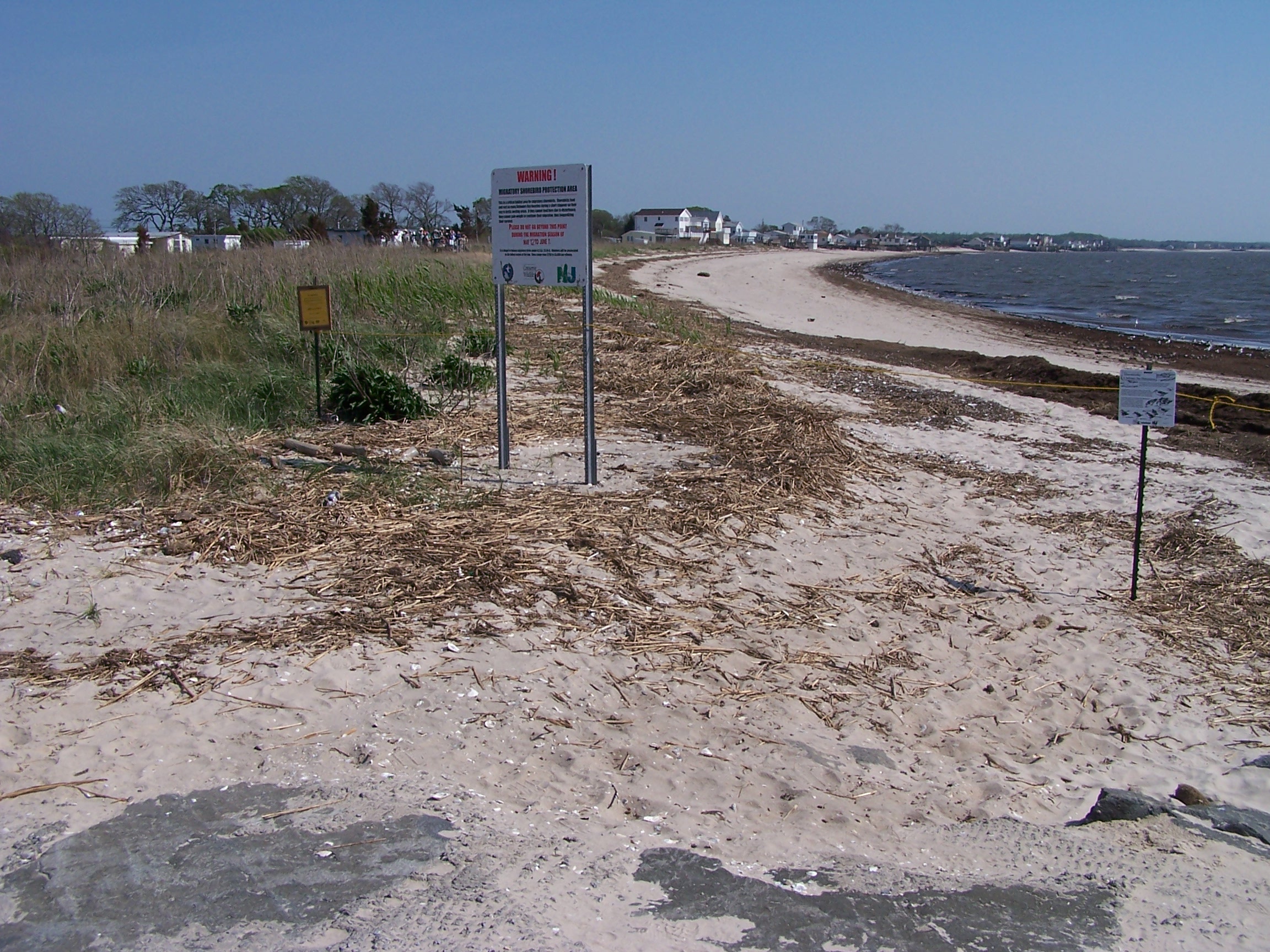
Reeds Beach: Closed area marked with signs and rope. In the background is the viewing platform © Ben Wurst

Several Delaware Bay beaches will be closed from Monday, May 7 to Thursday, June 7, 2012.  Beaches are closed to protect a rapidly-declining population of migrating shorebirds including the red knot which is an endangered species in NJ.  But this doesn’t mean that you can’t come out and view the shorebirds and horseshoe crabs. It’s the prefect time to see these birds undisturbed and feeding on horseshoe crab eggs.

Several beaches are set-up for shorebird viewing including Reeds Beach, Norburys Landing, Kimbles Beach and Cooks Beach in Cape May County. Find more viewing locations on our interactive Wildlife Viewing Map.

Shorebird Stewards will be present at closed beaches to educate the public about the interaction between the shorebirds and horseshoe crabs. Take some time this May and come visit the Delaware Bay and enjoy the view!

Detailed maps of the closed areas can be found at:

http://www.state.nj.us/dep/fgw/ensp/beachclozmap.htm


AMERICAN OYSTERCATCHERS TAGGED AND READY FOR MIGRATION

TRACKING THEIR PATH AS THEY HEAD SOUTH FOR THE WINTER

By Allison Anholt, Field Technician, (NJDFW) and Emily Heiser, Field Technician, (CWFNJ)

Color band being placed on oystercatcher.
Color band being placed on oystercatcher chick at Stone Harbor, N.J.

Throughout the fall, there is a remarkable sight to see along New Jersey’s coastline.  Thousands of shorebirds group together in huge flocks, using our state’s coastline as a migration stopover point to rest and feed.  One particularly interesting shorebird is the American oystercatcher, which is listed as a species of special concern in New Jersey.   At the Conserve Wildlife Foundation of New Jersey, we work with biologists from the New Jersey Division of Fish and Wildlife to survey these birds throughout the fall season.

The oystercatcher is an especially easy bird to survey during fall migration due to its distinct features. Not only do they stand apart from other shorebird species with their unique orange bill and striking coloration, but color bands help us determine individuals as well.  Banding efforts have been underway in New Jersey since 2004 in order to give insight to researchers regarding the
oystercatcher’s breeding habits, pair behavior, and migration patterns. About 300 oystercatchers have been banded in New Jersey to date, including a significant percentage of the state’s estimated 400 breeding pairs. Continue reading “AMERICAN OYSTERCATCHERS TAGGED AND READY FOR MIGRATION”

News from the International Shorebird Project

Red knot shot while on migration
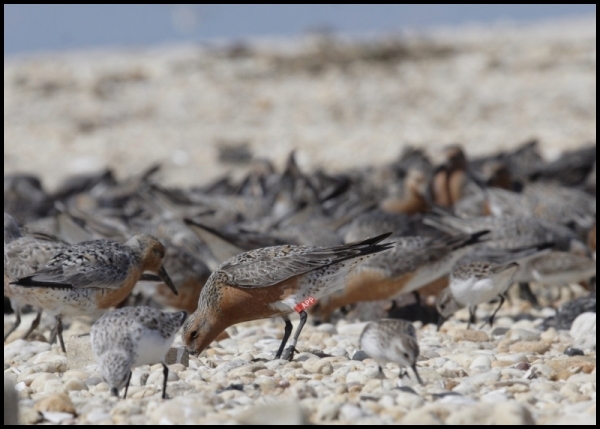
A banded red knot searches for food on a Delaware Bay beach.

Bandedbirds.org is an effort to collect data on shorebirds throughout their range from the southern tip of Chile to the Canadian arctic. This effort has been underway for many years and has an international network of volunteers reporting re-sightings data on shorebirds. 

The following was shared with the shorebird community by Jeannine Parvin, administrator for bandedbirds.org.

The bird being discussed was banded in NJ in May 2005.  It seemed to return to NJ each year, having been resighted most years up to 2010.  The bird seemed to be heading back up to NJ for the 2011 Spring shorebird season, when it was shot and killed in French Guiana.  Illegal hunting is still a big issue for shorebirds.  Paired with loss and degradation of habitat, and pollution, these birds face major threats.  Read more about CWF’s work to monitor and protect shorebirds here.

A red knot identified as FL(PPM) was shot in French Guiana by a hunter.

The data was submitted by Alexandre Vinot from French Guiana. He regularly reports to bandedbirds.org and is a volunteer with GEPOG.

His comments state: “shot in Mana Ricefield – flag given to Antoine Hausselman, who gave me the data”.

5.651519 -53.670960 approximates this location along NW coast of French Guiana. Continue reading “News from the International Shorebird Project”

Red knot wintering population drops by more than 5,000, accelerating slide to extinction

Decline emphasizes need to list the knot under the Endangered Species Act and implement stronger protections at key U.S. stopover
A red knot feeds on horsehsoe crabs on a Delaware Bay beach. © Bill Dalton

Summary:

  • Scientists today released a report announcing that a decrease of at least 5,000 red knots was observed at key wintering grounds in Tierra del Fuego, Chile from the previous year. Scientists reported population counts of wintering knots in other locations declined as well. The estimated current total population for the migratory shorebird is now unlikely to be more than 25,000.
  • The decline in red knot numbers elevates the importance of implementing stronger protections at Delaware Bay, a key U.S. stopover where migrating knots depend on an abundant supply of horseshoe crab eggs to fuel the final leg of their migration to breeding grounds in the Canadian Arctic.
  • The scientists’ report concludes that despite horseshoe crab harvest restrictions put in place by the Atlantic States Marine Fisheries Commission over the past decade “there is still no evidence of recovery of the horseshoe crab population, either in numbers of spawning females or in all sub-adult age groups including juveniles.” Restrictions to date have only been enough to stop the population from declining further, are insufficient to recover the population and will continue to be insufficient unless the harvest is greatly reduced.


WASHINGTON (May 23, 2011) – Conservation groups are calling on the U.S. Fish and Wildlife Service (FWS) to take immediate steps to list the red knot under the Endangered Species Act. A listing would initiate the development of a recovery plan and require federal agencies whose actions affect red knots to consult with the FWS. A listing would also require the Atlantic States Marine Fisheries Commission, housed under the National Marine Fisheries Service, to consult with the FWS on the regulations it establishes for the horseshoe crab fishery. The following are statements from groups pursuing an endangered species listing:

“It’s simple, to halt this decline and imminent extinction, we must list the red knot now and view all shorebird protection through the same lens,” said Margaret O’Gorman, executive director for Conserve Wildlife Foundation.

“This year’s huge decline in wintering red knots provides clear evidence that the status quo is not working. Unless action is taken now, red knots may be on an irreversible slide to extinction,” said Bob Irvin, senior vice president for conservation programs at Defenders of Wildlife. “The U.S. has a responsibility to the global community to protect this migratory shorebird, which stops along our coast to rest and feed while making one of the longest migrations in nature, from the tip of South America to the Arctic.”

“The bad news demands we redouble our efforts to rebuild the horseshoe crab population of Delaware Bay,” said Tim Dillingham, Executive Director of the American Littoral Society. “A listing of the red knot under the ESA will allow for management of the horseshoe crab population to be directed toward recovery of the shorebird populations, and not simply the local fishing interests. We urge the USFWS to make this a priority.”

“Until recently, the Delaware Bay resplendent with spawning horseshoe crabs and over a million shorebirds was the land of plenty – our Serengeti,” said Eric Stiles, vice president for Conservation and Stewardship for New Jersey Audubon Society. “The red knot is one of the shorebirds whose very existence is teetering on the brink of survival. Unlike special interest naysayers, we have full faith in the Endangered Species Act. Only through listing will the robin-sized, chestnut colored shorebird be enjoyed by future generations.”

“The decline of the shorebirds and the horseshoe crabs that sustain them is not speculation; it is a proven reality documented by science and history. The Atlantic States Marine Fisheries Counsel, among those charged with protecting the species, has ignored the science and the harm in order to assuage their political allies. In the absence of strong and earnest action from the ASMFC, we need strong action from our states. While New Jersey has taken that strong action to protect the crabs and the birds, Delaware’s actions leave a lot to be desired when the politics heats up” expresses Maya van Rossum, the Delaware Riverkeeper.

“The rufa red knot, which once darkened the skies during their migration, now stands on the very knife-edge of extinction. The states along the east coast, with the exception of New Jersey, dithered for decades and now the only way to save this subspecies is for the U.S. Fish and Wildlife Service to place it on the Endangered Species List. With this new report, it is clear that if the federal government doesn’t act soon, the next generation of Americans will never see this amazing long-distance migrant. People who want to see this bird in the wild best make plans in the near future because the way things are going, it will be gone sooner rather than later,”  said Darin Schroeder, Vice President for Conservation Advocacy for ABC.

“A population decline this large and this rapid is almost unequalled in our lifetime,” said Greg Butcher, Director of Bird Conservation for National Audubon Society. “Surely such a bird requires the immediate protection of the Endangered Species Act and needs to be a top conservation priority for all of us.”